A Baby Shower Turned Terrifying When Grandma Crossed the Line-tete

Everyone who came to my backyard baby shower remembers the pink ribbons.
I remember the smell of smoke.
That is the detail that stayed with me long after the lawn chairs were folded, after the lemonade pitchers were washed, after the neighbors stopped pretending they had not seen what they saw.
Smoke.
Sweet frosting.
Hot charcoal.
And my daughter’s cry slicing through it all.
My mother had decorated the backyard of my childhood home in Virginia like she was staging a magazine photo for strangers she wanted to impress.
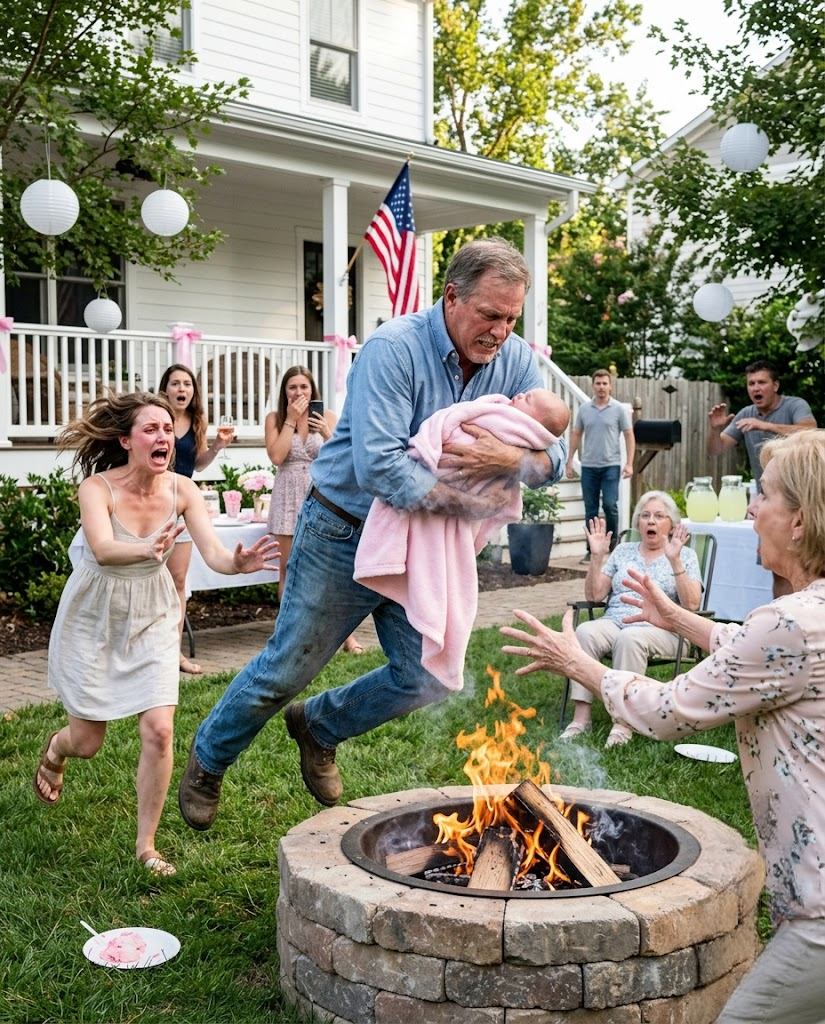
Pale-pink bows curled around the porch rail.
White lanterns hung from the maple branches and rocked gently in the late afternoon air.
Cupcakes sat under a clear plastic cover on the patio table, the icing softening in the heat.
Pitchers of lemonade sweated onto the tablecloth, leaving damp circles beside stacks of paper plates and gift bags.
The fire pit burned in the middle of the yard even though it was warm, even though nobody had asked for it, even though a baby shower in June had no reason to smell like smoke.
My daughter Lily was six weeks old.
She slept against my chest in a soft pink blanket, one tiny fist tucked under her chin.
I kept one hand beneath her back the entire time.
Not because I was afraid of dropping her.
Because every time my mother looked at her, something in her face went hard.
Helen had never been a warm woman, but I knew the difference between distance and resentment.
Distance leaves room.
Resentment moves closer.
At the hospital, on the morning Lily and I were discharged, my mother stood beside my bed with her purse still over her shoulder.
The discharge papers were on the rolling tray.
The nurse had just checked Lily’s bracelet and asked whether I had the car seat ready.
My mother waited until the nurse stepped into the hall, then looked down at my sleeping daughter and said, “Rebecca should have had this moment first.”
She said it quietly.
That was her gift.
She knew exactly how to bruise someone without leaving a mark anyone else could photograph.
Rebecca was my older sister.
She had wanted a baby for years.
I knew her pain was real.
I had driven her to appointments when her husband was out of town.
I had sat at her kitchen table at 10:38 p.m. while she stared at another negative test and could not make herself throw it away.
I had watched her smile at other people’s baby announcements with the kind of courage that looks almost like pain from the outside.
So no, I did not dismiss what she had been through.
I loved her through it.
But pain does not make another woman’s child a personal insult.
Grief can explain cruelty for a second.
It cannot baptize it.
By the time my shower came around, my mother had turned Rebecca’s heartbreak into a family rule.
She called my pregnancy thoughtless.
She said I had humiliated my sister.
She said I should have waited.
Waited for what, she never clearly said.
For permission.
For Rebecca’s life to unfold first.
For my daughter to understand, before she was even born, that she had arrived out of order.
That was the phrase my mother kept using.
Out of order.
As if babies were tickets at the DMV.
As if love had a waiting line.
As if Lily had done something wrong by existing.
At 3:12 p.m., I checked my phone because Lily stirred against me.
I thought it might be time to feed her.
The exact time mattered later, when the deputy asked me to walk him through everything.
I remembered the timestamp.
I remembered the hospital bracelet tucked in the diaper bag because I wanted to paste it into her baby book.
I remembered my cousin Emily gathering gift receipts into a white envelope so I could write thank-you notes.
I remembered Rebecca near the patio table in a glittering dress, holding a glass of rosé she did not seem to drink.
She moved through the shower like she was the person everyone should comfort.
Women squeezed her arm.
One neighbor whispered that life was unfair.
Rebecca nodded with her lips pressed together, accepting sympathy at my daughter’s celebration as if Lily’s birth had been a public attack.
Then my mother came toward me.
“Margaret,” she said, smiling for the guests, “you look exhausted. Let me hold the baby.”
I hesitated.
That hesitation has replayed in my mind more times than I can count.
Not because I blame myself.
I do not.
But because it was the last second in which the day could still have been only uncomfortable.
The neighbors were watching from lawn chairs.
My cousins stood near the patio table.
Rebecca was watching too, with that polished little smile she wore whenever she knew I had no graceful way to refuse.
I handed Lily over.
My mother did not cradle her.
She held her like evidence.
Like proof that I had committed some offense the entire backyard needed to recognize.
Rebecca came closer and murmured, “Mom says you broke the family order.”
I looked at her.
“What order?”
She lifted her glass without looking away from my daughter.
“The one where I mattered first,” she said. “But you have always taken things that didn’t belong to you.”
The heat from the fire pit rolled across my arms.
Still, I went cold.
I wanted to tell her that Lily was not a thing.
I wanted to tell her that motherhood was not a prize I had stolen off a shelf.
I wanted to ask how grief had turned her into someone who could look at a sleeping baby and see an enemy.
Before I could say anything, my mother raised her voice.
“Everyone, come to the fire pit,” she called. “We have a tradition to complete.”
We had no tradition.
None.
But people moved because Helen had spent a lifetime making rooms obey before anyone understood what was happening.
Chairs scraped over the patio.
Paper cups bent in nervous hands.
Someone laughed once, a small uncertain sound, then stopped when no one joined in.
My father stood near the porch steps.
James had always been the quiet parent.
He was the one who put extra grocery bags in my trunk after my mother yelled at me for needing help.
He fixed things my mother broke in anger and never spoke of it later.
He slipped money into my coat pocket when I was in college and pretended not to notice when I found it.
For thirty years, he lowered his voice so Helen’s could fill the house.
I had mistaken silence for peace because I was raised inside it.
A small American flag stirred on the porch behind him.
The fire snapped in the low stone circle.
My mother lifted Lily higher.
“You gave birth before your sister,” she said, her voice clear across the lawn. “You disrespected this family. You betrayed us.”
The neighbor by the mailbox turned.
A cousin stopped mid-breath.
My daughter shifted in the blanket.
“Mom,” I said, stepping forward. “Give me my baby.”
Rebecca moved between us.
She did not shove me.
She did not touch me.
She only placed herself calmly in my path, still holding that glass, still smiling like this was a toast at a bridal shower and not the edge of something monstrous.
“You caused this,” she said.
That sentence did something to me.
For one ugly heartbeat, I wanted to throw her out of my way.
I pictured the glass flying.
I pictured rosé splashing across the grass.
I pictured her perfect smile breaking before my daughter was used as a lesson.
But then my mother’s elbows bent.
Her hands shifted beneath Lily’s blanket.
And the pink bundle left her arms.
The world narrowed to one impossible shape moving through the air.
A baby blanket.
My baby.
Pale fabric against orange firelight.
A paper plate hit the ground somewhere behind me.
Someone screamed.
Then I realized the scream was mine.
I ran.
I ran with both hands out, seeing nothing except Lily, nothing except six weeks of milk breath and warm skin and tiny fingers heading toward flame.
But my father moved first.
James vaulted over the stone edge of the fire pit with a speed I had never seen in him.
His shoulder struck the rim.
His arm cut through the smoke.
He caught Lily against his chest and turned his whole body around her before the flames could reach the blanket.
His sleeve caught at the cuff.
He rolled hard into the grass, curling over my baby like the entire world had narrowed to one job and he had accepted it without question.
For one second, nobody helped.
My mother stared.
Rebecca’s smile fell apart.
The lanterns continued to sway.
The lemonade kept sweating in its pitchers.
A paper plate lay upside down in the grass with frosting crushed into the blades.
One guest had both hands over her mouth.
Another stared into the fire like if she looked long enough, she could make what we had all seen become less real.
Nobody moved.
Then I reached my father and dropped to my knees.
Lily was crying.
Alive.
Furious.
Her face was red inside the blanket, her little mouth open in a sound I had never been more grateful to hear.
My father’s hand shook as he passed her to me.
His eyes were not frightened.
They were furious.
He looked past me at Helen.
Then at Rebecca.
Then back at me.
“Enough,” he said. “Now.”
Those were the first words I had ever heard him use against my mother in that house.
Helen opened her mouth, ready to do what she always did.
Explain.
Deny.
Control the room.
But the room was no longer hers.
Emily was holding up her phone.
Her hand trembled so badly the video shook, but the recording was still running.
It had started at 3:17 p.m.
It caught my mother lifting Lily.
It caught Rebecca moving into my path.
It caught the words.
“You betrayed the order of our family.”
Then it caught the throw.
Rebecca saw the phone and went white.
The neighbor by the mailbox pulled out his own phone.
Someone behind me said, “I’m calling 911.”
That was when my mother tried to step toward me.
Her hands were out like she still believed she had the right to touch my child.
My father moved between us.
Smoke curled from the edge of his sleeve.
Helen snapped, “James, don’t you dare embarrass me in front of these people.”
He looked at her the way a man looks at a door he has finally decided to walk through.
“You embarrassed yourself,” he said.
My mother’s face changed.
Not because she was sorry.
Because she understood, maybe for the first time, that the quiet person in the family had been keeping a record.
The police arrived before the cupcakes were cleared from the table.
A deputy took statements from guests under the maple tree while Lily slept against me, exhausted from crying.
The fire pit had gone low by then.
My father sat on the porch step with a wet towel around his wrist and refused to leave until the officer finished speaking to me.
The deputy asked for the video.
Emily sent it.
Another neighbor provided a second angle from near the mailbox.
The 911 call time was logged at 3:20 p.m.
The hospital intake desk later noted smoke exposure concerns for Lily and a minor burn on my father’s sleeve-side wrist.
The pediatric nurse checked Lily’s breathing twice.
She checked her skin.
She checked the blanket.
Then she looked at me and said, “Your baby is okay.”
I cried harder at that than I had cried in the yard.
My father sat beside me in the hospital corridor.
For a long time, neither of us spoke.
His wrist was bandaged.
His shirt smelled like smoke.
Finally, he said, “I should have stopped her years ago.”
I looked at him.
He did not look away.
“I thought keeping quiet kept the family together,” he said. “It didn’t. It just taught you girls who was allowed to hurt people.”
That sentence stayed with me.
Because the truth was, an entire backyard had taught my daughter’s mother to wonder if politeness mattered more than safety.
My father had finally answered that question.
It did not.
The next week was paperwork.
Not healing.
Not closure.
Paperwork.
A police report.
A hospital discharge summary.
A copy of Emily’s video saved in three places.
A written statement from the neighbor by the mailbox.
A protective order request filed through the county clerk’s office.
I documented every call my mother made after that.
There were eleven the first night.
Six from Rebecca.
Three from numbers I did not recognize.
None of them asked if Lily was okay.
My mother left one voicemail saying I was destroying the family.
Rebecca left one saying I had always known how to make myself the victim.
I saved them both.
People think the worst moment is always the loudest one.
It is not.
Sometimes the worst moment is when you realize someone can watch a baby nearly burn and still care most about being exposed.
My father did not go back to the house that night.
He came home with me.
He slept in the recliner by Lily’s bassinet, one bandaged hand resting on his knee, waking every time she made a sound.
At 4:06 a.m., I found him standing in the doorway of the nursery, looking at her like he was memorizing the fact that she was still there.
“I heard her breathe,” he said, embarrassed.
“I know,” I told him.
He nodded.
Then he whispered, “Good.”
Rebecca tried once to come by.
She stood in my driveway with sunglasses on, even though the sky was cloudy.
She said she wanted to talk.
I opened the door only as far as the chain would allow.
She looked past me, searching for a glimpse of Lily.
“You don’t get to see her,” I said.
Her mouth tightened.
“So I’m just the villain now?”
I thought about her standing between me and my daughter.
I thought about her smile.
I thought about the way she had said, “You caused this.”
“No,” I said. “You are her aunt. That is why this is worse.”
She cried then.
Maybe some of those tears were real.
Maybe all of them were.
But I had learned something beside that fire pit.
A person can be in pain and still be responsible for what they do with it.
My mother never apologized.
She wrote a letter two months later through someone else, because she had been told not to contact me directly.
It said she had been overwhelmed.
It said the family had been under emotional strain.
It said Rebecca’s suffering had affected everyone.
It did not say Lily’s name once.
My father read it at my kitchen table.
He folded it carefully.
Then he put it back in the envelope and slid it toward me.
“That is not an apology,” he said.
It was the kind of simple truth he had spent most of his life swallowing.
Now he said it plainly.
Lily grew.
The pink blanket survived, though I could never bring myself to use it again.
I washed it twice, folded it, and placed it in a storage box with her hospital bracelet and the first tiny hat she wore home.
For a while, I hated that the blanket belonged to that day.
Then my father said something that changed how I saw it.
“That blanket is not about what Helen did,” he told me. “It is about where Lily landed.”
In his arms.
Not in the fire.
Not in the hands of people who thought birth order mattered more than a child’s life.
In the arms of the one person who finally stopped being quiet.
Every year, when the weather turns warm and someone in the neighborhood lights a grill, I still smell smoke and feel my body go tight.
I still reach for Lily before I remember she is safe.
I still see that pink flash in the air sometimes when I close my eyes too quickly.
But I also see my father moving.
I see him crossing the line he had spent thirty years standing behind.
I see him choosing my daughter faster than fear could stop him.
Everyone at that shower remembers the pink ribbons.
I remember the smoke.
But Lily will grow up hearing the rest of it.
She will know that the day someone tried to turn her life into punishment, her grandfather ran through fire and brought her back.
And she will never be taught that silence is peace.