A Boy Named Her As Emergency Contact, Then The ER Door Opened-mynraa

The hospital called at 11:38 on a Tuesday night, right when Nora Ellison was barefoot in her Portland kitchen, pretending cereal counted as dinner.
The tile was cold enough to make her toes curl.
The sink smelled like lemon dish soap and old coffee.
Rain slapped the window in hard little bursts, the kind of Pacific Northwest rain that made even a warm apartment feel borrowed.
When the unknown number lit up her phone, she nearly let it go to voicemail.
Unknown numbers after ten usually meant spam, a debt collector looking for someone she had never met, or a coworker who believed emergencies came in spreadsheet form.
She answered anyway.
“Is this Ms. Nora Ellison?” a woman asked.
“Yes.”
“This is St. Agnes Medical Center. We have a little boy here. He listed you as his emergency contact.”
Nora laughed once, thin and nervous, because fear had already slipped into the kitchen before she understood why.
“That’s impossible,” she said. “I’m 32, single, and I don’t have a son.”
There was a pause on the line.
Paper shifted.
Behind the woman’s voice, Nora heard monitors beeping, shoes moving fast over polished floors, and the low controlled hum of a hospital trying to keep panic in neat rows.
“A minor male,” the woman said carefully. “Around eleven years old. His name is Oliver.”
“I don’t have a son,” Nora repeated, slower now. “You have the wrong Nora Ellison.”
“He has your full name, phone number, and home address written on a card in his backpack.”
Nora stopped breathing for a second.
The spoon in her cereal bowl sank into the milk.
“Who gave him my number?” she asked.
“We are still confirming that. He was brought in after a traffic accident near Burnside. He is conscious, frightened, bruised, with a mild concussion and a fractured wrist.”
The nurse lowered her voice.
“He will not stop asking for you.”
Nora should have said no.
She should have said to call child services.
She should have said wrong woman, wrong number, wrong life, and let trained people handle whatever had gone wrong.
Clean boundaries are easy when nobody is hurt.
Then a child gets mentioned, and every rule you built to protect yourself starts sounding like an excuse.
Nora put the cereal in the sink without eating another bite.
She pulled on the first shoes she found, grabbed her keys, and ran through the rain without a jacket.
Twenty minutes later, she walked into St. Agnes Medical Center with wet hair, mismatched socks, and her pulse pounding so hard she felt it beneath her tongue.
The emergency entrance smelled like antiseptic, wet pavement, burnt cafeteria coffee, and that faint metallic hospital air that makes every bad possibility feel closer.
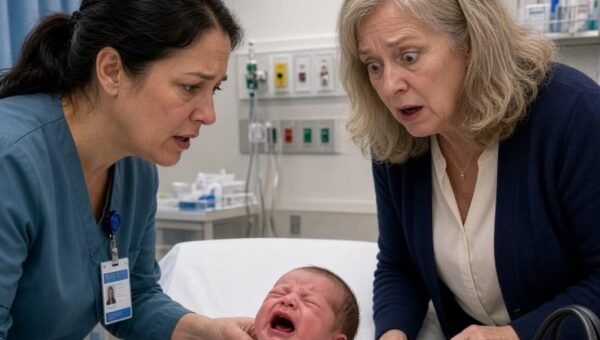
At the intake desk, a nurse named Maribel asked for her driver’s license.
Nora watched her compare it to a hospital intake form clipped to a blue folder.
The form had been marked 11:59 p.m., Room 12, Oliver Vance.
Beside it sat a child’s backpack sealed in a clear plastic belongings bag.
The tag read Oliver Vance.
Vance.
The name landed before Nora was ready for it.
Maribel looked up, and something in her face changed.
“Before you go in,” she asked gently, “do you recognize the name Oliver Vance?”
“No.”
“Do you know a woman named Rachel Vance?”
Cold moved through Nora so quickly she had to grip the edge of the counter.
Rachel.
She had not heard that name in twelve years.
Rachel Vance had once been Rachel before the last name, before the silence, before the kind of love that convinces a person to disappear from everybody who warned her.
In college, Rachel had been Nora’s roommate and best friend.
She had been the girl who stole Nora’s hoodie during finals week, the girl who knew which side of Nora’s face she hated in photos, the girl who could make cheap wine and instant noodles feel like a holiday.
They had shared laundry detergent, exam panic, borrowed sweaters, and secrets whispered on the dorm room floor at 2 a.m.
Rachel knew Nora’s eyes better than anybody.
One eye pale blue.
One eye dark brown.
Rachel used to call her a human warning light when Nora caught her lying to herself.
Then Marcus came into Rachel’s life.
Marcus smiled too wide and apologized too beautifully.
He brought flowers after every fight and learned how to make remorse sound like romance.
Nora saw the bruises before Rachel learned to hide them under sleeves.
She begged Rachel to leave.
She told her danger did not stop being danger just because it came back with flowers.
Rachel said Nora was jealous.
The next morning, Rachel packed her things.
There had been one final text two weeks later.
Please stop making this worse.
After that, nothing.
Silence is not always peace.
Sometimes it is only a wound learning how to close around the knife.
Maribel’s voice softened.
“Oliver says Rachel is his mother.”
Nora’s knees nearly gave out.
For a moment, the emergency room moved around her without sound.
A man coughed into his sleeve near the vending machines.
A woman in pajama pants argued quietly with someone on the phone.
A security officer guided a dripping umbrella stand closer to the door.
Everything looked normal, which made it worse.
The worst moments in life rarely arrive with music.
Most of the time, somebody says a name at a counter under fluorescent lights, and your whole past stands up.
Maribel led Nora down the hallway.
The floor shone with fresh mop water.
Somewhere behind them, a janitor’s cart squeaked.
At Room 12, Maribel paused with one hand on the door.
“He’s scared,” she said quietly. “But he calmed down when we told him you were coming.”
That sentence nearly broke Nora.
A child she did not know had been waiting for her like she was a promise.
Maribel opened the door.
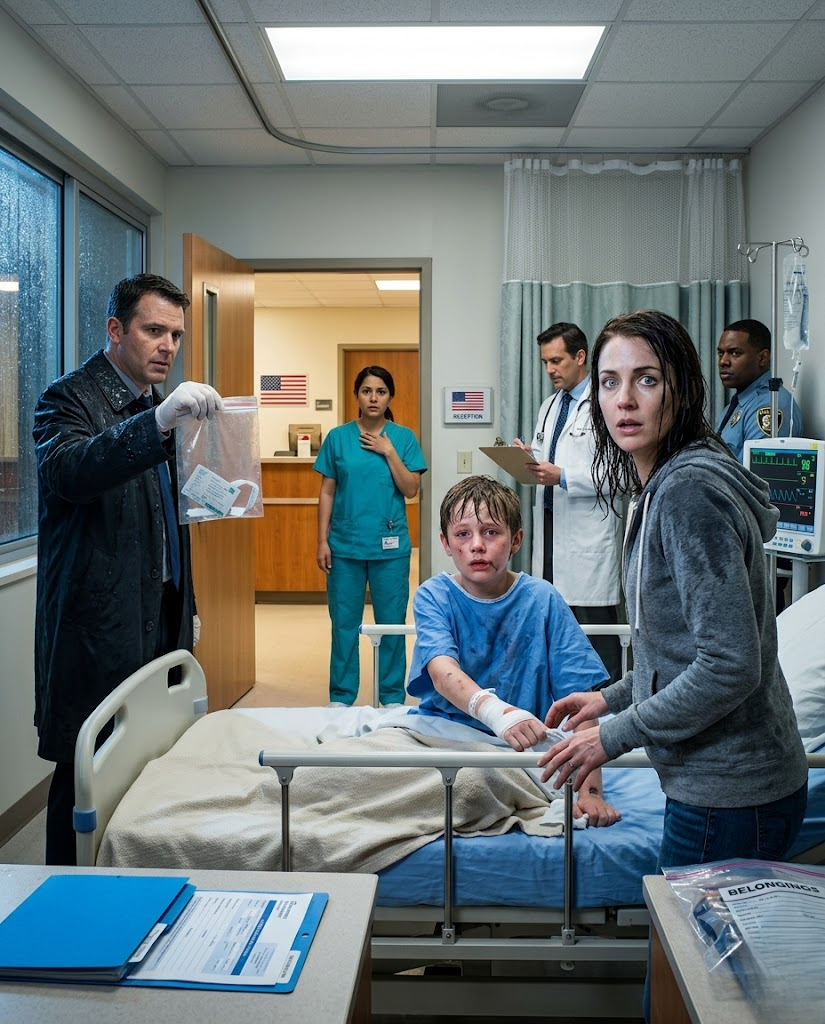
A small boy sat upright in the bed, his left wrist wrapped, his dark hair damp against his forehead.
His lip was split.
Dust and dried blood marked one cheek.
His eyes were wide and terrified and painfully familiar.
He saw Nora, and his whole face changed.
“Nora?” he whispered.
Her mouth went dry.
“Yes.”
His chin trembled.
“Mom said if anything bad happened, I had to find the lady with two eyes that don’t match.”
Nora lifted a hand before she could stop herself.
Left eye pale blue.
Right eye dark brown.
The room went still.
The doctor by the curtain stopped writing.
Maribel folded both hands in front of her.
A security officer near the doorway looked down at the floor instead of at the child.
The monitor kept beeping.
The IV bag kept swaying.
Rain kept ticking against the window.
Everyone waited for a stranger to become something else.
Nobody moved.
Nora stepped closer to the bed.
“I’m here, Oliver,” she said. “Where is your mom?”
The brave little mask he had been holding together broke.
Tears spilled down his face, cutting clean tracks through the dust and dried blood on his cheek.
His uninjured hand fisted in the hospital blanket until his knuckles went white.
“She was in the car,” he choked out.
Nora felt the air change.
“The man in the black truck kept hitting our bumper,” Oliver said. “We were running away from him.”
Maribel made a small sound behind her.
Nora sat carefully on the edge of the bed because if she stayed standing, she was afraid her legs would fail.
“Tell me what happened,” she said, though every part of her wanted to tell him he did not have to.
Oliver swallowed.
“Mom told me to unbuckle. When we spun into the ditch, she shoved my backpack at me and yelled to run into the trees. She told me to hide until the sirens came.”
He dragged a breath through his split lip.
“She said to give the card to the doctors.”
Nora looked toward the sealed backpack on the counter.
The card.
The backpack.
The intake form.
Rachel had built a trail out of the only things she could still control, and every piece of it led to Nora.
“Did you see the man?” Nora asked.
Oliver nodded once.
“Not his face. Just the truck. Black. Loud. The front was smashed already.”
The doctor’s pen moved again, slower this time.
The security officer stepped out into the hallway.
Nora heard him speak quietly into a radio.
At 12:27 a.m., a police detective arrived at Room 12 with rain still shining on his coat.
He introduced himself, but Nora barely heard the name.
Her eyes were on the clear evidence bag in his hand.
Inside was a folded card, damp at the edges.
The handwriting was Rachel’s.
Nora knew it immediately.
Rachel had always pressed too hard with a pen.
The detective looked at Oliver, then at Nora.
“Ms. Ellison,” he said, “before you promise this boy anything, there’s something you need to know about the woman they pulled from that car.”
Oliver went very still.
Nora felt his hand catch her sleeve.
The detective lowered his voice.
“Her ID says Rachel Vance. First responders found this in her coat pocket.”
He turned the evidence bag toward Nora.
The card inside had her full name, current address, and phone number written across the front.
Below it was one sentence.
If Oliver makes it to her, believe him.
Nora’s chest tightened until breathing felt like work.
Beneath the card was something else.
A hospital wristband, cut clean through.
Oliver Vance.
A date from years earlier.
A timestamp printed in faded black.
Nora looked at Oliver.
He looked smaller than eleven in that bed.
“She promised she’d come after me,” he whispered.
The detective’s face changed.
Not pity exactly.
Something heavier.
“The driver’s side took the worst of the impact,” he said. “She was alive when they got there, but barely conscious.”
Nora closed her eyes for half a second.
“Is she alive?”
The detective did not answer fast enough.
That was the answer.
Oliver made a sound that seemed too small to belong to grief.
Maribel stepped forward, but Nora was already there, turning toward him, placing one hand gently over the blanket beside his good hand.
“I’m not leaving,” she said.
The detective watched her.
“Ms. Ellison, there’s more.”
He removed a second folded paper from the evidence bag, still sealed in plastic.
“This was notarized,” he said. “It names you as temporary guardian for Oliver in the event Rachel could not appear in person.”
Nora stared at him.
“I didn’t sign anything.”
“You weren’t required to. It is not the final legal instrument. It is a statement of intent. But it gives us context.”
He paused.
“And there’s a police report attached from three days ago.”
Nora’s stomach dropped.
“What police report?”
The detective glanced toward Oliver, then back to Nora.
“Rachel reported that Marcus Vance had violated a protective order.”
The name Marcus hit the room like something thrown through glass.
Nora’s hand tightened.
Oliver flinched at the sound of it.
That told her enough.
Twelve years disappeared in one breath.
The bruises under Rachel’s sleeves.
The flowers after fights.
The way Rachel had defended him with the exhausted loyalty of someone already trapped.
The detective continued.
“She told the responding officer that if anything happened to her, Oliver was to be taken to Nora Ellison. She gave your address twice.”
Nora looked at the boy.
He was staring at the blanket as if all the answers might be stitched into it.
“Did you know my mom?” he asked.
Nora’s throat burned.
“Yes,” she said. “A long time ago.”
“Was she scared then too?”
The question broke something in the room.
The doctor turned away.
Maribel wiped beneath one eye with the back of her wrist.
Nora did not lie.
“She was scared,” she said. “But she was also funny and stubborn and brave when she thought nobody was looking.”
Oliver nodded like he needed every word.
“She said you would remember her.”
“I do.”
The detective asked if Nora would remain at the hospital until child welfare and the responding officers completed the initial transfer process.
She said yes before he finished the sentence.
At 1:06 a.m., Nora signed a visitor acknowledgment at the hospital desk.
At 1:22 a.m., a child welfare worker arrived with a county badge, a clipboard, and rainwater on the shoulders of her coat.
At 1:41 a.m., Nora watched Oliver’s backpack get cataloged item by item.
A hoodie.
Two school notebooks.
A cracked phone with no battery.
A granola bar flattened at the bottom.
The original emergency card Rachel had placed inside.
Every ordinary object looked like evidence now.
That is the cruelest part of running for your life.
The things you pack are not sentimental.
They are proof you were trying to survive.
Oliver fell asleep just after 2:00 a.m. with his good hand still curled around the edge of Nora’s sleeve.
Nora sat beside the bed and did not move.
Her back hurt.
Her socks were still damp.
The coffee Maribel brought her went cold in the paper cup.
But every time she considered shifting even slightly, Oliver’s fingers tightened, as if some part of him could feel another adult preparing to leave.
So she stayed.
In the gray hour before dawn, the detective returned.
He told Nora that officers had found the black truck abandoned several miles from the crash site.
The front end was damaged.
The plates had been removed.
A witness had reported seeing a man walking away toward an older neighborhood road.
They were not saying Marcus’s name yet as fact.
But they did not have to.
Nora knew how men like Marcus moved.
They counted on fear to do half their work for them.
By morning, Rachel Vance was gone.
Oliver was told by a doctor, a child welfare worker, and Nora together.
There is no gentle way to tell a child his mother died saving him.
There are only less cruel ways.
Nora sat on the bed beside him while the doctor explained what had happened.
Oliver did not scream.
He did not ask big dramatic questions.
He just pressed his face into Nora’s hoodie and whispered, “She said she was almost done running.”
Nora held him while the words went through her like a blade.
Rachel had been almost done.
Almost safe.
Almost free.
Almost is one of the meanest words in the English language.
Over the next forty-eight hours, Nora became a person she did not recognize.
She made calls.
She answered questions.
She gave a statement about Rachel, Marcus, college, bruises, the last message, and twelve years of silence.
She watched documents move from one folder to another.
Hospital discharge paperwork.
Police report supplements.
Temporary placement forms.
A notarized guardianship statement that Rachel had carried like a final match in the dark.
Nora did not become brave all at once.
She became useful.
That was easier.
She bought Oliver soft sweatpants from the hospital gift shop because his jeans had been cut off in the ER.
She found him a toothbrush.
She learned that he hated orange juice but drank apple juice if nobody called it healthy.
She learned he slept with his shoes near the bed.
She learned he flinched when a cart rattled too loudly past the door.
On the third day, a family services supervisor asked Nora if she understood what temporary placement meant.
“It means temporary,” Nora said.
The woman did not smile.
“It means responsibility until the court determines next steps.”
Nora looked through the glass wall at Oliver, who was sitting with Maribel and slowly turning the pages of a donated comic book.
He was not reading it.
He was watching the door.
“I understand,” Nora said.
Marcus was found before the end of the week.
He was picked up after a traffic camera and two witness statements placed the damaged black truck near the crash route.
The detective called Nora himself.
He did not give her details he could not give.
He simply said, “He is in custody.”
Nora was standing in her kitchen when the call came.
The same kitchen.
The same cold tile.
The same sink that smelled faintly of lemon soap and coffee.
Oliver was asleep on the couch under a gray blanket, his wrapped wrist propped on a pillow.
Nora hung up and stood very still.
For one ugly heartbeat, she wanted to feel relief.
Instead, she felt rage.
Rage that Rachel had called for help three days before the crash.
Rage that a child had memorized escape instructions.
Rage that twelve years of silence had not meant Rachel was safe.
Then Oliver stirred on the couch, and Nora swallowed it all down.
Children do not need your rage first.
They need breakfast, clean socks, the door locked, and somebody still there when they wake up.
So Nora made toast.
Weeks passed in paperwork and small routines.
Nora took Oliver to follow-up appointments.
She sat beside him in a clinic waiting room under a framed map of the United States while he traced the cast on his wrist with one finger.
She packed lunches he barely ate.
She learned the route to his school office.
She kept copies of every document in a blue folder on her dining table.
Police report.
Hospital discharge packet.
Guardianship statement.
Temporary placement order.
Rachel’s card.
That card stayed inside a plastic sleeve.
Nora could not touch it without seeing Rachel at nineteen, barefoot on their dorm room floor, laughing so hard she cried.
One afternoon, Oliver found an old photo in Nora’s closet.
It showed Nora and Rachel at college, arms around each other, both grinning into the camera.
Rachel was wearing Nora’s hoodie.
Nora was holding a paper cup of terrible coffee.
Oliver stared at it for a long time.
“She looks happy,” he said.
“She was,” Nora answered.
“Did she talk about me?”
Nora had to sit down.
“No,” she said gently. “I didn’t know about you.”
Oliver’s face tightened.
“She told me she wanted to call you.”
Nora nodded.
“I wish she had.”
“She said she was ashamed.”
The words landed softly but cut deep.
Nora looked at the photo again.
Rachel, young and laughing, before Marcus, before fear, before the long narrowing of her world.
“She shouldn’t have been,” Nora said.
Oliver looked up.
“Were you mad at her?”
Nora told the truth again.
“For a long time, I thought I was.”
“And now?”
Nora brushed her thumb over the edge of the photo.
“Now I think I was sad and didn’t know where to put it.”
Oliver leaned against her side.
It was the first time he did it without fear pulling him there.
The court hearing for temporary guardianship was not dramatic.
There were no speeches.
No music.
No sudden gasps.
Just a family court hallway, a plastic chair, a vending machine that hummed too loudly, and Oliver sitting beside Nora with his good hand tucked into the sleeve of his hoodie.
A small American flag stood near the front of the hearing room.
The judge reviewed the documents.
The child welfare worker summarized the placement.
The detective’s report was entered.
Rachel’s notarized statement was acknowledged.
When the judge asked Oliver if he understood who Nora was, the boy looked at her.
“She was my mom’s emergency plan,” he said.
The room went quiet.
Nora felt tears rise, but she did not wipe them away.
The judge’s expression softened.
“And what is she to you now?”
Oliver looked down at his shoes.
Then he reached for Nora’s hand.
“She came,” he said.
That was all.
But it was enough.
Months later, Nora still kept the blue folder.
She kept Rachel’s card.
She kept the old college photo on the refrigerator, held up by a magnet shaped like a tiny Statue of Liberty that Rachel had once bought as a joke during a layover.
Oliver noticed it every morning.
Sometimes he touched the corner of the photo before school.
Sometimes he said nothing.
Sometimes silence is peace.
Not the kind that hides a wound around a knife.
The kind that lets a child finish his cereal without listening for tires outside.
Nora never pretended she had become his mother overnight.
That would have been too easy and too false.
Love did not arrive like a title.
It arrived like a thousand ordinary proofs.
Toast cut diagonally because that was how he liked it.
A night-light in the hallway.
A spare hoodie in the car.
A promise that nobody would call him dramatic for being afraid.
One rainy Tuesday, almost a year after the first call, Nora came home to find Oliver at the kitchen table with his homework spread out beside a bowl of cereal.
He had drawn a family tree for school.
Rachel’s name was written in careful pencil.
Nora’s name was beside it, connected with a line he had erased and redrawn several times.
He looked nervous when she saw it.
“I didn’t know what to put,” he said.
Nora sat across from him.
The tile was cold under her feet.
The sink smelled like lemon dish soap and old coffee.
Rain tapped against the window, softer than it had that first night.
“What did you want to put?” she asked.
Oliver pushed the paper toward her.
Beside Nora’s name, in small careful letters, he had written emergency contact.
Then he had crossed it out.
Under it, he had written home.
Nora covered her mouth with one hand.
Oliver watched her closely.
“Is that okay?”
Nora thought of Rachel.
Rachel at nineteen.
Rachel in fear.
Rachel building a trail out of a backpack, a card, a hospital form, and the last little bit of control she had left.
Rachel had trusted Nora with the only thing that mattered.
Nora reached across the table and took Oliver’s hand.
“Yes,” she said. “That’s okay.”
The first time the hospital called, Nora said it was impossible because she was 32, single, and did not have a son.
She had been right about only one part.
She had not had one yet.