A Mother Ignored Her Husband And Found The Truth In One Scan-iwachan
Maya had been sick long before anyone in our house was willing to call it sickness.
That was the part I kept coming back to later.
Not the scan.
Not the doctor’s face.
Not even the sentence that changed the air in the exam room.
It was the weeks before, when my daughter was disappearing in plain sight and the person who should have helped me protect her kept acting like she was an inconvenience.
Maya was fifteen, and until that spring she had been the kind of girl who could fill a house without trying.
She kicked soccer balls across the backyard until the porch light buzzed on.
She left camera batteries charging beside the toaster because she was always chasing the right sunset.
She sang badly when she unloaded the dishwasher and laughed when I told her the dog had more rhythm than she did.
Then the nausea started.
At first, she said it was just her stomach.
Then she said lunch at school made her feel gross.
Then she stopped packing lunch at all.
I noticed the wrappers in her backpack were untouched.
I noticed the way she pressed one hand to her stomach when she thought nobody was looking.
I noticed her sleeping under a hoodie in the middle of the afternoon while the TV played to an empty room.
Robert noticed the bills.
That was my husband’s talent.
He could miss a child’s pain from three feet away, but he could hear the sound of money leaving an account from another room.
“She’s pretending,” he said one Tuesday evening while Maya sat at the kitchen table with her shoulders hunched over a bowl of soup she had not touched.
I looked at him because I thought I had misheard.
He kept scrolling on his phone.
“Teenagers dramatize everything,” he added. “We’re not wasting money on unnecessary doctor visits.”
The refrigerator hummed.
Outside, a neighbor’s dog barked twice and went quiet.
I wanted him to look at her.
Not glance.
Look.
See the hollows under her eyes.
See how pale her lips had become.
See the way her fingers shook every time she reached for the glass of water beside her plate.
But Robert had already decided what the truth was.
Once he decided something, he treated every new fact like an insult.
That was how our marriage had worked for years.
He called it being practical.
He called it keeping the family stable.
I called it what it was only in my own head, because saying it out loud always started a fight.
Control.
Maya got worse by the day.
She stopped answering her friends’ calls.
She quit asking to go to soccer practice.
Her camera sat on the dresser with dust gathering on the strap.
One morning, I found her sitting on the bathroom floor with her forehead against the cabinet.
She said she had just gotten dizzy.
She said it like she was apologizing.
That broke something in me.
Children should not apologize for being sick.
They should not have to measure their pain against a parent’s mood.
By Wednesday night, I had already started looking up clinics on my phone with the screen dimmed under the blanket.
I checked our insurance card in Robert’s wallet while he was in the shower.
I hated that I had to do it like that.
I hated that protecting my daughter felt like sneaking around.
But fear has a way of making you practical fast.
At 2:18 a.m. Thursday, I heard the sound from Maya’s room.
It was not a scream.
It was worse because it sounded like she was trying not to make noise at all.
I opened the door and found her curled on her side, arms wrapped around her stomach, hoodie sleeve bitten between her teeth.
The lamp beside her bed made her skin look gray.
Tears had soaked the pillowcase.
“Mom,” she whispered. “Please… make it stop hurting.”
There are moments when a mother stops negotiating with the world.
That was mine.
I sat on the edge of her bed and smoothed the hair from her damp forehead.
Her skin was cool, but her eyes looked fever-bright.
I told her we were going to the doctor the next day.
She shook her head weakly.
“Dad will be mad.”
I remember that more clearly than almost anything.
Not “Will I be okay?”
Not “What’s wrong with me?”
Dad will be mad.
The next afternoon, I waited until Robert texted that he had a late meeting.
Then I took the insurance card, Maya’s school ID, and the little folder where I kept her vaccination records.
I helped her into the passenger seat of our SUV.
She moved like every step had to be negotiated with her own body.
A small American flag clipped to our mailbox snapped in the wind as I backed out of the driveway.
I almost turned around once.
Not because I doubted Maya.
Because years of living with Robert had trained me to hear his voice even when he was not there.
Too expensive.
Too dramatic.
You always overreact.
Then Maya leaned her head against the window and closed her eyes.
I kept driving.
Riverside Medical Center sat off a busy road with a pharmacy on one side and a gas station on the other.
I had passed it a hundred times without thinking.
That day, the automatic doors felt like the entrance to another life.
At 3:46 p.m., I wrote Maya’s name on the hospital intake form.
The receptionist asked for her date of birth, insurance, symptoms, and emergency contact.
My pen shook over Robert’s name.
I wrote it anyway.
Then I checked the boxes.
Abdominal pain.
Nausea.
Dizziness.
Fatigue.
Unexplained weight loss.
Seeing those words lined up together made my throat tighten.
It looked less like a complaint and more like a warning.
The nurse who called us back was kind in the brisk way hospital people get when they are trying to be gentle and efficient at the same time.
She took Maya’s temperature.
She checked her pulse.
She wrapped the blood pressure cuff around Maya’s thin arm and frowned at the numbers without saying why.
Maya watched the cuff inflate like it had personally offended her.
I tried to smile.
She did not smile back.
In the exam room, the paper on the bed crinkled under her.
The air smelled like antiseptic, latex gloves, and burnt coffee drifting in from somewhere down the hall.
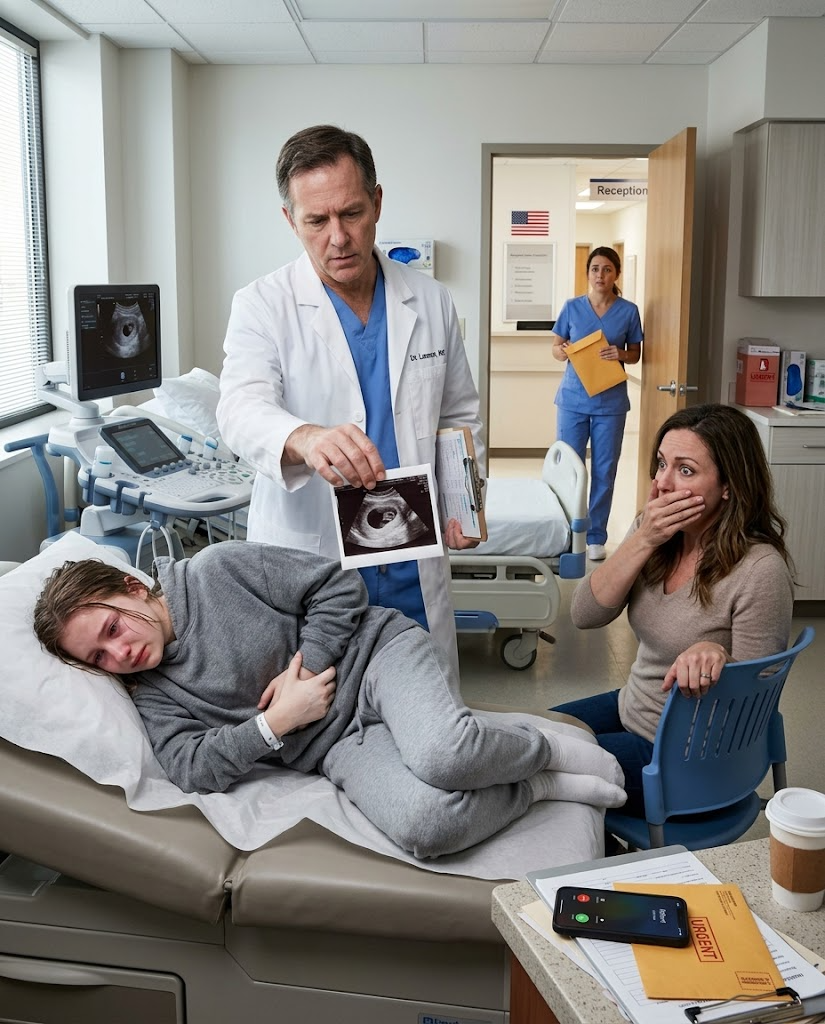
Dr. Lawson came in a few minutes later.
He looked to be in his fifties, with silver at his temples and the calm, tired eyes of a man who had delivered both good news and terrible news too many times to perform either one.
He asked Maya when the pain started.
She looked at me first.
That told him something.
He asked again, softer.
“About a month,” she said.
My heart dropped.
A month.
I had known weeks.
She had carried it longer.
Dr. Lawson asked about food, school, sleep, weight, medications, and whether the pain moved or stayed in one place.
Maya answered in short sentences.
Sometimes she swallowed hard before speaking.
Sometimes she pressed her hand under the edge of her hoodie and waited for the pain to pass.
He ordered blood work and an ultrasound.
He said it like a routine step, but I saw the way his eyes moved from Maya’s face to her stomach and back again.
The blood draw came first.
Maya hated needles, but she held still.
I watched her jaw clench.
A purple band appeared around her arm where the tourniquet had been.
The nurse labeled the tubes and placed them in a plastic bag with a printed sticker.
Name.
Time.
Patient number.
Proof that my daughter’s pain had entered a system where someone else finally had to acknowledge it.
Then came the ultrasound.
The technician rolled the machine in and warmed the gel between her hands.
Maya flinched when the wand touched her stomach.
“I’m sorry, honey,” the technician said.
Maya stared at the ceiling tiles.
I stood near her shoes.
They were the same white sneakers she had worn to school all year, now loose because she had lost weight.
The room filled with the low hum of the machine.
Gray shapes moved across the screen.
I did not know what I was looking at.
I only knew the technician’s face changed.
It was small.
A pause.
A stillness.
Her fingers stopped moving on the keyboard.
She looked at the screen, then at Maya, then back to the screen.
My stomach turned cold.
“Is everything okay?” I asked.
The technician smiled too quickly.
“The doctor will go over the results with you.”
That is when Robert texted.
Where are you?
I turned the phone face down.
A minute later, it buzzed again.
Don’t tell me you took her to a hospital.
I stared at the words until they blurred.
Maya saw my face.
“Is it Dad?” she whispered.
I lied.
“It’s fine.”
She knew it was not.
Children always know more than adults think they do.
They learn the weather inside a house before they learn algebra.
They know which footsteps mean peace and which ones mean brace yourself.
At 5:12 p.m., Dr. Lawson returned.
He held a clipboard against his chest and an ultrasound printout in his right hand.
One look at him, and the last hopeful part of me went quiet.
“Mrs. Thorne,” he said gently, “we need to talk.”
Maya pushed herself up on her elbows.
The paper beneath her crackled.
Dr. Lawson closed the door behind him.
He did not sit down.
That scared me.
“The scan shows there’s something inside her,” he said.
For a second, the room did not feel real.
The monitor clicked.
A cart wheel squeaked in the hallway.
Somewhere outside, a woman laughed, and the sound seemed obscene in the face of what he had just said.
“Inside her?” I repeated.
My voice sounded far away.
“What does that mean?”
Dr. Lawson looked at Maya.
Then he looked back at me.
“We need to discuss the results privately.”
Maya’s fingers dug into my sleeve.
Her eyes were wide now.
“No,” I said before I even knew I was going to speak. “She’s fifteen. She stays with me unless there is a medical reason she can’t.”
He studied my face for one second, then nodded.
“All right.”
He turned the scan toward me.
I could not understand the image, not really.
But I saw the dark shape.
I saw the outline that did not belong in my child’s body.
The sound that came out of me was not a word.
Maya started crying then.
Not loud.
Just tears slipping down her face while she tried to breathe through the pain.
Dr. Lawson explained carefully that they needed more imaging and immediate lab review.
He did not give us a dramatic label.
He did not guess.
He said they had to determine exactly what they were dealing with.
He said the next steps mattered.
He said the timing mattered.
Then my phone began vibrating again and again on the plastic chair.
Robert.
Robert.
Robert.
Maya stared at it like it was a second diagnosis.
“Don’t let him make us leave,” she whispered.
That was the sentence that changed Dr. Lawson’s face more than the scan had.
He looked from Maya to me.
Something in his eyes sharpened.
“Has someone been preventing her from getting care?” he asked.
The room went still.
I could have protected Robert then.
Wives are trained in a hundred little ways to protect the comfort of difficult men.
We soften them in public.
We explain them to family.
We turn cruelty into stress and neglect into concern.
I was done translating him.
“Yes,” I said.
Maya cried harder.
Dr. Lawson did not look surprised.
That hurt too.
He asked the nurse to document the statement in the chart.
He asked for the first blood results.
He asked that no discharge instructions be discussed with anyone who was not physically present and approved by me as Maya’s parent.
For the first time all day, I felt a thin line of ground under my feet.
Then the nurse came back holding a second envelope.
“Doctor,” she said quietly, “the first blood results just came through.”
Dr. Lawson opened it.
He read the top line.
His face went completely still.
I felt Maya stop breathing beside me.
“What?” I asked.
He did not answer immediately.
He looked at the lab report again, then at the scan, then at my daughter.
“Mrs. Thorne,” he said, “we need to move quickly.”
Everything after that happened fast and slow at the same time.
A wheelchair appeared.
Another nurse came in.
Someone placed a new wristband on Maya and checked her name against the chart.
Dr. Lawson explained that they were admitting her for further evaluation and treatment.
He still did not say more than he knew.
That was the first thing I respected about him.
He did not fill fear with guesses.
He filled it with steps.
Blood work.
Imaging.
Specialist consult.
Monitoring.
Pain control.
Documentation.
Maya asked if she was going to die.
The nurse turned away, and I saw her blink hard.
I took my daughter’s face in both hands.
“No,” I said.
I did not know if I was allowed to promise that.
I promised it anyway.
Robert arrived forty minutes later.
I heard him before I saw him.
His voice carried down the hallway, sharp and embarrassed, like the real emergency was that people could hear us.
“This is ridiculous,” he said. “Where is my wife?”
Maya shrank back against the hospital pillow.
Dr. Lawson noticed.
So did the nurse.
Robert walked into the room still wearing his work badge and that expression he used when he wanted everyone to understand he was the reasonable one.
“What did you tell them?” he asked me.
Not “How is she?”
Not “What did they find?”
What did you tell them?
I stood between him and the bed.
“She’s being admitted,” I said.
His eyes moved past me to Maya, then to the IV line, then to the chart.
For a second, uncertainty flickered across his face.
Then pride covered it.
“For stomach pain?”
Dr. Lawson stepped forward.
“For a medical condition that required immediate attention,” he said.
Robert’s mouth tightened.
“I’m her father.”
“And I’m her physician,” Dr. Lawson replied.
The nurse did not move, but her hand rested on the edge of the chart like she was ready to write down every word.
Robert looked at me then.
“You went behind my back.”
“Yes,” I said.
The word felt clean.
He blinked.
I do not think he had expected me to say it without apology.
Maya whispered, “Dad, I told you it hurt.”
That should have ended him.
It should have dropped him to his knees.
Instead, his face flushed.
“I thought you were exaggerating.”
Maya turned her head toward the window.
I saw the last piece of something break in her.
Not love, maybe.
Children love even when they should not have to.
But trust.
Trust can die quietly in a hospital room while a monitor keeps counting like nothing has happened.
The next two days were a blur of tests, nurses, alarms, and paper cups of coffee I forgot to drink.
The doctors found the source of the problem and treated it with the urgency it deserved.
I will not dress that part up for drama.
It was terrifying.
It was medical.
It was handled by people who knew what they were doing because I finally got her to them.
That is the sentence I repeat when guilt tries to rewrite the story.
I got her there.
Not early enough to erase what she suffered.
But in time to help.
Robert came and went.
He brought no overnight bag for me.
He brought no favorite blanket for Maya.
He brought complaints about parking, insurance, and how everyone was making him look like a bad father.
On the third morning, Maya asked him to leave.
Her voice shook, but she said it clearly.
“I don’t want you in here right now.”
Robert looked at me as if I had taught her the line.
I had not.
Pain had.
Dr. Lawson’s team documented everything they needed to document.
The hospital social worker spoke with me privately.
She gave me resources, forms, and language for things I had been too ashamed to name.
I kept every discharge paper.
I kept every lab summary.
I kept the intake form where my hand had shaken over the boxes.
Not because I wanted war.
Because for too long, Robert’s confidence had been treated like evidence.
Now I had actual evidence.
Maya came home five days later.
She moved slowly, but she was upright.
Her color was better.
She ate half a piece of toast at the kitchen counter while morning light touched the floor, and I had to turn away so she would not see me cry.
Robert stood in the doorway, quiet for once.
“I didn’t know,” he said.
Maya looked at him.
“You didn’t want to know.”
The words landed harder than any shouting could have.
He had no answer.
Weeks passed.
Maya healed in pieces.
Her laughter came back first in small flashes, like a light testing itself after a storm.
She picked up her camera again.
She took a picture of the backyard after rain, the soccer ball sitting in wet grass, the porch steps shining.
She showed it to me without saying why.
I knew why.
She was proving she could still see beauty.
I kept thinking about that night at 2:18 a.m.
I kept thinking about her whispering, “Please… make it stop hurting.”
A mother should not need permission to answer that.
No child should have to become evidence before someone believes her.
And no amount of money, pride, or household peace is worth the cost of ignoring pain.
Maya had been fading right in front of us.
The difference was simple in the end.
I chose to see her.
Robert chose to doubt her.
And one scan told the truth he had tried so hard not to hear.