A Veteran Found His Dog Chained in Snow, Then the Lock Spoke-xurixuri
The first thing I said when I saw my cabin door hanging open was not brave.
It was not clean.
It was the kind of sentence a man says when the part of him that still believes in rules has already stepped aside.
“Whoever chained my dog outside in this storm better hope the cold gets to me first.”
The wind came at me sideways through the pines, hard enough to make the rented Ford F-150 rock on its tires.
Snow hissed over the porch boards like sandpaper dragged across old wood.
The air tasted metallic, and every breath hurt.
I had come home from enough bad places to know when a house was wrong.
A house has a sound when it is alive.
The heater clicks.
The walls settle.
A dog hears you before you touch the knob.
That night, there was nothing.
No bark.
No claws against hardwood.
No Titan.
Titan was an eighty-five-pound German Shepherd with old scars under his coat and the calm eyes of a soldier who had already learned fear did not have to become cruelty.
He had served beside me overseas.
He had taken shrapnel meant for my body.
He had dragged me by my vest when I was too dazed to get up and too stubborn to stay down.
When the Navy finally cut me loose after fifteen years, three Purple Hearts, and more nights than I like to remember, I did not fight hardest over a ribbon or a retirement letter.
I fought hardest for Titan.
The transfer paperwork called him a military working dog.
I called him my partner.
I had mine.
I signed what they told me to sign, called every office they told me to call, waited in every hallway, and refused to leave the final review desk until someone looked me in the eye and understood that Titan was not equipment to be reassigned.
He came home with me.
Always.
Except for the last three weeks.
Washington dragged me back for one final mandatory debriefing tied to old operations and uglier names.
Temporary housing.
No dogs.
No exceptions.
So I left Titan with Greg Harrison.
Greg was the only man I trusted with my life.
He was also the only man outside my own skin who knew where the spare key was hidden.
We had grown up together back when trust was built from bike wrecks, unpaid lunches, borrowed tools, and the kind of trouble that seemed permanent until morning.
Greg fixed my first truck before either of us could afford the parts.
He stood beside me at my mother’s funeral and did not say the useless things people say when grief makes them nervous.
He mailed care packages to places he could not pronounce, with gas station coffee packets, socks, beef jerky, and notes about town gossip written like intelligence briefs.
Greg owned Harrison’s Auto & Transmission.
His hands always smelled faintly of motor oil.
Three days before I came home, he called me and laughed.
“Titan stole half my turkey sandwich right off the counter,” he said. “Dog’s living better than I am, Dave.”
I smiled then.
At 8:47 p.m. on that Thursday night, standing in front of my broken cabin with no cell service and a blizzard shutting down half the county, that laugh came back wrong.
Trust does not usually snap clean.
It starts as one detail that refuses to fit.
Then another.
Then another.
No porch light.
No tire tracks in the driveway.
No smoke from the chimney.
Greg had promised he would keep the place plowed.
Greg always did what he promised.
That was the sentence I had built thirty years of friendship on, and for the first time, it sounded like something I had been stupid enough to memorize.
My hand went to the Sig Sauer in my coat pocket before I made a decision to move it.
Old habits kept men alive.
They did nothing for the kind of fear that starts under the ribs.
“Greg!” I shouted.
The storm answered for him.
Inside, the cabin was colder than outside.
My flashlight cut across the living room and showed me a kind of damage that did not look random.
The leather couch was flipped.
The coffee table was smashed.
Kitchen drawers hung open.
Framed photos of my mother, my old team, and Titan in his service vest were shattered across the floor.
A thief takes.
A searcher opens, dumps, checks, and leaves behind the shape of a question.
Someone had not robbed me.
Someone had searched.
Training took over because panic had no useful hands.
I documented every room out loud even though there was no one to hear me.
Front door forced inward.
Deadbolt split.
Gun safe scratched but unopened.
Office ransacked.
Desk drawers emptied.
At 8:53 p.m., I found Titan’s water bowl dented against the wall with a dark frozen stain beside it.
I pulled off one glove and touched it with two fingers.
Blood.
For one ugly second, I wanted to go through the trees until I found whoever had done this and make the storm the kindest thing that happened to him.
I did not move.
I made myself breathe.
Rage is useful only when it listens.
Then I heard the whine.
Thin.
Weak.
Outside.
I ran through the back door into snow up to my thighs, flashlight shaking in my hand.
“Titan!”
The sound came again from near the old woodshed.
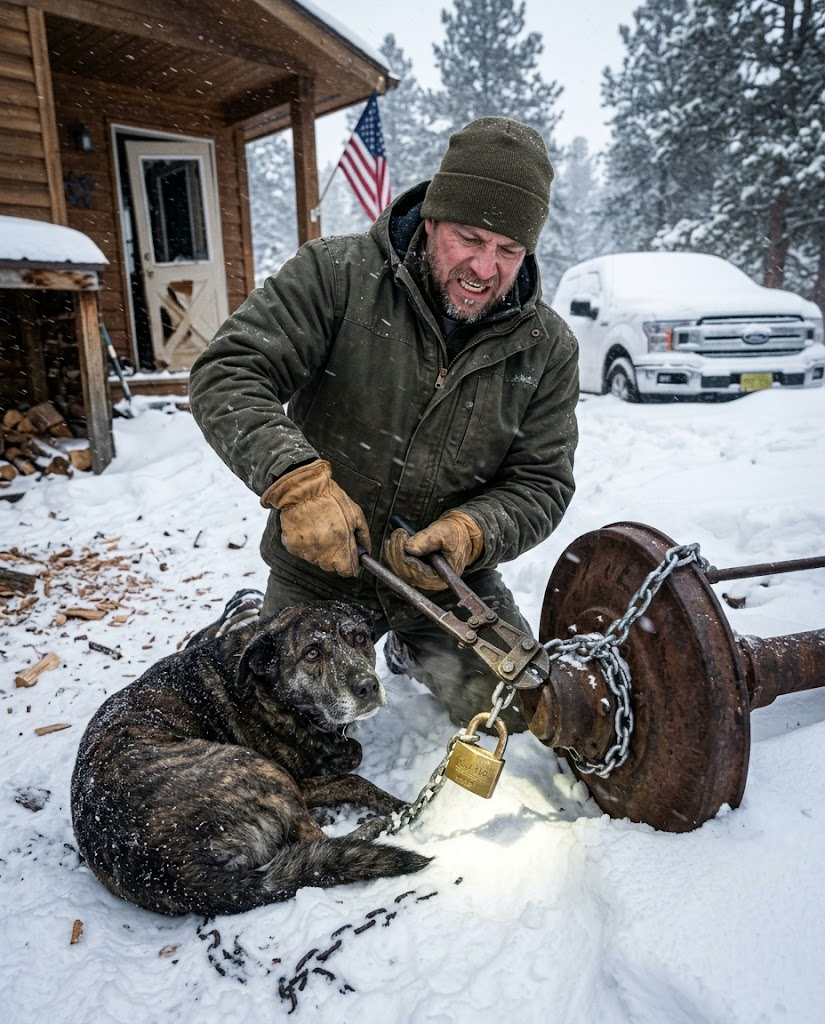
I fought through the whiteout until my beam caught the iron tractor axle half-buried beside the shed.
A steel chain had been wrapped around it.
At the end of that chain was my dog.
Titan lay curled in the snow, covered in ice, his muzzle white with frost.
His paws were scraped from clawing at frozen ground.
The chain was looped twice around his neck and held tight with a brass padlock.
“No, no, no.”
I dropped beside him.
Titan opened his eyes just enough to see me.
His tail moved once.
He tried to lick my hand, but his tongue was stiff from cold.
That nearly took me apart.
He was not shivering, and that was worse than shivering.
I had seen hypothermia in the field.
When the shaking stops, death has already stepped through the door.
“I’m here, buddy,” I said. “I’m here.”
I yanked at the padlock.
Nothing.
I jammed my knife into the mechanism and twisted until the blade snapped.
The chain did not give.
Whoever did this had not panicked.
They had not forgotten him.
They had wanted me to find him dead.
I kicked open the woodshed and tore through firewood, paint cans, and rusted tools until I found the old bolt cutters hanging on a nail.
The hinge screamed when I forced them open.
I set the jaws around one frozen link.
“Hold still, T.”
The cutters slipped.
I reset them.
My arms burned.
My fingers had gone numb.
The metal groaned once, then snapped with a sound I will remember for the rest of my life.
I carried Titan inside like he weighed nothing and everything.
I wrapped him in my coat.
Then I wrapped him in every blanket I could pull from the hallway closet.
I smashed what was left of the coffee table, threw the pieces into the fireplace, poured whiskey over the wood, and lit it with the silver Zippo sitting on my own hearth.
Only when the flame caught did I see the name stamped on it.
Apex Solutions.
Thomas Reed.
Five years earlier, Reed had been attached to an operation in Syria that should never have existed.
He got greedy.
Men died.
Civilians died.
I testified.
The tribunal file took three binders, two sealed statements, and one week of my life I still taste whenever someone says the word “necessary.”
Reed lost contracts.
He lost his reputation.
He nearly lost his freedom.
Across the tribunal table, he smiled at me like the whole thing was a misunderstanding he planned to outlive.
“You’re going to regret being righteous, Miller,” he said.
I thought that was a coward’s threat.
I was wrong.
For thirty minutes, I sat on the floor with Titan’s head in my lap.
I rubbed his ears, his legs, his chest.
His fur was wet and freezing under my palms.
His breathing was so shallow I kept lowering my face to his ribs to make sure it was still there.
“Stay with me,” I whispered. “We didn’t survive Kandahar for you to die on my living room floor.”
Then Titan took one deep, ragged breath.
His back leg twitched.
He began to shiver.
I bent over him and buried my forehead in his wet fur.
The sound that came out of me did not feel like mine.
He was alive.
That was when the firelight hit the brass padlock lying beside my boot.
I picked it up with fingers that still could not feel heat.
There were three clean letters engraved into the bottom.
G.
R.
H.
Greg Harrison’s mark.
Not scratched.
Not rushed.
Clean and centered, the same way he marked tools behind his shop so nobody borrowed them and forgot to bring them back.
For a moment, all I could do was stare at it.
Then headlights swept across the busted front window.
At 9:22 p.m., a pickup rolled into my driveway with its lights dimmed.
Not a plow.
Not a sheriff’s cruiser.
Greg.
Titan tried to lift his head at the sound of the truck.
His front legs pushed once under the blanket, then gave out.
The small sound he made nearly turned me into the man Reed always believed I was.
I stood with the broken knife in my hand.
Greg opened the driver’s door and stepped into the storm with one arm raised.
His face had no color in it.
“Dave,” he called, voice breaking through the wind, “before you do anything, you need to know who paid me.”
I did not answer.
He took two steps onto the porch, saw the gun safe scratched open, saw Titan on the floor through the broken doorway, and stopped like his bones had forgotten how to move.
“I didn’t know about the dog,” he said.
That was the worst sentence he could have chosen.
Not “I didn’t do it.”
Not “What happened?”
“I didn’t know about the dog.”
I raised the lock so he could see it.
Greg’s eyes dropped to the letters, and the last little piece of thirty years slid off his face.
“Reed said it was just a scare,” he whispered.
I wanted to hit him hard enough to make the whole world simple.
Instead, I stepped aside and pointed at Titan.
“Look at him.”
Greg did.
He made a sound like someone had punched the air out of him.
“He said you had files,” Greg said. “He said you were going to ruin people who had nothing to do with Syria. He said he only needed access. I owed money, Dave. The shop was behind. I thought if I gave him the key and a lock from the yard, he would toss the place, leave a message, and be gone.”
“You gave him my house,” I said.
Greg shook his head.
His eyes were wet, but tears did not impress me much that night.
“You gave him Titan,” I said.
That landed.
He looked at the dog again and folded at the knees right there on my porch.
The storm pushed snow across his boots.
“I’m sorry,” he said.
People think betrayal burns hot.
Sometimes it goes cold so fast you almost feel calm.
I told Greg to take out his phone and record what he had just told me.
He blinked.
“Dave—”
“Record it.”
He did.
His thumb shook so badly he hit the wrong button twice.
The video started at 9:29 p.m., and I made him say his name, the date, the time, Thomas Reed’s name, Apex Solutions, the cash amount, and the fact that he had given Reed access to my cabin while Titan was supposed to be under his care.
I made him say the part about the lock.
I made him say the part about the key.
When he tried to soften it, I made him start over.
By then, one bar of service came and went on my phone near the kitchen window.
It was enough for a text to push through to the county sheriff’s office contact I still had from a break-in two winters earlier.
It was not enough for a call.
So I sent three photos.
Forced door.
Apex Zippo.
Titan.
Then I sent Greg’s recording.
After that, I did the only thing that mattered.
I carried Titan to the truck.
Greg tried to help.
I told him not to touch my dog.
The drive to the emergency veterinary clinic took forty-one minutes and felt longer than any convoy road I had ever ridden.
The heater ran full blast.
Titan lay wrapped in blankets across the passenger seat, my right hand on his ribs whenever the road let me spare it.
Twice, I thought he had stopped breathing.
Twice, he proved me wrong.
At the clinic, the intake desk took one look at him and moved faster than paperwork.
A tech cut the chain scar area clear enough to check swelling.
A veterinarian slid warmed fluids into him and spoke in the low steady voice of someone who knows panic listens better when facts come first.
“Severe hypothermia,” she said. “Exposure. Soft tissue trauma around the neck. Paw abrasions. But he’s fighting.”
That sentence held me upright.
Greg stayed outside.
I saw him through the glass doors sitting on the curb in the blowing snow, both hands hanging between his knees.
The sheriff’s deputy arrived at 11:18 p.m.
I gave my statement.
Greg gave his.
The deputy photographed the lock, the Zippo, the broken knife, the chain marks, and the pictures on my phone.
He bagged the padlock like it was small enough to hold and heavy enough to change a life.
Reed did not answer his phone that night.
Men like Reed do not pick up when consequences call from unknown numbers.
By morning, he had a lawyer.
By afternoon, the story he tried to tell had already fallen apart.
Greg’s recording put him inside the plan.
The Zippo put him inside my house.
The padlock put Greg inside the betrayal.
The rest took longer than people want endings to take.
Real justice does not slam down like a movie gavel.
It crawls through reports, statements, timestamps, veterinary records, phone logs, and men trying to remember which lie they told first.
Titan spent two nights at the clinic.
I slept in a plastic chair beside a vending machine because they would not let me sleep in the treatment room.
Every few hours, a tech came out and told me he was still stable.
Every time, I nodded like a calm man.
Every time, my hands shook after she walked away.
On the third morning, they let me see him.
Titan lifted his head.
Barely.
His ears moved.
Then his tail tapped once against the blanket.
That one tap was enough to make me sit down before my knees embarrassed me.
“You scared me,” I told him.
He blinked slowly, like I was the one who had caused trouble.
The case against Reed moved through channels I will not pretend were clean or quick.
The county report named forced entry, animal cruelty, conspiracy, and property damage.
The old tribunal file gave investigators motive.
Apex Solutions tried to distance itself before anyone even asked.
Greg lost his shop before the first hearing.
Not because I took it from him.
Because trust is a kind of credit, and when a man spends the last of it, the whole town hears the account close.
He wrote me a letter from holding.
I did not read it for three weeks.
When I finally opened it, the handwriting was familiar enough to hurt.
He said he had told himself Titan would be at his sister’s place.
He said he had told himself Reed only wanted documents.
He said every lie had been small enough to swallow until he saw Titan on my floor.
There are apologies that ask to be forgiven, and there are apologies that understand they have no right to ask.
Greg’s was the second kind.
I kept it in the case file.
I did not keep him in my life.
Reed tried to smile through the first hearing.
He wore a clean coat, clean shoes, and that same face men wear when they believe money is a weather system and everyone else just has to live under it.
Then the prosecutor played Greg’s recording.
Reed’s smile disappeared.
Not all at once.
It went in pieces.
First the mouth.
Then the eyes.
Then the chin.
When the vet’s photographs were entered into the file, I looked down at Titan’s service tag in my hand and did not look at Reed at all.
I had learned something that night in the snow.
Anger wants a body.
Grief wants a reason.
But love, real love, wants you to do the next right thing even when the wrong thing would feel better.
The next right thing was keeping Titan alive.
Then it was telling the truth in a room where Reed could not buy the weather.
Months later, Titan came home for good.
He limped on cold mornings.
He hated chains after that, even the harmless rattle of a gate latch.
So I changed the gate.
I changed the locks.
I changed the porch light.
And every Thursday evening that first winter, I made him a turkey sandwich with no onions and tore it into pieces on a plate.
He stole half of mine anyway.
The cabin never sounded empty again.
The heater clicked.
The walls settled.
Titan’s nails touched the floor whenever I moved from one room to another.
Some nights, I still woke up hearing that thin whine from the woodshed.
When I did, I got out of bed, walked to the living room, and put my hand on Titan’s ribs until I felt the rise and fall.
He always opened one eye, annoyed but patient.
Like he was saying we had already survived worse.
He was right.
But survival did not make betrayal smaller.
It just taught me where to put it.
The brass padlock stayed in an evidence bag until the case was done.
When it came back to me, I did not throw it away.
I hung it on a nail inside the woodshed, next to the bolt cutters that saved him.
Not as a shrine.
As a warning.
Trust does not usually snap clean.
And sometimes the thing that saves you is not rage, not revenge, not even the truth spoken loudly.
Sometimes it is the moment you stop your hands from shaking long enough to cut the chain.