A Wild Horse Stopped the Wagon and Exposed a Frontier Town’s Lie-felicia

Dust had a way of making judgment look official.
It settled on boots, wagon wheels, hat brims, and the plain front of the general yard until every person standing there seemed covered in the same dry color.
Maybe that was why the crowd looked so sure of itself.
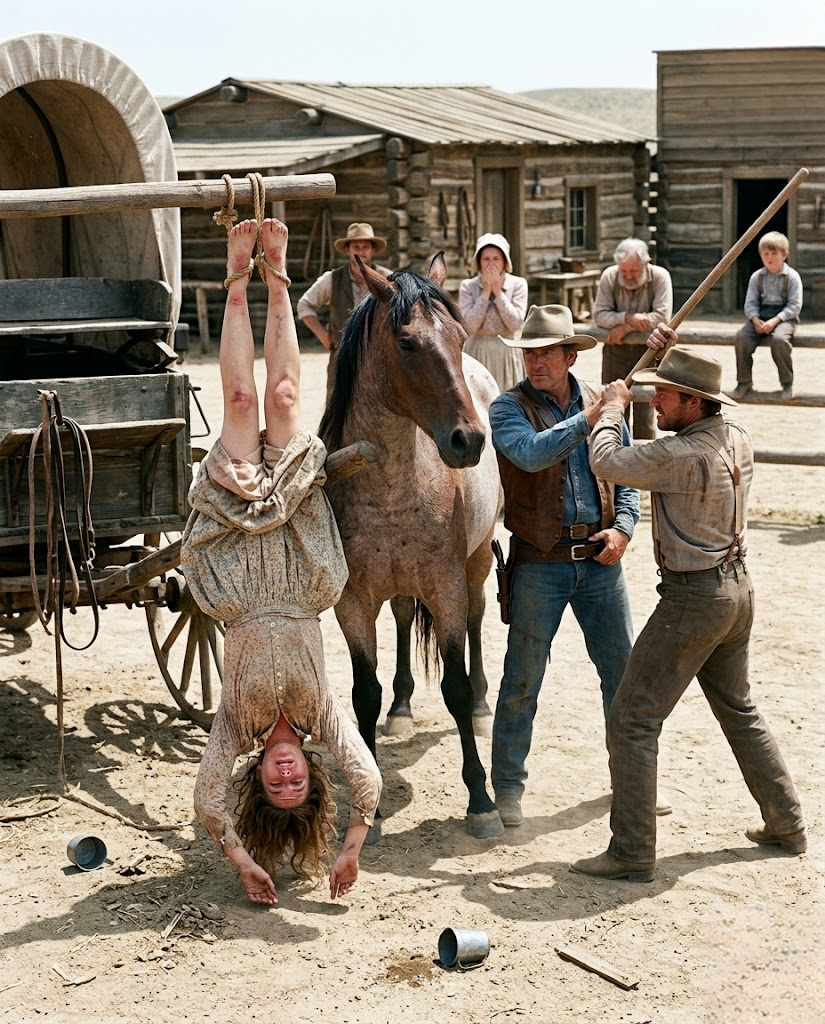
They all stood beneath the white glare of morning, watching a woman hang upside down from a wagon pole with her ankles tied in coarse rope, and not one of them seemed troubled enough to ask whether they had made a mistake.
Her hair brushed the dirt.
Her face had gone pale beneath the dust on her cheeks.
The blood had rushed to her head so long that the settlement had begun to smear at the edges, turning people into shapes and voices into murmurs.
‘I didn’t steal anything,’ she whispered.
The words were thin and cracked.
They barely reached past the wagon wheel.
But she had said them before.
The first time, they had laughed.
The second time, they had told her a guilty woman always begged.
Now most of them acted as if silence made them decent.
The rope around her ankles bit deeper each time the wagon shifted, and she had learned not to move unless she had to.
Every sway made her shoulders burn.
Every breath felt wrong.
Being punished was one thing.
Being displayed was another.
The man who accused her stood near the front of the crowd, broad-shouldered, hard-eyed, and loud enough to make doubt feel dangerous.
He said his knife had gone missing.
He said he had seen her near his wagon.
He said that was all the proof a decent settlement needed.
A missing knife, a woman with no one beside her, and a crowd hungry to believe the simplest story.
That was how fast truth could be buried.
Not by darkness.
By daylight.
The teamster climbed onto the wagon seat and snapped the reins over the back of the wild roan hitched in front.
The horse was famous in the settlement for the wrong reasons.
It had kicked loose boards, broken a hitch rail, and made grown men step away when it threw its head.
People kept their children back from it.
Handlers cursed it.
The teamster called it mean because mean was easier to understand than untamed.
Its dark mane whipped in the wind, and its hooves pawed the ground with restless force.
‘Pull,’ the teamster shouted.
He snapped the reins again.
The leather cracked sharply enough to make a child flinch.
Still, the horse planted its hooves.
Its ears were not pinned back at the man.
They were forward.
Toward her.
The woman blinked through the blur and saw the animal watching her.
For one dizzy second, the upside-down world made the horse look impossibly large, almost unreal, all muscle and breath and sunlit dust.
She expected it to shy away.
Everyone did.
Instead, the roan stepped closer.
A ripple moved through the crowd.
The teamster cursed under his breath and hauled harder on the reins.
The horse jerked sideways, not away from the woman, but toward her.
It let out a sharp cry that cut through the yard, then pressed its shoulder against the wagon pole.
The pole steadied.
So did she.
Warm breath touched her cheek.
The horse lowered its head near her tangled hair and huffed softly, as if checking whether she was still conscious.
No one laughed then.
The crowd had come to watch shame do its work, but shame requires agreement.
The animal had broken that agreement without saying a word.
The teamster’s face reddened.
Men like him could tolerate a frightened woman better than a horse that embarrassed him.
He climbed down from the seat, grabbed a long wooden pole from the side of the wagon, and strode toward the roan with his mouth twisted in anger.
That was when the rancher stepped forward.
He had been standing near the back, quiet under his hat, watching more than speaking.
He was not the largest man in the yard, but he moved with the plain confidence of someone who had handled frightened animals and angry men and knew which one was more dangerous.
He lifted one hand.
‘Easy, boy,’ he said to the horse.
The roan flicked one ear toward him but did not step away from the woman.
The teamster raised the pole.
The rancher caught it before it came down.
The yard froze.
A woman put a hand over her mouth.
A boy sitting on the wagon rail stopped swinging his legs.
Somewhere near the wheel, a tin cup rolled through the dirt and came to rest against a stone.
Nobody bent to pick it up.
The rancher lowered the pole and let it drop.
‘If that animal won’t pull,’ he said, ‘there’s a reason. And it isn’t your temper.’
The accuser pushed through the front of the crowd.
His pride was beginning to turn brittle, and brittle pride makes a man louder than courage ever does.
‘She hid my knife,’ he snapped. ‘I saw her near my wagon before it disappeared.’
The roan struck the ground.
Dust leapt beneath its hooves.
The wagon’s front wheels jolted, and two men stumbled back as if the animal had answered in a language even they understood.
The woman tried to speak again, but the blood rushing to her head stole the words.
Only a broken breath came out.
The rancher crouched beside the wagon pole.
He looked at the knot.
He looked at the rope burns around her ankles.
He looked at the bruising along her wrists where someone had grabbed too hard.
Then he lifted his eyes and found the accuser stepping backward, trying to slip behind a thicker part of the crowd.
That told him plenty.
Not everything.
Enough.
‘If she stole from you,’ the rancher said, standing, ‘show us the proof. Lay it out now.’
The accuser opened his mouth.
Nothing came.
The silence that followed was heavier than his shouting had been.
The roan nudged the woman again, softer this time, then snorted toward the rope as if urging every coward in the yard to stop waiting.
The rancher reached for the knife at his belt.
The blade flashed once in the sun.
‘Hold her steady,’ he said.
The horse did.
The roan pressed its shoulder harder to the wagon pole, grounding the sway of her body while the rancher cut through the rope.
She dropped only a short distance before he caught her under the shoulders.
A gasp tore through the crowd.
He lowered her gently into the dirt, one knee braced, one arm supporting her back as if she were a hurt traveler instead of a woman the town had called a thief.
Her legs trembled when the rope came loose.
The skin around her ankles was marked deep red.
The rancher winced at the sight but did not make a show of pity.
Pity would have humiliated her all over again.
Care was quieter.
‘Hold still now,’ he said. ‘Let me help.’
She tried to pull away on instinct.
He waited.
That waiting mattered.
A woman from the crowd came forward with a dipper of water, her hands shaking so badly some of it spilled over the rim.
The rancher guided it to the accused woman’s lips.
She drank in small, uneven gulps.
The water hit her stomach like shelter.
The roan stood close enough that its flank brushed her shoulder.
When her fingers searched the dirt for balance, the horse lowered its muzzle and nudged her hand as though insisting she lean on something living instead.
The crowd murmured differently now.
Less certain.
Less cruel.
The teamster had gone quiet, and the accuser’s face had lost some of its color.
The rancher tore a strip from the bottom of his sleeve and wrapped it around one of her raw wrists.
His movements were careful.
Respectful.
The kind of care that makes a person realize how badly everyone else has treated them.
Her breath hitched.
She covered the sound with the back of her hand.
‘You’re allowed to breathe now,’ the rancher said quietly. ‘No one’s hurting you.’
That broke what hanging upside down had not.
Tears spilled before she could stop them.
No one jeered.
No one called her guilty.
The crowd stood in the hard silence of people who had finally begun to see themselves.
‘I didn’t steal his knife,’ she said.
Her voice was rough, barely more than a rasp.
‘I never touched it.’
The rancher leaned closer, not pressing, just listening.
‘I was near his wagon because I heard crying,’ she said. ‘A child. Someone left a boy under the tarp with no blanket. I went to pick him up. That’s all.’
The words moved through the yard like cold water.
Mothers reached for their children.
Men looked toward the wagon.
The accuser’s jaw tightened.
The woman swallowed and kept going because stopping would mean letting his lie breathe again.
‘Then the knife went missing, and he blamed me before I could speak.’
The rancher turned slowly toward the accuser.
The roan snorted, sharp and low.
The woman on the ground lifted one shaking hand toward the crowd.
‘His wife saw me,’ she said. ‘She saw what happened. But she was afraid to speak against him.’
Every face turned toward the boy’s mother.
She stood near the wagon’s shadow, thin and pale, clutching her shawl with both hands.
Her eyes were swollen.
Her mouth trembled.
Her husband looked at her with a warning so plain even the children seemed to understand it.
The rancher rose.
‘Then we’ll hear from her today.’
The accuser barked before she could move.
‘Don’t you dare say a word.’
The roan stamped so hard the sound cracked across the yard.
Dust burst beneath its hooves.
The boy’s mother flinched.
Then, slowly, she lifted her chin.
Courage does not always look like fearlessness.
Sometimes it looks like a frightened woman deciding fear has already taken enough.
She stepped forward.
The crowd parted for her.
Her husband took one step toward her, but the rancher blocked him with a flat hand to the chest.
The roan moved at the same time, placing its big body between the man and the two women he had tried to silence.
‘Go on,’ the rancher said.
The boy’s mother looked at the accused woman first.
That was when the truth finally found a human voice.
‘She didn’t take your knife,’ she said, trembling but clear. ‘I saw what happened. She was holding our son because he was freezing.’
The accuser’s face hardened.
His wife turned toward him.
‘And you misplaced your own blade the night before,’ she said. ‘You were too drunk to remember where you put it.’
Gasps moved through the settlers.
The accuser lunged toward her with a roar, but the rancher stopped him before he reached the first step.
The roan surged forward too, nostrils flaring, muscles coiled beneath its coat.
The man’s fury ran straight into horse and rancher and went nowhere.
Then a small voice rose from the side of the crowd.
‘Papa?’
Everyone turned.
The boy was no more than five.
He clutched his mother’s skirt with one hand and held a knife in the other.
It looked too large for his fingers.
His eyes were wide, uncertain, and frightened by the number of adults suddenly staring at him.
He lifted the knife a little.
‘You dropped this under the wagon yesterday.’
No fistfight could have landed harder.
The accuser stared at the blade in his child’s hand.
The color drained from his face.
The crowd’s silence changed again, this time from doubt into recognition.
They had not punished a thief.
They had punished a woman who had heard a child cry and tried to help him.
The rancher took the knife carefully from the boy and held it where the crowd could see.
‘You punished an innocent woman,’ he said to the accuser. ‘You shamed her in front of this settlement, and you would have let the lie stand if not for your own child and a horse that saw what we refused to.’
No one argued.
That was perhaps the worst part for them.
They all knew he was right.
The boy looked at the woman sitting in the dust.
His lower lip trembled.
He stepped toward her with the small, careful walk of a child who knows adults have made something terrible but does not know how to fix it.
‘I’m sorry,’ he whispered.
She did not answer at first.
Her bruised wrists trembled.
Her throat worked around a sound that never fully came.
The roan lowered its head and nudged her gently under the chin, as if reminding her that she was still there, still breathing, still allowed to choose what came next.
She looked into the boy’s eyes and gave the faintest nod.
His mother came next.
Tears streaked her face.
‘I should have spoken sooner,’ she said. ‘I’m sorry they hurt you.’
The accused woman shook her head once.
It was not the easy forgiveness people ask for when they want guilt to leave quickly.
It was something quieter.
A refusal to become what they had done to her.
The rancher motioned for space.
The crowd parted.
He helped her stand, one steady hand at her elbow, then let her take her own weight when she was ready.
Her knees shook.
Her chin did not.
The roan fell into step beside her.
The settlement watched as the woman they had condemned walked through them with a wild horse guarding one side and the rancher a respectful pace behind.
Some settlers bowed their heads.
Some whispered apologies.
Some said nothing because words would have been too small.
The accuser remained near the wagon, trapped under the stare of his own neighbors and the quiet devastation of his wife’s courage.
No court had been called.
No formal paper had been stamped.
But everyone in that yard knew a verdict had been handed down all the same.
It had come from a child’s hand, a missing knife, a mother’s confession, and a horse that refused to move until the truth did.
That night, the rancher offered the woman a place to sleep beneath a roof instead of beneath the judgment of strangers.
She accepted because pride had already cost her enough.
She did not sleep much.
Her ankles throbbed.
Her wrists ached.
Every time the wind pushed against the cabin wall, some part of her body expected rope again.
But near dawn, when gray light spread over the yard, she opened the door and found the roan waiting outside.
It stood by the fence as if it had kept watch through the dark.
The rancher came from the barn a little later, hat low, boots quiet in the damp morning dirt.
He did not ask whether she was grateful.
He did not ask what she planned to do about the settlement.
He only looked toward the ridge trail and said, ‘Where do you want to go from here?’
That question nearly undid her.
No order.
No accusation.
No one naming her before she could name herself.
She looked past the cabins, past the wagon yard, past the place where they had hung her like guilt was already proven.
The open land stretched beyond the ridge, brushed gold by sunrise.
She nodded toward it.
The rancher understood.
He did not crowd her.
He simply walked a few paces behind while the roan moved at her side, its shoulder close enough for her fingers to rest in its mane whenever her steps faltered.
At the edge of the settlement, people had gathered in silence.
No one called after her.
No one asked her to stay so they could feel forgiven.
Their lowered heads said enough.
They had seen the truth too late, but they had seen it.
She paused once at the ridge and looked back.
Not with bitterness.
Not with softness either.
With the hard-won calm of someone who knew she had survived a town’s lie and did not have to carry it for them.
The roan gave a low knicker.
She turned forward.
Sometimes the frontier showed its harshest face before it showed its honest one.
Sometimes truth came from the one mouth that could not speak.
And sometimes a whole town had to learn that judgment was not justice just because everyone agreed to watch.
By the time the sun rose fully, she was walking away with the wild horse beside her, the rancher behind her, and her name finally loosened from the rope they had tied around it.