
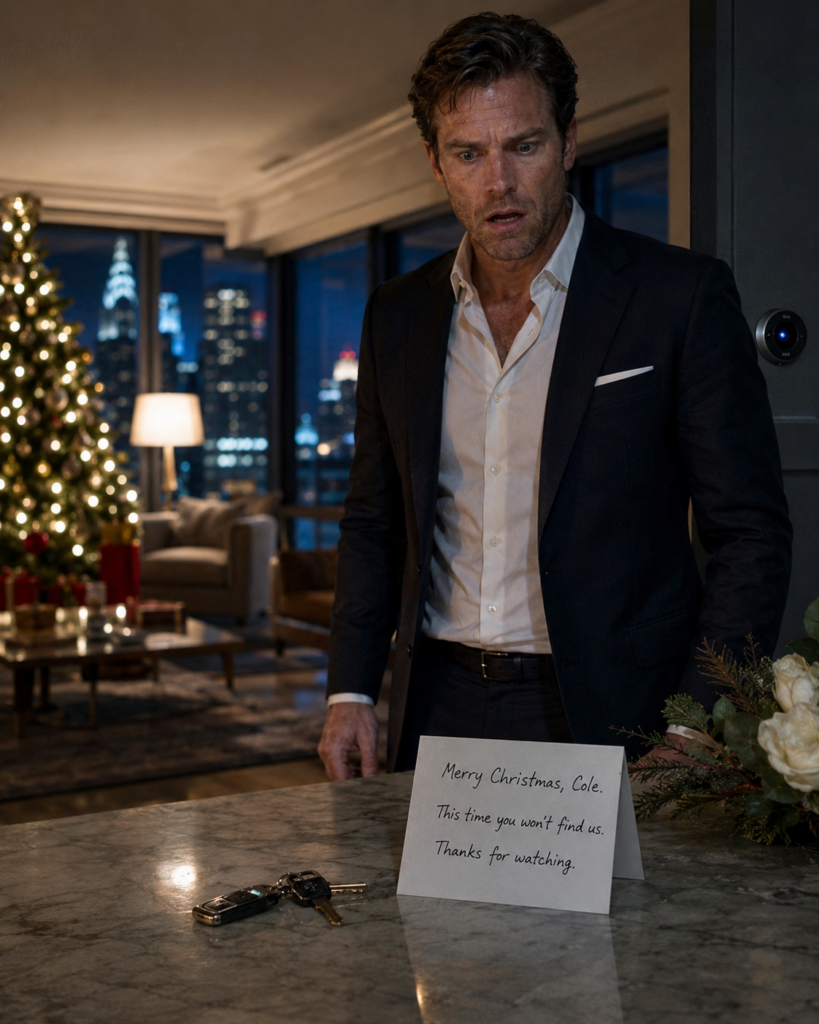
After He Spent Christmas With Mistress – He Realized His Wife Had Vanished With Their Twins

He left her alone on Christmas Eve with two feverish babies and a lie on his lips.
By dawn, she was gone with the twins, the diaper bag, and every ounce of fear he had taught her to carry.
When he finally came home, the only thing waiting for him was a note that made his hands go cold.
The snow had been falling over Manhattan since dusk, not violently, not dramatically, but with a soft, steady cruelty that made the city look gentler than it was. It gathered on fire escapes, softened the hard edges of parked cars, dusted the black iron railings outside the old buildings on West 85th Street, and turned every streetlamp into a blurred halo of gold. From the outside, the Whitmore apartment looked warm. A prewar building with a polished brass entrance, wreaths on the lobby doors, and a doorman who knew how to greet residents by name without ever asking questions.
Inside apartment 9B, Lauren Whitmore stood barefoot on cold hardwood, rocking one of her newborn twins against her shoulder while the other whimpered in the bassinet beside the Christmas tree.
The tree was beautiful in the sterile way Cole liked beautiful things. Silver ornaments. Navy ribbon. White lights. No mismatched childhood decorations, no handmade paper angels, no red or green because Cole said traditional Christmas colors looked cheap. The ornaments trembled faintly each time Lauren passed them, pacing from the living room window to the nursery door and back again, one hand pressed against the baby’s fever-warm back.
“Shh, I know,” she whispered, though she was not sure whether she was comforting her child or herself. “I know, sweetheart. Mommy’s here.”
The baby’s breath came quick and shallow against her neck.
The pediatrician had told her to monitor the fevers, to call again if they climbed, to keep them hydrated, to watch their breathing. Lauren had written everything down on the back of an envelope because she did not trust her own memory anymore. Sleep had become something that happened in scraps. Twenty minutes on the sofa. Nine minutes at the kitchen table. A half hour with her cheek pressed against folded laundry while bottles cooled in the sink. Since the twins were born, time had loosened its shape, and Lauren moved through it as if underwater.
Cole had left at seven.
“Investors,” he had said, buttoning his tailored charcoal coat while glancing at his phone. “Important dinner. Don’t start.”
“I wasn’t starting anything,” Lauren had said.
“You have that look.”
“What look?”
“The one where you’re about to make my work about your feelings.”
One of the babies had cried then, thin and hoarse. Lauren had turned instinctively toward the sound. When she looked back, Cole was already at the door.
“They have fevers,” she said. “Both of them. I might need help tonight.”
Cole sighed as if she had asked him to carry the building on his back. “You have the pediatrician’s number.”
“They’re your children too.”
His hand froze on the doorknob.
For one second, she saw his face without polish. Annoyed. Cold. Almost insulted.
“I provide for them,” he said. “Don’t confuse roles.”
Then he left.
The words stayed in the apartment after him, drifting through the rooms like the scent of his cologne. Don’t confuse roles. He was the provider, the man with the Mercedes and the Park Avenue office and the expensive watch. She was the wife who kept the babies alive, the apartment presentable, the laundry folded, the bills questioned only softly, the tears hidden in bathroom steam.
Lauren had been trying not to know the truth for months.
She had smelled another woman’s perfume on his coat in October. Found a lipstick smear on the inside of his collar in November. Seen dinner charges at places he told her he hated. Heard him whispering in the hallway at midnight, his voice lowered into a version of tenderness he no longer used with her.
Each time, she swallowed the evidence.
Not because she believed him.
Because she was tired.
Because the twins were small.
Because her mother lived in an assisted care facility in Ohio and sometimes called Lauren by her sister’s name. Because her father was buried under a maple tree outside Dayton. Because there was no childhood bedroom waiting for her, no older brother with a spare guest room, no savings account Cole had not quietly drained or frozen “for budgeting discipline.”
He knew exactly how alone she was.
He had turned that knowledge into architecture.
At 11:47 p.m., while one baby finally slept and the other fussed against her chest, Lauren’s phone buzzed on the coffee table.
Cole.
For half a second, relief moved through her so sharply it hurt.
Then she read the message.
Don’t wait up. Big clients. Stay quiet so I can focus.
Attached beneath it was a photograph.
A mistake, perhaps. A careless thumb. Or maybe arrogance had finally made him lazy.
The image was cropped, but not enough. A hotel mirror. Warm amber light. A woman’s bare shoulder. Long blonde hair falling over silk. Cole’s hand at her waist, his wedding ring catching light like an insult.
Lauren stared at the photo until the baby stirred in her arms.
Her heart did not break. That would have implied noise. A cracking. A dramatic rupture.
Instead, something simply went still.
She placed the baby in the bassinet with shaking care, then walked down the hall to the bedroom because she needed air, needed a sweater, needed something ordinary to hold in her hands before she stopped being able to stand. Cole’s side of the closet was open. His discarded scarf hung over the chair. His second coat, the black cashmere one, lay across the bed where he had tried it and rejected it before leaving.
A small blue box sat half-hidden in the pocket.
Lauren saw it before she understood it.
Tiffany blue.
Her fingers moved without asking permission from her mind. She opened the box. Inside lay a delicate necklace of pearls and small diamonds, elegant, expensive, intimate. Not the kind of gift a man bought for a client. Not the kind of gift Cole had ever bought his wife.
The receipt was tucked beneath the velvet.
To Sierra. Christmas Eve.
For a moment, the room seemed to tilt away from her.
Sierra.
Lauren had heard the name before. Sierra Hale, junior partner liaison at Stonebridge Capital. Cole had mentioned her as “sharp, a little hungry, but useful.” Lauren had seen her once at a company holiday party, a blonde woman in a cream dress who had looked at Cole as if she were already waiting for Lauren to disappear.
Lauren set the necklace back in the box.
In the nursery, one baby coughed.
That sound brought her back to her body.
Not the photograph. Not the necklace. Not the receipt.
The cough.
Small, helpless, real.
Lauren stood in the center of the bedroom, surrounded by Cole’s expensive coats and polished shoes, and finally understood something simple. He could betray her. Humiliate her. Lie to her. Starve her confidence until she apologized for breathing. But he would not teach her children that this was what love looked like.
Not one more night.
She moved quickly then.
Not calmly. Not elegantly. Quickly.
She packed the diaper bag with formula, bottles, wipes, two changes of clothes for each baby, fever medicine, the pediatrician’s instructions, birth certificates from the file box, and every small document she knew she might need. Her own hands shook so badly she dropped the thermometer twice. She put on jeans under her robe, then a sweater, then the warmest coat she could find. She tucked her phone charger into her pocket. She hesitated over her wedding ring, then slid it off and placed it on the kitchen counter.
The twins were bundled in layers, their faces flushed, their tiny fists pressed near their cheeks.
At 4:06 a.m., Lauren opened the apartment door.
The hallway was quiet. Thick carpet. Dim sconces. Someone’s wreath tied with red velvet ribbon across the hall. Her arms ached as she pushed the stroller toward the elevator, diaper bag cutting into one shoulder. Her C-section scar pulled sharply with each step, a private pain she had never properly had time to heal from.
When the elevator doors opened, she saw herself in the mirrored wall.
Pale. Hair unwashed. Eyes too large. A mother holding herself together with thread.
For one second, panic surged so hard she almost turned back.
Then one of the twins whimpered.
Lauren pressed the lobby button.
Downstairs, the doorman looked up from behind the desk, surprise flickering across his face.
“Mrs. Whitmore?”
“I’m going out,” she said.
“At this hour? Do you need help?”
The question nearly undid her because it was the first kind thing anyone had said to her all night.
“No,” she managed. “Thank you.”
She passed the security camera by the mailroom and stopped.
Cole would look.
She knew him. He would demand footage. He would want evidence of her leaving. He would use it to call her irrational, unstable, dramatic.
Lauren looked straight into the camera.
Not crying.
Not pleading.
Looking.
Then she walked out into the snow.
The cold struck her so hard her breath disappeared. The city at that hour was nearly empty, the sidewalks slick, the snow fresh enough to mute everything. A delivery truck groaned at the corner. Steam lifted from a manhole. A cab passed with its light off. Lauren stood beneath the awning with two feverish infants and nowhere to go.
She opened her banking app.
The joint account showed $12.43 available.
Her own account showed $186.
Cole had frozen the rest again.
A sick laugh rose in her throat, but it came out like a sob.
She tried calling a car service, then stopped when she saw the price surge. She tried to think of friends, but Cole had trimmed those away over the years with tiny comments and larger moods. He disliked Maya because she was “too opinionated.” He disliked Rachel because she was divorced. He disliked her old coworker Tess because “single women love making wives miserable.” Eventually, the invitations stopped coming, and Lauren had let them stop because it was easier than fighting.
Snow settled on the twins’ blankets.
“Okay,” she whispered. “Okay. We’re going to figure this out.”
But her body did not believe her.
By the time she reached the corner, her chest had begun to tighten. It started as a band beneath her ribs, then became a fist. Her hands went numb. Her vision blurred at the edges. Panic, old and familiar, rose through her like black water.
No.
Not here.
Not with the babies.
She pushed the stroller toward a bus shelter and sat heavily on the cold bench. Her breath came too fast. She could hear Cole’s voice in her head.
You’re unstable.
You always make things dramatic.
This is why I can’t talk to you.
A woman passing with a small dog glanced at Lauren, slowed, then kept walking.
The humiliation of needing help and not receiving it was almost worse than the fear.
Lauren bent over the stroller, shielding the babies from the wind with her own body. “I’m trying,” she whispered, tears falling onto the blanket. “I’m trying, I’m trying.”
Headlights slowed beside the curb.
A black SUV stopped.
For one terrifying second, she thought it was Cole.
Then the window rolled down.
“Lauren?”
The voice was deep, controlled, familiar in a way that seemed impossible at four in the morning during a snowstorm.
She looked up.
Evan Lancaster sat behind the wheel, his dark coat collar turned up, his expression calm but sharply concerned. She had met him three years earlier while coordinating a charity event at Lancaster Suites, his family’s hotel. He had been the keynote donor, impossibly composed, intimidating to everyone in the room, but he had thanked her personally after she fixed a catering disaster and treated her competence as if it deserved attention.
She had thought he forgot her.
Apparently, he had not.
“Get in,” Evan said. “The babies need warmth.”
Lauren did not move.
Trust had become a foreign language.
Evan seemed to understand. He did not reach for her, did not raise his voice.
“I can call an ambulance if their fevers are high. I can call the police if you want. I can call anyone you name. But you cannot sit in the snow with newborns, Lauren.”
The steadiness in his voice reached something inside her that panic had not destroyed.
She stood.
Evan got out and helped lift the stroller into the back. He did it carefully, as if the smallest motion mattered. Inside the SUV, heat wrapped around them. Lauren’s hands began to hurt as feeling returned to her fingers. Evan angled the vents away from the babies’ faces and toward their blankets. He handed her a bottle of water from the console.
“You’re shaking,” he said.
“I’m fine.”
“No,” he replied gently. “You’re functioning. That is different.”
The sentence broke something open.
Lauren turned her face toward the window and cried without sound.
Evan drove without asking questions for several blocks. The city slid past in white and gold. Finally, he said, “Do you need a hospital?”
“The pediatrician said to watch them. Their fevers are lower than they were. I just… I had to leave.”
“Because of Cole?”
Her head turned sharply.
Evan kept his eyes on the road. “I know some things.”
“What things?”
He exhaled slowly. “Enough to know you should not go back tonight.”
A coldness moved through her that had nothing to do with the weather.
“Evan.”
He reached into the side pocket of the door and handed her a folder.
“Read only the first page for now.”
Inside were copies of financial documents. Internal transfers. Event expenses. Vendor names that looked unfamiliar. Cole’s signature repeated in blue ink beneath approvals tied to Stonebridge Capital.
Lauren stared at the papers.
“I don’t understand.”
“Stonebridge has been investigating unauthorized transfers for months. Some of them were disguised as client entertainment. Some as investor relations. Some appear tied to gifts, hotel rooms, and payments routed through shell vendors.”
“Sierra,” Lauren whispered.
“That name appears more than once.”
Her stomach turned.
“Why are you showing me this?”
“Because Cole is not just cheating,” Evan said. “He is exposed. A man like Cole, when exposed, does not tell the truth. He looks for someone else to blame. You and the twins are the easiest way for him to create sympathy.”
Lauren looked down at the sleeping babies.
“He’d use them?”
Evan’s jaw tightened. “He already has.”
His phone lit on the console. A message preview appeared from someone named Marissa Vale.
Evan read it, his expression hardening.
“What?” Lauren asked.
“Cole has contacted building security and reported you missing under suspicious circumstances.”
The air left her lungs.
“Missing?”
“He is laying groundwork.”
“No. No, he can’t. I left a note. I left the ring. The camera—”
“He will say you were unstable.”
The word landed with brutal precision.
Unstable.
Cole’s favorite weapon.
Lauren pressed a hand to her mouth.
Evan pulled to the curb outside Lancaster Suites, where warm light spilled across the snow from the hotel’s revolving doors. Christmas garlands framed the entrance, and two staff members hurried forward the moment they saw his car.
“You’ll stay here tonight,” he said.
“I can’t afford—”
“I did not ask you to rent a room.”
“Evan, I can’t accept this.”
“You can accept safety.”
She looked at him then, really looked. He was not offering rescue as performance. There was no hunger in his expression, no need to be admired. Only resolve.
“I don’t know what to do,” she admitted.
“That’s all right,” he said. “Tonight, you rest. Tomorrow, we make a plan.”
The suite at Lancaster Suites was not just beautiful; it was quiet. That was what undid her. Not the thick carpet, not the cream walls, not the view of Central Park softened beneath snow, not the bassinet the staff somehow brought within minutes. It was the quiet. No slammed cabinets. No clipped sighs. No footsteps that made her body tense before a door opened.
The twins were checked by a discreet private nurse Evan called from the hotel’s medical concierge list. Their fevers were monitored, their breathing listened to, their tiny bodies wrapped properly in warmth. Lauren stood nearby in borrowed slippers and a soft robe, watching someone else help her children with competent tenderness, and felt shame burn behind her eyes.
“I should have handled this,” she whispered.
The nurse, a woman in her fifties with silver at her temples, gave her a firm look. “You did handle it. You got them somewhere warm.”
After the nurse left, Lauren showered. Hot water ran over her shoulders, stinging her cold skin, loosening the terror stored in her muscles. She pressed one hand against the tile and cried until her throat hurt. Then she dressed in the simple black lounge set hotel staff had found for her and stepped back into the living room.
Evan was standing near the window, phone to his ear, speaking in a low voice.
“No public statement yet,” he said. “Not until her attorney is present. And tell Marissa I want the full timeline before morning.”
Lauren stopped.
He ended the call.
“Who is Marissa?”
Evan turned. “Marissa Vale. Financial investigator. She has been looking into Cole’s conduct independently.”
“Why independently?”
“Because Stonebridge did not want scandal. Someone on the board hired her quietly when the internal numbers stopped making sense.”
Lauren sat slowly on the sofa. “How long have you known?”
“That Cole was in trouble? Weeks.”
“That he was hurting me?”
Evan’s silence answered before he did.
“I suspected,” he said. “At the charity gala two years ago, you flinched when your phone rang. Then you smiled too quickly. I know that kind of smile.”
Lauren looked away.
“Why didn’t you say anything?”
“Because I had no right to walk into your marriage with suspicions. And because people in your position often deny the truth until they are ready. If I had pushed, you might have run from the help.”
She hated that he was right.
He crossed the room and placed another envelope on the coffee table.
“I kept this.”
Lauren opened it.
Inside was a thank-you note in her own handwriting from the charity event.
Thank you for treating my work like it mattered.
Beneath it was a note from Evan, never sent.
It did matter. And so did you. If you ever need real help, I hope you find someone who shows up.
Lauren’s fingers tightened around the paper.
“You kept this for two years?”
“Yes.”
“Why?”
For the first time, uncertainty moved across his face.
“Because that night, you looked at me like you were surprised to be respected. I did not forget it.”
She did not know what to do with that kind of gentleness.
So she folded the note carefully and set it beside her.
By morning, Cole had come home.
He found the apartment silent, the twins gone, Lauren gone, and the wedding ring on the counter. The note sat on the kitchen table, written in Lauren’s careful hand.
Merry Christmas, Cole. This time you won’t find us unless the law says you can.
He read it once.
Then again.
His smugness did not vanish all at once. Men like Cole did not surrender their narratives quickly. First came anger. He called Lauren twelve times. Left messages that moved from irritated to threatening to falsely gentle.
Lauren, stop this nonsense.
You are not thinking clearly.
You are hurting the children.
Come home now and we can discuss it.
You are making yourself look unstable.
Then he called the doorman and demanded footage. In the lobby, under the polite gaze of tenants collecting packages, he watched Lauren leave at 4:06 a.m. She paused before the camera and looked directly into it. Not wild. Not confused. Not reckless.
Clear.
That frightened him more than tears would have.
So Cole did what he always did when reality resisted him.
He rewrote it.
By noon, he had filed a report stating his postpartum wife had fled with the children during a possible mental health episode. By three, Sierra Hale had submitted a statement claiming Lauren had seemed “erratic and hostile” in the weeks before Christmas, though she had only met Lauren twice. By five, Cole’s attorney requested emergency custody review.
At six, Stonebridge suspended him pending investigation.
By seven, the story leaked.
Not fully. Not accurately. But enough.
Executive under investigation. Wife missing with infants. Allegations of financial misconduct. Possible affair with subordinate.
Lauren watched the headlines from the Lancaster suite with one hand over her mouth while the twins slept beside her.
Evan stood nearby with a lawyer named Dana Moreno, a compact woman with gray eyes, a blunt haircut, and the moral temperature of a locked vault. Dana had arrived with a binder, two phones, and the calm of someone who had seen powerful men behave badly and was no longer impressed.
“First,” Dana said, “you are not missing. You are voluntarily separated from your spouse and staying in a secure location with your children. Second, you did not kidnap your children. There is no custody order preventing you from having them. Third, we document everything.”
Lauren nodded, though her hands were cold.
Dana slid a legal pad toward her. “Write down every incident you remember. Financial control. Threats. Medical neglect. Infidelity only matters if it connects to misuse of marital funds or the children’s welfare. I need facts, dates, witnesses, screenshots.”
Lauren stared at the blank page.
For years, she had been told her memory was unreliable.
Now someone was asking her to trust it.
Slowly, she began to write.
The frozen accounts.
The hospital discharge Cole missed.
The night he told her postpartum anxiety was “a convenient excuse.”
The time he took her debit card after she questioned a hotel charge.
The fever on Christmas Eve.
The photograph.
The necklace.
The receipt.
As she wrote, the story of her marriage changed shape. It stopped being fog. It became evidence.
That was the first step in becoming free.
Two nights later, Stonebridge held its annual winter gala at the Lancaster Suites ballroom. It should have been canceled, but corporations were strange organisms; even scandal did not always stop ritual. Investors still arrived in black coats and diamonds. Champagne still moved through the room. The string quartet still played beneath chandeliers while board members whispered behind smiles.
Cole arrived late, pale but polished, with Sierra beside him.
He had decided appearance would save him.
It had saved him before.
Lauren watched from a private balcony with Evan and Dana at her side. She wore a simple black dress borrowed from a hotel stylist, her hair pinned back, her face still tired but composed. The twins were upstairs with the nurse and two security staff. Her body trembled beneath the dress, but her mind felt strangely clear.
“I don’t want revenge,” she said.
Dana looked at her. “Good. Revenge makes people sloppy.”
Evan’s eyes remained on the ballroom. “Truth is enough.”
Across the room, Cole laughed too loudly at something a board member said. Sierra touched his arm, but her face was tense. She kept checking her phone.
Then Marissa Vale entered.
Lauren knew her immediately from Evan’s description: dark hair, charcoal coat, precise movements, the kind of woman who did not waste energy. She crossed the ballroom and handed a sealed folder to the Stonebridge board chair.
The chair opened it.
His face changed.
Not dramatically. Professionally. That was worse.
Within minutes, two other board members were reading. Then security shifted position near the exits. Cole noticed. His smile faltered.
The board chair approached him.
“Mr. Whitmore,” he said, voice low but audible to those nearby. “We need to speak privately.”
Cole’s face hardened. “If this is about the ridiculous leak—”
“It is about unauthorized transfers, falsified client expenses, and evidence suggesting proprietary information was shared with Julian Cross through Ms. Hale.”
The ballroom quieted in rings.
Sierra went white.
Cole looked at her.
She looked away.
“That’s absurd,” Cole said.
Marissa stepped forward. “It is documented.”
Lauren descended the stairs before she fully decided to move.
Heads turned.
Cole saw her and froze.
For one moment, the entire room seemed to narrow to the distance between them.
“You,” he said.
Lauren stopped several feet away. Evan remained at her side but slightly behind her. Not shielding. Standing with.
Cole’s eyes darted from her to Evan, then to the board. “This is personal. My wife is unstable. She has been manipulated by—”
“No,” Lauren said.
The word was quiet, but it carried.
Cole blinked.
“No,” she repeated. “You do not get to use that word anymore because I finally left a room where you controlled the language.”
A murmur moved through the crowd.
Cole’s jaw tightened. “Lauren, you are embarrassing yourself.”
“I spent years being embarrassed in private,” she said. “Tonight, I am simply telling the truth.”
Dana handed the board chair copies of Lauren’s documentation: the frozen accounts, the Christmas Eve photo, the receipt, the messages, the pediatrician’s call log, the security footage of Lauren leaving calmly with the twins. Marissa’s evidence followed: transfers, shell vendors, hotel charges, messages linking Sierra to Julian Cross.
Cole reached for the folder, but security stepped in.
Sierra began to cry. Not prettily. Not theatrically. Fearfully.
“I didn’t know all of it,” she said, voice shaking. “Julian said it was leverage. Cole said the expenses were handled. I thought—”
“You thought you could climb over another woman’s life and not look down,” Lauren said.
Sierra flinched.
Lauren’s voice softened, not out of forgiveness, but exhaustion. “That is between you and your conscience now.”
Cole turned on Sierra. “You stupid—”
“Enough,” the board chair snapped.
Security took Cole by the arms.
He fought at first, not violently enough to become a spectacle, but enough to erase whatever remained of his dignity. Cameras were not supposed to be filming, but several phones were already out. His face twisted with rage as he looked back at Lauren.
“You did this.”
Lauren shook her head.
“You did. I just stopped hiding the wreckage.”
As security escorted him out, Lauren felt no triumph.
Only air.
For the first time in years, she could breathe all the way down.
But powerful men did not fall cleanly.
By midnight, Cole had filed for emergency custody, accusing Lauren of emotional instability and parental alienation. Sierra, desperate to save herself, initially supported part of his claim, saying Lauren had appeared “distressed” the morning she left. Cole’s attorney submitted a photograph taken from across the street: Lauren bent over the stroller in the snow, crying, mid-panic attack. Without context, it looked damning.
Lauren stared at it in Dana’s temporary office upstairs.
Her cheeks burned.
“That was the lowest moment of my life,” she whispered. “He turned it into proof against me.”
Dana’s expression did not change. “Then we provide context.”
“How?”
“Medical records. Pediatrician call. Bank freeze. Hotel footage. Evan’s testimony. The doorman. The nurse. Your written timeline. His messages. His report timing. The court does not need a perfect mother. It needs evidence of a safe one.”
Lauren closed her eyes.
A safe one.
She could be that.
She already was.
The emergency hearing happened the next morning by video because the snow had shut down half the city. Lauren sat in a conference room at Lancaster Suites, wearing a navy sweater, her hair pulled back. The twins slept in the next room under the nurse’s care. Evan sat outside because Dana insisted the court should see Lauren stand as herself, not as someone’s rescued cause.
Cole appeared from his attorney’s office, pale and furious.
His lawyer painted Lauren as fragile, overwhelmed, irrational. He used polished phrases that made cruelty sound like concern. Postpartum instability. Abrupt departure. Exposure of infants to winter conditions. Questionable influence from third parties.
Lauren listened.
Her hands trembled beneath the table, but her voice did not when Dana asked her to speak.
“I left because my children were sick, my husband was unreachable, my access to family funds had been restricted, and I discovered evidence that he was spending Christmas Eve with another woman while misusing money connected to his work. I did not leave to punish him. I left because staying had become unsafe for my mind and my children’s stability.”
The judge, a woman with silver hair and tired eyes, reviewed the documents silently.
Cole interrupted twice.
The second time, the judge said, “Mr. Whitmore, if you speak over this court again, it will not help your petition.”
He stopped.
The doorman’s statement confirmed Lauren left calmly. The pediatrician’s call log confirmed the babies had fevers. The nurse confirmed they were stable after arrival at the hotel. Evan’s statement confirmed he found her in distress but coherent, focused on the infants, and seeking safety. Bank records showed Cole had restricted account access hours before she left. His own messages showed no concern for the twins until after he realized she was gone.
Then Marissa’s preliminary evidence entered the record.
The judge read for a long time.
When she looked back up, her voice had cooled.
“Temporary sole physical custody is granted to Mrs. Whitmore pending full hearing. Mr. Whitmore is to have no unsupervised contact with the children. Given the financial misconduct investigation and the use of questionable evidence in this petition, the court will appoint a guardian ad litem and schedule review.”
Lauren did not move.
For a moment, she did not understand.
Dana touched her arm. “You won temporary custody.”
Lauren covered her mouth as tears filled her eyes.
Not victorious tears.
Relief so deep it almost hurt.
Cole leaned toward his camera. “Lauren, don’t do this.”
She looked at him through the screen.
“You did this,” she said. “I’m just protecting them from it.”
The hearing ended.
Only then did Lauren break down.
Evan found her in the hallway outside the conference room, one hand against the wall, crying into her sleeve. He did not touch her until she nodded. Then he stepped close, and she let herself lean against him, not because she could not stand, but because for once, she did not have to prove she could stand alone every second.
“It’s not over,” she whispered.
“No,” he said. “But the worst part is.”
It was not, exactly.
Cole was arrested three days later after attempting to pressure Sierra into changing her statement. Sierra’s sister, Emily Hale, unexpectedly came forward with recordings Sierra had sent her in fear, including one where Cole admitted to hiding transfers and using Lauren’s mental health against her. Julian Cross tried to distance himself from everyone, but Marissa’s evidence was cleaner than his denials. Stonebridge cooperated with investigators to save itself.
The scandal lasted weeks.
Headlines came and went.
Cole’s name became something people discussed with professional disgust over coffee. Sierra resigned and entered an agreement to testify. Lauren refused interviews. She had no interest in becoming a symbol before she had finished becoming herself again.
She moved into a smaller apartment first.
Not glamorous. Not permanent. A two-bedroom on the Upper West Side with sunlight in the morning and old radiators that clanged at night. Evan offered better. Larger. Easier. She said no.
“I need to know I can stand inside a home that is mine,” she told him.
He accepted that.
No argument. No wounded pride.
Just, “Then let’s find you one with good locks and decent light.”
That was when Lauren began to understand the difference between help and control.
Help opened doors.
Control decided which ones you were allowed to walk through.
Her recovery was not cinematic at first. It was paperwork, therapy, custody meetings, pediatric appointments, court dates, and nights when she woke from dreams of Cole taking the twins and had to walk barefoot into the nursery just to see them breathing. It was learning the bank passwords only she controlled. It was buying her own phone plan. It was crying in a grocery store because she could choose cereal without imagining criticism.
It was shame leaving slowly.
Not all at once.
In therapy, she said, “I feel stupid.”
Her therapist, Dr. Elaine Foster, a calm woman with silver glasses, asked, “For trusting your husband?”
“For not leaving sooner.”
“Lauren, survival often looks like staying until you have enough strength to leave.”
That sentence stayed with her.
She returned to work part-time, then moved into event coordination again, the thing she had once done well before marriage narrowed her world. Evan connected her with no one until she asked. When she did, he introduced her to a nonprofit needing someone meticulous, empathetic, and unafraid of chaos. Lauren was all three.
The first event she managed after leaving Cole was small: a winter fundraiser for a family legal aid clinic. She stood in a community hall with folding chairs and donated flowers, checking the microphone, adjusting table cards, calming a volunteer who misplaced the donor list. Her hair was pinned back. Her dress was simple. There were shadows beneath her eyes because the twins were teething.
But when the doors opened and people began to arrive, Lauren felt something she had not felt in years.
Competence.
Not beauty. Not approval. Not relief from someone else’s anger.
Competence.
A solid floor beneath her.
Evan attended quietly, standing near the back, applauding when the director thanked Lauren by name. He did not take credit. He did not perform pride as ownership. Afterward, as volunteers cleared plates and someone swept glitter from the floor, he handed her a paper cup of coffee.
“You were extraordinary,” he said.
Lauren smiled tiredly. “I was organized.”
“That too.”
Their relationship grew slowly because Lauren insisted on slow. Evan never pressed. Sometimes they had dinner after the twins slept. Sometimes they walked through Central Park with the stroller, talking about nothing urgent. Sometimes Lauren canceled because trauma had made her tired in a way sleep did not fix, and Evan simply said, “Rest. I’ll check in tomorrow.”
Months passed.
The custody arrangement became permanent: Lauren retained primary custody, Cole received supervised visitation after completing required evaluations and cooperating with financial proceedings. He aged quickly in those months. The arrogance thinned. The charm cracked. In one supervised session, he cried when one of the twins reached for Lauren instead of him. Lauren felt sadness then, but not guilt.
She had learned the difference.
Cole eventually pleaded guilty to reduced financial charges after cooperating against Julian Cross. His career in Manhattan finance ended quietly, without the dramatic ruin he had once feared but with something he perhaps feared more: irrelevance. He moved to New Jersey, took consulting work under restrictions, and sent formal messages through the parenting app Dana insisted on using.
No late-night calls.
No emotional ambushes.
No private negotiations.
Boundaries, Lauren discovered, were not walls. They were doors with locks she controlled.
A year after the night she left, snow fell over Manhattan again.
Lauren stood at the window of her new apartment while the twins played on a soft rug behind her, bumping blocks together with serious concentration. The Christmas tree in the corner was small, slightly crooked, and completely wrong by Cole’s standards. Red ribbon. Wooden ornaments. A paper star Lauren made herself because one of the babies had chewed the box the real star came in. It was imperfect, warm, alive.
Her mother sat in an armchair nearby, visiting with a caregiver, humming along to a Christmas song she only half remembered. She called Lauren by the correct name twice that day, which felt like a gift too fragile to mention.
A knock came at the door.
Lauren opened it to find Evan holding a paper bag from a bakery and wearing snow in his hair.
“I brought too many cinnamon rolls,” he said.
“That sounds like a serious problem.”
“I hoped you might help.”
She let him in.
He greeted her mother kindly, then crouched to let the twins climb over his shoes. Lauren watched him with them, his patience, his care, the way he never grabbed, never demanded affection, never mistook access for entitlement.
Later, after the babies were asleep and her mother had gone back to the care facility, Lauren and Evan stood by the kitchen counter eating cinnamon rolls from napkins.
“I got an email today,” Lauren said.
“From?”
“Cole.”
Evan’s face remained calm, though she saw the alertness enter his eyes.
“What did he say?”
“He apologized.”
Evan waited.
“He said he knows he loved control more than he loved me. He said he’s trying to understand what that cost everyone.”
“How did that feel?”
Lauren thought about it.
There had been a time when Cole’s apology would have pulled her apart. She would have studied it for hidden doors. Hope. Regret. A way back. Proof that the pain had mattered.
Now it felt like a letter from a country she no longer lived in.
“Sad,” she said. “But not heavy.”
Evan nodded. “Did you answer?”
“No.”
“Do you want to?”
“No.”
He smiled faintly. “Then there’s your answer.”
Lauren looked toward the crooked Christmas tree, the soft light, the toys under the coffee table, the signs of life everywhere Cole would have called clutter.
“I used to think freedom would feel dramatic,” she said. “Like running. Or winning. Or proving something.”
“What does it feel like?”
She listened to the radiators clang. To the wind press snow against the windows. To her children breathing through the baby monitor.
“This,” she said. “Quiet. Mine.”
Evan stepped closer, not touching until she reached for his hand.
“I love you,” he said.
He said it without demand. Without expectation. Without trying to turn the room into a contract.
Lauren closed her eyes for a moment.
The words did not frighten her as much as she thought they would.
“I’m still healing,” she said.
“I know.”
“I have days when I don’t trust my own judgment.”
“I know.”
“I need my life to stay mine.”
“It should.”
She looked at him then, this man who had shown up in snow and waited through silence, who stood beside her without trying to become the author of her survival.
“I love you too,” she said.
Not because he saved her.
Because he had not tried to own the fact that he helped.
Outside, Manhattan glittered under fresh snow.
A year earlier, Lauren had walked into that same cold with two feverish babies, a diaper bag, $186, and no plan except not going back. She had believed she was disappearing.
She understood now that she had been returning.
To her own mind.
Her own name.
Her own strength.
Her own future.
The life ahead would not be perfect. There would be hearings and co-parenting complications, fevers and bills, hard mornings, old fears that rose without warning. Healing did not erase the past. It taught the body that the past was over.
Lauren turned off the kitchen light and stood for a moment in the glow of the Christmas tree.
The crooked star leaned slightly to the left.
One of the wooden ornaments had fallen to the floor.
The couch had a milk stain on one cushion.
The apartment was small, imperfect, lived in, and full of everything she had once been told made a home look messy.
Lauren smiled.
For the first time in years, no part of her wanted to apologize for it.
And when dawn came over Manhattan, pale and gold against the snow, she was still there. Not hiding. Not waiting for permission. Not surviving someone else’s version of love.
She was awake.
She was free.
And her children were sleeping safely in the next room.