
After The ER, Her Parents Threw Her Out. The Camera Changed Everything-galacy

When Rachel brought Ava home from the ER, she thought the worst part of the night was already behind them.
Ava had finally stopped wheezing.
The nurse had gone over the discharge papers twice.
Rachel had signed the last hospital form with the kind of tired hand that barely remembers how to hold a pen.
Outside, rain fell in steady sheets across the parking lot, turning the yellow lines into dull reflections under the hospital lights.
Ava sat in the back seat with her pink blanket pulled up to her chin and her stuffed bunny pressed against her chest.
“Are we going home now?” she whispered.
Rachel looked at her in the rearview mirror and forced a smile.
“Yeah, baby. We’re going home.”
She hated that word sometimes.
Home.
For three years, it had meant her parents’ house.
It had meant the spare bedroom at the end of the hall, the one with the broken closet door and the old sewing table shoved under the window.
It had meant sharing a bathroom with her mother’s storage baskets and keeping Ava’s toys in labeled bins so nobody could accuse them of making a mess.
It had meant hearing her father clear his throat from the kitchen whenever Rachel came in after work five minutes later than expected.
It had meant safety, or at least the version of safety she could afford after the divorce.
Rachel had moved there because she had been tired, embarrassed, and scared.
Ava had been four then, small enough to still fall asleep in car seats and young enough to ask why Daddy had a new apartment.
Rachel’s mother had opened the front door that first week and said, “This is what family is for.”
Rachel believed her.
That was the trust signal she gave them.
She gave them her shame.
She gave them access to her child’s routines, her bank balance, her fear of failing, and the little piece of herself that still wanted her parents to love her without keeping score.
Then the scorekeeping began.
At first, it was small.
Could Rachel pick up groceries since she was already out?
Could she cover the electric bill this month because her father’s hours had been cut?
Could she help with the mortgage just until things were normal again?
Things never became normal again.
By the eighth month, Rachel was paying the mortgage, utilities, groceries, a plumbing repair, and the property taxes her mother had cried about one Sunday morning over coffee.
She had a way of pressing tissue under one eye and making herself look abandoned even while someone else was saving her.
Her father did not cry.
He watched.
He watched Rachel move around the kitchen like she was an employee.
He watched Ava leave crumbs near the toaster.
He watched the driveway when Rachel came home from work.
He watched the checkbook, too, though he never called it that.
He called it “helping family.”
People who use family as a leash always forget one thing.
Receipts do not get sentimental.
Rachel kept every payment.
Not because she was planning revenge.
Because after the divorce, she had learned that a record was sometimes the only witness that did not get tired, scared, or manipulated.
She kept mortgage transfers.
She kept utility confirmations.
She kept screenshots of texts.
She kept invoices from the roof repair and the water heater replacement.
She kept a folder labeled House Help because she was still too ashamed to label it what it was.
Exploitation.
The night of the ER visit, Ava’s breathing had turned sharp around dinner.
At first, Rachel thought it was another flare-up that would settle with the inhaler.
Then Ava’s little shoulders started rising too fast.
Her lips got pale.
Rachel grabbed the medical bag, wrapped Ava in the pink blanket, and drove through rain so hard the wipers could barely keep up.
Her mother called twice while Rachel was in the hospital waiting room.
Rachel ignored the first call because a nurse was listening to Ava’s lungs.
She ignored the second because a doctor was explaining discharge instructions.
Then the text came.
You need to come home and discuss rent.
Rachel stared at it under the fluorescent light.
Rent.
Ava was sitting on the exam bed with a pulse oximeter clipped to her finger.
The machine beeped softly.
Rachel felt something tighten behind her ribs.
She typed, Ava is sick. We’ll talk tomorrow.
Her mother replied almost immediately.
Tonight.
Rachel did not answer.
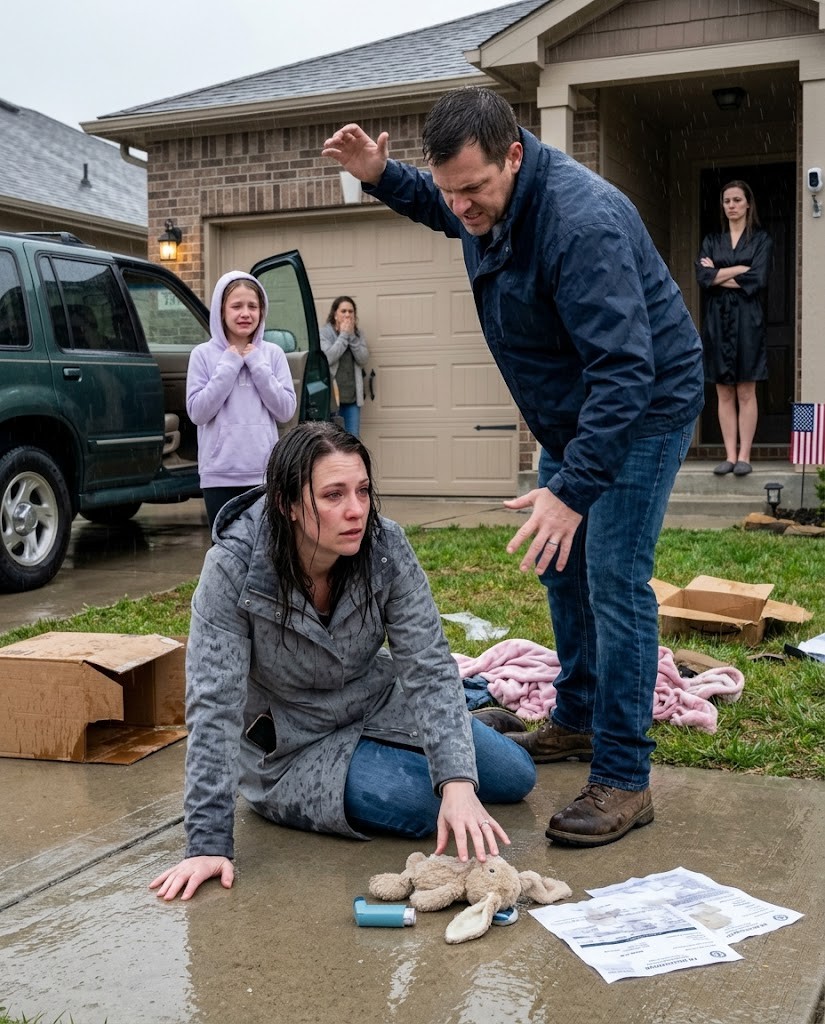
An hour later, she pulled into her parents’ driveway and saw the boxes.
At first, her mind refused to understand them.
The porch light was on.
The rain was falling.
Their things were on the lawn.
Ava’s plastic storage bins.
Rachel’s laundry basket.
A trash bag with shoes spilling out.
Her laptop.
The pink blanket from the ER, already thrown onto the wet grass like it was nothing.
Rachel got out of the SUV slowly, the discharge papers still in her hand.
Ava unbuckled herself before Rachel could stop her.
“Mommy?” she said.
Rachel heard the front door open.
Her mother stepped onto the porch in a silk robe, hair pinned back, face tight with satisfaction.
Her father stood behind her in the doorway.
The small American flag beside the front door snapped in the rain.
Rachel remembered buying that flag the previous Fourth of July because Ava wanted “a porch flag like the neighbors.”
Now it fluttered above their dumped belongings.
“Pay rent or get out!” her mother screamed.
Rachel blinked rain out of her eyes.
“What?”
“Two thousand dollars. Tonight.”
Her mother’s voice carried across the yard.
“Cash, transfer, I don’t care. You’ve lived here for free long enough.”
Rachel looked at the boxes, then at the woman who had once held her hand during her divorce hearing.
“For free?” Rachel said.
Her father came down the porch steps.
“Don’t start.”
“I paid your mortgage for eight months.”
“Watch your mouth,” he snapped.
Ava moved closer to Rachel’s side.
The rain had plastered the little girl’s hair to her cheeks.
“Grandma,” Ava whispered, “my bunny is wet.”
Her mother did not look at her.
That small refusal did something to Rachel.
Not the boxes.
Not the money.
Not even the screaming.
The fact that her mother could hear a child fresh from the ER and still choose the performance over the child.
Rachel bent to pick up the bunny.
Her father moved before she saw him coming.
The slap cracked across the rain.
Rachel’s head snapped sideways.
Her body went down hard on the driveway.
The discharge papers flew from her hand and slid through a puddle.
For one bright second, all she could taste was blood and wet concrete.
Ava screamed.
“Grandpa, stop!”
Rachel pressed one palm to the ground and tried to push herself up.
Her lip throbbed.
The rain ran down her face so cold it made the blood feel hot.
Her father stood above her, breathing hard.
“Maybe now you’ll obey.”
There are moments when anger arrives like fire.
This did not.
This arrived like a door closing.
Rachel went completely still.
Her mother mistook it for weakness.
She always had.
“You have one hour,” her mother said from the porch.
Rachel looked at her.
“Otherwise?”
“Otherwise I’ll call the police and tell them you attacked your father.”
Ava sobbed behind her.
Rachel’s fingers curled against the driveway.
For one ugly heartbeat, she imagined standing up, grabbing the nearest box, and throwing it through the front window.
She imagined the glass breaking.
She imagined her mother finally looking afraid.
Then Ava made a small choking sound.
Rachel let the thought go.
A child remembers what rage looks like.
Rachel refused to give hers another version of it.
She wiped her mouth.
“You’d lie to the police?”
Her mother laughed.
“Who do you think they’ll believe? A divorced single mother with nowhere to go? Or us?”
Rachel looked past her mother’s shoulder.
Mounted beside the porch light was the security camera Rachel had installed six months earlier after her father accused neighborhood teenagers of stealing tools from his garage.
Her father had complained about the cost until Rachel paid for it herself.
He had complained about the app until Rachel connected it to her phone.
He had never learned how cloud storage worked.
Rachel’s hand slipped into her coat pocket.
Her phone was still recording audio.
It had been recording since her mother’s first scream.
“What are you staring at?” her father demanded.
“Nothing,” Rachel said.
She picked up Ava’s stuffed bunny and squeezed water from its ears.
Then she guided Ava back to the SUV.
Ava’s hands shook so badly Rachel had to buckle her in twice.
Her mother shouted from the porch.
“Run away again! That’s all you ever do!”
Rachel closed Ava’s door gently.
Then she turned around.
“No,” she said.
Her voice sounded strange even to her.
Calm.
Clear.
“This time, I’m done running.”
They drove thirty miles to a roadside motel near the highway.
The room smelled like bleach, old smoke, and damp carpet.
The heater rattled under the window.
A soda machine hummed outside the door.
Ava curled on the bed in her hospital bracelet, clutching Rachel’s sleeve with one hand and the damp bunny with the other.
“Are we in trouble?” Ava asked.
Rachel sat beside her and touched her hair.
“No, baby.”
“Grandpa hit you.”
“I know.”
“Is he going to come here?”
“No.”
Rachel said it before she knew how she would make it true.
Then she made it true.
After Ava fell asleep, Rachel opened her laptop on the tiny motel desk.
The desk rocked every time she typed.
At 12:18 a.m., she uploaded three videos to secure cloud storage.
The driveway footage from the porch camera.
The audio from her phone.
The clip showing her mother demanding $2,000 while Ava cried in the rain.
At 12:47 a.m., Rachel downloaded eight months of bank records.
Mortgage payments.
Utility bills.
Grocery receipts.
Home repair invoices.
The property tax confirmation.
At 1:09 a.m., she saved Ava’s ER discharge papers as a scanned PDF using her phone.
At 1:26 a.m., she made a folder with everything labeled by date.
Not emotional names.
Not revenge names.
Dates.
Because emotions could be dismissed.
Documents could be filed.
At 2:06 a.m., she emailed the folder to Daniel.
Daniel had been her attorney during the divorce.
He had seen Rachel at one of the lowest points of her life and had never once spoken to her like she was broken.
He had walked her through custody paperwork, property division, and the long humiliation of proving she was competent while exhausted.
After the divorce, he stayed a family friend in the careful way decent professionals sometimes do.
Christmas cards.
Ava’s birthday gift once.
A recommendation for a pediatric specialist when Ava’s asthma got worse.
He was not dramatic.
That was why his silence on the phone before sunrise scared her more than yelling would have.
“Rachel?” he said when he called at 6:41 a.m.
“Daniel.”
“Is Ava okay?”
“She is now.”
He breathed once.
“Good. I reviewed what you sent.”
Rachel looked at Ava sleeping under the motel blanket.
“And?”
“Your parents are idiots.”
“That your professional legal opinion?”
“No,” he said.
“That is my emotional opinion. My professional opinion is much worse for them.”
Rachel closed her eyes.
For the first time since the slap, her hands stopped shaking.
“What happens now?”
“We start with a police report,” Daniel said.
“We document the assault. We document the threat to make a false report. We document the housing situation, the financial contributions, and the child witness. You do not go back there alone. You do not negotiate. You do not warn them.”
Rachel swallowed.
“They’ll say I’m unstable.”
“They already said that.”
“They’ll say I’m lying.”
“They said it on camera.”
That landed differently.
Rachel looked at the motel curtains, thin and yellowed, glowing with early morning light.
For three years, her parents had built a story around her.
Poor Rachel.
Difficult Rachel.
Unstable Rachel.
Rachel, who needed help.
Rachel, who should be grateful.
They had made pity into a cage.
Daniel was quiet for a second.
“Did they keep any of Ava’s medication?”
Rachel stood so fast the chair scraped the carpet.
She checked the medical bag.
The spacer was there.
The backup inhaler was not.
Her stomach dropped.
Then her phone buzzed.
A text from her mother.
One photo.
Ava’s inhaler sat on the porch railing in the rain.
Below it, her mother had written, Maybe this will teach you to be grateful.
Rachel did not speak.
She forwarded the message to Daniel.
On the phone, he went completely silent.
Not confused.
Not surprised.
Cold.
“That,” he said, “was the mistake.”
Ava stirred behind Rachel.
“Mommy?”
Rachel turned.
Her daughter was sitting up, eyes swollen, hair tangled, staring at the phone like children stare at smoke before they understand fire.
“Did Grandma take my medicine?” Ava asked.
Rachel crossed the room and sat beside her.
“Not anymore.”
She said it softly.
Then another notification came through.
It was from the security camera app.
Motion detected.
Rachel opened the thumbnail.
Her father was standing on the porch in the rain with a black trash bag in one hand.
Her mother pointed toward Ava’s medical bag.
Boxes were being moved.
Not stored.
Thrown away.
Rachel sent that clip, too.
Daniel watched it while still on the call.
“Rachel,” he said, “before I make the next call, I need you to understand what this means.”
“What does it mean?”
“It means this stopped being a family argument the second they put a child’s medication in the rain and documented themselves doing it.”
By 8:15 a.m., Daniel had given her a list.
Call the local police non-emergency line and request an officer meet her at the motel.
Do not return to the house without law enforcement present.
Preserve the original videos.
Do not delete texts.
Do not answer calls.
Screenshot everything.
Rachel followed every instruction.
At 8:43 a.m., an officer knocked on the motel door.
Ava hid behind Rachel’s leg.
The officer lowered his voice when he saw her.
Rachel gave the statement in the motel room while Ava colored on the notepad Daniel had once given her with his firm logo on the top.
She showed the ER papers.
She showed the video.
She showed the text with the inhaler.
The officer’s face changed while watching the porch footage.
People often tell themselves they will know what justice looks like when it arrives.
Mostly, it looks like someone finally writing down what happened without asking you to soften it.
The report was filed before lunch.
Daniel met Rachel outside the house that afternoon with the officer present.
Rachel did not go there to argue.
She went to retrieve what belonged to her child.
Her parents had expected her alone.
That much was obvious the second her mother opened the door and saw Daniel standing on the walkway with a folder in his hand.
Her mother’s face rearranged itself.
The outrage turned into concern so quickly it would have been impressive if Rachel had not been so tired.
“Rachel,” her mother said, “you didn’t have to make this ugly.”
Rachel looked past her at the hallway.
The house smelled like coffee and lemon cleaner.
Normal smells.
That almost made it worse.
Her father appeared behind her mother.
He saw Daniel.
Then he saw the officer.
His mouth tightened.
“What is this?” he demanded.
Daniel opened the folder.
“This is a documented request for immediate access to Rachel’s and Ava’s personal property, including medical items, financial records, electronics, clothing, and documents.”
Her mother laughed once.
“You’re kidding.”
Daniel did not smile.
“I am not.”
The officer stepped forward.
“Let’s keep this calm.”
Her father pointed at Rachel.
“She hit me first.”
Rachel said nothing.
Daniel looked at him with the same expression he had once worn when Rachel’s ex-husband tried to lie about a bank account.
Then Daniel lifted his phone and played the audio.
Rachel heard it again.
Her mother’s voice demanding $2,000.
Ava crying.
Her father’s slap.
The line that followed.
Maybe now you’ll obey.
The front hallway froze.
Her mother’s hand dropped from the doorframe.
Her father stopped breathing through his mouth.
The officer looked from the phone to Rachel’s father.
“Sir,” he said, “you told me she hit you first.”
Rachel’s father did not answer.
Silence had always been their weapon.
For once, it turned on them.
Rachel went inside with the officer watching.
She packed Ava’s clothes first.
Then the inhaler from the porch, now sealed in a plastic evidence bag.
Then the school folder.
Then the stuffed bunny’s backup from the closet.
Then her laptop charger, tax papers, birth certificate, Social Security card, and the folder labeled House Help.
Her mother followed at a distance, crying now.
Not the beautiful crying from property tax morning.
This was panicked and uneven.
“You’re destroying this family,” she said.
Rachel zipped Ava’s backpack.
“No,” she said.
“I’m leaving the part that tried to destroy mine.”
Her father made one more mistake before Rachel walked out.
He muttered, “After everything we did for you.”
Rachel turned around.
The hallway felt smaller than it ever had.
“You gave me a room,” she said.
“I gave you eight months of mortgage payments, utilities, groceries, property taxes, repairs, childcare, silence, and the benefit of the doubt. You spent all of it.”
Her mother covered her mouth.
The officer looked down at his notepad.
Daniel did not interrupt.
Outside, Ava waited in the SUV, wrapped in the pink blanket Rachel had dried at the motel with a hair dryer that barely worked.
When Rachel got in, Ava looked at the house.
“Are we going back?”
Rachel started the engine.
“No.”
“For visits?”
Rachel looked at her daughter.
That question hurt more than the slap.
“Not until it’s safe.”
Ava nodded like children do when they are trying too hard to be grown.
The weeks that followed were not cinematic.
There was no perfect speech on a courthouse step.
There was paperwork.
A temporary protective order.
A police report.
A civil demand letter.
A housing assistance intake appointment.
A school office meeting to update Ava’s emergency contacts.
A pediatric follow-up visit where Rachel had to explain why Ava had been waking up crying.
There were bank calls, password changes, and boxes stacked in Daniel’s sister’s guest room for ten days until Rachel found a small apartment near Ava’s school.
The apartment had beige walls, old carpet, and a kitchen drawer that stuck.
Ava loved it immediately.
“Only us?” she asked the first night.
“Only us,” Rachel said.
They ate grilled cheese on paper plates because Rachel had not unpacked the dishes yet.
Ava put the stuffed bunny in the window and said he was watching the parking lot.
Rachel laughed for the first time in days.
Then she cried in the bathroom with the faucet running so Ava would not hear.
Healing did not arrive as a grand moment.
It arrived in small permissions.
Ava leaving her shoes by the door without flinching.
Rachel buying groceries without checking whether her mother would complain about the brand.
The two of them sleeping through a full night.
The school pickup line becoming ordinary again.
The first time Ava asked if they could put a little flag sticker on their mailbox because “this is our home now.”
Rachel said yes.
The financial part took longer.
Daniel helped her file a civil claim for documented payments that had been represented as temporary household contributions but used as leverage after she was threatened and removed.
Not every dollar came back.
Some damage never returns in the same shape it was taken.
But enough came back for the security deposit, a real bed for Ava, and a used dining table where nobody yelled over dinner.
Her father faced consequences for the assault.
Her mother tried to deny the text about the inhaler until Daniel produced the screenshot, the metadata, and the porch camera clip.
After that, she changed tactics.
She said she had been overwhelmed.
She said she had not meant it.
She said families say things.
Rachel’s attorney answered with dates, documents, and video.
Receipts do not get sentimental.
Months later, Rachel saw her mother at the grocery store.
Ava was not with her.
Rachel was holding a paper coffee cup in one hand and a bag of apples in the other when her mother appeared at the end of the aisle.
For a second, neither of them moved.
Her mother looked smaller without the porch around her.
“I miss Ava,” she said.
Rachel felt the old reflex rise.
Comfort her.
Explain herself.
Make the scene easier for everyone else.
She did not.
“Ava misses who she thought you were,” Rachel said.
Her mother’s eyes filled.
Rachel let them.
Then she walked past her and paid for the apples.
That night, Ava asked why people can be nice sometimes and mean other times.
Rachel thought about lying.
Then she chose the truth a child could hold.
“Sometimes people love control more than they love people,” she said.
Ava was quiet.
“Do we love control?”
Rachel kissed her forehead.
“No. We love peace.”
The slap did not ruin Rachel.
The divorce had not ruined her either.
That was what her parents never understood.
The divorce had trained her.
It taught her how to document.
It taught her how to recognize a threat wearing a family face.
It taught her that being tired was not the same as being weak.
Most of all, it taught her that silence can be survival for a while, but eventually, survival needs a voice.
Rachel found hers on a wet driveway with blood in her mouth, her daughter crying behind her, and the camera her father had demanded she install recording everything.
Her parents thought that would break her.
Instead, it became the first piece of evidence.
And evidence, unlike fear, knows exactly where to go.