Advertisement

At 104 degrees, my baby was burning up, but the doctor looked at me and said, “New mothers often panic over nothing.”

PART 1

Advertisement

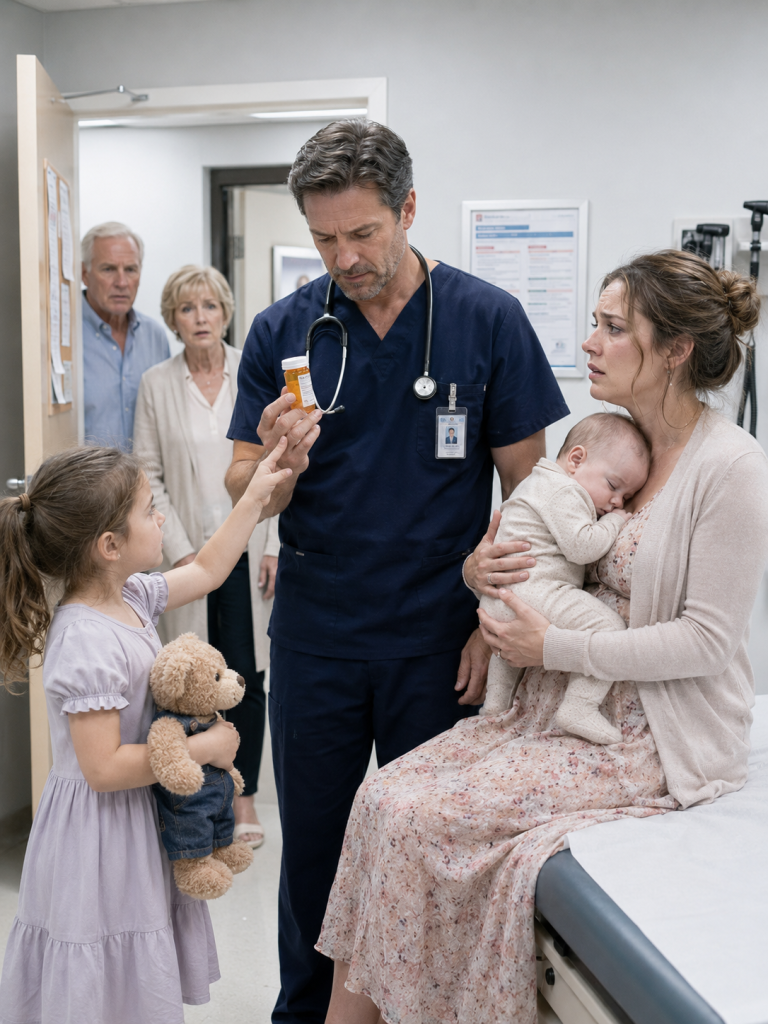
At 104 degrees, my baby was burning up, but the doctor looked at me and said, “New mothers often panic over nothing.” My mother-in-law gave that satisfied little smirk, and my husband said, “She’s always overly anxious.” I said nothing and kept rocking my son. Then my seven-year-old daughter lifted her teddy bear and asked, “Dr. Hensley, should I tell you what Grandma gave the baby instead of his real medicine?”

Advertisement

Dr. Hensley slowly lowered his stethoscope as his eyes moved from my daughter to the amber prescription bottle tucked beneath the teddy bear’s tiny denim overalls.

“Tell me exactly what you saw,” he said.

My daughter hugged the bear against her school jacket, her fingers trembling while her voice stayed clear.

“Grandma poured the baby’s medicine down the sink,” she whispered. “Then she put the purple sleepy medicine in his syringe.”

My mother-in-law leaned forward with a frown. “She’s seven, so she gets confused very easily.”

“I’m not confused,” my daughter said, looking right at her. “I took his real medicine out of the trash because his name was on it.”

Dr. Hensley held out his hand, and she carefully passed him the bottle. The pharmacy label was still intact, showing that the liquid inside sat almost at the original fill line even though my son had supposedly been receiving it for several days.

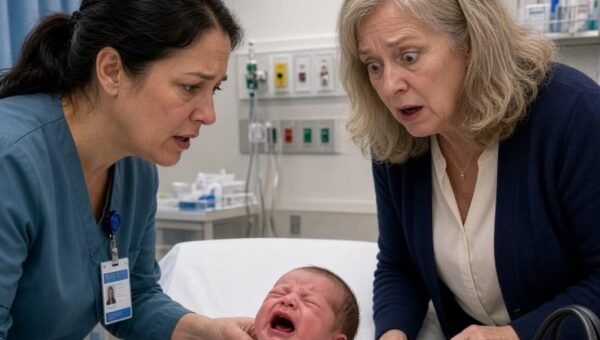
The paper beneath my baby crinkled as he shifted against my chest. His skin felt frighteningly hot through his thin cotton sleeper, and his cry had weakened into a rough little whimper.

Dr. Hensley pressed the call button on the wall.

“We need to move this family into a treatment room immediately,” he told the nurse who walked in. “Place this bottle in a medication bag, and bring someone to review everything this baby might have been given.”

My husband stepped closer to the exam table. “This is getting ridiculous because my mom raised three children without any problems.”

Dr. Hensley did not argue with him and looked at my daughter instead.

“Did you see which purple bottle Grandma used?” he asked softly.

She nodded quickly. “The one she keeps by her bed that says nighttime on the front.”

My stomach tightened into a hard knot.

My mother-in-law insisted she had only been trying to settle the baby because I refused to let anyone help. My husband backed her up, repeating that I had barely slept and was imagining danger everywhere.

For months, every concern I raised had been turned into evidence against me. If I checked the baby’s breathing, I was dramatic, and if I asked someone to wash their hands, I was controlling. If I called the pediatrician, I was wasting money.

But the nearly full prescription bottle was sitting in Dr. Hensley’s hand.

I stopped defending myself right then.

“Please write down exactly what my daughter said,” I told the doctor. “And I don’t want either of them answering questions for me.”

My husband stared at me in disbelief. “I’m his father.”

“Then answer one question,” I said. “Did you know your mother was replacing his medicine?”

He looked toward the door instead of looking at our son.

My mother-in-law crossed her arms defensively. “We did what was necessary because you were making that baby nervous, and children can feel panic.”

The nurse returned with a clear medication bag. Dr. Hensley placed the prescription bottle inside, sealed it tight, and wrote the exact time on the label.

Then he asked my daughter when she had first seen the medicine switched.

She looked down at the teddy bear’s brown fur.

“The first night Grandma stayed over,” she said.

My husband shook his head aggressively. “She dreamed that whole thing.”

“No, I didn’t,” my daughter replied firmly. “I came downstairs because the baby was crying, Grandma was holding the syringe, and Daddy told me to go back to bed.”

I could hear my own heartbeat pounding in my ears as I asked, “Did it happen more than once?”

My daughter counted silently against the bear’s paw.

“Three nights,” she said. “Grandma did it every night after you fell asleep.”

My mother-in-law started saying that children had wild imaginations, but my daughter lifted her face and looked directly at her father.

“Daddy held the baby while she did it,” she stated.

PART 2

My husband opened his mouth to make an excuse, but Dr. Hensley raised one hand before he could speak a single word.

“I need everyone to stop right now,” the doctor said. “The baby’s condition comes first, and the child who witnessed this will not be argued with in my treatment room.”

The nurse guided my daughter beside me while another staff member began preparing the room for an emergency examination. My son’s weak whimper scraped against every instinct in my body, making me hold him close enough to feel each shallow breath while Dr. Hensley asked my husband one question.

“Were you present when a nighttime medication was placed in your infant son’s syringe?” Dr. Hensley asked.

My husband stared at the sealed prescription bottle on the counter before turning his gaze to his mother.

She answered for him before he could speak. “We were helping because his wife was exhausted and making everyone miserable.”

“I didn’t ask you,” Dr. Hensley said without looking at her.

My daughter pressed the teddy bear against my arm for comfort. My husband’s face tightened as if he were searching for an answer that would make him look less responsible.

“I was there,” he finally said in a low voice. “But my mother told me she knew what she was doing.”

My mother-in-law turned sharply toward him. “Don’t put this on me when we decided together!”

That was the first time either of them had admitted any part of what had been happening behind my back.

I looked at my husband and realized he was not frightened because our baby had been given the wrong medicine. He was frightened because someone outside our family had heard the truth.

“Why?” I asked, holding my crying son tighter. “Why would you let her do that to him?”

He rubbed both hands over his face repeatedly. When he lowered them, he still would not look at our son.

“Because she said it would make him sleep long enough for you to finally calm down,” he admitted quietly.

PART 3

The silence that fell over the examination room was colder than the air coming through the vents above us. My husband’s words hung between us, heavy and sickening, revealing that they hadn’t just been trying to quiet a fussing infant. They had been drugging my son to manufacture proof that I was losing my mind, prioritizing their own need to control me over the fragile life of a sick child.

Dr. Hensley didn’t waste another second on them. His face was set like concrete as he turned to the charge nurse standing in the doorway.

“Call 911 immediately,” he commanded in a voice that was absolute. “I need an ambulance routed for an emergency transfer to the Pediatric Intensive Care Unit at St. Jude Children’s Hospital, and report a case of intentional acute pediatric toxic exposure with severe hyperpyrexia.”

He paused to point at the sealed plastic bag on the table.

“Inform dispatch to contact hospital security and local law enforcement because we have active child endangerment and medical sabotage on-site,” he added.

My mother-in-law gasped loudly, her manicured hand flying to her chest. “Sabotage? How dare you when I am his grandmother who raised three successful adults, so I will not be spoken to like a criminal by a clinic doctor!”

“You will be quiet, or I will have security remove you from this building right now,” Dr. Hensley snapped, stepping directly between her and the examination table where my baby lay. “You gave an adult-strength sedating antihistamine to an infant with a 104-degree fever, and you withheld critical antibiotics for a systemic infection when every breath this child is taking right now is a fight.”

My husband panicked, his voice rising to an octave I had never heard before. “Wait, Dr. Hensley, please don’t call the police over a family misunderstanding because my mother was just using an old remedy that we can handle at home!”

“Get back,” I said, stepping away from him.

My voice wasn’t loud, but it cut through the room like a sharp blade. I had spent months whispering, doubting myself, and believing that maybe I was just an anxious new mother. But looking at my daughter standing bravely beside me with her teddy bear while feeling the terrifying heat coming off my son’s body made the fog vanish entirely.

“Don’t touch him,” I said as my husband tried to reach for the baby. “Don’t come near either of my children ever again.”

“Wyatt, be reasonable!” he pleaded, his eyes darting toward the hallway where we could hear heavy footsteps approaching. “If you let them call the police, it will destroy my career and ruin my family!”

“You ruined this family the second you held your son down while your mother poisoned him,” I told him cold-heartedly.

Two uniformed security guards stepped into the room quickly. Dr. Hensley gave them a decisive order to keep those two individuals away from me and the children until the police arrived.

Within minutes, the distant wail of sirens pierced the afternoon air, growing louder until flashing red and blue lights swept across the clinic windows. Paramedics rushed through the doors with a pediatric gurney, working with rapid precision to attach monitor leads to my son’s chest while wrapping him in cooling packs.

“Mom, you’re riding up front with us,” the lead paramedic said gently.

I looked back at my daughter with terror at leaving her, but Dr. Hensley stepped in immediately to reassure me.

“She stays with me and our head social worker until the police take her statement,” Dr. Hensley said. “Then she will be escorted directly to you at the hospital because I promise you she is completely safe here.”

My daughter squeezed my hand tightly. “Go with the baby, Mommy, because I saved his real medicine and I’ll keep the bear safe.”

I kissed her forehead as tears broke through my composure. “You are the bravest girl in the world.”

As the paramedics wheeled the stretcher down the hall, I passed my husband and mother-in-law, who were already being confronted by two city police officers pulling out handcuffs while my husband stammered out excuses. I didn’t stop or look back at them for even a second.

The next forty-eight hours were a blur of sterile white corridors, the frantic beep of heart monitors, and the mechanical hiss of IV pumps.

At St. Jude Children’s Hospital, the PICU team worked tirelessly to stabilize my son. The combination of the untreated kidney infection and the toxic buildup of the nighttime sedative had put his tiny organs under immense strain, forcing doctors to push fluids and heavy-duty antibiotics through his veins all night.

I sat in the armchair beside his crib, holding his tiny hand without sleeping at all. My daughter sat next to me wrapped in a warm blanket, coloring in a book brought by a specialist.

Detective Palmer, a sharp-eyed investigator, arrived early the second morning to take a detailed statement from me regarding the months of manipulation I had endured.

“You need to know that your daughter’s testimony was rock solid,” Detective Palmer said as she rested a folder on the table. “Combined with the prescription bottle, the liquid chemical analysis from the lab, and clinic surveillance footage showing your mother-in-law dropping something in the trash, we have an ironclad case.”

“What are they being charged with?” I asked softly.

“Child abuse resulting in serious bodily injury, deliberate poisoning, and medical neglect,” Detective Palmer replied plainly. “Your husband is being charged as an accessory because he admitted on tape that he knew his mother was administering an over-the-counter sedative to suppress the baby’s crying.”

A cold chill ran down my spine as I realized the sheer cruelty of their actions. They had been risking a baby’s life just to validate their narrative that I was mentally unstable.

“The judge signed an emergency temporary restraining order this morning,” the detective added while handing me the legal paper. “Neither your husband nor your mother-in-law is permitted within 1,000 feet of you, his access to joint bank accounts has been frozen, and emergency full legal custody has been granted to you.”

On the third day, the miracle finally happened.

The angry flush of the 104-degree fever broke, leaving my baby’s skin cool to the touch. He opened his big blue eyes and let out a bright, clear cry that signaled he was hungry and strong again.

I pulled him into my arms, weeping tears of pure relief as he drank eagerly. The pediatrician walked in an hour later, checked his vitals, and smiled warmly at us.

“He’s out of the woods because his liver enzymes are stabilizing and the infection is clearing up nicely,” the doctor told me.

Six months later, the summer sun streamed through the windows of the family court building. I adjusted my blazer and looked at my reflection in the glass door, knowing that the exhausted woman who had dragged herself into the clinic half a year ago was completely gone.

Inside the courtroom, my ex-husband sat at the defense table alongside his mother, both wearing orange county jail jumpsuits. Without his tailored suits, my ex-husband looked small and defeated, while his mother’s face was lined with the bitter reality of facing consequences that their money could not fix.

My attorney handed the judge a finalized bundle of documents.

“Your Honor, we are presenting the final agreement for a complete severance of parental rights and a permanent order of protection,” my lawyer stated.

The judge nodded solemnly as he reviewed the paperwork before looking down over his glasses at my ex-husband.

“In my twenty years on the bench, I have rarely seen a more despicable breach of paternal duty,” the judge said sternly. “You allowed your mother to poison your infant son to gaslight your wife, and you are fortunate the child survived or you would be facing a murder charge.”

The judge slammed his gavel down with a sharp crack that echoed through the room.

“Parental rights are permanently terminated, and the decree of divorce is granted,” the judge declared firmly.

As the bailiffs stepped forward to handcuff my ex-husband, he turned toward me with tears streaming down his cheeks.

“Wyatt, please,” he choked out as they pulled him away. “I made a terrible mistake, so please just let me see them once to explain to our daughter!”

I didn’t yell or cry as I held his gaze with total indifference.

“You don’t exist to them anymore,” I said quietly before turning my back on him forever.

That evening, the autumn breeze carried the sweet scent of fallen leaves through the park near our new apartment, which was filled with light, laughter, and complete peace.

I sat on a wooden bench watching my son, who was now a chubby ten-month-old crawling across a blanket to chase a red rubber ball.

Beside him, my daughter was swinging happily on the playground before running over to join us with her worn teddy bear.

“Mommy?” she asked softly as she sat down beside her little brother.

“Yes, sweetheart?” I replied.

“Are we going to be safe now forever?” she asked, looking up at me.

I pulled her close, wrapping my arm around her shoulder to hold both of my children in a warm embrace.

“Yes, my brave girl,” I said, kissing the top of her head gently. “We are completely safe, and no one is ever going to hurt us or make us feel small ever again.”

THE END.

Advertisement
info@teaytech

info@teaytech

2025 articles published