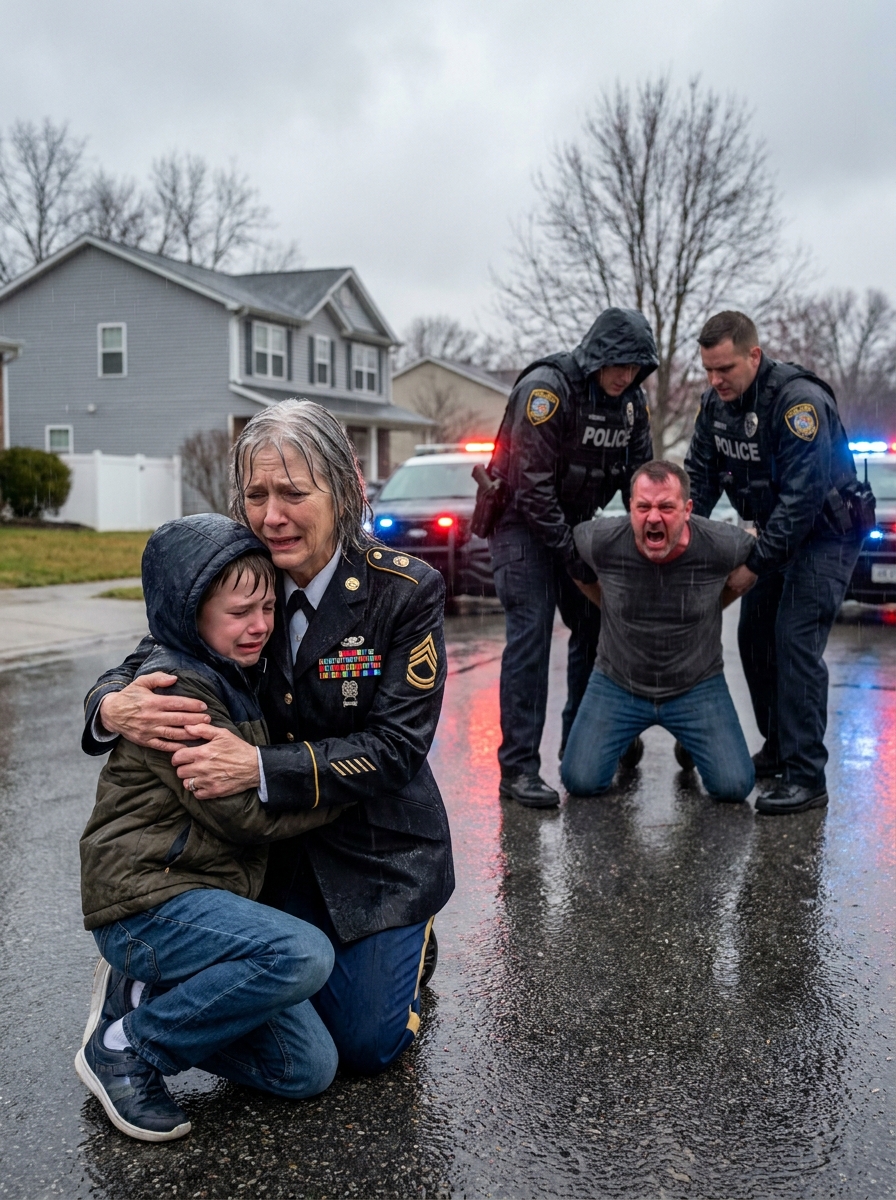
At 3 a.m., my grandson appeared at my door—mud-streaked, trembling, terror in his eyes.
The storm did not arrive with a warning because it simply crashed against the house like a physical blow. The wind howled through the massive pine trees surrounding my isolated cottage and the rain lashed against the windows in sheets of grey violence.
At 3:00 A.M., the world belongs to the ghosts and the guilty. I was awake, of course, because I am always awake at that hour. It is an old habit, a scar left over from a life I buried thirty years ago.
I sat in my armchair, knitting a scarf that was already too long, listening to the rhythm of the thunder. To the outside world, I was Beatrice O’Malley, seventy two years old, a widow, a lover of dahlias, and a woman whose hands shook slightly when she poured tea.
Then came the knocking.
It was not the polite rap of a neighbor but a frantic, desperate pounding that shook the front door in its frame. I did not freeze and I did not gasp.
My hands stopped knitting and the slight tremor that I feigned for the benefit of my doctors vanished instantly. I set the needles down on the side table, next to the picture of my late husband, and stood up.
My movements were fluid, silent, and precise. I walked to the door, checking the peephole.
What I saw made the blood run cold in my veins, though my heart rate remained a steady fifty five beats per minute. It was Leo, my eight year old grandson.
He was soaked to the bone, his pajamas clinging to his shivering frame. He was barefoot, his small feet caked in mud and bleeding from the gravel driveway.
But it was his face that ignited a cold fury deep in my gut. His left eye was swollen shut, a bloom of purple bruising spreading across his cheek.
I threw the bolts and opened the door. The wind tried to tear it from my grasp, but I held it firm.
“Leo,” I said, my voice low.
He collapsed into me. He smelled of rain, pine needles, and terrified sweat. I scooped him up, noticing he felt lighter than he should, and kicked the door shut, locking it instantly.
I carried him to the kitchen, setting him on the counter. I did not ask what happened immediately because panic makes witnesses unreliable.
Instead, I grabbed a towel and began to dry him, checking for other injuries. Ribs intact. No defensive wounds on the arms. Just the face.
“Leo,” I said, catching his chin gently. “Look at me and please just breathe.”
He gasped, his single open eye wide with trauma. “Grandma, Dad he did this.”
“Slow down,” I commanded softly. “Where is your mother?”
Leo began to sob, a sound that tore at my soul. “Dad said she went on vacation and he told me she left while I was sleeping.”
“Okay,” I said, keeping my tone steady. “Why are you here?”
“I woke up and I heard a noise in the basement,” Leo stammered. “I went down and I hid in the closet behind the water heater.”
He stopped, his body convulsing with a fresh wave of terror.
“What did you see, Leo?” I asked.
“I saw Dad,” he whispered. “He had a rug and it was the big Persian one from the hallway. He was rolling it up but Grandma there was a foot sticking out. Mom’s foot and she was inside. She was not moving.”
The kitchen went silent, save for the hum of the refrigerator and the storm outside.
“Are you sure?” I asked, knowing it was the most important question of my life.
“I am sure,” Leo cried. “Then he saw me and he dragged me out and hit me. He said if I told anyone he would put me in the rug too. He locked me in my room, but I climbed out the window.”
My daughter. Penelope. My beautiful, kind, foolish Penelope, who had married a man with a smile like a shark and the ambition of a Caesar.
Lucas Kincaid. The town’s prominent real estate developer. The golden boy. The monster.
I looked at the clock and saw it was 3:15 A.M.
If Leo had climbed out the window, Lucas would know by now. He would be coming.
I turned away from Leo for a second and looked at my reflection in the dark kitchen window. The frail grandmother was gone. In her place stood Colonel Beatrice O’Malley, former Director of Black Operations for the Intelligence Division.
“Drink this,” I said, sliding a glass of water to Leo.
I walked to the bookshelf in the living room. I pulled out a heavy volume. It was hollow. Inside sat a secure satellite phone and a pistol with a full magazine.
I checked the chamber. The metallic sound was the noise of my old life waking up.
The landline rang. I did not flinch. I picked it up.
“Hello?” I answered.
“Open the door, Beatrice,” Lucas said.
His voice was calm, smooth, the voice he used to charm business partners.
“Lucas,” I said. “It is late.”
“I know my son is there,” Lucas said. “I tracked his smartwatch. Open the door, Beatrice. The boy is confused and having night terrors. He needs his father.”
“He has bruises, Lucas,” I said.
There was a pause on the line. The charm evaporated, replaced by a cold, metallic menace.
“He fell,” Lucas said. “He is a clumsy kid. Now, open the door, you old hag. Or I will kick it down, drag him out, and then I will deal with you.”
“Deal with me?” I asked.
“I will bury you, Beatrice,” Lucas hissed. “I am the law in this town. You are just a senile relic. Disappear, or I will make you disappear.”
I looked at the gun in my hand. I looked at Leo, shivering on the counter.
“Lucas,” I said, my voice devoid of any grandma’s wobble. “You have no idea what you just started.”
I hung up.
I moved with efficiency. Emotions were a luxury I could not afford. Panic gets you killed; protocol keeps you alive.
“Leo,” I said, returning to the kitchen. “I need you to be brave. Can you do that for me?”
He nodded, though his lip trembled.
“Good. Come with me.”
I led him to the pantry. To the naked eye, it was a closet full of canned food. I reached under the second shelf and pressed a hidden latch. The back wall swung open silently, revealing a small, steel reinforced room.
“It is a secret fort,” I told him. “There are blankets and snacks. You go in, you lock the door from the inside, and you do not open it for anyone but me. Not even for the police. Do you understand? Only Grandma.”
“Is Dad coming in?” Leo asked.
“He is going to try,” I said. “Go.”
I closed the false wall. I heard the lock click. He was safe. For now.
I went to the living room window and peered through the blinds. A black SUV was idling at the bottom of my driveway. The headlights cut through the rain. Lucas was standing by the gate, but he was not alone. There were two other cars. Police cruisers.
Of course. Lucas Kincaid did not do his own dirty work if he could help it. He brought his lapdogs.
The intercom by the door buzzed.
“Beatrice,” Lucas’s voice crackled through the speaker. “I see you are awake. I have Sheriff Hammond here. We have a warrant for the removal of a minor. Open up.”
Sheriff Hammond. A man who had been fixing Lucas’s parking tickets for a decade. A man who owed his position to Lucas’s political machine.
I pressed the talk button. “A warrant? At 3:30 in the morning? That was fast, Sheriff.”