
At my father’s retirement BBQ, he held up the $10,000 Rolex I bought him and said, “You’re still my disappointment.

He thought he was humiliating the daughter who had kept his life running for years. He didn’t know there was a sealed bank folder in my purse that could remove every dollar of access tied to my name.
For three seconds, the backyard applauded.
Then my father, Frank Reed, examined the black-faced Rolex, looked directly at me, and smirked.
“You heard me, Allison. A fancy watch doesn’t change what you are.”
The burgers hissed on the grill. Music played beside the patio. Nearly forty relatives, neighbors, and retired police officers suddenly became fascinated by their paper plates.
My younger brother, Jason, laughed first. He always did.
Jason had wrecked two cars, quit four jobs, borrowed money he never repaid, and recently announced that he was opening a sports bar despite having no savings and no business plan.
Dad still called him “a good kid who needs support.”
I had earned scholarships, built a career as a financial analyst in Boston, bought my own condo, paid off Dad’s truck, covered Mom’s medical bills, and handled their property taxes for three years.
I was still the disappointment because I wasn’t married, didn’t have children, and had learned to say no.
Mom touched Dad’s arm. “Frank, not today.”
It wasn’t a defense. It was a request for him to be cruel more quietly.
Dad slipped the Rolex toward his wrist.
I reached across the table, removed the box from his hand, and snapped it shut.
Mom’s face changed instantly. “Allison, don’t you dare.”
“Don’t I dare what?”
“That is your father’s retirement gift.”
“No,” I said. “It was.”
Dad’s smile disappeared. “You can’t take back something you gave me.”
“I hadn’t handed it over yet.”
Jason lifted his beer. “There she goes. Making everything about herself.”
I looked at him. “Buy Dad another one.” His eyes dropped to the cooler.
Dad rose from his chair. His retired coworkers watched him turn red beneath the string lights. “You’re humiliating me in my own home.”
“You handled that without my help.”
A few people looked away. My aunt opened her mouth, then closed it. Mom’s brother stared at the ground. No one defended me.
That silence hurt more than Dad’s words. But it also made my decision simple.
I placed the Rolex in my purse beside the sealed folder I had brought in case Dad asked about the family support account.
For seven years, that account had covered emergencies, medical deductibles, home repairs, insurance gaps, Jason’s rent, and every crisis my parents called “temporary.”
The account was funded by me. Owned by me.
Dad and Mom had viewing access. Jason had an emergency card Mom once begged me to approve.
None of them seemed to remember the difference between access and ownership.
Mom followed me toward the gate. “Allison, get back here. Your father deserves respect.”
I stopped. “So do I.”
“He sacrificed his life for this family.”
“And I’ve spent seven years financing it.”
Her eyes flicked toward my purse. That was when I realized she knew exactly what was inside the folder.
“Allison,” she whispered, “don’t do anything emotional.”
I almost laughed. They had mistaken my silence for emotion and their entitlement for logic.
Dad shouted from the patio, “Fine. Keep your damn watch.”
I nodded. “I will.”
Then I drove home, opened my laptop, and removed all three of them from every account, card, payment authorization, and emergency transfer connected to my name.
I canceled the automatic property-tax transfer.
I stopped the monthly deposit that covered Mom’s medical balance.
I revoked Jason’s card.
Then I found something I had not authorized.
A pending request for $78,000.
The note attached to it read: INITIAL FUNDING JASON REED SPORTS BAR.
The request had been submitted Friday afternoon. Before the BBQ.
Dad hadn’t insulted me after receiving an expensive gift. He had insulted me while believing my money was already on its way to his favorite child.
At 8:02 Monday morning, I denied the transfer and called the bank.
At 8:11, Mom called six times.
At 8:19, Jason texted: WHAT DID YOU DO?
At 8:27, Dad left a voicemail threatening to report me for stealing “family money.”
I forwarded the voicemail to my attorney.
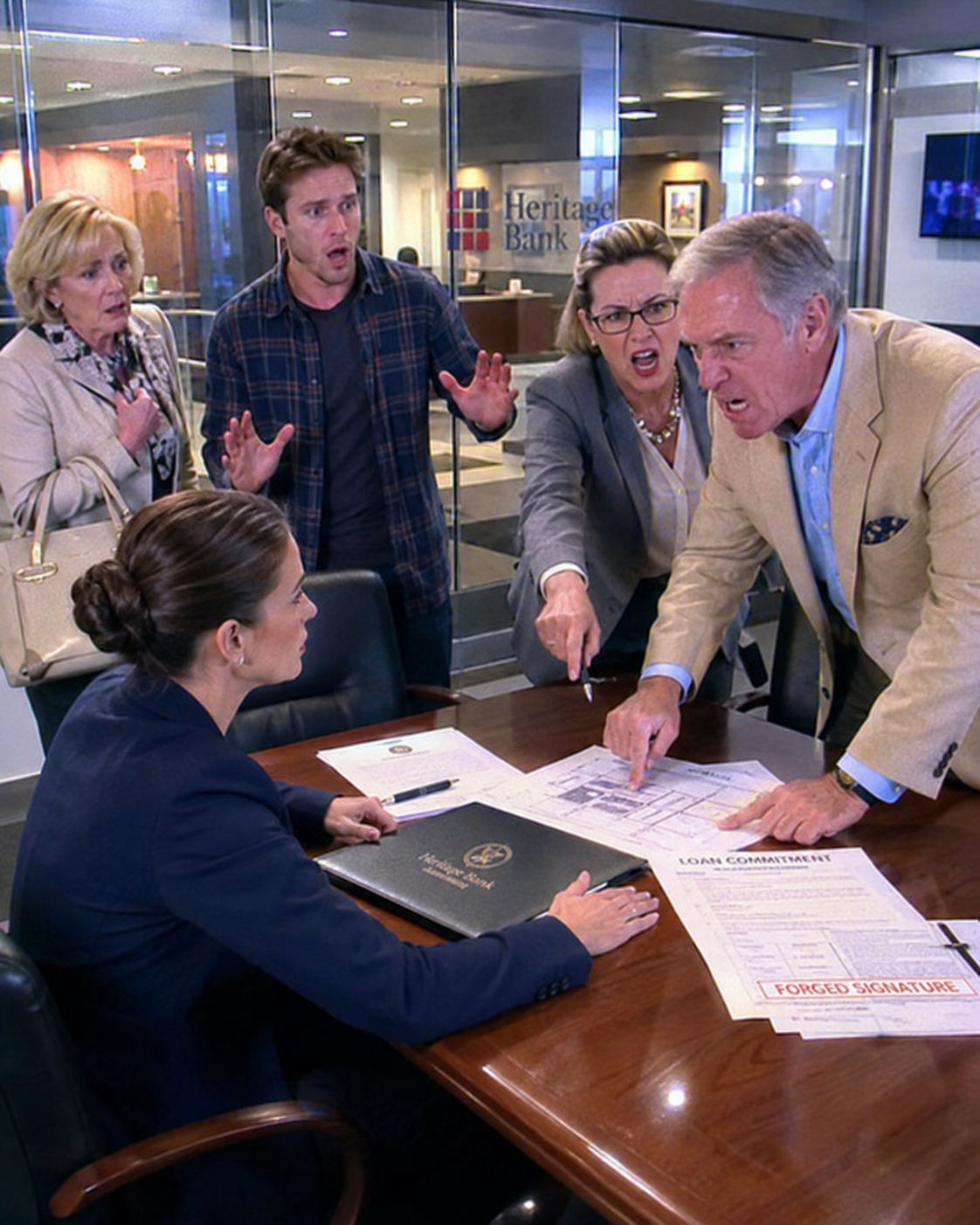
By ten, all four of us were seated inside a glass conference room at the bank.
Dad wore his retirement jacket like a uniform. Jason kept bouncing his knee beneath the table. Mom clutched her handbag with both hands.
I placed the sealed folder in front of me.
Dad pointed at it. “You put everything back the way it was, and maybe we forget this little tantrum.”
I said nothing.
The branch manager entered carrying the withdrawal request. She sat down, studied the signature page, and looked directly at my father.
“Captain Reed,” she said, “the only person who could release this $78,000 was your daughter.”
Dad leaned back.
Then the manager turned the document around and placed one finger beneath a signature written in my name.
“And she is not the person who signed this.”
Jason went completely still.
I opened the folder.
Part 2
The first page inside my folder showed every dollar I had paid for them over seven years. Dad’s truck. Mom’s hospital balance. Property taxes. Jason’s rent. Emergency transfers totaling $186,400.
Dad barely glanced at it. “Family helps family.”
“Family asks,” I said. “It doesn’t forge.”
Jason shoved back his chair. “Nobody forged anything. Mom said you’d approve it.”
Mom whispered his name, but it was too late.
The branch manager pulled a second sheet from her file. “The request was submitted at 3:46 Friday afternoon. Our camera recorded the person completing the owner-authorization line.”
Dad’s face drained of color. Jason looked toward the glass door.
Then the manager pressed a button on the conference-room phone and said, “Please send in the investigator.”
The handle began to turn.
Part 3
The handle turned slowly.
The door opened to reveal a man in a sharp charcoal suit holding a thick manila envelope. He didn’t look like a typical bank employee. He had the cold, methodical posture of a forensic investigator who had spent decades untangling white-collar fraud.
He stepped inside, closed the door quietly, and nodded at the branch manager.
“Mr. Vance,” the manager said, addressing him. “Please brief the room on what your analysis uncovered regarding the unauthorized transaction attempted last Friday afternoon.”
Mr. Vance didn’t sit down. He remained standing near the glass partition, pulling a series of glossy photographs and digital printouts from his envelope. He laid them flat on the polished table, sliding them past Dad and directly into Jason’s line of sight.
“At 3:46 PM on Friday,” Mr. Vance began, his voice flat and devoid of emotion, “our branch security system captured a login terminal session and subsequent physical override attempt. The user utilized administrator privileges tied to a secondary access key.”
Dad straightened his posture, trying to reclaim his retired-captain authority. “My son is a co-holder of an emergency household profile. He has every right to look at account statuses.”
“Viewing status, yes, Captain Reed,” Mr. Vance replied calmly. “Authorizing a commercial disbursement of seventy-eight thousand dollars? Absolutely not. Furthermore, the security camera directly above terminal four recorded more than just a digital login.”
He tapped a finger on one of the glossy photographs.
The image showed Jason standing over a keyboard, leaning in close, his tongue slightly caught between his teeth—the exact expression he wore whenever he was trying to sneak past the consequences of his own carelessness. Another photo captured a close-up of a hand pressing a stylus pad, forging my legal signature with a hurried, shaky slant.
Jason swallowed hard, his throat bobbing visibly.
“That’s a glitch,” Jason blurted out, his voice cracking. “The camera angles are distorted. Anyone could look like that from the side. You can’t prove I touched anything.”
Mr. Vance pulled out a final sheet of paper—a digital forensic log.
“The terminal requires a secondary biometric verification code or a physical authenticator token sent via SMS to the primary owner’s secure device,” Mr. Vance said. He looked directly at Mom. “Or, in rare legacy cases, an override code authorized in person by a secondary account holder who claims an immediate family emergency.”
Mom’s face went from pale to completely translucent.
She dropped her handbag. It hit the floor with a heavy thud, spilling a small pack of tissues and a mint container across the carpet.
“Helen?” Dad turned sharply toward his wife, his brows crashing together in confusion. “What is he talking about? What override code?”
Mom didn’t answer. She couldn’t. Her hands were shaking so violently she had to press them into her lap to keep them still.
I looked across the table at the woman who had raised me, the woman for whom I had paid three years of specialized medical deductibles without missing a single payment.
“You gave him the code, didn’t you, Mom?” I asked. My voice didn’t shake. It was quieter than I intended, but it cut through the sterile air of the conference room like a scalpel.
Mom kept her eyes glued to the table. “He needed a fresh start, Allison. You don’t understand what it’s like for a young man trying to build something of his own. The banks wouldn’t look at him because of his past car loans. We had to do something.”
“You didn’t ‘do something,’” I said, leaning forward. “You committed fraud. You and Jason conspired to steal seventy-eight thousand dollars of my capital to fund a bar that will fail in six months, exactly like his four previous jobs.”
Dad slammed his palm against the glass table. The heavy thud made the water pitcher rattle.
“Watch your tone when you speak to your mother!” Dad bellowed, his face turning that familiar, dangerous shade of purple. “We raised you! We fed you! We put a roof over your head until you were old enough to run off to Boston and forget where you came from! A true family doesn’t drag each other into police stations over pocket change!”
“Pocket change?” I repeated the words slowly, as if tasting something foul.
I picked up the first page of my folder—the itemized list totaling one hundred eighty-six thousand, four hundred dollars. I slid it across the table until it rested right beneath Dad’s folded hands.
“Read it, Dad,” I whispered. “Read every single line.”
Dad looked down, but he refused to touch the paper.
“Truck repairs: four thousand, two hundred,” I read aloud, my voice steady. “Mom’s hip replacement deductible: twelve thousand, five hundred. Property taxes for 2024, 2025, and 2026: thirty-one thousand. Jason’s back-rent in Worcester to keep him from getting evicted: eighteen thousand. And those are just the major items. That isn’t pocket change, Dad. That was my life, my savings, and my twenties, poured into a black hole of your excuses.”
Dad’s jaw tightened. He looked up, his eyes narrowing into cold slits. “You throw numbers in our faces like we’re business clients. We are your blood.”
“Blood doesn’t give you the right to sign my name on a legal document,” I replied.
I turned to the branch manager and Mr. Vance.
“My decision stands,” I said clearly. “The transfer is permanently blocked. Furthermore, I am revoking all legacy access, secondary viewing rights, and emergency profile linkages for Frank Reed, Helen Reed, and Jason Reed, effective immediately.”
Jason leaped out of his chair, knocking it backward onto the floor.
“You can’t do that!” Jason screamed, spittle flying from his lips. “You’re ruining my life! The lease on the commercial space is already signed! The brewing equipment is scheduled for delivery on Wednesday! If I don’t wire that deposit, they’re going to sue me for breach of contract!”
“Then I suggest you start calling bankruptcy lawyers,” I said, standing up from my chair and buttoning my blazer.
I picked up my purse, dropped the sealed folder inside, and looked at my family one last time. There was no anger left in me—only a cold, clean emptiness that felt remarkably like freedom.
Part 4
The drive back to my condo in Boston was the quietest drive of my life.
There were no calls coming through on my phone anymore. I had blocked all three of their numbers before walking out of the bank’s glass doors. Mr. Vance and my attorney had assured me that because I acted immediately and formally documented the forgery with forensic evidence, the bank would handle the internal compliance flags without requiring me to press formal criminal charges against my own mother and brother—though the option remained entirely in my hands if they ever tried to contact me again.
When I unlocked my front door, the silence of my apartment wrapped around me like a warm blanket.
For seven years, I hadn’t realized how much ambient noise I had been living with. Every ring of the phone had meant a crisis. Every weekend visit had meant an inspection of my life choices, followed by a subtle or overt request for financial intervention.
I poured myself a glass of water, walked over to the floor-to-ceiling window overlooking the city skyline, and took a long, deep breath.
For the first time since I graduated college, I didn’t owe anyone an explanation.
By Wednesday afternoon, the fallout began to ripple through the extended family.
My phone—using a secondary, unlisted client number I kept strictly for work—began receiving frantic voicemails from my aunt and my mother’s brother. They had heard distorted versions of the story through the grapevine: that Allison had gone insane, called the cops on her own family over a birthday gift, and thrown her aging parents out onto the street.
I listened to my aunt’s voicemail once, deleted it, and blocked that number too.
People who only benefit from your strength will always panic the moment you decide to set down your burdens. They didn’t care about the forgery. They didn’t care about the betrayal, the stolen signature, or the erosion of trust. They only cared that the endless ATM machine had finally closed its doors.
On Thursday morning, a FedEx package arrived at my office reception desk in downtown Boston.
I signed for it, carried it back to my desk, and used a letter opener to slice through the heavy packing tape. Inside was a single cardboard box containing two items:
First, the black-faced Rolex watch I had intended to give my father at the backyard barbecue.
Second, a handwritten note scrawled on the back of a greasy diner napkin in my father’s unsteady, stubborn handwriting.
Allison,
Your mother hasn’t eaten in two days. Jason is packing his bags to move into a friend’s basement because the commercial landlord locked him out this morning. You’ve made your point. You’ve proven how smart you are, how much money you make, and how little respect you have for the people who raised you.
A family isn’t a ledger. But since you want to treat it like one, consider yourself uninvited from Thanksgiving, Christmas, and any future family gatherings until you learn what it means to be a daughter.
Your mother still loves you, despite everything. I hope you can live with yourself.
— Frank Reed, Captain (Ret.)
I stared at the napkin for a long moment.
There was no apology for the forgery. No acknowledgment that Jason had broken the law. No remorse for the seventy-eight-thousand-dollar theft they had plotted behind my back while eating burgers under the string lights. To them, I was still the villain simply because I had refused to be the victim.
I picked up the Rolex, placed it inside my desk drawer alongside extra paper clips and spare charging cables, and threw the napkin straight into the recycling bin.
Then I opened my calendar, blocked out the upcoming holiday weekend, and booked a solo flight to Montreal for five days of uninterrupted peace.
Part 5
Three months later, autumn in Boston had given way to the biting, sharp chill of early winter.
The trees along the Boston Common were stripped bare, their dark branches cutting like iron against the slate-gray sky. My career as a financial analyst was thriving; I had recently been promoted to senior portfolio director, a position that came with a substantial pay raise and zero obligation to subsidize anyone’s bad decisions.
Life had settled into an extraordinary, uneventful rhythm.
No emergency medical bills. No frantic texts about broken-down trucks or eviction notices. No guilt-tripping voicemails about family loyalty.
One Saturday afternoon, while walking back from a local coffee shop near my condo, I ran into my mother’s brother, Uncle David, near the entrance of a grocery store.
He stopped in his tracks when he saw me. For a second, he looked like he wanted to turn around and pretend he hadn’t noticed me, but the sidewalk was too narrow.
“Allison,” he said, adjusting his wool scarf nervously.
“Hi, Uncle David,” I said, stopping politely. I didn’t smile, but my voice remained calm and neutral. “How are things?”
He cleared his throat, looking older and more tired than he had back in July. The lines around his eyes seemed deeper, etched by the quiet stress of watching my parents struggle without my financial safety net.
“They’re… managing,” David said cautiously. “Your father’s truck finally gave out for good last month. He tried to get a bank loan to replace it, but without your name attached to his credit profile, they turned him down in five minutes. He’s had to take the municipal bus to his veterans’ meetings.”
I nodded slowly. “I’m sorry to hear that. But there are public transit options available for seniors.”
David winced slightly at my lack of warmth. He shifted his grocery bags from one hand to the other.
“And Jason?” I asked, curious despite myself.
“Jason moved out of state,” David murmured, staring down at the slush on the pavement. “Went out to Denver to live with an old high school buddy. Got a job working logistics in a warehouse. The sports bar venture… well, that fell apart completely after the bank flagged the paperwork. The commercial space went to another tenant.”
He paused, looking up at me with a mixture of sadness and lingering judgment.
“Your mother misses you, Allison. She won’t admit it to Frank, but she cries when she looks at old photo albums. She thinks you’ve locked your heart away completely.”
I looked past my uncle, watching the yellow cabs crawl down the busy Boston street through the cold mist of the afternoon.
“I haven’t locked my heart away, Uncle David,” I said softly, meeting his eyes. “I just finally learned how to spend it on myself.”
David didn’t have an answer for that. He gave a small, defeated nod, muttered a quiet goodbye, and walked away into the crowd.
I turned back toward my condo, the cold wind catching the collar of my coat.
I didn’t feel bitter. I didn’t feel angry. As I walked up the stone steps of my building and unlocked the heavy glass door, I realized something wonderful:
For the first time in my life, I was entirely safe, entirely independent, and entirely free.