“Daddy… Do I Have To Say Sorry?” My Five-Year-Old Whispered After Hiding From My Aunt During A Family Birthday Party…

- The Afternoon I Found My Little Girl in the Laundry Room
- The Paper Bag on My Porch
- When Their Story Fell Apart
The Afternoon I Found My Little Girl in the Laundry Room
The backyard of my parents’ house in Boise, Idaho, was full of sunlight, balloons, and laughing children.
It was my niece’s sixth birthday, and from the outside, everything looked perfect. There was a pink cake on the patio table, lemonade in glass pitchers, and a bounce house swaying gently near the fence.
But my five-year-old daughter, Millie, was gone.
At first, I told myself she was just tired. Millie had always been quiet around crowds, especially after her mother, Hannah, passed away two years earlier. She liked small spaces, soft voices, and holding my hand when rooms got too loud.
I checked the kitchen. Then the hallway. Then the guest bedroom.
Finally, I heard a tiny sound from behind the laundry room door.
When I opened it, my heart dropped.
Millie was sitting on the floor between the dryer and a basket of towels, hugging her knees. Her yellow dress was wrinkled, her cheeks were wet, and one side of her face had a dark red mark across it.
She looked up at me and whispered, “Daddy, please don’t be mad.”
I knelt slowly in front of her.
“Sweetheart, I’m not mad at you. I’m here.”
When I reached for her, she flinched.
That single movement broke something inside me.
My little girl had never pulled away from me before.
I forced my voice to stay gentle. “Millie, who scared you?”
She shook her head and pressed her lips together, as if speaking would make everything worse.
Then I noticed the small marks on her arms. Not terrible enough for people to notice from across a room, but clear enough for a father to understand that something was very wrong.
I lifted her carefully into my arms.
Her fingers grabbed my shirt like she was afraid someone would take her away.
As I carried her toward the living room, I remembered Hannah’s last words to me in the hospital.
“Promise me you’ll protect her, Jonah.”
And I had promised.
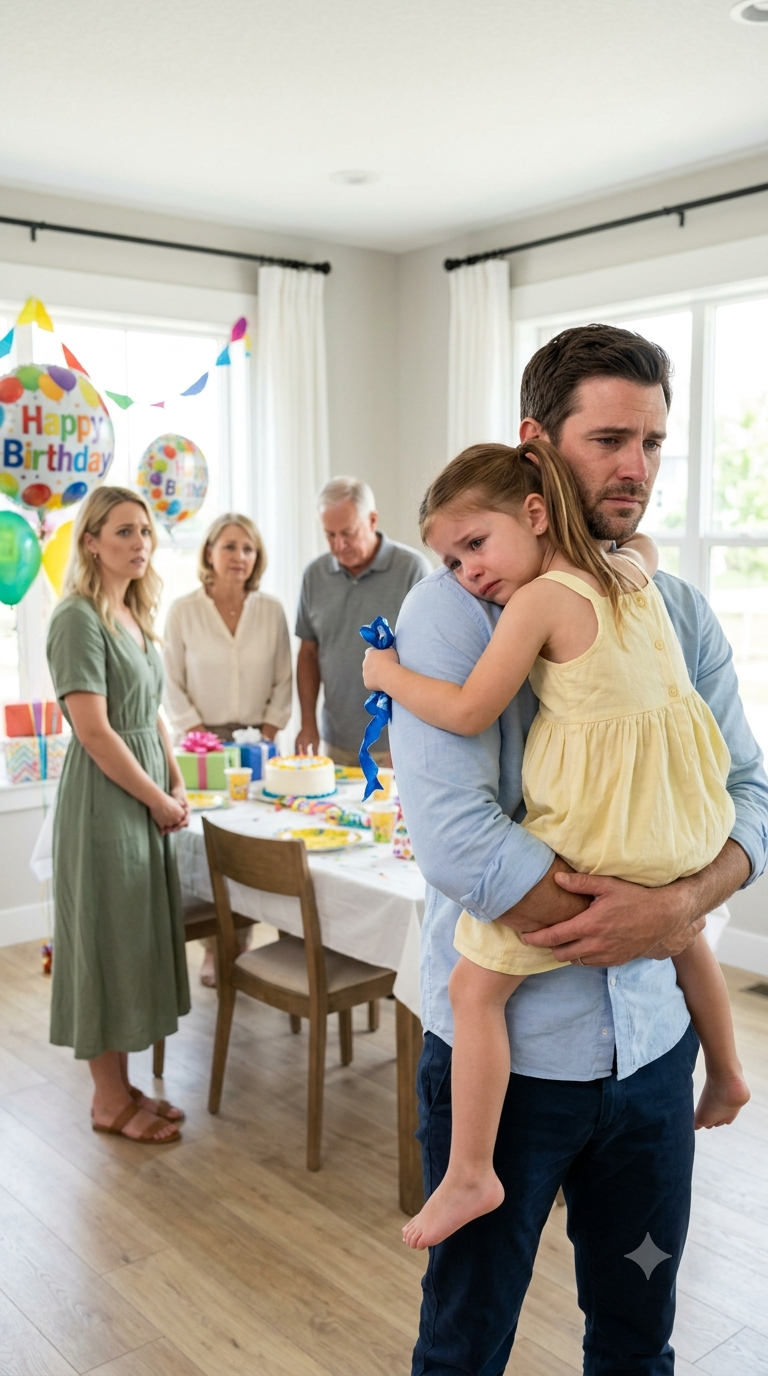
I walked into the party with Millie in my arms.
The laughter faded almost instantly.
My sister, Kendra, was standing beside the gift table with a plastic cup in her hand. My parents, Marlene and Howard, were near the sliding glass door. Everyone stared at Millie’s face.
I looked at my family and asked one question.
“Who did this to my daughter?”
No one answered.
Then Kendra sighed, as if I had interrupted her perfect afternoon.
“Jonah, don’t start. She was being dramatic.”
I looked at her.
“What did you do?”
Kendra rolled her eyes. “She knocked over Ava’s birthday cupcakes and started crying like the world was ending. I only grabbed her arm and told her to stop acting spoiled.”
Millie buried her face in my neck.
My mother stepped forward quickly.
“This is not the place for this conversation.”
I almost laughed.
Not because anything was funny, but because I finally understood the shape of my family’s loyalty.
My daughter was trembling in my arms, and my mother was worried about the guests.
My father lowered his voice. “Jonah, calm down. Children fall. Children cry. Don’t turn a birthday party into a courtroom.”
Kendra crossed her arms. “You let Millie get away with everything because you feel guilty about Hannah.”
The room went silent.
That was the moment I stopped hoping for an apology.
I looked at my parents, then at my sister.
“We’re leaving.”
My mother grabbed my sleeve. “Don’t embarrass us in front of everyone.”
I pulled my arm away.
“You already embarrassed yourselves.”
I carried Millie to the car while the birthday balloons danced behind us in the wind.
On the drive to urgent care, Millie whispered, “Do I have to say sorry to Aunt Kendra?”
My hands tightened around the steering wheel.
“No, baby. You never have to apologize for being scared.”
The Paper Bag on My Porch
The nurse at urgent care took one look at Millie and became very quiet.
She asked calm questions. She took notes. She documented everything carefully. A child safety worker came in later and spoke to me in a soft but serious voice.
I told the truth.
My daughter had been fine when we arrived.
I found her hidden in the laundry room.
My sister admitted grabbing her.
My parents told me not to make a scene.
Every word felt heavy, but every word mattered.
That night, I saved everything: the medical papers, the photos, the messages, the exact time we left my parents’ house.
Because by then, I knew my family would not tell the truth unless the truth left them no room to hide.
The next morning, I found a brown paper bag on my porch.
Inside was Millie’s little white cardigan from the party.
Folded inside the cardigan was a handwritten note from my mother.
Jonah, please think carefully before you destroy your sister’s future. Kendra is under stress. Millie is sensitive. Families forgive.
I read the note three times.
Not once did my mother ask how Millie was feeling.
Not once did she say my daughter deserved safety.
Before I could even close the bag, my phone buzzed.
It was Kendra.
You’re making this bigger than it is.
Then another message.
If people ask, just say Millie fell.
Then another.
Mom and Dad agree with me.
I took screenshots.
By noon, my father called.
I answered on speaker while Millie colored at the kitchen table.
“Jonah,” he said, “you need to be reasonable.”
“Reasonable about what?”
He exhaled. “Your sister could lose her job at the daycare if this gets out.”
The pencil in Millie’s hand stopped moving.
I looked at her small face.
She had heard enough.
I walked into the hallway and closed the door behind me.
“Dad, you are more worried about Kendra’s job than your granddaughter.”
He was silent for a moment.
Then he said, “Your mother and I are trying to keep this family together.”
“No,” I said quietly. “You’re trying to keep the truth quiet.”
That evening, the child safety worker called again. I sent her the note, the messages, and the call details.
Two days later, an investigator came to my house.
He sat at my kitchen table, opened a folder, and asked me to tell the story from the beginning.
So I did.
I told him about the party.
The laundry room.
The mark on Millie’s face.
Kendra’s words.
My parents’ silence.
When I finished, he looked at the screenshots and said, “Keep saving everything.”
I nodded.
Because by then, I was done being the son who stayed quiet to keep the peace.
I was only Millie’s father.
And that mattered more.
When Their Story Fell Apart
Kendra changed her story three times.
First, she said Millie had fallen.
Then she said Millie had thrown herself onto the floor.
Then she said she had only “corrected” her because nobody else would.
My parents said they hadn’t seen enough to know what happened.
But the backyard camera near the patio told a different story.
It showed Kendra leading Millie into the house after the cupcakes fell.
It showed Millie walking normally before they disappeared inside.
It showed me entering the house ten minutes later, searching for my daughter.
And it showed me leaving with Millie crying in my arms.
No camera caught what happened inside the laundry room.
But the timeline told enough.
So did Kendra’s messages.
So did my mother’s note.
So did my father’s phone call.
The truth did not arrive all at once.
It arrived piece by piece, until my family’s version had nowhere left to stand.
A few weeks later, Kendra was officially investigated, and her workplace was notified. My parents were not accused of hurting Millie, but their choice to pressure me into silence was documented.
That was enough for me.
My mother cried when I told her she could not see Millie anymore.
“You’re taking our granddaughter away from us?”
I looked at her and said, “No. You handed her away the moment you chose Kendra over her.”
My father stared at the floor.
Kendra shouted from the driveway, “You’ll regret this, Jonah.”
I held Millie’s hand tighter.
“The only thing I regret is trusting you with my child.”
After that day, our home became quiet.
Not empty.
Quiet.
Millie started sleeping better. She stopped asking if she had done something wrong. She began smiling again when I picked her up from preschool.
Some days were still hard.
Sometimes a loud voice made her freeze.
Sometimes she asked if Aunt Kendra was coming.
Every time, I gave her the same answer.
“No, sweetheart. You are safe here.”
Months later, on a cool October evening, Millie climbed into my lap on the porch.
The sky was orange, and the leaves were blowing across the yard.
She rested her head against my chest and asked, “Daddy, did Mommy know you would keep me safe?”
I closed my eyes for a second.
“Yes,” I whispered. “She knew.”
Millie looked up at me.
“Because you promised?”
I kissed her forehead.
“Because I promised. And because you are the most important person in my whole world.”
That night, after she fell asleep, I stood in the hallway outside her room and looked at the framed photo of Hannah holding newborn Millie.
For a long time, I thought losing my wife was the hardest thing I would ever survive.
I was wrong.
The hardest thing was realizing that some people you call family will ask you to protect their image instead of protecting your child.
But I learned something else too.
Family is not proven by last names.
Family is proven by who stands beside the vulnerable when the truth becomes uncomfortable.
And if protecting my daughter meant walking away from every person who shared my blood, then I would walk away without looking back.
Because Hannah asked me to protect Millie.
And I will.
For the rest of my life.
A child’s fear should never be treated as an inconvenience, because the moment adults ignore that fear, they teach the child that silence is safer than truth.
Real family is not the group of people who demand loyalty when they are wrong, but the people who choose honesty even when honesty costs them comfort.
A parent’s first duty is not to keep peace at the table, protect reputations, or avoid uncomfortable conversations, but to make sure their child feels safe in every room they enter.
Some betrayals do not begin with shouting or cruelty; they begin with excuses, soft pressure, and the quiet request to pretend nothing happened.
When a child asks whether they need to apologize for being hurt, every adult in the room should understand that something deeply important has already been broken.
Protecting someone who caused pain does not keep a family together; it only teaches the innocent person that their suffering matters less than someone else’s image.
The truth does not always need anger to survive, because sometimes records, messages, timestamps, and calm courage can speak louder than any argument.
Walking away from people you love can be heartbreaking, but staying close to people who refuse to protect your child can break something even deeper.
A good parent does not need to be perfect; they only need to be present, brave, and willing to stand between their child and anyone who makes them feel unsafe.
The strongest promise a parent can make is not spoken during easy days, but kept during the painful moments when protecting a child means losing everyone else.