
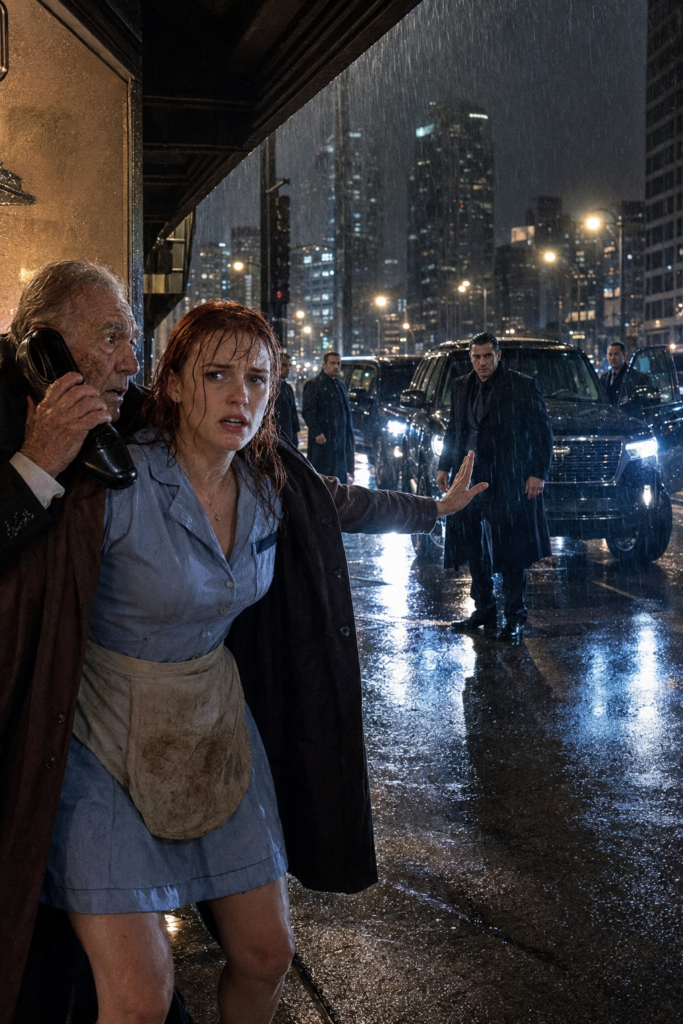
“Get In, I’ll Take You Home” – Poor Waitress Helps an Old Man – Unaware He’s The Mafia Boss’s Father

SHE GAVE HER COAT TO A CONFUSED OLD MAN IN THE RAIN… THEN HIS MAFIA BOSS SON SHOWED UP WITH THREE BLACK SUVS
I was just a broke waitress trying to catch the last bus home.
He was a lost old man standing in traffic, holding a shoe to his ear and calling for a woman who was already gone.
I thought saving him would cost me sleep.
I had no idea it would cost me my old life.
The first thing I smelled that night was grease.
Not rain. Not Chicago pavement. Not the cold wind coming off the lake.
Grease.
It sat at the back of my throat like punishment, clung to my hair, soaked into my uniform, and followed me out of the diner like a bad memory. Twelve hours of scraping half-eaten fries off chipped plates, dodging wandering hands from drunk men who thought a two-dollar tip bought them permission, and pretending Stan’s voice did not make my skin crawl every time he barked my name from the pass-through window.
“You’re moving like a snail, Wells!” he shouted, his face red and shiny under the kitchen lights. “Table four has been waiting for their check for three minutes. You want to live here?”
I did not answer.
Women like me learned early that answering men like Stan only gave them more room to enjoy themselves.
So I grabbed the receipt, forced my tired mouth into a polite shape, and carried it to the booth.
“Here you go, sir. Whenever you’re ready.”
The man did not even look up from his phone.
He just waved one hand like I was steam rising from his coffee.
That was my life then.
Invisible until someone wanted something.
Too visible when someone wanted to hurt.
I was twenty-three, two months behind on rent, one failed scholarship appeal away from dropping out of my online art history program, and so tired that my bones felt older than the cracked sidewalk outside. My laptop at home was the only bright thing waiting for me. Lectures on Renaissance composition. Digital museum archives. Sketches stacked under my bed. A dream I fed in stolen hours between shifts.
At 11:42 p.m., I pushed through the diner’s heavy glass door.
The bell jingled behind me like it was laughing.
Chicago hit me hard.
The wind was not just cold. It was cruel. It slapped the breath out of my chest and bit through my thin uniform before I could pull my threadbare coat tight around my body. Rain had been falling for hours, turning gutters into black rivers and streetlights into trembling halos.
I checked my watch.
Eight minutes.
The last express bus to the South Side left in eight minutes.
If I missed it, I would have to wait for the local, and the local at midnight was less transportation and more a test of faith. Forty extra minutes. More empty sidewalks. More men watching too long from parked cars. More time for the cold to find every weak place in me.
So I walked fast.
Head down.
Scarf up.
Shoes already damp.
The city screamed around me. Sirens in the distance. Taxi horns. Delivery trucks growling through puddles. Neon signs flickering in windows. The bakery on the corner dark. The newsstand shuttered. The cracked pavement near the alley slick with rain.
I knew every broken curb by memory.
Every blocked drain.
Every doorway where someone might be sleeping.
Every place I should not pause.
I was two blocks from the bus stop when I saw him.
At first, I thought he was a mannequin.
There was a department store renovation nearby, and sometimes they threw things out at night—broken displays, headless forms, mirrors wrapped in plastic. The figure stood too still in the middle of the intersection, dark suit soaked through, silver hair flattened by rain.
Then he moved.
One slow, confused step into the crosswalk against the light.
A yellow taxi swerved, horn blaring.
The driver shouted something through the closed window and sped away, spraying dirty water into the air.
The man did not react.
He just stood there, staring upward into the storm as if the clouds were trying to tell him something.
I stopped.
The express bus was coming. I could see its headlights turning the corner three blocks away.
“Don’t do it, Chloe,” I whispered to myself. “You have an exam tomorrow. You’re exhausted. Keep walking.”
I took one step toward the bus stop.
Then another car slammed its brakes inches from the man’s legs.
“Get out of the road!” the driver screamed.
The old man turned slowly.
And I saw his face.
Not drunk.
Not high.
Lost.
Terrified.
His eyes were wide with the kind of fear children have when they look up in a grocery store and realize their mother’s hand is gone.
He was holding something to his ear.
A phone, I thought.
Then I looked closer.
It was a shoe.
A black leather loafer pressed to his ear like a telephone.
My stomach sank.
“Damn it.”
I turned and ran.
Not toward the bus.
Toward him.
Water soaked through my canvas sneakers immediately. My toes went numb before I reached the curb. A bicycle courier nearly hit me, shouting as he swerved, but I barely heard him over the pounding in my ears.
“Sir!” I yelled, waving both arms at traffic. “Sir, move!”
The wind tore my voice apart.
He did not hear me.
He stood under the red light, soaked and shaking, holding that shoe like it connected him to someone he loved.
A delivery truck roared down the street.
Too fast.
Too close.
I did not think.
I grabbed the sleeve of his ruined suit jacket and yanked him backward with every ounce of strength left in my body.
“Move!”
He stumbled with me, dead weight, feet dragging like he had forgotten how legs worked.
The truck thundered past, so close the rush of air nearly knocked us over. Dirty water hit me full in the face, tasting like oil and grit.
We collapsed under the awning of a closed jewelry store.
I was panting.
He was shivering violently.
And the express bus flew past the stop without me.
Its red taillights faded into the rain.
There went my ride.
There went four hours of sleep.
There went whatever small illusion I had that minding my own business kept me safe.
I wiped sludge from my eyes and looked at him properly.
He was older than I first thought. Late sixties, maybe early seventies. Handsome in a grand, old-world way, with deep lines cut into his face and dark eyes that looked too sharp one second, then completely lost the next. His lips had turned pale blue. His soaked suit was expensive enough that I knew immediately he belonged to a world that would never let someone like me through the front door.
He lifted the shoe to his mouth.
“Hello?” he said. “Martha? The line is bad. I can’t hear you, my love.”
My chest tightened.
“Sir,” I said gently. “You’re safe. You’re out of the road.”
He flinched when I touched his arm and clutched the shoe against his chest.
“I have to tell her I’ll be late,” he whispered. “The meeting ran long. The boys are waiting.”
I kept my voice low.
“My name is Chloe. I’m going to help you, okay?”
For one brief second, clarity broke through his eyes like sunlight through dirty glass.
“Martha?” he breathed.
He reached toward a loose strand of my wet red hair, his fingers trembling.
“You came. I told them you wouldn’t leave me here.”
I did not know who Martha was.
But I knew how love sounded when it was half memory and half prayer.
“I’m not Martha,” I said softly. “But I’m here.”
He was shaking harder now.
Hypothermia was not romantic. It was not cinematic. It was a body shutting down one shiver at a time.
I unbuttoned my coat.
It was cheap. Thrift store. Fake wool, polyester lining, missing one button.
But the inside was dry.
“No,” he protested weakly as I draped it over his shoulders. “A gentleman does not take a lady’s coat.”
“This gentleman is freezing,” I said, pulling the lapels together. “So he’s taking it.”
That was when I noticed the cufflinks.
Gold.
Heavy.
Engraved with a crest.
And the watch on his wrist looked like something you insured separately.
Whoever this man was, someone had to be looking for him.
Or someone had abandoned him.
“Can you tell me your name?” I asked.
He frowned as if the question had to travel through fog.
“Carlo,” he said finally. “I am Carlo.”
“Good. That’s good. Carlo, do you know where you live?”
He pointed vaguely toward the skyline.
“The house with the lions. The boys like the lions.”
Chicago had many things.
Many wealthy houses.
Many lions.
That was not useful.
I pulled out my cracked phone.
Twelve percent battery.
Of course.
“I’m going to call the police,” I said. “They can help find your family.”
The panic that seized him was immediate.
He grabbed my wrist with surprising strength.
“No police,” he rasped. “No police, Martha. They are not friends. You know this.”
The fear in his voice stopped me cold.
This was not random confusion.
This was old knowledge.
Trained fear.
“Okay,” I said quickly, lowering the phone. “No police. But we can’t stay here. Is there anyone I can call? A son? A daughter?”
His face changed.
“Marco,” he whispered.
“Marco is your son?”
He nodded. “Marco fixes it. Marco always fixes it.”
“Do you know Marco’s number?”
Carlo patted his soaked pockets. A handkerchief. A mint. Another mint. Then, somehow, a folded piece of heavy cardstock, soft at the edges from the rain.
There was a gold-embossed logo on the front and a number handwritten on the back in sharp, aggressive strokes.
I dialed before I could talk myself out of it.
It rang once.
Twice.
Then the line opened.
No hello.
No greeting.
Just silence.
A heavy, listening silence that made every hair on my arms rise.
“Hello?” I said. “I think I found your father. Or someone named Carlo. He’s confused and really cold. We’re at Fifth and Grand, under the awning by the jewelry store. You need to—”
“Where?”
The voice was deep.
Rough.
Not asking.
Commanding.
I repeated the location.
The line went dead.
I stared at my phone.
“Well,” I muttered, “he’s rude.”
“Marco is coming?” Carlo asked, hope lighting his face.
“I think so.”
We waited four minutes.
It felt like forty.
I wrapped my arms around Carlo, sharing what little body heat I had left. The rain kept coming. The cold worked its way through my uniform and into my skin. I was starting to regret not calling an ambulance when the sound of the street changed.
Engines.
Not one.
Several.
Deep and controlled, moving together.
Three black SUVs turned the corner in tight formation, ignoring the red light, cutting across lanes, and stopping in a semicircle that trapped us against the storefront.
Headlights flooded the awning.
Doors opened.
Men stepped out.
They were not police.
They were not paramedics.
They were large, silent, dressed in dark suits, and armed.
Carlo whimpered behind me.
“The bad men,” he whispered. “Martha, the bad men are here.”
Something in me hardened.
I did not know who these men were. Kidnappers. Gangsters. Enemies. Family. Maybe all of it.
But I knew the man behind me was scared.
And I knew nobody else had stopped.
So I stepped in front of him.
Five-foot-four.
Soaked.
Exhausted.
Smelling like diner grease.
Standing between a confused old man and a wall of guns.
“Stay back!” I yelled.
One of the men paused, confused.
“If you touch him, I’ll scream until every cop in Chicago hears me!”
It was a ridiculous threat.
But I meant it.
Then the back door of the middle SUV opened.
The atmosphere changed instantly.
The men straightened.
Not because they were trained.
Because they were afraid.
A man stepped out.
He did not hurry.
He moved like a storm that knew the whole city would rearrange itself around him.
Tall. Broad. Black coat. Jet-black hair slicked back from a face built from sharp angles and bad decisions. He was devastatingly handsome, but not in a soft way. In the way lightning is beautiful right before it splits a tree.
His eyes were almost black.
Cold.
Endless.
Merciless.
He looked at the men.
At the street.
At Carlo.
Then at me.
At my arms spread wide.
At my ruined uniform.
At his father wearing my cheap coat.
He stopped three feet away.
“Step aside,” he said.
It was the same voice from the phone.
“No.”
The word came out before fear could stop it.
The men behind him reacted like I had slapped a saint in church.
One raised his weapon slightly.
“Boss—”
The man lifted one hand.
Silence.
He did not look away from me.
“Do you understand who you are speaking to?”
“No,” I said. “That’s the point. Prove you’re Marco.”
His eyes narrowed.
“Excuse me?”
“Tell me something only his son would know.”
For the first time, something flickered across his face.
Not anger.
Curiosity.
“He thinks the stone lions in the library guard his books,” he said. “And he calls everyone he trusts Martha.”
Behind me, Carlo sighed with relief.
“It is Marco,” he said, patting my shoulder. “See, Martha? Marco fixes it.”
I lowered my arms slowly.
“Okay,” I whispered. “He was in the road. He’s really cold.”
Marco stepped past me.
The change was immediate and disorienting.
The predator vanished.
The son appeared.
He wrapped his father in his own heavy coat, over mine, and murmured, “I’ve got you, Papa. I’ve got you.”
Carlo leaned into him.
“I lost my shoe.”
“We’ll find another shoe.”
“The rain wanted me.”
Marco’s jaw tightened.
“The rain can’t have you.”
The guards helped Carlo into the SUV with surprising tenderness.
Then I was alone on the curb.
Cold crashed into me now that the adrenaline was gone. My teeth chattered. My arms turned blue under the wet sleeves of my uniform. I had missed the express bus, the local would not come for forty minutes, and I had just stood in front of armed men for a stranger who thought I was his dead wife.
“Well,” I said to the empty street. “That happened.”
I turned toward the bus stop.
“Where do you think you’re going?”
Marco stood beside the open SUV door.
“Home.”
His eyes moved over my soaked shoes, my trembling arms, the empty street.
“Get in.”
“I’m fine.”
“You’ll be hypothermic in ten minutes.”
“The bus is coming.”
“In forty.”
I stared at him.
He stared back.
“You stood in front of guns for a man you did not know,” he said. “Why?”
“Because he was scared,” I answered. “And nobody else stopped.”
The silence between us changed.
He opened the door wider.
“I’ll take you home.”
“I don’t know you. You have guns. You’re dangerous.”
“I am,” he said without hesitation. “But I owe you a debt. DeLucas pay their debts.”
“I have pepper spray.”
I did not.
I had gum and lip balm.
One corner of his mouth moved.
Almost a smile.
“Understood.”
I got in.
The warmth hit me like mercy.
Carlo slept with his head on my shoulder while the SUV moved through Chicago like traffic laws were polite suggestions. Marco sat across from me, silent and watchful, his gaze returning again and again to his father’s face.
“He never sleeps,” he said quietly.
“He was exhausted.”
His eyes snapped to mine, the armor back in place.
“Where do you live, Chloe?”
I hesitated.
Telling a man like him where I slept felt like handing him a blade and pointing to my throat.
“South Side.”
“Address.”
I looked at Carlo.
Still shivering under two coats.
Then I gave it.
When we reached my building, shame rose hot in my throat.
Crumbling brick. Broken security light. Front door that never latched. The kind of building where people did not move in because they wanted to, but because all other doors had already closed.
The SUV looked obscene at the curb.
A spaceship in a landfill.
“Thank you,” I said, trying to shift Carlo gently away from my shoulder.
Marco stepped out and came around to open my door.
“I’ll walk you up.”
“That’s not necessary.”
“This neighborhood disagrees.”
He walked beside me through the front entrance without reacting to the smell of stale urine and old cabbage. We climbed three flights in silence. Graffiti crawled along the walls. Somewhere behind a door, a baby cried. Somewhere else, a television shouted about a late-night lawsuit.
When we reached 4B, I stopped.
There, taped to my door in bright red, was the thing I had been expecting and dreading.
NOTICE OF EVICTION.
I closed my eyes.
Not here.
Not in front of him.
“I have it handled,” I lied, ripping the paper off the door and crumpling it in my fist. “Bank mix-up.”
Marco said nothing.
That was worse.
He read the notice over my shoulder. Absorbed the amount. The deadline. The humiliation.
Then he said, “Go inside, Chloe. Lock the door. Turn up the heat.”
I wanted to snap at him.
I wanted to say something proud and wounded.
But I was too cold.
So I went inside, locked the door, slid down against it, and sat there in the dark with the eviction notice crushed in my hand.
By morning, I had a fever.
By nine, I had lost my job.
Stan texted me.
Don’t bother coming in. Mr. Henderson saw the SUVs last night. Says you bring trouble. Pick up your final check next week.
No warning.
No conversation.
Just a text that cut the last thread holding me above water.
I dumped my purse onto the couch.
Twelve dollars.
Some quarters.
Forty-three dollars on my debit card.
Twelve hundred due by Friday.
I did not cry.
That came later for people who had time.
I packed.
Two suitcases.
A box of books.
My laptop.
My sketchbooks.
My one good watercolor of the Chicago skyline wrapped in a towel.
When the knock came, I assumed it was my landlord.
I opened the door already begging.
“I know I’m late, Mr. Kowalski, but I just need—”
The words died.
Marco DeLuca stood in my hallway.
Daylight did not make him less dangerous.
If anything, it made the danger clearer.
Charcoal suit. White shirt open at the throat. No tie. Eyes moving past me to the open suitcases and half-packed boxes.
“Going somewhere?”
“I don’t see how that’s your business.”
“May I come in?”
He stepped forward as he asked, so I either moved or got walked over.
He entered my apartment like a panther entering a cardboard box.
“What do you want?” I asked. “Did I scratch your leather seats?”
“My father woke up this morning.”
I blinked. “Okay. That’s good.”
“He asked for Martha.”
“I told you, I’m not—”
“I know who you are, Chloe Wells. Twenty-three. Online student at the Institute of Art. Former waitress at The Greasy Spoon as of this morning, I assume.”
My blood went cold.
“You checked up on me?”
“I check on everyone who gets close to my family.”
He walked to the table and picked up one of my sketchbooks with surprising care. He opened it to a charcoal drawing of a church gargoyle I had made during a lunch break months ago.
“You have talent,” he said.
“Stop it.”
He looked up.
“Stop what?”
“Whatever this is. Charity. Pity. Rich-man guilt. I don’t want it.”
“I don’t do charity,” Marco said. “And I don’t mock people who work for a living. I’m offering you a job.”
I laughed.
It hurt my throat.
“What, you need a waitress for your mafia clubhouse?”
The room dropped ten degrees.
“Careful,” he said softly. “I am offering you a lifeline. Do not cut it before you hear the terms.”
I looked at the suitcases.
The eviction notice.
The sketchbooks.
My life reduced to objects I could carry.
“What kind of job?”
“My father needs a caregiver. Full-time. Live-in.”
“You can hire the best nurses in the city.”
“I have. They treated him like a broken object. Sedated him when he got agitated. Ignored him when he spoke nonsense. They saw the illness and forgot the man.”
His voice roughened.
“Last night, you did not.”
The anger inside me softened despite my best efforts.
“He has Alzheimer’s,” I said quietly.
“I know what he has.”
The pain that crossed his face was quick, but real.
“I need someone he trusts. For some reason, that is you.”
He handed me an envelope.
I opened it.
Inside was more money than I made in months.
“This is too much.”
“Hazard pay.”
“I have conditions.”
His eyebrow lifted.
“I’m not a prisoner. I finish my degree. I get internet, time to study, and access to my art supplies. I am a caregiver, not a maid, not a cook, and definitely not anything else.”
Marco’s eyes darkened, but he nodded.
“You are there for my father. Nothing else. Contract in writing.”
The front door downstairs slammed.
Marco tilted his head.
“Your landlord is coming. If you want that conversation, stay. Otherwise, pack.”
Ten minutes later, Marco carried my suitcase and box of books past Mr. Kowalski, who opened his mouth to demand rent.
Marco looked at him once.
Mr. Kowalski stepped back against the wall.
“Never mind,” he squeaked.
I got into the SUV.
The door closed with a heavy final sound.
As my old building disappeared behind us, I realized I had traded poverty for danger.
I did not know yet whether I had been rescued or captured.
But I knew one thing.
I was not invisible anymore.
The DeLuca estate was a museum pretending to be a fortress.
Or maybe a fortress pretending to be a home.
Bulletproof windows. Marble floors. Oil paintings. Stone lions by the library entrance. Guards at every door. Cameras tucked into corners. A kitchen bigger than the diner where I had worked twelve hours a day.
Carlo lived mostly in the east wing, where sunlight came through tall windows and old music played softly in the mornings. Some days he called me Martha. Some days Chloe. Some days he looked at me like I was a stranger who had wandered into the wrong century.
But when I gave him paint, his hands steadied.
That was my idea.
Art therapy.
The nurses before me had tried to quiet him. I learned to listen sideways. If he thought the gardener had stolen his cufflinks, we painted cufflinks. If he talked about Lake Como, I gave him blue. If he missed Martha, I let him speak to her through color.
One afternoon, Marco appeared in the sunroom doorway.
“You have a light touch with him.”
I did not jump, though my heart betrayed me.
“He’s having a good day,” I said. “The painting helps. Yesterday he thought the gardener was stealing from him. Today he’s just painting the lake.”
Marco walked in.
Carlo painted blue and white across the canvas, humming.
“He hasn’t painted in ten years,” Marco said. “Not since my mother died. He burned his brushes the day after the funeral.”
“Maybe he just needed someone to hand them back.”
Marco looked at me then.
Really looked.
Paint on my cheek. Pencil in my messy bun. Oversized sweater. Art history books stacked beside my tea.
“You’re doing well.”
It sounded like a military assessment.
“My head of security says you follow protocol. You don’t ask questions. You don’t try to leave.”
“I have Wi-Fi and a library. I submitted my midterm paper yesterday.”
“Good.”
Then the air changed.
“But the quiet days are ending. The Albanian faction is testing our borders. Security will be tighter. You keep my father inside after sunset. No exceptions.”
“Is he in danger?”
“Everyone near me is in danger,” Marco said. “That includes you now.”
He walked out before I could answer.
After that, the house tightened around us.
More guards. Fewer smiles. Earlier shutters. Staff whispering in corners. The estate no longer felt like a golden cage.
It felt like a held breath.
One night at one in the morning, I went to the kitchen for tea and found Marco coming through the back door.
He looked wrecked.
No jacket. Shirt torn at the shoulder. Dirt on his face. Bruise along his jaw. His hands raw, shaking slightly.
When he saw me, his hand twitched toward his waistband.
Then he recognized me.
“Chloe.”
“You’re hurt.”
“It’s nothing.”
He went to the sink and turned on the water.
“Spilled wine,” he said.
The water running off his hands turned pink.
Then red.
“That’s a lot of wine.”
He scrubbed harder.
I turned off the tap.
The silence was enormous.
He looked at me like he was daring me to be horrified.
I reached for a clean towel instead.
“You’ll get an infection if you keep scrubbing like that.”
I took his hand.
It was huge in mine.
Trembling.
I cleaned the cuts carefully, rinsing away dirt and blood without asking where it came from.
“You’re not asking,” he said.
“You pay me to care for your father and be discreet.”
“Most people would run.”
“I’ve seen blood before.”
“That was not an answer.”
“It was the only one you’re getting tonight.”
His mouth shifted.
Almost a smile.
When I finished, I stepped back.
“There’s tea on the counter. It helps with adrenaline.”
I turned to leave.
“Chloe.”
I stopped.
“Thank you.”
His voice was stripped bare.
I went to my room and sat on the bed, staring at my own hands.
They were not shaking.
That scared me more than if they had.
Because I had touched the violence of his world and had not crumbled.
Maybe I was stronger than I thought.
Or maybe the house was changing me.
The first time Marco almost kissed me, it was during a storm.
A real Midwestern thunderstorm that turned the sky green and made the windows rattle in their frames. Carlo was restless all evening, so I read to him in the library until he finally slept.
On my way back, I heard a sound from Marco’s study.
A groan.
Then glass breaking.
The study was forbidden.
I opened the door anyway.
“Get out,” Marco snarled from the darkness.
“What happened?”
“Light. No light.”
Migraine.
I knew the signs. My mother used to get them. Storm pressure triggered hers too.
I found ice, wrapped it in a linen napkin, and put it against his forehead despite his protests. Then I stood behind his chair and massaged his temples, his jaw, the tight muscles at the base of his skull.
“You carry too much tension,” I whispered. “Breathe.”
“If I breathe,” he said, voice rough with pain, “the wolves get in.”
“The wolves are outside. The gates are locked. You can breathe for five minutes.”
For once, he listened.
In the darkness, with rain hammering the windows, Marco told me he never wanted the crown. He wanted to be an architect. To build things instead of breaking them. But Carlo got sick. His brother was weak. The family needed someone.
So Marco became the wall.
“You do build things,” I told him. “You built a safe place for your father.”
He caught my hand and pressed my palm against his cheek.
His skin burned beneath my fingers.
When he turned to face me, his eyes were dark and unguarded.
“You shouldn’t be here,” he whispered. “You’re too bright for this room.”
“I’m not made of glass, Marco.”
His gaze dropped to my mouth.
I wanted him to kiss me.
God help me, I wanted the monster to kiss me.
His thumb brushed my lower lip.
Then he froze.
He stepped back like touching me had burned him.
“Go to your room, Chloe. Lock the door. Don’t come back in here.”
It hurt.
But I saw the restraint trembling through him.
He was not rejecting me because he did not want me.
He was rejecting me because he thought wanting me made him poison.
The next morning, he was gone.
But on the kitchen counter sat a box of professional watercolor brushes.
Sable hair.
The kind I had stared at online for months.
No note.
No explanation.
He had noticed.
In the middle of blood, migraines, guards, threats, and secret wars, Marco DeLuca had noticed what I needed.
That was when I realized the game had changed.
I was not just an employee.
And he was not just my boss.
We were two people standing too close to a cliff, pretending the ground was not already cracking beneath us.
Then came the gala.
The dress arrived in a black velvet box the size of a small coffin.
Emerald silk.
A designer name I had only seen in magazines.
Marco stood in my doorway wearing a tuxedo and the unreadable expression of a man who had already made a decision.
“We are attending the DeLuca Foundation Gala tonight,” he said. “It is mandatory.”
“You said Carlo had to stay inside. You said the Albanians were testing borders.”
“The rule changed. Rumors are spreading that my father is dead or incapacitated. If the other families believe that, they strike. They need to see him standing.”
“He tried to eat paint yesterday.”
“That is why you are coming. You are his anchor.”
He placed a velvet pouch on the bed.
Inside was a gold chain with a teardrop emerald.
“Wear it.”
I stared.
“This is not mine.”
“It was my mother’s.”
“Marco—”
“It signals trust. It keeps the wolves back.”
The Drake Hotel ballroom glittered like a dangerous dream.
Crystal chandeliers. Lilies. Champagne. Old money. Quiet power. Men who smiled without warmth. Women who understood more than anyone gave them credit for.
I walked on Marco’s left with my hand tucked into his arm.
Carlo was on his right, looking elegant and almost lucid, patting his pocket to make sure his “library card” was still there.
“Smile,” Marco murmured. “You look like you are marching to your execution.”
“I feel like I am.”
“Everyone is staring.”
“Let them. You look magnificent.”
He said it so flatly I almost missed the compliment.
I caught our reflection in a mirror.
Emerald dress. Red hair. Gold necklace.
For one impossible second, I did not look like a broke waitress from the South Side.
I looked like I belonged.
Then I saw the waiter.
I had spent years waiting tables.
I knew how servers moved. The glide. The balance. The invisible rhythm of people trained not to spill a tray.
This man was not gliding.
He was marching.
His shoulders were too tight. His eyes kept scanning exits. He carried champagne, but he was not offering it to anyone. And under his polished black trousers were boots.
Not dress shoes.
Tactical boots.
My stomach dropped.
I looked toward the kitchen.
Another one.
Same posture.
Same boots.
A napkin draped over one wrist, covering something bulky.
“Carlo,” I said quietly. “We need Marco. Now.”
I steered him through the crowd, ignoring etiquette, ignoring stares, ignoring the way Carlo complained about wanting sparkling water.
Marco was speaking with Councilman Ricci near a marble pillar.
When he saw my face, he stopped mid-sentence.
I stepped close, pretending intimacy so I could whisper in his ear.
“The waiters are fake. One by the pillar. One by the kitchen. Tactical boots. Moving toward the dais. The kitchen one has something under his napkin.”
Marco did not ask if I was sure.
He did not hesitate.
“Ricci,” he said calmly, “take my father to the car. East exit. Now.”
The fake waiter near the pillar locked eyes with him.
He knew.
“Down!” Marco roared.
He tackled me behind the marble pillar just as chaos erupted.
Glass shattered.
People screamed.
The ballroom exploded into panic.
Marco covered me with his body, shielding me from the debris. Then he moved, fast and precise, giving orders, returning fire only long enough to clear a path.
“Run.”
We ran.
Not to the crowded front exit, but through a service corridor, down stairs, into the cold night where Ricci had already gotten Carlo into the armored car.
Marco pushed me inside.
Carlo clutched my hand.
“Martha,” he whispered, terrified.
“It’s Chloe,” I said, squeezing back. “And we’re safe.”
For now.
The attack changed everything.
The Albanians had moved from testing borders to public strike.
Marco’s enemies now knew Carlo was alive.
They also knew I had spotted the attack before it landed.
That made me useful.
And dangerous.
Marco wanted to send me away.
I refused.
“I didn’t survive Stan, poverty, eviction, and your terrifying house just to hide now.”
“This is not your war.”
“It became mine when they pointed weapons at Carlo.”
His jaw tightened.
“You think courage makes you safe?”
“No. But fear does not make me useless.”
For a long moment, he said nothing.
Then he walked to a safe, opened it, and took out a small handgun.
He placed it on the desk, far enough away that I had to choose to step toward it.
“You learn safety first,” he said. “Then aim. Then consequence.”
So I learned.
Not because I wanted violence.
Because I had already learned what helplessness cost.
Weeks blurred into training, strategy, and strange intimacy.
I studied art history in the mornings, helped Carlo paint in the afternoons, and sat in security briefings at night while men twice my age looked annoyed that Marco listened when I spoke.
But I noticed things.
Routes.
Patterns.
Weak entrances.
Staff behavior.
The same instincts that made me a good waitress—watching hands, moods, timing, tiny shifts in a room—made me useful in Marco’s world.
At first, the men called me the caregiver.
Then the girl.
Then Chloe.
Then, eventually, Miss Wells.
Marco heard the change.
So did I.
The night the Albanians came for the estate, I was in the kitchen making Carlo warm milk.
The power flickered.
The guards tensed.
Then the alarms sounded.
Not loud at first.
A low pulse beneath the walls.
Marco appeared within seconds.
“Take my father to the safe room.”
“I can help.”
“You can help by keeping him alive.”
That I could not argue with.
I got Carlo downstairs, through the hidden corridor behind the library shelves, into the reinforced room under the east wing. But I did not stay passive. I watched the security feeds. I tracked movement. I called out blind spots. I noticed the pantry door camera had gone dark before the first breach alert.
“They’re coming through the service pantry,” I said.
One of Marco’s men hesitated.
“That entrance is sealed.”
“Then they unsealed it.”
He looked at Ricci.
Ricci looked at the screen.
Then he cursed and moved.
They stopped the breach there.
Later, people would say I helped save the house.
That was dramatic.
What I did was notice.
Sometimes survival is just paying attention when everyone else is busy looking at the obvious door.
When the fighting ended, Marco found me in the command room with Carlo asleep against my shoulder and my hand still gripping the radio.
He looked at me like he had never seen me before.
“You should have been in the safe room.”
“I was.”
“You should have stayed there.”
“I didn’t.”
“That was reckless.”
“That was useful.”
He stared at me.
Then he laughed once.
Short.
Rough.
A sound I had never heard from him before.
“You are impossible.”
“You hired me.”
“I hired you to care for my father.”
“I do.”
“You are also apparently staging defensive operations from my basement.”
“Your pantry camera went out.”
He crossed the room and kissed me.
Not almost.
Not restrained.
Not in the shadow of a migraine or behind words he could take back.
He kissed me like surrender and victory had finally become the same thing.
Carlo woke halfway through and said, “Martha, tell the boys to stop fighting in the house.”
I laughed against Marco’s mouth.
For the first time, the house felt like a home.
Not safe.
Not simple.
But alive.
After that, Marco stopped pretending distance was protection.
He still tried to command the weather. Still growled when I stood too close to danger. Still looked at my world with the suspicion of a man trained to see traps in kindness.
But he also asked now.
Not always.
But more.
He asked before touching me.
Asked what I wanted.
Asked where I wanted my studio in the estate.
Asked how Carlo’s paintings should be stored.
Asked whether the foundation gala should fund memory-care programs instead of political donations.
That was my idea.
A real foundation.
Not the kind rich men use to clean reputations.
A place for Alzheimer’s care, art therapy, caregiver support, and families who had run out of money long before they ran out of love.
“You want me to make my mother’s charity honest,” Marco said.
“I want you to make it useful.”
He looked at me for a long moment.
“Done.”
Not because it was easy.
Because I asked.
And because Marco DeLuca had spent his life breaking things he had secretly wanted to build.
The war did not end quickly.
Wars rarely do.
The Albanian leader, Kristo, believed Marco had weakened because of Carlo’s illness and because of me. He mistook care for softness. He mistook grief for vulnerability. He mistook a woman in an emerald dress for decoration.
Men like that make predictable mistakes.
They do not see women at tables.
They do not see caregivers in command rooms.
They do not see waitresses who remember every face, every shoe, every incorrect movement in a ballroom.
I remembered.
And Marco listened.
By the time the final confrontation came during the Feast of San Gennaro, the DeLucas were ready.
I was not on the front line.
Marco drew that boundary, and this time I accepted it.
But I was in the command center.
I monitored feeds, coordinated extraction routes, redirected two teams when Kristo’s men moved earlier than expected, and caught a false delivery truck before it reached the south entrance.
By dawn, the streets were quiet.
Kristo was gone.
His warehouses were seized.
The faction that had threatened Carlo, Marco, and every person under the DeLuca roof fractured before noon.
When Marco came back to the estate, he had a fresh cut near his cheekbone and exhaustion in every line of his body.
I met him in the foyer.
Neither of us spoke.
He crossed the marble floor and pulled me into his arms.
Not because I was fragile.
Because he was tired of pretending he did not need somewhere to rest.
A week later, Marco took me to the lake house.
Lake Como.
Carlo’s memories had lived there long before I saw it.
Blue water. Gray stone. Cypress trees. Morning fog over the surface like a veil.
For two days, there were no guards in the room, no alarms under the walls, no men whispering in corridors.
Only Carlo asleep in the sun, Marco reading old architectural journals he pretended he did not care about, and me painting water that never stopped changing color.
On the third evening, Marco opened a black velvet box.
Inside was a ring.
Not a delicate diamond.
A ruby.
Dark, ancient, surrounded by sharp diamonds like teeth.
“My grandmother’s,” he said. “They called her the Iron Matron. She did not stand behind my grandfather. She stood beside him.”
He took my hand.
“I am not asking you to be hidden in my house. I am not asking you to wait while I fight and smile when I return. I am asking if you will stand beside me. With all the blood in this life. All the sins. All the work it will take to make any of it worth surviving.”
The ring looked like a promise.
And a weapon.
And a warning.
I thought about the diner.
The eviction notice.
The bus I missed.
The old man in the rain.
The guns.
The gala.
The pantry camera.
The way Marco looked at his father when he thought nobody was watching.
The way he looked at me when he finally stopped trying not to.
“Put it on,” I said.
He slid the ring onto my finger.
It fit perfectly.
“Now,” he whispered, kissing the ruby, “we are ready.”
Months later, after the war was over and the foundation had opened its first memory-care art program on the South Side, Carlo had one lucid morning.
The doctors had warned us those moments would become rarer.
He sat in the sunroom, snow falling beyond the glass, a blanket over his lap.
Marco and I entered together.
“Papa,” Marco said softly.
Carlo turned.
His eyes were clear.
Startlingly clear.
“Marco,” he said. “You’re late. The light is changing.”
Marco’s breath caught.
“I know, Papa. I’m sorry.”
Carlo looked past him.
At me.
For months, he had called me Martha. Sometimes it hurt. Sometimes it felt like an honor. Sometimes it reminded me that grief does not leave; it simply changes names.
“Come here, girl,” he said.
I knelt beside his chair and took his hand.
“You are not Martha.”
My heart stopped.
“No,” I whispered. “I’m not.”
“Martha hated the cold,” Carlo said, looking toward the snow. “She would never have stood in the rain. She would never have fought in a kitchen.”
He looked back at me.
“You are the one from the storm. The one with the coat.”
Tears blurred my vision.
“Chloe,” he said.
I pressed his hand to my cheek.
“Yes, Carlo. I’m Chloe.”
He smiled.
Then he looked at Marco.
“You chose well.”
Marco knelt beside us.
For a moment, the Don of Chicago was gone. The wall was gone. The man who had carried a family, a war, and a dying father on his shoulders was just a son holding his father’s hand.
“No,” Marco said, voice rough. “She chose us.”
Carlo laughed softly.
“Smart girl.”
He closed his eyes.
Not forever.
Not that morning.
But the moment passed, as all bright things do.
Still, he had known my name.
That was enough.
People tell the story wrong now.
They say I was a poor waitress rescued by a mafia boss.
They say Marco DeLuca saved me from eviction.
They say I became powerful because a dangerous man loved me.
That is not the story.
The story is that I stopped for a confused old man when nobody else would.
I missed the bus.
I gave him my coat.
I stood in front of headlights, guns, wolves, and the kind of men who think money makes them untouchable.
Marco did not make me brave.
He noticed I already was.
And I did not make him good.
I reminded him that building something is harder than ruling through fear, and far more worthy of the man he once wanted to become.
Love did not clean his world.
It gave him a reason to change the parts of it he could.
It gave me a reason to stop confusing survival with invisibility.
Now, sometimes, when the rain hits the windows of the estate, I still smell grease.
I still remember the diner.
Stan’s voice.
The bus headlights.
My cracked phone at twelve percent.
A black leather shoe pressed to an old man’s ear.
And Marco stepping out of that SUV like danger had learned my name.
If I had kept walking, I might have caught the bus.
I might have slept four hours.
I might have gone to my exam, served another shift, begged my landlord for more time, and slowly disappeared inside a life that had already decided I was replaceable.
But I stopped.
And everything changed.
So if you ask me whether one small act of kindness can rewrite a life, I will tell you yes.
But kindness is not always soft.
Sometimes kindness is standing in the rain with your arms spread wide, shaking so badly your teeth hurt, and telling armed men they will not touch the old man behind you.
Sometimes kindness is cleaning blood from someone’s hands without pretending you do not know what it is.
Sometimes kindness is handing a broken man a paintbrush.
Sometimes kindness is forcing a monster to remember he once wanted to build houses instead of walls.
My name is Chloe Wells.
I was a waitress, an art student, a girl with twelve dollars in her purse and eviction taped to her door.
Then I gave my coat to a stranger in the rain.
And by morning, the most dangerous man in Chicago knew my name.
He thought he owed me a debt.
He was wrong.
What he owed me was the truth.
And what I gave him in return was not softness.
It was light.
Enough to show him the cracks.
Enough to show me the door.
Enough for both of us to step through.