Grandma Left a Six-Year-Old at Disney. Then the Report Arrived-ginny

I said yes to the Disney trip because I wanted my son to have one day that felt bigger than our bills, bigger than my schedule, bigger than the careful life I had been holding together with overtime and store-brand groceries.
Elliot was six years old.
He was small for his age, with brown hair that never stayed flat and a nervous habit of rubbing the seam of his hoodie whenever crowds got loud.
He loved dinosaurs, pancakes, stickers, and any story where the lost kid found his way home before dark.
Disney was the kind of place he had talked about in half-sentences for months.
He would see commercials and go quiet, not asking, just watching with that hopeful little face that made me feel both proud and guilty.
I could not take time off work that week.
My department was short two people, my supervisor had already warned us about attendance, and I was one missed paycheck away from rearranging the whole month around groceries and the electric bill.
So when my parents offered to take him, I tried to make myself believe it was a gift.
My mother, Denise, stood in my kitchen two nights before the trip while the dishwasher hummed and the smell of frozen pizza still sat heavy in the air.
“We’ll take Elliot,” she said, waving one hand like I had been making a problem out of nothing.
My father, Ray, nodded from beside the sink, holding his coffee mug with both hands.
“Your sister and her kids are going too,” Denise added. “It’ll be easy. Stop worrying.”
Kara, my older sister, was leaning against my counter, scrolling through her phone with one thumb.
“He’ll be fine with us,” she said. “You make everything dramatic.”
That was always the word they used when I set a boundary.
Dramatic.
Not cautious.
Not protective.
Not a mother who knew her child better than they did.
Dramatic.
Kara had two kids of her own, both older than Elliot, both louder, faster, and more comfortable in the world.
She loved to say they were independent.
What she meant was that she did not have patience for children who needed reassurance.
My mother had the same belief, just dressed in a nicer sweater.
She thought fear was something a child should be embarrassed out of.
She thought a quiet child was being difficult.
She thought my parenting was soft because Elliot still reached for my hand in parking lots.
The night before they left, Elliot packed his little backpack at the foot of his bed.
He put in a blue hoodie, a plastic dinosaur, a pack of crackers, and a folded piece of construction paper where he had drawn a lopsided castle.
Then I gave him a small white card with my phone number written in thick black marker.
“This stays in your backpack,” I told him.
He took it with both hands.
“For emergencies?”
“For anything,” I said.
“You’ll answer if I call, right?”
I pulled him into my arms and kissed his hair.
“Always.”
The next morning, my father pulled into my driveway at 6:12 a.m. in his SUV.
The sky was pale and humid, the kind of morning where the air already felt warm before the sun had fully settled over the houses.
Kara’s kids were in the back seat with gas-station donuts, laughing too loudly for that hour of the morning.
My mother sat up front with sunglasses on top of her head and impatience already on her face.
Elliot held my hand while I walked him to the car.
“Phone number card?” I asked.
He patted his backpack.
“Find a staff member if you get separated. Look for a badge. Stay where people can see you. Do not leave with anyone except Grandma, Grandpa, Aunt Kara, or official staff.”
My mother sighed.
“Emily, for heaven’s sake, we’re taking him to a theme park, not dropping him in the woods.”
I ignored her.
I crouched in front of Elliot and zipped his hoodie into the backpack pocket.
“You listen to your body,” I told him. “If you need the bathroom, you say so. If you feel scared, you say so.”
Kara gave a small laugh from the open back door.
“He’s going to be fine. You’re winding him up.”
I looked at her then.
“I’m trusting you with him.”
She smiled like that sentence was overdramatic too.
They drove away with Elliot turning in his seat to wave at me through the rear window.
I stood in the driveway until the SUV turned the corner.
Then I went inside, washed the coffee cup I had already washed once, and left for work.
The first photos came before 10:00 a.m.
Elliot under the entrance sign, squinting in the sun.
Elliot holding a park map almost as big as his chest.
My dad pointing at something in the distance while Kara’s kids bounced beside him with souvenir cups and bright red tongues from slushies.
My mother sent one message.
See? Fine.
I stared at the photo for longer than I needed to.
He did look happy.
That was what made me relax enough to put the phone face-up beside my keyboard and try to work.
The office smelled like printer toner, reheated pasta, and coffee that had been sitting too long on the burner.
My supervisor was walking us through quarterly numbers, and I was nodding in all the right places while my eyes kept dropping to my screen.
At 12:41 p.m., Kara posted a photo in the family group chat of her kids eating ice cream.
Elliot was not in the frame.
I typed, Where’s Elliot?
Three dots appeared.
Then disappeared.
Then appeared again.
Kara finally replied, Bathroom with Dad.
I told myself not to be ridiculous.
By 2:05 p.m., my mother sent a picture of everyone standing near a ride sign.
Elliot was there, but his smile looked tight.
I knew that smile.
It was the smile he gave adults when he was trying not to be a problem.
I almost called then.
I did not.
That is the part that haunted me later.
Mothers are told not to hover until the exact second something goes wrong, and then everyone wants to know why we did not hover harder.
At 3:17 p.m., an unknown number flashed on my screen.
I stood before I answered.
My body understood danger before my mind had proof.
“Hello?”
“This is Disney Guest Relations,” a woman said, calm and clear. “Are you Elliot Parker’s mother?”
The room seemed to tilt.
“Yes,” I said. “Why?”
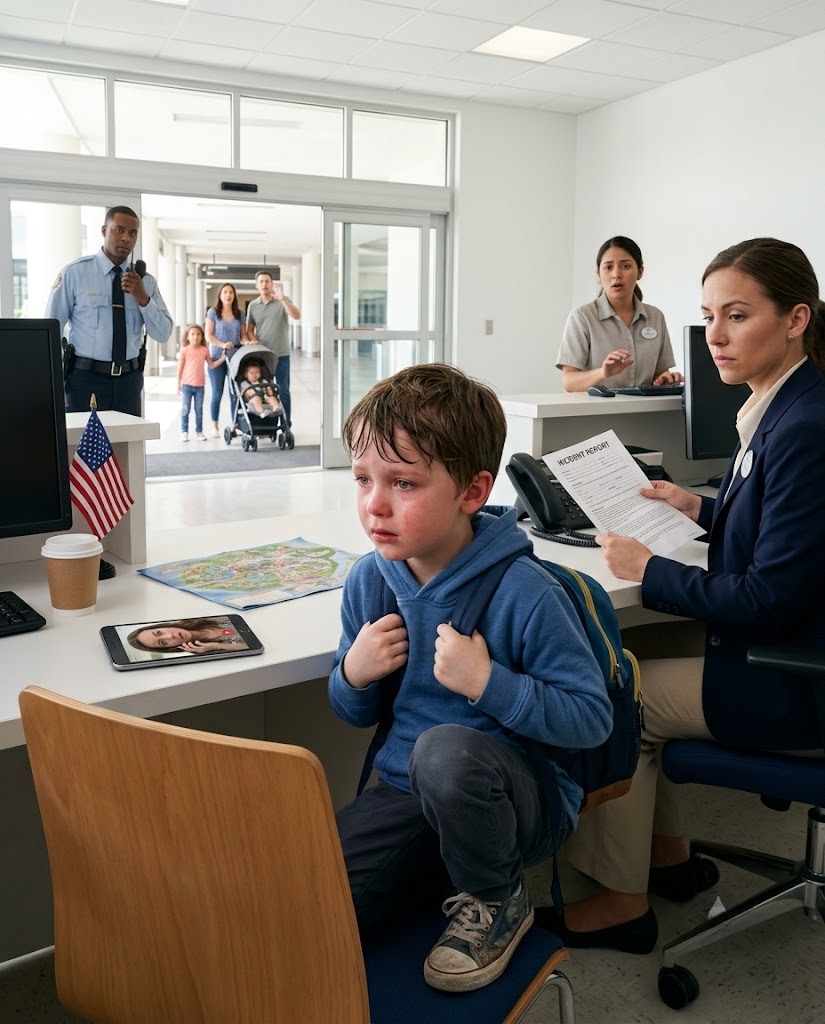
“Ma’am, your child is safe. He’s with us at Lost & Found. He was located alone near the exit corridor by the transportation area.”
I walked out of the conference room without excusing myself.
I remember my supervisor saying my name behind me.
I remember the carpet changing to tile under my shoes.
I remember pushing open the stairwell door so hard it hit the wall.
“Alone?” I asked.
“Yes, ma’am,” the woman said. “A cast member found him upset and brought him to us. He gave us your phone number.”
My hand went to the concrete wall.
It was cold under my palm, rough enough that I felt the texture even through the panic.
“Can I speak to him?”
“Of course. He’s right here.”
There was a small rustle.
Then Elliot’s voice came through.
“Mom?”
He sounded like he had been trying not to cry for so long that his voice had run out of places to hide.
“I’m here, baby,” I said. “I’m right here. Tell me what happened.”
He took one shaky breath.
“They left me.”
“Who left you?”
“Grandma. Grandpa. Aunt Kara.”
I closed my eyes.
“Where were you?”
“I had to go to the bathroom,” he whispered. “Grandma was mad because I was slowing everyone down. She said everybody had to wait for me again.”
I pressed my forehead against the stairwell wall.
“And then?”
“Grandpa took me near the bathroom. I came out and they were gone. I waited by the wall like you said. I waited and waited.”
His voice cracked.
“Then I heard Grandpa say, ‘We’re leaving. Your mom can deal with it.’”
For a second, I did not understand the words.
They were too clean.
Too deliberate.
Too much like a choice.
“You heard Grandpa say that?”
“Yes,” Elliot whispered. “Then they went home. Mom, they went home without me.”
Something cold moved through me beneath the fear.
It was not rage yet.
Rage is hot and wild.
This was cleaner.
This was the part of me that checked locks at night, counted exits in crowded rooms, saved receipts, wrote down names, and kept my child’s documents in a folder by the door.
“Listen to me,” I said, making my voice steady. “You did exactly the right thing. You found a staff member. You showed them the card. You stayed where people could help you. I am so proud of you.”
He made a small sound.
“Am I in trouble?”
That almost broke me.
“No,” I said immediately. “You are not in trouble. Not even a little. The grown-ups are.”
The Guest Relations woman came back on the line.
I asked for her name.
I asked where he had been found.
I asked what time the cast member brought him in.
I asked whether an incident report would be generated.
She answered every question.
2:48 p.m., child located near the transportation exit corridor.
3:03 p.m., child brought to Lost & Found.
3:17 p.m., mother contacted.
Incident report pending.
I repeated every detail back to her.
Not because I did not trust her.
Because I wanted the facts anchored somewhere outside my shaking body.
Then I called my mother.
She answered on the second ring.
There was road noise in the background and Kara’s kids talking over each other.
“What?” Denise said.
Not hello.
What.
“Where is Elliot?” I asked.
There was a pause so small most people might have missed it.
I did not.
Then my mother laughed.
Actually laughed.
“Oh really? He’s at Lost & Found? Didn’t notice.”
In the background, Kara chuckled.
“My kids never get lost.”
I stared at the gray stairwell door.
My free hand curled slowly into a fist.
“So you left him there,” I said.
My mother sighed like I had asked her to return a sweater without a receipt.
“Relax. Disney people love lost kids. He’s fine.”
“You drove away from a theme park without my six-year-old son.”
“He wanders,” Kara called from somewhere behind her. “Maybe teach him to keep up.”
I thought about Elliot’s small white card.
I thought about his crackers for emergencies.
I thought about him standing near a bathroom wall in a sea of strangers while the adults who promised me he would be safe walked away.
For one ugly heartbeat, I wanted to scream.
I wanted to make my mother feel even one second of what Elliot had felt.
I wanted to say every cruel thing I had swallowed for thirty years.
I did not.
A mother does not have to be loud to become dangerous.
Sometimes the most frightening thing she can do is get organized.
“You have one minute,” I said quietly, “to tell me exactly where you are.”
Kara snorted.
“What are you gonna do?”
That question changed something in me.
Until then, some foolish part of me had still been waiting for an apology.
A gasp.
A sudden turn of the car.
A mother becoming a grandmother again instead of a woman defending her pride.
But Kara was amused.
My mother was dismissive.
My father was silent.
And my son was sitting in Lost & Found because they had decided his fear was an inconvenience.
“I’m going to make sure you never get unsupervised access to my child again,” I said.
My mother snapped then.
“Emily, don’t you dare threaten me after everything I’ve done for you.”
“Everything you’ve done for me?”
“I raised you,” she said.
“And today you abandoned my child.”
The road noise shifted.
My father said something low that I could not make out.
Kara muttered, “Here we go.”
Then my phone buzzed against my cheek.
I pulled it away just enough to see the notification.
Disney Guest Relations.
Subject line: INCIDENT REPORT – MINOR CHILD FOUND UNACCOMPANIED.
My mother was still talking.
“You’re acting like we left him on the side of the highway.”
I opened the email.
The first line listed the location.
The second line listed the time.
The third line listed Elliot’s condition as frightened but physically unharmed.
The fourth line said guardian party not present at time of recovery.
That sentence did not tremble.
It did not care about family politics.
It did not care that my mother hated being corrected.
It sat there in black and white, plain as a locked door.
“Denise,” my father said suddenly in the background. “Hang up.”
That was the first time I heard fear in that SUV.
My mother lowered her voice.
“What did she get?”
I did not answer.
A second email arrived.
This one had an attachment labeled AUDIO SUMMARY – CHILD STATEMENT.
I pressed my thumb to the screen and watched the loading circle turn.
My supervisor opened the stairwell door behind me.
She looked at my face and stopped.
“Emily?”
I held up one finger.
On the phone, Kara was no longer laughing.
“Emily,” she said, too quickly. “Don’t be stupid. You know Mom didn’t mean anything.”
That was the first lie.
My mother followed with the second.
“We thought he was with Ray.”
My father said nothing.
Silence is not always neutrality.
Sometimes silence is an accomplice trying to decide whether the evidence can still be managed.
The Disney staff member called back before I could open the attachment.
I switched lines.
“Ms. Parker,” she said, her voice careful now. “Before you speak further with the adults who left with him, I need you to know what Elliot told us they said before they walked away.”
I looked through the little stairwell window at the office parking lot.
The afternoon sun was hard and bright on the asphalt.
A tiny American flag sticker on the security booth glass fluttered every time the booth door opened and closed.
Normal life was still happening.
People were carrying lunch bags.
Cars were pulling into spaces.
Somewhere below me, a man laughed into his phone.
My child was five hours away from me, sitting with strangers because his own family had left him behind.
“Tell me,” I said.
The staff member did.
She told me Elliot reported that my mother had said, “If he wants to act like a baby, let his mother come get him.”
She told me Elliot reported that Kara laughed and said, “Maybe next time Emily won’t dump him on everybody.”
She told me Elliot reported that my father said, “We’re leaving. Your mom can deal with it.”
Then she said the words I had not known I needed.
“We are documenting all of that.”
I thanked her.
I asked if they could keep Elliot in staff care until an approved pickup arrived.
I asked what identification would be required.
I asked whether the report could include the exact recovery location, the names of staff involved, and the timeline.
She said yes.
My supervisor was still standing there.
“Go,” she said.
“I have to get him,” I replied, already moving.
“I know. Go. We’ll handle your shift.”
I drove with both hands on the wheel and my phone connected to the car speaker.
I arranged for my best friend Sarah, who lived closer to the park than I did and was already on file as Elliot’s emergency contact, to get him first.
Sarah answered on the first ring.
I said, “I need you to go to Disney Guest Relations. Elliot is safe, but he’s alone.”
She did not ask me to explain twice.
“I’m leaving now,” she said.
That is the difference between people who love a child and people who love control.
Love moves.
Control argues.
At 4:06 p.m., Sarah called from the parking structure.
At 4:21 p.m., she texted a photo of Elliot sitting beside her with a bottle of water in his hands.
His eyes were swollen.
His hoodie sleeves were pulled over his fists.
But he was with someone who would not leave him.
I pulled into a gas station because I could not keep driving while looking at the picture.
I parked beside an old pickup truck, put my head down on the steering wheel, and cried so hard my chest hurt.
Then I wiped my face, bought water, and kept going.
My mother called eleven times.
Kara called four.
My father sent one text.
We need to talk before you make this bigger than it is.
I stared at that message at a red light until the car behind me honked.
Then I forwarded him the incident report.
He did not text again for forty-seven minutes.
When he finally did, the message was different.
Your mother is upset.
Not Elliot is okay?
Not I am sorry?
Not I should have turned the car around?
Your mother is upset.
That was the family I had grown up in, compressed into four words.
By the time I reached Sarah’s house, the sky was darkening.
Elliot was on her couch with a blanket around his shoulders and the plastic dinosaur in his lap.
He looked up when I came in.
For one second, he did not move.
Then he dropped the dinosaur and ran.
I knelt on Sarah’s living room floor and caught him so hard we both almost tipped over.
He smelled like sunscreen, sweat, and fear.
“I knew you’d answer,” he whispered into my shirt.
That broke whatever part of me had been holding itself upright.
“Always,” I said. “I told you. Always.”
Sarah stood in the kitchen doorway with her hands over her mouth.
She had already printed the incident report.
She had written down the staff names.
She had saved screenshots of the call log.
She had packed Elliot’s souvenir cup, his backpack, and the paper Guest Relations had given him to color while he waited.
That picture was a castle.
He had colored one side blue and left the other side blank.
When we got home, I put him in a bath, made toast because it was all he wanted, and let him sleep in my bed.
He woke up twice crying.
The first time, he asked if Grandma was mad.
The second time, he asked if he had ruined the trip.
Both times I told him no.
Both times I said it until he believed me enough to sleep again.
The next morning, I started making calls.
I called the school office and removed my parents and Kara from the pickup list.
I emailed the after-school program and updated emergency contacts.
I called the pediatrician and scheduled an appointment because fear leaves marks even when the body looks unharmed.
I printed the Disney incident report, the email headers, the call log, and the text messages.
I saved the voicemail my mother left at 9:32 a.m., where she said I was “punishing the family over a misunderstanding.”
Then I listened to the audio summary.
Elliot’s voice was quiet.
The staff member asked him if he knew where his group was.
He said, “They went home because I was too slow.”
The staff member asked how he knew.
He said, “Grandpa said my mom could deal with it.”
I had to pause the recording there.
Not because I was surprised.
Because hearing a six-year-old repeat adult cruelty in a polite little voice is a specific kind of injury.
At noon, my mother came to my house.
She did not call first.
She pulled into my driveway and walked up my front porch like she still had the right to enter without being invited.
I opened the door but kept the chain lock on.
Her face changed when she saw it.
“Seriously?” she said.
“Yes.”
Kara was behind her, arms crossed.
My father stood near the walkway, not quite on the porch, not quite away from it.
That was Ray’s favorite position.
Close enough to claim he was present.
Far enough to deny responsibility.
“We need to talk,” Denise said.
“No,” I replied. “You need to listen.”
Her mouth tightened.
I held up the folder.
“Disney documented the incident. Elliot’s school has been updated. You are no longer authorized for pickup. Kara is no longer authorized. Dad is no longer authorized. None of you will be alone with him again.”
Kara laughed once, but it came out thin.
“You can’t just cut off family.”
“I can cut off unsafe adults.”
My mother leaned toward the door.
“He is our grandson.”
“He is my son.”
For the first time, she had no instant answer.
My father finally spoke.
“Emily, your mother made a mistake.”
I looked past Denise at him.
“No. A mistake is thinking someone else packed the sunscreen. A mistake is missing an exit. Leaving a child alone near a transportation corridor because you were irritated is a decision.”
His face went dull and red.
Kara’s eyes moved to the folder.
“What’s in that?”
“Proof.”
That word landed harder than I expected.
My mother blinked.
“You wouldn’t use that against us.”
There it was.
Not we are sorry.
Not how is Elliot?
Not can we make this right?
Only the fear that consequences might arrive with paperwork attached.
I opened the folder and read the phrase exactly as written.
“Minor child found unaccompanied. Guardian party not present at time of recovery. Child stated accompanying adults left the location and went home.”
Kara’s face changed.
My father looked down at the porch boards.
My mother whispered, “You’re humiliating us.”
“No,” I said. “You did that without me.”
Elliot appeared at the hallway behind me then.
He had his dinosaur in one hand and his blanket around his shoulders.
When he saw them on the porch, he stopped.
My mother’s expression softened instantly, but not in a way I trusted.
It was performance softness.
The kind she used in public when she wanted people to forget what she had just said in private.
“Sweetheart,” she said, “Grandma didn’t mean to scare you.”
Elliot stepped behind my leg.
That was his answer.
I did not ask him to be polite.
I did not ask him to hug anyone.
I did not ask him to make adults comfortable at his own expense.
“We’re done,” I said.
Denise stared at me.
“You will regret this.”
I looked at Elliot’s small hand gripping the back of my shirt.
“No,” I said. “I regret trusting you.”
Then I closed the door.
For three days, the family group chat burned.
Aunts I barely heard from called me cruel.
A cousin said kids get lost all the time.
Kara posted a vague quote about forgiveness and family.
My mother told people I was keeping Elliot from his grandparents because she had “lost sight of him for a few minutes.”
So I sent one message to the group chat.
I did not explain.
I did not argue.
I attached the incident report.
Then I attached my father’s text.
We need to talk before you make this bigger than it is.
After that, the chat went quiet.
Silence again.
But this time, it was not the silence of people protecting my mother.
It was the silence of people realizing the story they had been told had a paper trail.
My father came by alone a week later.
He stood at the edge of my porch holding his baseball cap in both hands.
He looked older than he had the week before.
“I should’ve turned around,” he said.
It was the closest thing to truth I had heard from him.
“Yes,” I said.
He swallowed.
“Your mother was angry. Kara was saying you needed to learn. I thought…”
He stopped.
“You thought what?”
He looked at the porch rail.
“I thought Disney staff would handle it.”
I nodded once.
“They did. That’s why you don’t get to.”
He flinched.
I did not soften it.
Because my son had been taught, for twenty-nine minutes, that the people responsible for him could walk away and make it his fault.
I would spend longer than twenty-nine minutes undoing that.
I would spend months if I had to.
Years.
However long it took.
Elliot is better now, but better is not the same as untouched.
He still asks who is picking him up from school, even when he knows the answer.
He still keeps my number card in his backpack, laminated now, tucked in the front pocket.
He still reaches for my hand in crowded places.
And I still let him.
My mother has not had unsupervised access to him since that day.
Kara tells people I am holding a grudge.
Maybe I am.
Some grudges are just boundaries with a memory.
The Disney report is still in my file cabinet.
The audio summary is still saved in three places.
The school office still has the updated pickup list.
And every time someone says I went too far, I remember my six-year-old son sitting in Lost & Found with tear tracks on his face, telling a stranger, “My mom will answer.”
He was right.
I did answer.
And after that day, I made sure the people who left him behind never got the chance to do it again.