Grandma Took a Child’s Inhaler, Then Police Heard Her Excuse-ginny

My phone rang at 3:17 p.m. on a weekday afternoon, at the exact moment I was stepping out of a budget meeting in downtown Columbus, Ohio.
The conference room still smelled like stale coffee and dry-erase markers.
The fluorescent lights had left that thin white ache behind my eyes, and I was balancing my laptop bag against one hip while trying to remember whether I had enough milk at home for Lily’s cereal the next morning.
Then I saw my daughter’s name on the screen.
Lily.
Seven years old.
My whole face softened before I answered, because that was what her name did to me.
Even on the worst workdays, even when invoices were wrong and managers were short-tempered, Lily’s calls made me smile before she spoke.
But this time, she did not say hello.
There was only breathing.
Not normal breathing.
A thin, ragged sound came through the phone, like air scraping through something too narrow.
“Mommy,” she wheezed. “I can’t… breathe.”
Everything around me dropped away.
The hallway, the office chatter, the elevator ding, the woman walking past with a paper coffee cup.
All of it vanished behind the sound of my child fighting for air.
“Lily?” I said, already moving. “Where’s your inhaler?”
There was a pause.
Then came one tiny gasp that I still hear sometimes when the house is too quiet.
“Grandma… took it.”
For one second, I could not understand her.
Not because the words were unclear.
Because they were too clear.
My daughter had moderate persistent asthma.
Her rescue inhaler was not a toy.
It was not dessert.
It was not a reward for good manners or something an adult could lock away until a child sounded sorry enough.
It was medicine.
It was the line between fear and emergency.
“Where is Grandma now?” I asked.
My hand had already found my purse strap, and I pulled so hard it dug into my palm.
“In the kitchen,” Lily whispered. “She said… I was rude.”
I put the call on speaker and ran toward the elevator.
My heels hit the tile too hard.
Every step sounded like a warning.
There was shuffling.
A chair scraped against the floor.
Then my mother-in-law’s voice came through, calm and cool, the way she sounded when she was sure everyone else was being unreasonable.
“Rachel, she’s fine. She was being dramatic.”
I pushed the elevator button so many times my finger hurt.
“Where is her inhaler?”
“I put it away.”
The elevator doors opened.
Three people inside looked at me, then looked away because strangers know when a face has turned into something private and terrible.
“Give it back to her immediately,” I said.
“No,” Elaine replied.
Her voice did not shake.
“She spoke to me with disrespect. Children today think they can snap their fingers and get everything. She can breathe after she learns her lesson.”
I stepped into the elevator and stared at my own reflection in the metal doors.
For a second, I did not recognize myself.
“You took asthma medication from a child who is having trouble breathing?”
“She needs discipline.”
“She needs oxygen.”
“Don’t be hysterical,” Elaine said. “This is old-school parenting. Your husband survived my parenting.”
That sentence hit a place in me that had been sore for years.
My husband, Daniel, had survived Elaine’s parenting.
That was true.
He had survived by becoming quiet.
He had survived by apologizing before he knew what he had done.
He had survived by freezing whenever his mother used that flat disappointed tone, the one she dressed up as wisdom and called love.
Survival is not proof someone loved you well.
Sometimes it is only proof you learned where to hide the hurt.
“Elaine,” I said, keeping my voice as steady as I could, “stay exactly where you are.”
“Excuse me?”
“I’m calling 911 for child endangerment.”
That was when her voice changed.
Not much.
Just enough.
“Rachel, don’t you dare embarrass this family.”
I hung up.
Then I called 911.
The dispatcher’s voice was clear, trained, and calm in a way that kept me from coming apart entirely.
She asked my daughter’s age.
Seven.
She asked about her diagnosis.
Moderate persistent asthma.
She asked what medication had been withheld.
Albuterol rescue inhaler.
She asked if my daughter was conscious.
I said yes, but her breathing sounded bad, and I was not with her because I was driving home from work.
She told me not to hang up.
So I didn’t.
I drove with the phone wedged in the cupholder and my hazard lights blinking.
My hands locked around the steering wheel until my knuckles ached.
I gave my address twice.
I spelled my last name.
I repeated Elaine’s name, then Lily’s, then Daniel’s, because panic makes you believe that if you say facts clearly enough, the world will move faster.
At 3:29 p.m., the dispatcher told me officers had been assigned.
At 3:31 p.m., she said an ambulance was on the way.
At 3:36 p.m., I turned onto our street and saw red-and-blue lights washing across the windows of the houses I passed every day.
That ordinary street looked different under emergency lights.
The same mailboxes.
The same parked SUVs.
The same patchy lawns in the summer heat.
But everything felt sharpened, exposed, as if the whole block had been forced to look at what had been happening behind one front door.
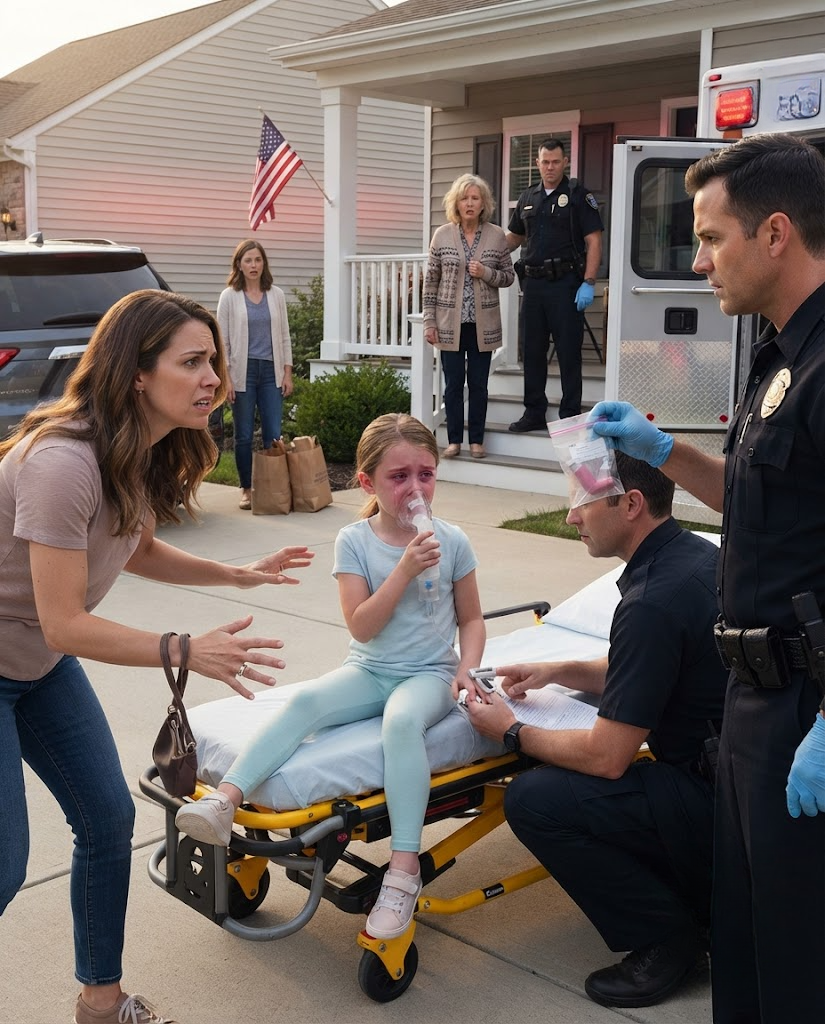
The ambulance was in my driveway.
Two police cruisers were parked at the curb.
Our small American flag hung from the porch railing, barely moving in the thick afternoon air.
A neighbor stood behind her curtains.
Another neighbor had stopped on the sidewalk with paper grocery bags still looped over both arms.
Elaine stood on the porch in her church cardigan, arms crossed, chin lifted.
She was speaking to an officer like she was correcting a cashier.
“This is a misunderstanding,” she said. “The girl was being mouthy.”
Then the paramedic came out carrying Lily.
My daughter’s lips were pale.
Her chest was moving too fast.
Her small fingers clutched the nebulizer mask with the kind of strength children only find when they are terrified.
I ran toward her, but the paramedic lifted one hand just enough to slow me.
Not to keep me away.
To keep me calm.
“Mom?” Lily rasped through the mask.
“I’m here,” I said.
My voice sounded strange.
Thin.
Far away.
“I’m here, baby.”
Her eyes found mine, wet and scared, and then she did something that nearly broke me more than the wheezing had.
She looked sorry.
Not angry.
Not confused.
Sorry.
As if she had caused this by needing air at the wrong time.
That was the damage Elaine had done before I even reached the driveway.
She had made my child think breathing was negotiable.
For one ugly heartbeat, I imagined crossing the porch and putting my hands on Elaine’s cardigan.
I imagined shaking the certainty out of her.
I imagined making her feel one second of the helplessness Lily had just felt.
Then Lily’s fingers tightened around the mask, and I put both hands where my daughter could see them instead.
I would not become one more adult making the porch unsafe.
The paramedic clipped a pulse oximeter to Lily’s finger.
The small red light glowed against her skin.
He read the number and spoke quietly to his partner.
Then he began filling out a hospital intake sheet on a clipboard.
Every word he wrote felt like something permanent.
Wheezing.
Medication withheld.
Respiratory distress.
Elaine was still talking.
“She started it,” she said.
The porch went quiet.
Even the neighbor with the grocery bags seemed to stop breathing.
One of the officers looked from Lily’s mask to Elaine’s folded arms.
Then he looked at me.
“Ma’am,” he said, “where is the child’s inhaler?”
Elaine blinked as if the question offended her.
“I told you, I put it away. I was handling her behavior before Rachel decided to make a scene.”
“Where did you put it?”
“In a safe place.”
That was not an answer.
The officer knew it.
I knew it.
Even Lily, seven years old and shaking on an ambulance stretcher, knew it.
“The asthma action plan is on the fridge,” I said.
My voice was steadier now because rage had cooled into something much more useful.
“It says rescue inhaler immediately at the first sign of wheezing.”
The second officer stepped into the house.
Elaine turned toward him sharply.
“You don’t have permission to go through my son’s home.”
“It’s my home,” I said.
She looked at me like that had never occurred to her.
For years, Elaine had treated our house as an extension of herself because Daniel had let her have a key.
She had watered plants when we traveled.
She had watched Lily after school when my meetings ran late.
She had known where the snacks were, where the spare towels were, and where we kept the medical paperwork because I had trusted her with the details that kept my daughter safe.
That was the trust signal.
The key.
The schedule.
The action plan.
The emergency medication.
I had handed her access in the name of family, and she had turned that access into control.
The second officer returned less than a minute later.
He wore gloves.
In his hand was a clear plastic sandwich bag.
Inside it was Lily’s pink rescue inhaler.
Beside it were Elaine’s house keys.
The officer held the bag up just enough for the first officer to see.
No one had to say what it meant.
It had not rolled under the couch.
It had not been misplaced.
It had not been forgotten in a purse during a hectic afternoon.
It had been hidden.
Elaine’s face tightened.
“I was going to give it back.”
“When?” I asked.
She looked at me.
“When she stopped acting like that.”
The paramedic stopped writing.
Just stopped.
His pen hovered over the intake sheet.
It is a terrible thing when a stranger’s silence tells you your family has crossed a line that cannot be softened anymore.
Then Daniel’s truck turned the corner.
He came in too fast.
The tires chirped against the curb, and he parked crooked behind the ambulance.
He jumped out still wearing his work badge, his face gray, his phone clenched in one hand.
I had left him one message.
He had heard enough.
He saw Lily first.
Then he saw the nebulizer.
Then the evidence bag.
His eyes moved to his mother.
Elaine’s expression changed instantly.
Not sorry.
Prepared.
She lifted her chin in that old way, as if she could pull him back into childhood with one look.
“Daniel,” she began. “Your wife is overreacting.”
Daniel did not go to her.
He went to Lily.
He knelt beside the stretcher and put one hand lightly on her ankle, the only place that did not interfere with the paramedic.
“Hey, bug,” he said, and his voice cracked on the nickname.
Lily reached one shaking hand toward him.
Daniel took it.
The moment her fingers closed around his, something in his face collapsed.
Not loudly.
Not dramatically.
It was worse because it was quiet.
It was the look of a grown man realizing the thing he had survived as a child had reached for his daughter.
“Mom,” he whispered, still staring at the inhaler in the bag. “Please tell me you didn’t do this.”
Elaine looked at him, then at the officers, then at me.
She chose pride anyway.
“She needed to learn respect,” she said. “You both baby her too much, and now she thinks breathing problems give her permission to be rude.”
Daniel closed his eyes.
I watched his jaw tighten.
Years passed over his face in a second.
Every swallowed apology.
Every holiday where she made him small.
Every time he told me, “That’s just how she is,” because admitting the truth would have meant grieving the mother he wished he had.
The first officer shifted his stance.
“Mrs. Elaine,” he said, “withholding prescribed rescue medication from a child in respiratory distress is not discipline.”
Elaine laughed once.
It was not a real laugh.
It was a defense cracking at the edges.
“She was not in distress until Rachel scared everyone.”
The paramedic turned the clipboard slightly.
His voice was professional, but there was steel under it.
“She was wheezing when we arrived. Respirations were elevated. Lips pale. We began nebulizer treatment on scene.”
He tapped the hospital intake sheet with his pen.
“It’s documented.”
That word landed hard.
Documented.
Elaine had always done her worst work in places where no one wrote anything down.
Kitchens.
Hallways.
Guest rooms.
Phone calls.
But now there was an intake sheet.
There was a dispatch log.
There was an officer’s body camera.
There was an inhaler in a bag.
Some people only understand truth when it has a case number attached.
The officer asked me if I wanted to ride with Lily to the hospital.
I said yes before he finished the sentence.
Daniel stood up.
“I’m coming too.”
Elaine grabbed his sleeve.
“Daniel, don’t you dare leave me standing here like some criminal.”
He looked down at her hand on his arm.
For a second, I saw the old freeze begin.
The childhood reflex.
The little boy inside him waiting to be punished for disappointing his mother.
Then Lily coughed behind the mask.
Daniel gently removed Elaine’s fingers from his sleeve.
“You left my daughter without her medicine,” he said.
Elaine’s mouth opened.
He did not let her speak.
“No,” he said. “Not this time.”
Those three words did something to the air.
Not this time.
It was not loud enough for a movie.
It was not a speech.
It was just a door closing.
The officer asked Elaine to step aside and remain on the porch while they finished speaking with her.
She looked around at the neighbors, the paramedics, the police cars, the ambulance.
For the first time, she seemed to understand that embarrassment was not the emergency.
The emergency was the child she had decided to teach.
At the hospital, Lily was taken through intake quickly.
The waiting room smelled like disinfectant and vending machine coffee.
A television murmured in the corner.
Daniel sat beside me with his elbows on his knees and his hands clasped so tightly the veins stood out.
Neither of us spoke for a while.
There are silences inside a marriage that are peaceful.
This was not one of them.
This silence was full of everything we had excused too long.
“She had the action plan,” I said finally.
“I know.”
“She knew what to do.”
“I know.”
“She took the inhaler anyway.”
Daniel looked at the floor.
His eyes were red.
“I know.”
A nurse came out and told us Lily was responding well to treatment.
Her oxygen level was improving.
They wanted to observe her and make sure she stayed stable.
I nodded through the whole explanation, but the words did not reach my body until the nurse said, “She’s asking for you.”
I went in first.
Lily looked very small in the hospital bed.
Her hair was messy from the mask straps.
There was a hospital wristband around her wrist.
Her stuffed rabbit, which one paramedic had apparently carried from the house, sat beside her pillow.
“Am I in trouble?” she asked.
I sat down carefully because if I moved too fast, I was afraid I would fall apart.
“No, baby.”
“Grandma said I was being dramatic.”
“You were having an asthma attack.”
“She said I had to say sorry first.”
I took her hand.
It was warm now.
Still too small.
“You never have to earn medicine,” I said. “Not from Grandma. Not from me. Not from anybody.”
Her eyes filled.
“I thought if I called you, Grandma would be madder.”
That was the sentence that stayed with me later.
Not the sirens.
Not the evidence bag.
Not Elaine’s excuses.
That sentence.
My child had been trying to decide whether breathing was worth making an adult angry.
Daniel came in after me.
He sat on the other side of the bed.
For a moment, he could not speak.
Then Lily reached for him again.
He bent over her hand and kissed her knuckles.
“I’m sorry,” he said.
Lily frowned.
“You didn’t take it.”
“No,” he said. “But I should have made sure no one ever thought they could.”
That was the beginning of the real change.
Not the police report.
Not the hospital paperwork.
Not even Elaine’s panic once consequences became real.
The real change was Daniel saying out loud that access to our child was not owed to anyone just because they shared blood.
By that evening, the officer had taken our statements.
The hospital records included the asthma attack, the reported withholding of medication, and the treatment provided.
The paramedic’s intake notes matched the dispatch timeline.
The inhaler had been photographed where it was found.
I kept copies of everything.
The hospital discharge summary.
The incident number.
The updated asthma action plan.
The text messages Elaine sent later that night.
First, she said I had humiliated her.
Then she said I had turned Daniel against her.
Then she said Lily was too sensitive.
Then, at 11:42 p.m., she wrote, “I would never actually let anything happen to her.”
I stared at that message for a long time.
Because that was the entire problem.
Elaine believed she was allowed to bring my daughter right up to the edge of danger as long as she personally decided when to stop.
The next morning, Daniel changed the locks.
He did it himself.
He stood on the porch in an old T-shirt with a screwdriver in one hand and the new deadbolt package on the railing.
His mother called three times while he worked.
He did not answer.
When the new lock clicked into place, he rested his forehead against the door for a second.
Then he turned and handed me the new key.
“No copies,” he said.
I nodded.
“No copies.”
We also called the school office and updated Lily’s emergency pickup list.
Elaine’s name came off it.
We gave the nurse a fresh inhaler, a new spacer, and a printed asthma action plan signed by Lily’s doctor.
The school secretary did not ask for gossip.
She just said, “We’ll make sure only authorized adults have access.”
That sentence felt like oxygen.
For the next week, Elaine tried every door she had always used.
She called Daniel.
She called me.
She left voicemails about forgiveness, family, overreaction, disrespect, and how hard motherhood had been for her.
She called from a church friend’s phone when Daniel stopped answering.
She sent a message saying, “You cannot keep my granddaughter from me forever.”
Daniel answered that one in writing.
“You endangered my child by withholding prescribed medication during an asthma attack. Do not contact us except in writing. Do not come to our house. Do not go to Lily’s school.”
He showed me before he sent it.
His hand shook.
But he sent it.
There are moments when love does not look soft.
Sometimes love looks like a changed lock, a removed name on a school form, and a father finally refusing to hand his daughter the same fear he inherited.
Lily recovered physically faster than either of us recovered emotionally.
Children can bounce back in ways that make adults grateful and ashamed at the same time.
She went back to school.
She watched cartoons.
She asked for mac and cheese.
But for weeks, she carried her inhaler from room to room inside a little zippered pouch.
At night, she asked if Grandma knew where we kept the new one.
Every time, I told her no.
Every time, Daniel told her the same thing.
“No one gets to take your medicine.”
Eventually, she stopped asking every night.
But she did not forget.
Neither did we.
The police report did not magically fix a family.
The hospital paperwork did not erase Daniel’s childhood.
Elaine did not suddenly become a different person because an officer had said the word child endangerment on our porch.
Real life is rarely that neat.
But consequences changed the shape of what she could reach.
She no longer had a key.
She no longer had school access.
She no longer had unsupervised time with Lily.
And Daniel no longer translated cruelty into tradition just because it came from his mother’s mouth.
Months later, Lily drew a picture at school.
It showed our house, our driveway, our mailbox, and three people standing on the porch.
Me.
Daniel.
Lily.
No Elaine.
There was a little pink rectangle in Lily’s hand.
When I asked what it was, she said, “That’s my inhaler. It stays with me.”
Then she added, very seriously, “Medicine is not for lessons.”
I had to turn away for a second.
Not because I was sad exactly.
Because she had learned something no child should ever need to learn, and yet she had learned it clearly.
She had learned that her body mattered.
She had learned that needing help was not bad behavior.
She had learned that adults do not get to call danger discipline just because they are embarrassed by a child’s voice.
And Daniel learned something too.
He learned that surviving his mother was not the same as protecting his daughter from her.
That difference changed our family.
It changed our locks, our forms, our holidays, our phone numbers, and the way he stood whenever Elaine’s name appeared on a screen.
The last time she tried to come by unannounced, Daniel met her on the porch.
I watched from the living room with Lily behind me, holding her rabbit in one hand and her inhaler pouch in the other.
Elaine started crying before Daniel said a word.
She told him she had made one mistake.
She told him she had raised him better than this.
She told him family should handle things privately.
Daniel listened.
Then he said, “You made my daughter afraid to breathe.”
Elaine went still.
He did not raise his voice.
He did not insult her.
He did not give her the old frightened silence she expected.
He simply stepped back and closed the door.
Behind me, Lily exhaled.
A small sound.
Easy.
Unforced.
The kind of breath most people never notice unless they have almost lost it.
I noticed.
Daniel noticed.
And in our house, from that day on, no one ever again confused control with care.