Grandma Took Her Phone During 911 Call. The Dash Cam Heard Everything-yilux

My eight-year-old son was curled on my parents’ living room carpet, trying to breathe like each breath had to be dragged through a locked door.
The carpet was beige, the same old carpet my mother had always bragged about keeping spotless, and my son’s fingers were dug into it like he was trying to hold himself to the earth.
The house smelled like lemon cleaner and burned coffee.
The TV was on mute, throwing blue and white flashes across the walls.
Somewhere in the kitchen, a pot lid clicked softly as metal cooled, and the sound was so ordinary it almost made the moment worse.
Ordinary rooms are not supposed to hold that kind of fear.
At first, I tried to make my mind choose the least terrible answer.
Maybe he had fallen.
Maybe he had tripped coming in from the backyard.
Maybe he was scared more than hurt.
Children get bruises and scrapes.
Children make terrible noises over small injuries.
Parents learn to breathe through panic because not every cry means disaster.
But this was not that.
His face had gone pale in a way I had never seen on him, not even when he had the flu in second grade and slept with a cool washcloth folded across his forehead.
His hand was pressed to his side.
His fingers were curled into his shirt.
Every time he tried to inhale, his little body stopped halfway, like something inside him was catching.
“Mom,” he whispered, “it hurts.”
I dropped to my knees beside him.
I touched his shoulder first, then his side, slow and gentle, the way you touch something you are afraid might already be broken.
The second my fingers reached the place beneath his ribs, he made a thin sound that cut straight through every polite rule I had ever followed in that house.
I looked up.
Ryan was standing near the edge of the living room.
He was twelve, tall for his age, with that stiff, squared-up posture boys sometimes wear when they think size is the same thing as being right.
His fists were still clenched.
One knuckle was scraped red.
He would not look at me.
“What happened?” I asked.
Nobody answered.
My sister Carla stood in the kitchen doorway with one hip against the counter and her arms crossed over her chest.
She looked annoyed.
That was what I remember most clearly.
Not scared.
Not guilty.
Annoyed.
As if my son’s pain had interrupted the evening.
My mother stood beside the couch with her mouth pressed into a line.
My father sat in his recliner with his reading glasses low on his nose, holding a magazine he was no longer reading.
The TV kept flashing color over everyone’s face.
For one terrible second, the room looked like a family gathering and a crime scene at the same time.
“He just shoved him,” Carla said finally.
Her voice was too casual.
“Kids get rough.”
My son tried to breathe again and failed.
That was the end of my patience.
I pulled my phone from my back pocket.
My hands were shaking so badly I almost dropped it.
I dialed 911.
Before the call could connect, my mother moved faster than I had seen her move in years.
She reached down and snatched the phone right out of my hand.
“Don’t you dare,” she snapped.
For a second, I just stared at her.
It was such a small object in her hand.
A phone.
A rectangle of glass and metal.
But in that moment, it was the difference between help and silence.
“Mom,” I said, “he can’t breathe.”
“Boys fight,” she said.
Then she lifted her chin.
“You don’t destroy your nephew’s future over a playground scuffle.”
My son was on the carpet.
My nephew was standing.
That should have been enough for anybody.
“My son is on the floor,” I said.
My father barely looked up.
“You’re overreacting,” he muttered.
“He’ll be fine in a day or two.”
I turned toward Carla.
She was smirking.
Not a big smile.
Not something she could not deny later.
Just the little curve of a mouth that had decided she was protected.
Family loyalty sounds beautiful until someone uses it as a blanket to cover the harm right in front of you.
It stops being love the second it asks a child to pay for an adult’s comfort.
I knew, right then, that if I let them decide what happened next, my son would learn the wrong lesson forever.
He would learn that pain had to be quiet when family caused it.
He would learn that adults could look away and still call themselves loving.
He would learn that his mother could be surrounded and still not choose him.
I would not let that be the story.
The room froze.
My mother’s fingers tightened around my phone.
My father turned one page of his magazine without reading it.
Carla’s bracelet clicked against the counter as she shifted her weight.
Ryan stared at the floor, his jaw hard.
My son breathed in tiny, ragged pulls.
Nobody moved.
I had trusted that house.
That was the part that kept striking me even as I slid my arms under my son.
I had trusted my parents enough to let him spend afternoons there.
I had trusted Carla enough to let her son play with mine.
I had trusted the word family like it was a locked door between my child and danger.
That trust had been used against him.
“Give me my phone,” I said.
My voice was quieter than I expected.
“No,” my mother said.
She pulled it closer to her chest.
“You are not calling the police on family.”
I looked at her.
I looked at my father.
I looked at Carla.
Then I looked down at my son.
His eyes were wet and wide.
His lips trembled.
“Mom,” he whispered, “am I in trouble?”
I do not know if people understand what a sentence like that does to a parent.
It does not break your heart in a soft way.
It sharpens something inside you.
It takes all the confusion, all the old guilt, all the training that tells you to keep peace with your parents, and cuts it clean away.
“No, baby,” I said.
“You are not in trouble.”
I stood up with him in my arms.
He was getting too big for me to carry the way I used to when he was three and fell asleep on the couch during cartoons.
But fear gives you strength, and love gives it direction.
His knees hung over one arm.
His head pressed against my shoulder.
Each small breath he took landed against my collarbone.
My mother stepped in front of me.
“Put him down,” she said.
I did not.
“Move.”
She stared at me like I had slapped her.
Carla pushed away from the counter.
“Oh my God,” she said.
“You are making this insane.”
I kept walking.
The front door felt farther away than it had ever felt before.
I passed the framed family photos in the hallway.
Christmas mornings.
Backyard cookouts.
School pictures.
Proof of closeness hanging on the wall while the people in those frames chose silence.
My father finally stood.
“Don’t be foolish,” he said.
His voice had the tone he used when I was a teenager and he wanted obedience without having to earn respect.
I did not answer him.
At 6:42 p.m., I carried my son out the front door.
The evening air hit us cold and sharp.
The porch boards creaked under my shoes.
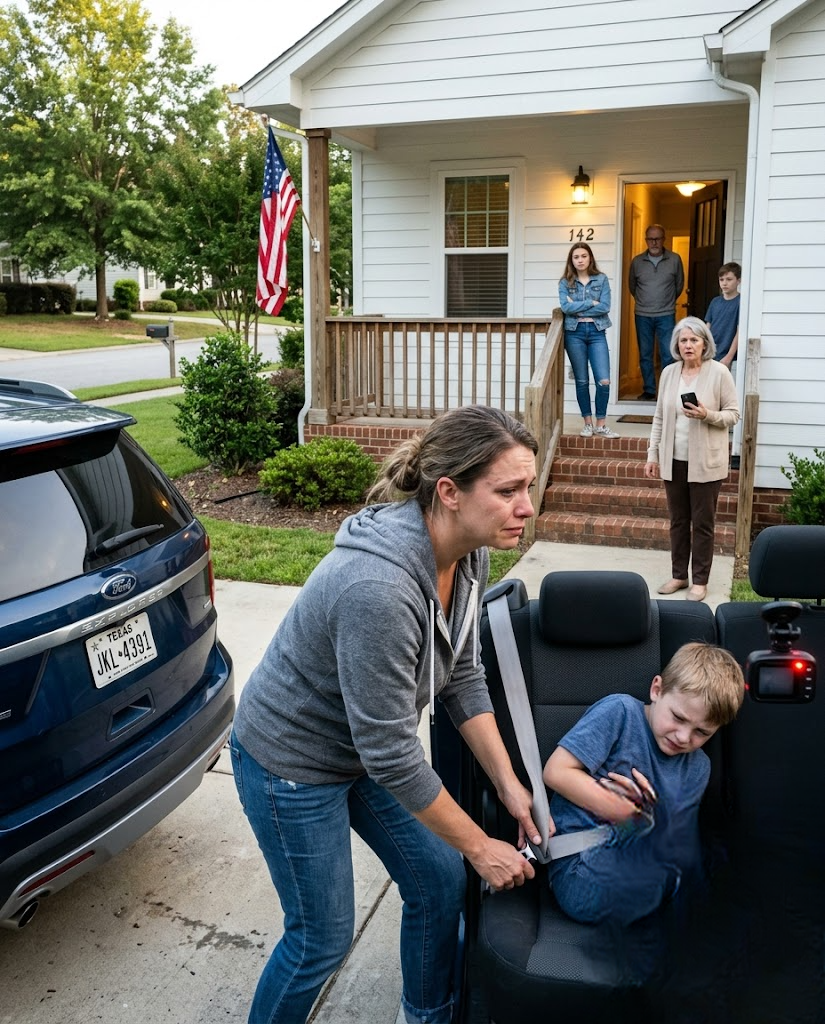
There was a small American flag mounted near the door, moving a little in the breeze, the kind my mother put out every summer and forgot to take down.
I remember seeing it because my mind had begun recording details the way frightened people do.
The porch light.
The mailbox at the curb.
The sound of my keys biting into my palm.
The weight of my son against my chest.
I did not have my phone.
That should have stopped me.
Maybe that was what my mother thought.
Maybe she believed that without the phone, I would stand there and beg.
But I had my keys.
I had my memory.
I knew where the nearest emergency room was.
At 6:49 p.m., I reached my SUV in the driveway.
I opened the back door and lowered my son inside as gently as I could.
The seat belt latch slipped the first time because my hands were shaking.
It clicked on the second try.
Behind me, the front door opened.
Carla came out first.
She still had that thin smile on her face, but it looked less certain now.
My mother followed, holding my phone in her hand like she had won some private contest.
My father stayed in the doorway.
Ryan lingered behind Carla, half-hidden by her shoulder.
“You need to calm down,” Carla called.
I turned my head just enough to look at her.
My son made a small sound from the back seat.
That was when my eyes caught the windshield.
The dash camera was still mounted behind the rearview mirror.
The little red light was blinking.
For one second, I could not move.
Then everything inside me went still.
I had forgotten it was there.
I had installed it months earlier after someone sideswiped my car in a grocery store parking lot and drove away.
It started recording automatically whenever the car was on, and sometimes it stayed active after parking if it sensed movement.
I had complained about the price when I bought it.
Now that small black camera was the only witness in that driveway that had not looked away.
My mother noticed where I was staring.
Carla noticed too.
The smile slid off Carla’s face.
My mother’s fingers tightened around my phone.
I opened the driver’s door.
“Give me my phone,” I said again.
My mother took one step back.
“You’re being dramatic.”
“No,” I said.
“I’m being a mother.”
I got in the car.
I backed out of the driveway while all of them stood there on the porch.
In the rearview mirror, I saw my mother raise my phone like she might call someone herself now.
Maybe my father.
Maybe Carla.
Maybe nobody.
It did not matter.
The recording had already happened.
The emergency room was fifteen minutes away.
I drove carefully because every bump made my son flinch.
At red lights, I turned my head and watched his chest move.
In.
Out.
Too shallow.
Too guarded.
I talked to him the whole way.
Not because I knew what to say, but because silence felt too close to what they had tried to force on us.
“You’re doing good,” I told him.
“We’re almost there.”
“You are not in trouble.”
That last sentence I repeated more than once.
By the time I pulled under the emergency room entrance, my throat hurt from holding back everything I had not said in that living room.
A nurse saw us before I even reached the sliding doors.
She came over with a wheelchair.
“What happened?” she asked.
I told her my son had been hurt by an older child and was having trouble breathing.
She looked at his face once and moved faster.
At the intake desk, the woman asked for my phone number.
That was when I had to say it.
“I don’t have my phone.”
She looked up.
“My mother took it when I tried to call 911.”
Her hand paused over the keyboard.
Some sentences change a room.
That one changed the emergency intake desk.
The nurse looked from me to my son and then back to me.
“Your mother took your phone while you were trying to call emergency services?”
“Yes.”
She did not accuse me of exaggerating.
She did not tell me boys fight.
She did not ask whether I wanted to ruin anyone’s future.
She just said, “We’re going to get him seen.”
A hospital intake form was printed.
A wristband was placed around my son’s wrist.
A nurse documented his pain level.
Another asked if he felt safe going home.
He looked at me before he answered.
That look almost undid me.
The doctor examined him with the focused calm of someone who knew panic did not help but urgency did.
She pressed gently.
She listened to his breathing.
She asked where it hurt.
My son pointed to his side.
The doctor’s face did not change much, but her eyes sharpened.
“We’re going to order imaging,” she said.
A chest X-ray.
More questions.
A hospital incident report.
Process words began filling the air around us.
Documented.
Reviewed.
Ordered.
Reported.
Those words steadied me in a strange way.
Not because they were gentle, but because they meant the truth was being handled by people who did not owe Carla anything.
About twenty-two minutes after we arrived, a security guard helped me remove the dash camera’s memory card.
I had not known whether anyone would take it seriously.
I had not known whether it would even have the right audio.
But the hospital staff did not laugh.
They did not roll their eyes.
They found a small office near the nurse’s station and pulled the file up on a computer.
The timestamp appeared at the bottom of the video.
6:41 p.m.
The angle was not perfect.
It showed more windshield and porch than living room, but the audio was clear from the driveway once the door opened and then clear enough through the open front door before I carried my son out.
My mother’s voice came through first.
“Don’t you dare.”
Then my voice.
“Mom, he can’t breathe.”
Then hers again.
“Boys fight. You don’t destroy your nephew’s future over a playground scuffle.”
The room went quiet.
The doctor stood beside the desk.
A nurse stood behind her.
The security guard looked down at the keyboard like he wanted to give us privacy but knew this was evidence now.
Then my father’s voice came through.
“You’re overreacting. He’ll be fine in a day or two.”
Then Carla.
“Kids get rough.”
My stomach turned.
Hearing it again was worse than living it the first time.
The first time, I had been moving, deciding, carrying, driving.
The second time, I had to stand still and listen to adults choose an older child’s reputation over my son’s breath.
The doctor’s expression changed when my son’s voice came through the recording.
“Mom, am I in trouble?”
The nurse covered her mouth.
No one spoke for several seconds.
Then the doctor turned toward the desk phone.
“I’m making the required report,” she said.
Her voice was calm.
Final.
Carla arrived at the emergency room shortly after that.
I do not know who told her where I had gone.
Maybe my mother called from another phone.
Maybe my father finally decided the situation was serious once it left his living room.
Carla came through the waiting room doors still wearing the same clothes and the same fragile performance of outrage.
“This is ridiculous,” she said when she saw me.
The nurse stepped between us before I could answer.
“Ma’am, you need to wait out here.”
Carla looked offended.
“That’s my nephew.”
The nurse did not move.
“He is being treated.”
Carla’s eyes found mine over the nurse’s shoulder.
“You’re really doing this?”
I thought about my son on the carpet.
I thought about my mother’s hand closing around my phone.
I thought about Ryan’s scraped knuckle and Carla’s smirk.
“Yes,” I said.
“I am.”
That was when the doctor stepped out with the first result.
A broken rib.
Non-graphic, simple, devastating words.
There were other concerns they wanted to monitor, but that was the phrase that made the hallway tilt around me.
A broken rib.
Not a playground scuffle.
Not roughhousing.
Not boys being boys.
A broken rib.
Carla heard it too.
For the first time that night, she went pale.
Her hand lifted to her mouth.
“I didn’t know,” she whispered.
I believed that she had not known the exact medical term.
I did not believe she had not known he was hurt.
Ignorance is a thin blanket when everyone watched the child gasping underneath it.
The doctor asked if I wanted to make my own police report in addition to the required hospital report.
I said yes.
The word came out before fear could dress itself up as guilt.
A police officer arrived later.
He took my statement.
He took note of the stolen phone.
He asked about the dash camera footage.
He asked whether my mother still had the device she had taken.
He asked whether there were prior incidents between Ryan and my son.
That question made my mind go back in pieces.
Small things I had dismissed because family had told me to.
My son not wanting to stay over when Ryan would be there.
A bruise he said came from falling in the backyard.
Ryan calling him a baby under his breath during Thanksgiving.
Carla laughing and saying, “He needs to toughen up.”
A child learns where to aim by watching who adults refuse to defend.
I had missed that lesson until it landed on my child’s ribs.
The officer documented everything.
The hospital copied the footage.
The doctor wrote her notes.
My son slept for a little while after pain medicine, one hand still resting carefully over his side even in sleep.
I sat beside him and watched the rise and fall of his chest.
At some point, a nurse brought me a paper cup of water.
I had not realized how badly my hands were shaking until I tried to hold it.
My phone was returned the next day.
Not by my mother.
My father dropped it off at my apartment in a plastic grocery bag, like the bag could keep him from touching the truth directly.
He did not apologize.
He stood on the walkway outside my door and said, “Your mother was upset.”
I looked at him for a long time.
“My son had a broken rib.”
His eyes moved away first.
“She didn’t know that.”
“She knew he couldn’t breathe.”
He had no answer.
People think the loudest betrayal is the person who does the worst thing.
Sometimes it is the quiet person sitting nearby, waiting for you to lower your standards so the room can feel normal again.
I filed the police report.
I kept copies of the hospital discharge papers.
I wrote down the timeline while it was still fresh.
6:41 p.m., recording begins.
6:42 p.m., I carry my son out.
6:49 p.m., I buckle him into the car.
7:06 p.m., hospital intake.
Every time I wrote a timestamp, I felt less crazy.
Facts have weight.
They sit on the table and refuse to be smirked away.
In the days after, my mother called from blocked numbers.
Carla texted from a friend’s phone.
The messages came in waves.
You’re tearing this family apart.
Ryan is just a child.
You could have handled this privately.
My favorite was the one that said, “You know Mom didn’t mean it that way.”
I saved every message.
I screenshotted every attempt to pressure me.
I forwarded what mattered to the officer handling the report.
For the first time in my life, I did not try to make my family sound better than they were.
That was harder than I expected.
There is grief in telling the truth about people you once needed.
There is also relief.
My son recovered slowly.
Children are resilient, but that does not mean they are untouched.
For days, he asked if Grandma was mad.
He asked if Ryan hated him.
He asked if we had to go back there.
“No,” I told him every time.
“We do not have to go back.”
One night, while I was helping him settle into bed, he looked at me and asked the question that stayed with me longer than anything else.
“Why didn’t they help me?”
I sat on the edge of his bed.
His room smelled like laundry detergent and the peppermint toothpaste he always used too much of.
A little plastic dinosaur sat on his nightstand.
His school hoodie was thrown over the chair.
Everything around us was painfully normal.
“I don’t know how to explain what they chose,” I said carefully.
“But I know what I chose.”
He looked at me.
“I chose you.”
His eyes filled.
Then he nodded once and leaned into me as much as his side allowed.
That was when I realized the story had not ended in the living room.
It had not ended in the driveway.
It had not ended when the doctor picked up the phone.
It would end, piece by piece, every time my son learned that what happened to him mattered.
The police report moved forward.
The hospital record stayed in the file.
The dash camera recording did exactly what my mother had tried to prevent.
It gave the truth a voice outside that house.
There were consequences.
There were interviews.
There were family members who took sides without knowing the facts and then grew quiet when they heard the recording.
There were people who said I had gone too far.
I learned to let them say it.
Too far from what?
Too far from silence?
Too far from protecting a twelve-year-old’s future by teaching an eight-year-old his pain was inconvenient?
Too far from a family system that only worked when I stayed obedient?
Then yes.
I went too far.
I went all the way to the emergency room.
I went all the way to the police report.
I went all the way to keeping my son away from people who had watched him gasp on a carpet and called it roughhousing.
My mother never gave me the apology I wanted.
Carla never admitted what her smile had said before her mouth found better words.
My father never became the man I needed him to be in that doorway.
But my son healed.
Not all at once.
Not in some movie-ending way.
He healed in small pieces.
He slept through the night again.
He stopped asking if he was in trouble.
He started laughing in the car again when we passed the grocery store with the giant inflatable holiday decorations out front.
He asked for pancakes one Saturday and ate three.
Those ordinary things felt like victories.
The dash camera stayed in my SUV.
Sometimes I glanced at it and remembered that tiny red light blinking in the driveway.
At first, it felt like evidence.
Later, it felt like a reminder.
My family thought they had silenced me when my mother took my phone.
They thought the room belonged to them because there were more of them than there were of me.
They thought silence was the same thing as control.
But my son had trusted that house because I had trusted it first.
And when that trust broke, I learned something I should have known sooner.
Family is not the person asking you to hide the damage.
Family is the person who carries you out.