He Found His Wife Bleeding While His Son Laughed in the Kitchen-Neyney

I was supposed to come home on Sunday.
That was the plan everyone had heard when I left for the transportation conference, and in my family, plans usually became assumptions before anyone bothered to confirm them.
Sarah had kissed me in the driveway that morning with one hand on my coat sleeve and told me to bring back nothing but myself.
I brought wine anyway.
I brought almond cookies too, because after twenty years married, a man learns which small gifts still have the power to make his wife stand in the kitchen smiling like the day had improved without warning.
The conference ended early because the final panel canceled, and I remember feeling almost boyish on the drive home.
I did not call Sarah.
That is the part I kept replaying later, not because I regretted surprising her, but because the surprise was the only reason I saw the truth before anybody had time to sweep it clean.
At 5:18 p.m. on a Friday, I pulled into our driveway with a bottle of red wine on the passenger seat and a white bakery box of almond cookies beside it.
The house looked peaceful from outside.
The maple tree was throwing shade across the front walk, the blinds were open in the living room, and one of Sarah’s ceramic planters was sitting crooked beside the steps because she always meant to fix it and always forgot.
The screen door gave its familiar scrape when I pushed it open.
Warm air came from the hallway, carrying lemon cleaner, old wood, and something sharp underneath.
Copper.
At first, my mind refused to name it.
Then I saw Sarah on the living room floor.
She was against the beige sofa with her hand pressed to her right eyebrow, and blood had slipped between her fingers, down her temple, onto the collar of her cream blouse.
The Persian-style rug beneath her had little dark dots across it, as if somebody had scattered red seeds where we used to watch movies on winter nights.
I put the bakery box down without knowing I had done it.
“Sarah,” I said.
She looked at me, and there are certain looks a husband never forgets once he has seen them on his wife’s face.
Pain is one thing.
Fear is another.
But humiliation has a particular weight to it, because it means the wound did not just happen to the body.
Sarah whispered my name like she was apologizing for being found.
From the kitchen came laughter.
It was not quiet.
It was full-bodied, careless laughter, with glasses clinking and chairs scraping against tile, the kind of laughter people allow themselves when they believe the house belongs to them.
I heard Michael.
I heard Olivia.
I heard David and Jessica, Olivia’s parents, laughing from the kitchen ten steps away from the woman bleeding on the floor.
My son’s voice was the one that landed hardest.
Michael had once been a little boy who cried because a bird hit our front window.
He had once sat on the garage floor with grease on his cheek while I taught him how to change a starter in his first car.
He had once carried soup to Sarah when she had the flu, walking so carefully down the hall that he spilled half of it before he reached the bedroom.
That was the boy I had raised.
The man in my kitchen was laughing while his mother bled.
I knelt beside Sarah and asked, “Who did this?”
She looked toward the kitchen.
Then she looked back at me.
“I tried to make them leave,” she whispered.
Her voice was thin enough to break.
“I wouldn’t sign.”
Only then did I notice the folder on the coffee table.
It was not one of our household folders.
It was too stiff, too formal, too deliberate, with pages fanned open as if someone had been interrupted during a presentation.
There was a notary packet.
There were county recorder transfer forms.
There was a deed draft for the little beach house Sarah inherited from her mother.
That house was not just property.
It was the last place Sarah had spent a full summer with her mother before the cancer made travel impossible.
It still had the blue shutters her mother had painted herself, the warped porch boards that popped under bare feet, and a cabinet full of mismatched mugs nobody had been able to throw away.
Michael knew that.
Everybody knew that.
For weeks, he had been pushing us to sell it.
At first, he called it practical.
Then he called it wasteful to keep.
Then he started using words like “family opportunity” and “short-term bridge,” because David’s restaurant was failing and someone had convinced my son that his mother’s inheritance was the cleanest way to cover another man’s mistakes.
I had told him no.
Sarah had told him no.
He had stopped asking me after that, which should have warned me that he had only changed targets.
Greed rarely kicks down the front door.
Most of the time, it walks in carrying family history, smiling like it only wants what is fair.
Sarah moved her hand from her brow, and fresh blood slipped again.
“Michael grabbed my arm,” she said.
She swallowed.
“I pulled away. I hit the table.”
The laughter from the kitchen rose again, and something inside me went so still that it frightened me.
I wanted violence.
I will not make myself sound nobler than I was.
For one second, I saw myself walking into that kitchen and putting my own son through the wall.
I saw David’s wineglass breaking against the cabinets.
I saw Olivia screaming and Jessica running for a door that I would not let her reach.
Then Sarah made a small sound, and that saved me from becoming the kind of man they could use against her.
I took out my phone.
My hands were cold.
I photographed Sarah’s face.
I photographed the blood on the rug.
I photographed the folder, the deed draft, the notary page, the county recorder forms, and the uncapped pen sitting beside the stack like a little metal threat.
At 5:21 p.m., I called 911.
I kept my voice low.
The people in the kitchen kept laughing, and that helped, because the dispatcher could hear how close they were and how unaware they were that anyone outside their little circle had begun documenting them.
I gave our address.
I said my wife was injured.
I said there had been pressure over property documents.
I said there were four people in my kitchen and one of them was my adult son.
The dispatcher told me to stay on the line.
I stayed.
Then I stood up.
The doorway between the living room and kitchen had never felt like a boundary before, but that evening it felt like the line between a home and an ambush.
Michael saw me first.
His smile died so quickly it almost looked like a trick of light.
Olivia froze with a fork halfway to her mouth.
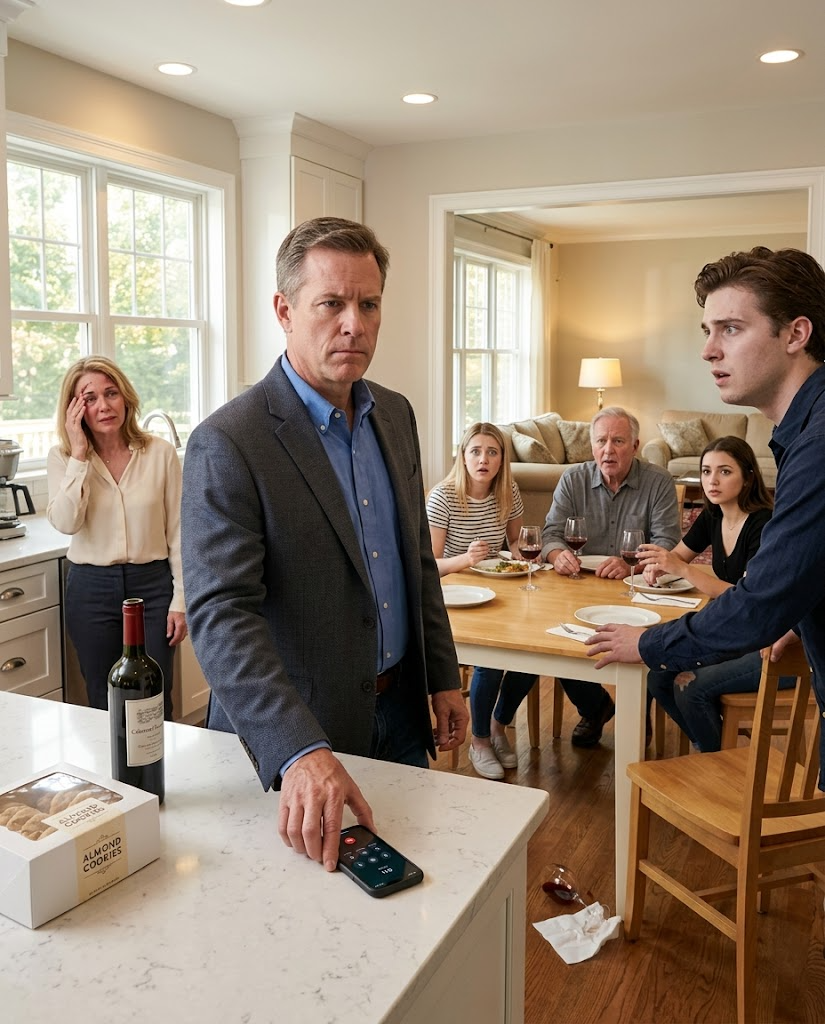
David lowered his wineglass just enough for the red wine to tremble against the rim.
Jessica’s fingers stayed suspended above the stem of her glass, and a paper napkin slid off the table near David’s shoe.
Nobody bent to pick it up.
Nobody moved.
I set my phone faceup on the counter.
The call timer glowed.
“911 is on the line,” I said.
Every face in that kitchen changed.
Michael stood halfway, then stopped when I lifted one hand.
“Nobody touch that folder,” I said.
David recovered first, because men like David often mistake volume for authority.
“This is a family matter,” he said.
“No,” I told him.
My voice sounded strange to me, flat and hard.
“This became a legal matter at 5:21 p.m.”
The dispatcher asked through the speaker if I was still safe.
I answered, “For now.”
Olivia’s mouth opened, but no words came out.
Jessica began shaking her head, not as a denial of what had happened, but as a denial of what it meant for her.
Michael looked past me toward the living room, and that was when Sarah pulled herself upright against the sofa.
She should not have had to stand.
She should not have had to make herself visible to be believed.
But she did, because women like Sarah learn early that people who injure them will often accuse them of exaggerating the damage.
“Tell him what you said,” she called from the living room.
Michael whispered, “Mom.”
The word was too small for the room.
Sarah’s hand was still pressed near her eyebrow.
“Tell him what you said when I told you my mother’s house was not for sale.”
The sirens were faint then, somewhere beyond our street.
David’s face went pale.
That was the first moment I understood he had not expected police.
He had expected a signature, a family argument, maybe a few tears, and then paperwork that could be explained later as misunderstanding and pressure and good intentions.
He had not expected the call to already be open.
He had not expected the dispatcher to be listening.
Michael looked at me, and the boy I remembered flickered there for one miserable second.
Then the man he had become swallowed him again.
“I said she was being selfish,” he admitted.
Sarah gave a small laugh that had no humor in it.
“That is not all you said.”
The knock at the front door came before he could answer.
Two officers entered first, followed by paramedics.
I stepped back from the counter with both hands visible.
The officer nearest me asked who was injured, and I pointed to Sarah.
The second officer looked at the table, the wineglasses, the doorway, and then the phone still lying faceup with the dispatcher connected.
He told everyone in the kitchen not to touch the documents.
That was when Michael began to understand.
Not when he saw his mother bleeding.
Not when he saw me standing there.
When an officer told him to keep his hands away from the folder, his expression changed from embarrassment to fear.
It made something in me ache, because regret that begins only at consequence is not regret.
It is math.
The paramedics cleaned Sarah’s brow in the living room while one officer spoke to me in the hallway.
I gave him the timeline.
I gave him the photographs.
I gave him the names.
At 5:18 p.m., I had arrived.
At 5:21 p.m., I had called 911.
Between those times, I had found my wife injured, heard laughter from the kitchen, and seen the documents prepared for a property transfer she had refused.
Sarah repeated her statement with a gauze pad held to her eyebrow.
Her voice shook, but it never changed.
She told them Michael had grabbed her arm.
She told them she pulled away and struck the table.
She told them David had kept saying the beach house was “dead equity” and that family should not hoard assets while others were drowning.
Olivia cried through most of her statement.
Jessica said almost nothing.
David said too much.
People who are used to selling themselves as reasonable often ruin themselves when they are finally forced to explain the unreasonable thing out loud.
He said no one had meant to hurt Sarah.
He said everyone was emotional.
He said Michael was under pressure.
He said the restaurant had employees and obligations and that Sarah did not understand business.
The officer let him talk.
That was smart.
By the time David stopped, he had described the pressure campaign better than I could have.
Sarah did not go to the hospital in an ambulance, because the paramedics said the cut looked manageable and she wanted me to drive her.
I told the officers we would cooperate with everything.
Before we left, Michael tried to come toward his mother.
The officer stopped him with one arm.
“Dad,” Michael said.
It was the same word he had used when he was seventeen and wrecked the bumper of my truck.
It was the same word he had used when he needed tuition help after changing majors.
It was the same word he had used every time he believed I would become a bridge between him and the consequences of his choices.
This time, I did not move.
Sarah looked at him once.
Then she looked away.
That broke him more completely than anything I said.
At urgent care, Sarah needed adhesive strips and a protective dressing.
The bruise bloomed darker by the hour, first red, then purple near the edge, and every time a nurse asked how it happened, Sarah answered in a voice that became steadier with repetition.
“My adult son grabbed my arm during an argument over property documents.”
She said it three times that night.
By the third time, she no longer looked ashamed.
That mattered to me.
Shame belongs to the person who brings papers into a mother’s house and tries to turn grief into collateral.
It does not belong to the woman who says no.
We did not go home immediately.
I drove us to a hotel near the clinic, checked in under my name, and watched Sarah sit on the edge of the bed with the little bakery box in her lap because she had asked me not to throw it away.
The almond cookies were cracked.
She opened the box anyway.
For a while, neither of us spoke.
Then she said, “Your face when you saw him.”
I thought she meant Michael.
She meant me.
“I was afraid you would hit him,” she said.
“So was I,” I told her.
She nodded, and in that nod was twenty years of knowing exactly when a man is choosing not to become his anger.
The next morning, we called an attorney.
Not Michael’s attorney.
Not anyone connected to David.
We called the lawyer who had helped Sarah handle her mother’s estate, the one who still had copies of the inheritance documents and the original deed.
By Monday, the beach house paperwork was reviewed, cataloged, and placed beyond easy reach of family pressure.
The attorney told us the attempted transfer had not been completed, and that mattered legally, but it did not erase what had happened emotionally.
A house does not have to be stolen to become the weapon someone tried to use.
The police report took longer.
There were interviews.
There were follow-up questions.
There were photographs, timestamps, statements, and the 911 recording, which captured more than Michael probably remembered saying.
The law moved in its own careful way.
Our household moved faster.
We changed the locks.
We changed the garage code.
We removed Michael from the emergency contact list at Sarah’s doctor’s office.
We told him all communication would go through writing for the time being.
David called once from a blocked number and left a message about misunderstandings.
I saved it.
Jessica sent Sarah a text that said she was sorry for how “things got out of hand.”
Sarah did not answer.
Olivia sent three messages.
The first defended Michael.
The second blamed David.
The third asked if Sarah would please say she had fallen by accident because “this could ruin everything.”
That was the one Sarah read twice.
Then she handed me the phone and said, “Save it.”
So I did.
Weeks passed before Michael sent a letter.
It arrived in a white envelope with our address written in handwriting I had known since he was a child.
Sarah put it on the kitchen table and left it there all day.
That night, she opened it while I stood at the sink pretending not to watch her.
He wrote that he was sorry.
He wrote that he had been desperate.
He wrote that David had made the investment sound like the only way to keep the restaurant alive.
He wrote that he never meant for her to get hurt.
Sarah read the last sentence out loud.
Then she folded the letter carefully and placed it back in the envelope.
“People always say they never meant for the damage,” she said.
Her voice was tired but clear.
“They only meant for the pressure.”
She was right.
Pressure is violence that still wants to be invited to Thanksgiving.
That year, Michael was not at our Thanksgiving table.
Neither were Olivia, David, or Jessica.
It was quieter than usual.
The silence hurt.
I will not pretend it did not.
I missed the boy who helped me fix that first car, the teenager who ate cereal straight from the box, the young man who once called his mother from college because he wanted her soup recipe.
But missing someone is not the same as permitting them back into the room where they learned they could harm you.
Sarah and I ate dinner at the small table near the window.
She wore a blue sweater because cream blouses had become something she avoided for a while.
The mark near her eyebrow had faded into a thin line you could miss unless you knew where to look.
I knew where to look.
Sometimes I caught myself looking too often.
One month later, we drove to the beach house.
The air was cold and smelled like salt.
The porch boards still popped under our feet.
Sarah unlocked the door and stood in the entryway for a long time, breathing in dust, wood, and memory.
Her mother’s mugs were still in the cabinet.
The blue shutters still needed repainting.
The little back bedroom still had curtains with tiny yellow flowers, faded from too many summers of sun.
Sarah walked from room to room touching things lightly, as if confirming they were still there and still hers.
On the kitchen counter, she found an old recipe card in her mother’s handwriting.
Almond cookies.
She laughed, and then she cried, and I stood beside her without trying to stop either one.
That house had almost been turned into a rescue plan for a failing restaurant.
Instead, it became the place where Sarah remembered that inheritance is not only money.
Sometimes it is proof that someone loved you before the world started asking what that love was worth.
Michael’s regret came quickly.
Repair did not.
Those are different things, and families get destroyed when people confuse them.
He asked for a meeting months later through a counselor.
Sarah agreed to one conversation, in a neutral office, with me beside her and clear rules written down before we arrived.
He cried.
He apologized without David’s name attached to every sentence.
He admitted he had known she did not want to sign.
He admitted he grabbed her arm.
He admitted he heard her crying from the kitchen and stayed there because he was afraid of what David would say if he helped her.
That admission was the one that changed Sarah’s face.
Not because it surprised her.
Because it finally matched what she had already lived.
She did not forgive him that day.
She did not punish him either.
She simply said, “You watched your mother bleed because you were afraid of disappointing another man.”
Michael put his hands over his face.
I looked away, not to spare him, but to spare myself the sight of my son understanding himself too late.
The last thing Sarah told him before we left was simple.
“You can rebuild trust only with truth, time, and no access to what you tried to take.”
That became the boundary.
No house keys.
No financial conversations.
No private visits.
No David.
No Jessica.
No pressure disguised as concern.
People sometimes ask, when they hear pieces of the story, whether I lost my son that night.
I tell them the truth.
I lost the version of my son I had been protecting in my head.
The real one had been sitting in my kitchen all along, laughing because he thought his mother’s pain was less urgent than his own wants.
Maybe he will become better.
I hope he does.
But hope is not a deed, not a signature, not a key, and not a reason to hand someone the weapon they already used once.
Sarah still owns the beach house.
The blue shutters have been repainted.
There is a new lock on the front door, and only two people have keys.
Every time we visit, I carry in groceries, and Sarah opens the windows before she does anything else.
The house smells like salt, old wood, and sometimes almond cookies.
On the mantel, she keeps a framed photo of her mother standing on the porch in a sun hat, laughing at something outside the frame.
Beside it, she keeps nothing from Michael.
Not yet.
Maybe someday.
Maybe not.
That choice belongs to Sarah.
The night I came home early, I thought I was bringing my wife wine and cookies.
Instead, I brought witnesses, a timestamp, and the one thing people like David never plan for.
I arrived before they could agree on a lie.
And when I remember Sarah on that living room floor, I no longer remember only the blood.
I remember the moment she stood in the doorway and made them hear her.
I remember her voice shaking, then steadying.
I remember my son learning that a mother’s silence is not consent.
Most of all, I remember that greed rarely kicks down the front door.
Sometimes it is already sitting in your kitchen, laughing.
And sometimes the only thing that stops it is coming home two days early, setting your phone on the counter, and refusing to let anybody touch the folder.