He Left His Bleeding Wife For A Birthday Trip. Court Heard Everything-iwachan

Eight days after I gave birth, I learned how quiet a house can become when someone decides your pain is inconvenient.
Not peaceful.
Quiet.
The kind of quiet that lets you hear a sprinkler ticking across the lawn, a dog barking two houses down, and your newborn trying to cry himself hoarse because the only adult left in the room cannot stand up.
Parker had been born on a Thursday morning after a labor that left me shaking so hard the nurse tucked a warm blanket around my shoulders and told me to breathe one minute at a time.
Tyler cried when he held him.
People love that part of the story because it sounds like proof.
A man crying in a hospital room looks like a promise.
He kissed Parker’s forehead, took pictures for his family, and told everyone in the group chat that he had never loved anything more.
Then he went into the hallway to answer birthday texts.
That was Tyler.
He knew how to look devoted where other people could see him.
At home, devotion became something he scheduled around himself.
The first week with Parker was a blur of alarms, feedings, sore stitches, milk leaking through cotton, and the sour smell of burp cloths piled beside the rocking chair.
I slept in pieces.
Twenty minutes here.
Forty there.
I learned the sound Parker made before a full cry, a tiny hitch in the back of his throat like a match being struck.
Tyler learned how to say, “I have work tomorrow,” even on nights when he did not have work tomorrow.
His thirtieth birthday had been planned for months.
A cabin in the Blue Ridge Mountains.
A hot tub.
Private dinner.
His friends.
I told him before Parker was born that the trip felt too close to the due date.
He laughed and kissed my forehead.
“Liv, you worry too much,” he said.
That was the trust signal I ignored.
He always made dismissal sound like affection.
On the eighth day, the nursery smelled like baby lotion, warm laundry, and copper.
I did not want to admit that last smell.
I kept telling myself it was just my body doing what bodies do after birth.
The hospital discharge packet was on the dresser.
The nurse at the hospital intake desk had circled the warning section in red pen before we left.
Heavy bleeding.
Dizziness.
Weakness.
Call immediately.
Tyler had stood beside me holding Parker’s car seat and nodding like a man who could be trusted with an emergency.
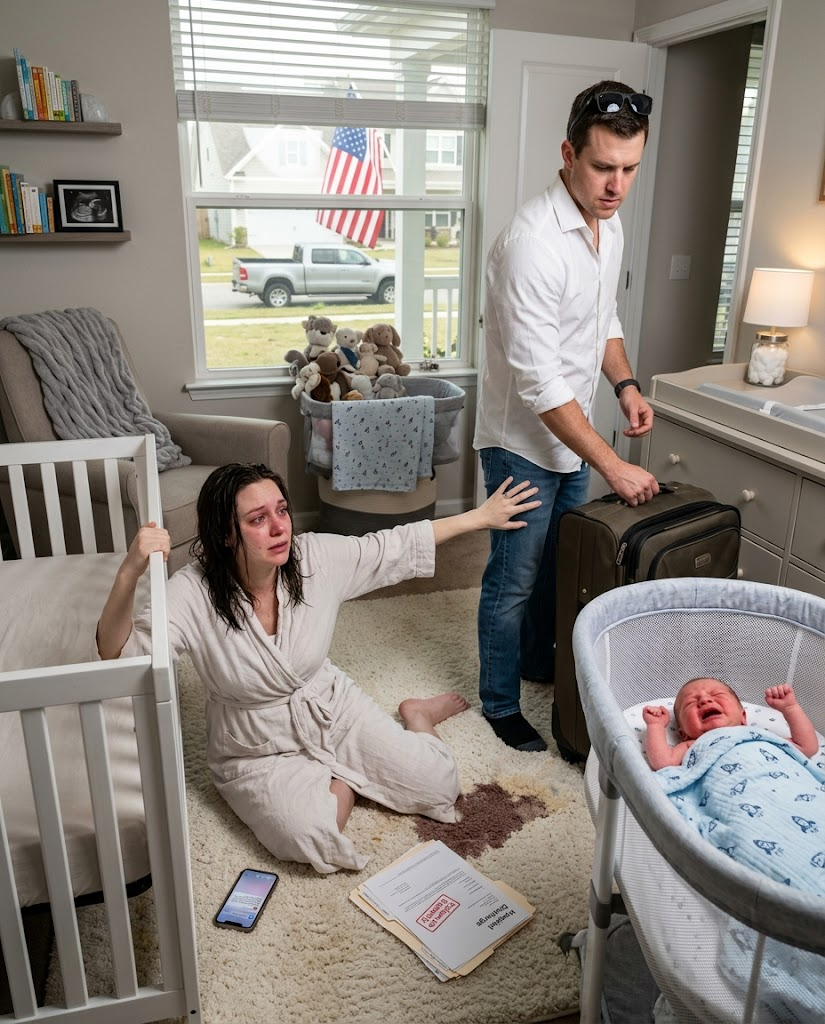
At 2:14 p.m. that Friday, I was on the nursery floor with one hand wrapped around the crib rail and the other pressed against my stomach.
The cream carpet under my knees was turning dark.
Parker was in his bassinet, kicking inside a striped sleeper, his face red and furious with need.
I called Tyler once.
Then again.
He came out of the closet already dressed for the weekend, sunglasses on his head, new white shirt on, cologne sharp enough to cut through the smell in the room.
His suitcase was open on the changing table where Parker’s wipes and diapers should have been.
“Tyler,” I said, “I need to go to the hospital.”
He looked at me like I had asked him to cancel a holiday because I was bored.
“Here we go again.”
I remember those words because they landed before the pain did.
“My mom said all women bleed after giving birth,” he said. “You’re not the first woman in the world to have a baby.”
“This is different,” I said.
My voice sounded far away from me.
Parker started crying.
I tried to turn toward him, but my arm trembled and slid.
Tyler saw that.
He saw it.
That is the part nobody can talk me out of.
He saw the carpet.
He saw my face.
He saw the baby crying less than three feet from me.
For half a second, fear crossed his face, and if he had moved then, even after everything, I might have forgiven the first delay.
But pride is faster than mercy in some people.
His jaw hardened.
“You always do this,” he said. “You make everything about you.”
I said, “Call an ambulance.”
He laughed without humor.
“An ambulance? So everybody can say I’m the bad guy because I left to celebrate my birthday?”
There it was.
Not concern.
Not confusion.
Image management.
He was not afraid I would die.
He was afraid people would think poorly of him if I almost did.
A selfish man will call your emergency attention-seeking because admitting the truth would make him responsible.
Not scared.
Responsible.
He grabbed the zipper of his suitcase and pulled it shut.
The sound was small and ugly.
I reached for his pant leg.
“Tyler, please. Look at me.”
He jerked away.
“If you’re bleeding that badly, put a towel on it and stop ruining my birthday.”
Then he walked out.
From the hallway, he shouted that he was putting his phone on airplane mode because he did not want crying messages.
The door slammed.
The nursery window rattled.
Parker screamed harder.
For a few seconds, I listened to Tyler’s truck back down the driveway.
The engine faded past the mailbox, past the neighbor’s hedge, past the private street where everyone’s lawns looked too neat for the kind of thing happening in my house.
My phone was on the dresser.
I stretched for it.
The carpet scraped my elbow.
My fingertips caught the edge of the case, and the phone fell face-up beside me.
The screen lit.
A notification slid down.
Tyler posted a story.
His hand was on the steering wheel.
His watch caught the sunlight.
The road opened ahead of him like a reward.
“On the way to Blue Ridge,” the caption said. “Meat, whiskey, friends, and zero drama.”
I do not remember deciding to survive.
I remember Parker crying.
I remember the discharge packet half under the crib.
I remember the red line that said to call 911.
I remember trying to say “Hey Siri” and getting only air the first time.
The second time, my voice cracked.
The third time, the phone answered.
When the emergency operator picked up, I was crying so hard I could barely say our address.
The 911 call log later showed 2:32 p.m.
That timestamp became one of the first things my attorney circled in black ink.
The operator kept me talking.
She asked if I could unlock the front door.
I said no.
She asked if anyone else was in the house.
I said, “My baby.”
Then I heard myself say, “My husband left.”
There are sentences you do not understand until you hear them outside your body.
My husband left.
The neighbor who had been watering plants heard the siren before I did.
She was the one who came running to the porch when the ambulance pulled in.
She was the one who held Parker while two paramedics lifted me from the nursery floor.
I saw her face when she stepped into the room.
She looked at the carpet.
Then at me.
Then at the baby.
She did not ask a single question.
That kind of silence can be kinder than comfort.
At the hospital, the ceiling lights passed over me in white rectangles.
Someone asked how many days postpartum.
Someone asked if I had passed out.
Someone asked whether my husband was coming.
I said, “He’s in Blue Ridge.”
Nobody responded to that the way people do in movies.
Nobody gasped.
Nobody cursed him.
They just moved faster.
The hospital intake form listed me as postpartum emergency, eight days after delivery.
The nurse put Parker’s tiny receiving blanket in a plastic bag because it had been on the nursery floor.
Another nurse wrote my answers into the chart.
Time symptoms began.
Time emergency call placed.
Person present at onset.
Spouse departed residence.
That last line looked clinical.
It felt like a knife.
Tyler’s mother arrived at the hospital with her hair still wet from the shower and guilt all over her face.
She had called me back because Tyler had complained to her first.
“He said you were being dramatic,” she whispered.
I did not have the strength to answer.
She stood beside Parker’s bassinet and cried without touching him, as if she was afraid she had lost the right.
Maybe she had.
Maybe she had only repeated the kind of nonsense women repeat when they want their sons to remain innocent.
All women bleed.
All wives exaggerate.
All mothers survive because everybody needs them to.
I survived because strangers believed me faster than my husband did.
Tyler did not call until the next afternoon.
His first words were not “Are you okay?”
They were, “Why is my mom blowing up my phone?”
I was too weak to hold the phone, so his mother put it on speaker.
The room went still.
I could hear music behind him.
Men laughing.
A door opening and closing.
I said, “I’m in the hospital.”
He exhaled like I had inconvenienced him again.
“Seriously, Olivia?”
His mother closed her eyes.
The nurse beside my bed looked down at the chart and said nothing.
That call lasted forty-six seconds.
The phone record later showed the duration.
Forty-six seconds was all he gave the wife he had left bleeding on the floor.
He came back Sunday evening sunburned.
That is one detail I hate remembering, but it matters.
His face was red from mountain sun.
His neck had a tan line.
He smelled like smoke, beer, and hotel soap when he walked into our house expecting a fight he could win with volume.
Instead, the house was quiet.
Parker was with me at the hospital.
His mother had taken the spare key.
The nursery door was open.
The cream carpet had dried.
The truth was still there.
Dark.
Spread wide.
Impossible to explain away.
He stood in that doorway and finally saw what he had stepped around.
The neighbor saw him see it because she had come over to leave a casserole on the porch.
His mother saw him see it because she was behind him with a trash bag full of Parker’s laundry.
Everyone says later that Tyler’s face changed.
Not with sorrow.
With calculation.
He looked at the stain.
Then at his mother.
Then at the neighbor.
Then he said, “Why didn’t anybody clean this up?”
That sentence did more damage to him than any screaming could have done.
His mother slapped her hand over her mouth.
The neighbor turned and walked off the porch without leaving the casserole.
Tyler called me seventeen times that night.
I did not answer.
At 9:08 p.m., he texted, “You’re making this bigger than it was.”
At 9:11 p.m., he texted, “You know I didn’t think it was serious.”
At 9:17 p.m., he texted, “Do not let my mom turn you against me.”
At 9:23 p.m., he texted, “We need to control the story.”
There it was again.
The story.
Not the marriage.
Not the baby.
Not the body he had left on the floor.
The story.
I took screenshots because competence sometimes looks cold from the outside.
It is not cold.
It is what you do when your hands have finally stopped shaking.
My mother came to the hospital the next morning and packed my bag without asking whether I wanted to go home to Tyler.
She folded Parker’s sleepers.
She found my insurance card.
She placed the hospital discharge summary, the 911 call number, and the printed screenshot of Tyler’s Blue Ridge story into a folder.
Then she wrote the date on the front.
That was my mother’s way of loving me.
No speech.
No revenge fantasy.
Just a folder with tabs.
When I was discharged, I did not go back to the house alone.
A deputy met us there while I gathered what belonged to Parker and me.
That was not dramatic.
It was procedural.
I packed diapers, bottles, the bassinet sheet, three nursing bras, my medication, and the framed ultrasound Tyler used to show people when he wanted credit for wanting a baby.
The nursery carpet was photographed.
The discharge packet was photographed.
The suitcase mark on the changing table was photographed because he had used our son’s changing table to pack for a birthday trip while I was asking for an ambulance.
I did not take the crib.
I could not look at it yet.
Tyler came home while we were still there.
He stood in the driveway with his arms out like he was the injured party.
“Olivia, come on,” he said. “You’re really doing this in front of people?”
My mother put Parker’s diaper bag into her SUV and did not look at him.
The deputy told Tyler to stay back.
For the first time since I had known him, Tyler obeyed someone immediately.
Power had always understood him better than love did.
The first hearing was in a county family court building with a flag outside the entrance and vending machines humming near the hallway.
I sat on a wooden bench with Parker’s car seat at my feet and my hospital wristband still folded inside my purse.
Tyler arrived in a navy shirt, freshly shaved, with the tired face of a man who had practiced looking sorry in the mirror.
His friends came with him.
So did his mother.
So did mine.
The hallway felt too bright.
Every cough echoed.
Every shoe squeaked.
He tried to approach me before the hearing.
“Liv,” he said softly, because soft voices are useful when there are witnesses.
I looked at his shoes.
They were clean.
I thought of the nursery carpet.
Then I looked away.
Inside the courtroom, the judge asked questions in a voice that did not rise.
That scared Tyler more than anger would have.
Anger gives men like him something to fight.
Calm makes them stand still and listen.
My attorney presented the hospital intake record.
Then the 911 call log.
Then the discharge warning sheet.
Then the screenshot from Tyler’s story, posted minutes after he left the house.
Then the text where he wrote, “We need to control the story.”
Each item sounded small by itself.
Together, they made a shape no excuse could soften.
Tyler’s attorney tried to say he believed I was experiencing normal postpartum bleeding.
The judge looked at the photo of the nursery carpet.
Then at Tyler.
Then back at the file.
“Mr. Hayes,” she said, “are you saying you saw this and believed it required no medical attention?”
Tyler swallowed.
His mother lowered her head.
That was the moment the room changed.
Not when I cried.
Not when my attorney spoke.
When his own mother could not look at him.
He started explaining.
He said he had been under stress.
He said I had been emotional during pregnancy.
He said his birthday weekend had been prepaid.
He said his friends were already on the way.
He said his phone was on airplane mode.
Every sentence made the silence deeper.
My attorney waited until he finished.
Then she played the short clip from his own story.
Tyler on the cabin driveway.
Sun on his face.
Friends laughing behind him.
A drink in his hand.
Someone off-camera asking, “Man, your wife really let you come?”
Tyler laughing.
Tyler lifting the drink.
Tyler saying, “She’ll live. She just loves drama.”
No one moved.
The judge did not blink.
His mother made a sound so small I almost missed it.
One of his friends, sitting behind him, stared at the floor as if the tile had become fascinating.
Tyler looked back at them, maybe expecting loyalty.
He got a row of averted faces.
That is how some men lose everything.
Not with one explosion.
With a room full of people finally refusing to help them pretend.
The judge issued temporary orders that day.
Parker stayed with me.
Tyler’s visitation was supervised pending review.
He was ordered not to come to my mother’s house.
The divorce filing moved through the county clerk the following week.
Those are plain sentences for enormous things.
Custody order.
Medical record.
Police report.
Divorce petition.
The language was dry because paperwork does not care how much your heart is breaking.
It only asks what happened, when it happened, and who can prove it.
Months later, people still asked whether I hated him.
I did not know how to answer.
Hate sounds active.
What I felt was cleaner.
I no longer trusted him with my fear.
That is a different kind of ending.
Tyler tried apologies after the court hearing.
Long texts.
Emails with subject lines like “Please read.”
Voice messages where he cried in the first ten seconds and blamed stress by the thirtieth.
He said he panicked.
He said he was ashamed.
He said he did not understand how bad it was.
The problem was that I had begged him to understand.
I had put the truth at his feet.
He stepped around it with a suitcase.
Parker grew.
He became a baby with fat wrists and serious eyes.
He learned to smile at ceiling fans.
He learned to grab my finger while he drank his bottle.
He learned that when he cried, someone came.
That mattered to me more than anything.
I wanted his first lesson about love to be ordinary and reliable.
Not loud.
Not performative.
Not conditional on whether someone had weekend plans.
One afternoon, after the carpet had finally been removed from the nursery, my mother asked if I wanted to keep anything from that room.
I kept the crib.
I kept the blanket.
I kept the discharge packet, not because I wanted pain framed in a file, but because I needed to remember that I had not imagined the danger.
The paper had been there.
The warning had been there.
My voice had been there.
And so had his choice.
The house sold before the divorce was final.
Tyler fought about money longer than he fought for access to Parker.
That told me what court had only confirmed.
He had loved the version of family that made him look like a man.
He had not loved the work of being one.
The final hearing was quieter than the first.
No friends this time.
No performance.
Just Tyler, his attorney, my attorney, my mother in the back row, and Parker asleep against my chest in a soft blue sleeper.
The judge reviewed the agreement.
Tyler stared at the table.
When it was done, he turned once like he wanted to say something.
Maybe sorry.
Maybe unfair.
Maybe another sentence about how nobody understood him.
I did not wait to find out.
I carried my son into the courthouse hallway, past the bulletin board, past the vending machines, past the flag by the door.
Outside, the air smelled like cut grass and hot pavement.
Parker stirred against me.
His tiny hand opened and closed on my shirt.
For the first time in months, I did not feel like I was escaping.
I felt like I was leaving.
There is a difference.
Escaping means the danger still owns the story.
Leaving means it does not get the last word.
Eight days after giving birth, I was bleeding in the baby’s room while my husband zipped up his suitcase and told me to stop ruining his birthday.
He came back sunburned and found the dried truth on the carpet.
But the truth did not end on that floor.
It followed him into a courtroom, into a file, into the mouths of witnesses who could no longer protect him, and into the quiet life I built after I finally understood that survival is not the same thing as forgiveness.
My son was crying, and I could no longer get my knees underneath me.
That was the beginning.
The ending was me standing under a bright courthouse sky, holding Parker close, knowing the next time he cried, nobody would have to beg a man like Tyler to care.