He Said Divorce at Dawn. The File She Opened Changed Everything-iwachan
At 4:30 a.m., the front door opened with the small, ordinary click that should have belonged to a husband coming home quietly.
It did not sound like the beginning of the end of a marriage.
It sounded like a key turning in a lock, a refrigerator humming in the dark, and bacon grease beginning to smoke because I had been cooking with one hand while holding my two-month-old son with the other.
The kitchen tile was cold under my bare feet.
The coffee had burned bitter in the pot.
Our son slept against my chest, his cheek warm through my T-shirt, his fist closed so tightly around the fabric that I had to move slowly just to keep from waking him.
Mark’s parents were supposed to arrive at eight.
His sister had made that clear at 1:17 a.m., when she texted to remind me that his mother liked her eggs soft and her toast dry.
That text had not asked whether the baby was sleeping.
It had not asked whether I had slept.
It had not asked why Mark was still out the night before a family breakfast.
In Mark’s family, service was treated like love only when a woman performed it quietly.
If she questioned the terms, they called it attitude.
I knew that pattern before I married him, but I used to think I could out-kind it.
For ten years before that morning, I had been trained to distrust patterns that looked too clean.
Mrs. Henderson had taught me that in conference rooms that smelled of stale coffee and printer toner, back when I was a senior corporate auditor and not yet the wife who knew which serving bowl Mark’s mother preferred.
She taught me to read ledgers the way other people read confessions.
She taught me that fraud rarely announces itself with a dramatic mistake.
It whispers through timing, repetition, and a number that keeps appearing where it should not.
When I met Mark, that skill impressed him.
He used to tell people at dinner parties that I could find money in a locked room with the lights off.
He liked being married to a woman with a sharp mind until that mind turned toward him.
The first year of our marriage, he was proud of my work.
The second year, he began saying the travel was too much.
His mother said babies needed present mothers.
His sister said Mark deserved a calm home.
Mark said he was not asking me to give anything up forever.
That was the trust signal I gave him.
I stepped back.
I moved my files into boxes, learned his family’s rhythms, signed household paperwork he placed in front of me, and let him believe domestic exhaustion had made me less observant.
It had not.
Eight months before he said the word divorce, I saw the first transfer.
It was small enough to look boring.
That was what made it interesting.
A payment labeled HOME EXPENSES appeared in a folder that had nothing to do with our mortgage, utilities, groceries, or repairs.
Then came a vendor advance.
Then came a consulting fee.
Then came a bank transfer scheduled at 2:13 a.m., routed through an account Mark had never mentioned.
I did not confront him.
Confrontation teaches careful liars to clean faster.
I took screenshots.
I copied account numbers.
I printed wire transfer ledgers when he was in the shower and returned the pages to their folders in the same order.
I found a county clerk filing connected to a property Mark had sworn he never owned.
I kept the documents behind the loose back panel of my nightstand because Mark never opened anything in our bedroom that looked practical.
He saw diapers, nursing pads, and folded towels.
I saw evidence.
By the time our son was born, I understood something was wrong, but I did not yet understand how close it was to the people sitting at our table every holiday.
Then came that morning.
Mark stepped inside wearing the same navy suit he had left in the night before.
His tie hung loose, his hair was damp from fog, and there was a scent on him that did not belong to our laundry detergent or our house.
He looked at the table I had set.
Folded napkins.
Clean plates.
A baby bottle warming in a mug of water.
A skillet full of breakfast for his family.
Then he looked at me like I was already something he had finished using.
“Divorce,” he said.
It was not shouted.
That made it worse.
A shouted word can be explained as anger.
A quiet word at 4:30 a.m., spoken to a woman holding your newborn son, is not an accident.
It is a decision.
For a second, my pulse hit so hard I thought the baby would startle awake.
He only shifted against me and breathed into my shirt.
I did not ask who she was.
I did not ask whether his parents knew.
I did not ask how long he had been rehearsing that single word on the drive home.
I reached over and turned off the stove.
The flame died with a soft little click.
Mark frowned as if I had missed my line in a play he had staged for himself.
“Did you hear me?”
“I heard you.”
My voice sounded so calm that it frightened me.
Inside, something had gone cold and precise.
I walked past him into the bedroom, opened the closet, and pulled out the old navy suitcase I had owned before I took his last name.
I did not pack like a woman leaving in panic.
I packed like an auditor preparing a file.
Diapers.
Bottles.
Two sleepers.
My laptop.
My birth certificate.
The baby’s hospital discharge papers.
The folder from behind the loose back panel of my nightstand.
My hands did not shake.
That scared me more than crying would have.
Mark followed me as far as the hall, but he did not come close enough to help and did not stay far enough to look innocent.
“What are you doing?”
“Leaving.”
“With what money?”
I folded the second sleeper and placed it beside the bottle brush.
That was when he smiled, just a little.
It was not happiness.
It was calculation.
He thought the bank accounts were the marriage.
He thought the house was the marriage.
He thought I had become dependent enough to mistake his permission for oxygen.
By 4:52 a.m., I was in the driveway with my son buckled into his car seat, my suitcase beside my old SUV, and the porch flag tapping in the wind.
Mark stood in the doorway with his phone in his hand.
“Where are you going?” he asked.
“Out.”
He gave a small laugh, like I was making a scene that would embarrass only me.
He thought I meant my mother’s house.
He thought I meant a motel.
He thought I would return before lunch because his parents would arrive and someone still had to serve breakfast.
Men like Mark do not fear quiet women.
They mistake restraint for permission.
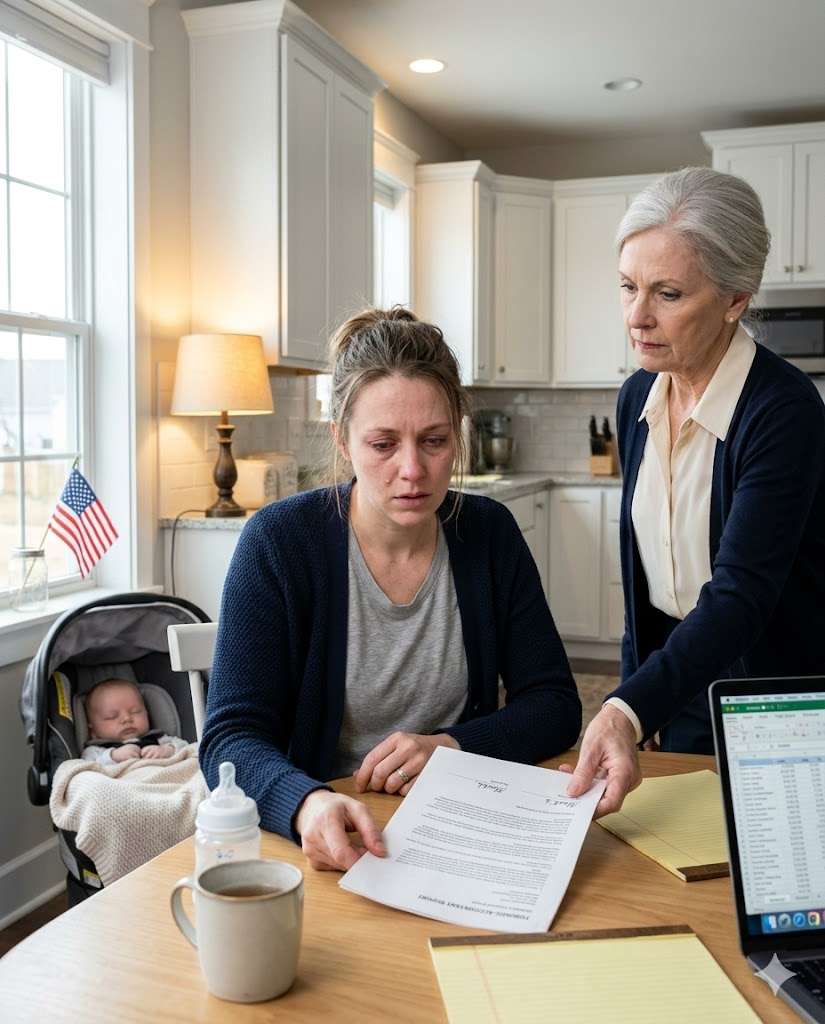
At 6:08 a.m., I sat at Mrs. Henderson’s kitchen table.
Her house smelled of peppermint tea, lemon furniture polish, and old books.
A small American flag stood in a jar beside her window, next to tax journals stacked so neatly they looked like they had been cross-examined.
She opened the door in a robe and slippers, took one look at the baby carrier in my hand, and did not ask me whether I was sure.
That was why I had gone to her.
Some women ask for the story.
Mrs. Henderson asked for the evidence.
“He said it while you were holding the baby?”
I nodded.
“And you left?”
“I packed one suitcase.”
She looked at the suitcase, then at me, then at the sleeping child at my feet.
“Good,” she said.
The word had no comfort in it.
It had strategy.
“Let him think that was all you had.”
I told her his family thought I was helpless.
She slid a yellow legal pad toward me.
“No,” she said, “they need you to be helpless. That’s different.”
At 7:31 a.m., Mark’s mother called.
I let it ring.
Then his sister called.
I let that ring too.
Mark called three times.
At 8:04, his text arrived.
My parents are here. Don’t embarrass me.
I stared at the message until the words stopped looking like words and started looking like a confession.
Even then, he was not asking where his son was.
He was asking whether breakfast would be served without damage to his image.
I opened my laptop.
The sound of the keys under my fingers steadied me.
Mrs. Henderson put tea beside me, took the baby when he stirred, and told me to start at the first unexplained transfer.
For the next ninety minutes, my old life returned through muscle memory.
I named folders.
I sorted dates.
I separated screenshots from ledgers, ledgers from county filings, county filings from account authorizations.
I did not write emotional labels.
I wrote what auditors write.
Date.
Source.
Account.
Authorized by.
Not authorized by me.
At 9:46 a.m., Mark texted again.
You’ll get nothing if you make this ugly.
I read it once.
Then I read it again, because threats often reveal what people fear before they reveal what they plan.
He still believed I was fighting over marriage.
He did not realize I was documenting exposure.
Mrs. Henderson called a forensic accountant she trusted.
She did not explain my pain to him.
She explained the pattern.
Shell company.
Midnight transfer.
Vendor account.
County clerk filing.
Possible marital asset concealment.
Possible unauthorized movement of funds.
Within an hour, the first report came through.
The printer beside Mrs. Henderson’s pantry began to cough out pages.
The baby slept through it.
I remember that more clearly than anything else.
The machine rattled and clicked, documents landing one by one in the tray, while my son slept with his mouth soft and open, innocent of all the adult ruin being laid out in black ink.
Mrs. Henderson picked up the first packet.
She did not rush.
She never rushed around evidence.
She placed the report in front of me and tapped the account opening date.
“Start here.”
The account had been opened three weeks before the baby was born.
The signature was Mark’s.
The transfer beside it was not one I had authorized.
And underneath the authorization chain was a name that made the whole kitchen go still.
It was his mother.
Not an assistant.
Not a business partner.
Not a mysterious girlfriend whose existence would have at least made the betrayal simple.
His mother’s legal name sat there beside the authorization as if she had always belonged inside the secret.
For a long moment, neither Mrs. Henderson nor I spoke.
The house seemed to hold its breath.
The refrigerator hummed.
The tea cooled.
My son made one tiny sleeping sound from the car seat, and it almost broke me.
Then Mrs. Henderson removed her glasses.
“He pulled her into it,” she said softly.
“No,” I said, because the shape of it had finally become clear. “She was already there.”
That was the moment my grief changed form.
It stopped being humiliation.
It became evidence with a pulse.
The county clerk filing showed the property Mark had denied owning.
The HOME EXPENSES folder showed payments tied to that property.
The wire transfer ledger showed money moving out of marital accounts in patterns designed to look ordinary.
The report showed his mother’s name connected to authorization documents before our son was even born.
I thought about every time she had walked through my kitchen and corrected the way I folded napkins.
I thought about the toast.
I thought about the eggs.
I thought about her asking whether I had planned to go back to work or whether I was finally “settling into real family life.”
She had not wanted me at home because she respected motherhood.
She wanted me away from numbers.
Mark called while I was still looking at the signature.
I put him on speaker.
In the background, I heard dishes and his sister’s voice asking whether I had come to my senses.
Mark spoke low.
“Whatever you think you found, you don’t know what it means.”
Mrs. Henderson tapped the circled name and mouthed one word.
Client.
I understood then that the account was not merely family money being hidden.
It touched money Mark had moved through a business relationship he had told me was routine.
That changed the shape of everything.
Mrs. Henderson wrote three instructions on the yellow legal pad.
Do not argue.
Do not warn him.
Preserve everything.
So I did not argue.
I told Mark only one thing.
“You asked for divorce at 4:30 a.m. while I was holding our son.”
He laughed once, sharp and nervous.
“You’re being dramatic.”
“No,” I said, staring at his mother’s name. “I’m being accurate.”
After that, I stopped answering him.
The next hours were not cinematic.
They were printer toner, passwords, certified copies, and a baby who needed to eat while my whole life became exhibits.
Mrs. Henderson contacted an attorney before noon.
The forensic accountant preserved the files in a clean chain.
I forwarded nothing from my personal email until I was told how to do it properly.
That mattered.
Rage feels satisfying in the moment, but evidence survives longer when it is handled like evidence.
By the next morning, Mark had sent apologies, threats, questions, and one message that only said, We need to talk without lawyers.
That was the first message that made Mrs. Henderson smile.
“Now he understands what room he is in,” she said.
His mother called that afternoon.
Her voice was not commanding anymore.
It was thin.
She said there had been misunderstandings.
She said family paperwork could look confusing.
She said I needed to think about the baby.
I looked at my son sleeping in the bassinet Mrs. Henderson had pulled from her attic, and for the first time since Mark came home, I almost laughed.
“I am,” I said.
The legal process did not happen overnight.
Nothing real does.
Temporary custody came first.
Then financial disclosures.
Then preservation orders.
Then the kind of silence that arrives when people who used to speak loudly discover every word might be read back to them later.
Mark tried to say I had abandoned the house.
My attorney placed the 4:30 a.m. timeline, the 4:52 a.m. departure, the baby’s hospital discharge papers, and his 8:04 a.m. text into the record.
My parents are here. Don’t embarrass me.
That message did more damage than he expected.
It showed what mattered to him in the first hours after his wife and newborn son left.
Not safety.
Not the child.
Not reconciliation.
Breakfast.
Image.
Control.
The forensic accountant traced the transfers.
The account opened three weeks before the baby was born became the center of the case.
The property Mark swore he never owned became impossible to deny once the county clerk filing, payment trail, and HOME EXPENSES folder were placed side by side.
His mother’s role became uglier because she had signed enough to understand exactly what she was helping protect.
She tried to say she was only following Mark’s instructions.
That might have sounded believable if she had not called me helpless for months.
There is a special kind of cruelty in people who need you dependent and then blame you for needing help.
The day Mark finally sat across from me in mediation, he looked smaller than he had in our doorway.
Same navy suit.
Different face.
No fog in his hair this time.
No perfume hiding under soap.
Just a man surrounded by papers he had thought his wife would never understand.
He said, “I didn’t think you’d take it this far.”
I looked at him for a long moment.
That was the closest he ever came to honesty.
He had not said he thought I was wrong.
He had not said he thought he was innocent.
He had said he miscalculated me.
I remembered the cold tile, the burnt coffee, the warm weight of our son, and one word dropped into the kitchen like a blade.
Divorce.
“I know,” I said.
The settlement came before testimony.
People like Mark love the sound of court until discovery begins speaking in complete sentences.
I received primary physical custody.
The hidden assets were accounted for in the divorce.
The property he swore he did not own was no longer a secret he could use against me.
The accounts were reviewed, the improper transfers were documented, and his mother stopped calling me before breakfast.
I did not become triumphant.
That is a story people like to imagine because it feels cleaner.
The truth is quieter.
I became tired, careful, and free.
I moved into a smaller place with better light.
The first morning there, my son woke before dawn and I carried him to the kitchen while coffee brewed.
The tile was warm from the little rug I had bought for myself.
There was no skillet full of food for people who would never thank me.
There was no text telling me how someone wanted her eggs.
There was only my baby, my own breathing, and a silence that did not demand performance.
Months later, when the divorce was final, I found the old navy suitcase in the closet and left it there.
Not because I planned to run again.
Because I liked remembering that I could leave with one suitcase and still carry everything that mattered.
At 4:30 A.M., my husband came home, saw me holding our 2-month-old baby while I cooked breakfast for his whole family, and said one word: “Divorce.”
I didn’t cry.
I didn’t beg.
I turned off the stove, packed one suitcase, and left.
He thought I had nothing.
He forgot what I did before I became his wife.
And in the end, that was not revenge.
It was the audit he never expected to survive.