Advertisement

He Shamed His Marine Daughter At His Wedding—Then The Room Turned-iwachan

The microphone squealed before my father said the sentence he had been saving for years.

Advertisement

The sound cut through the American Legion hall and made people flinch over their paper plates.

Advertisement

The room smelled like barbecue sauce, stale coffee, and old smoke trapped in the ceiling tiles.

Plastic cups sweated on folding tables, gold streamers trembled under the air conditioner, and a small American flag leaned in its holder near the stage like even it was tired of pretending this was a normal wedding reception.

I was holding a paper coffee cup when my father raised his champagne glass.

I remember the sticky rim against my palm.

I remember Denise Calloway, his new wife, standing beside him with one hand tucked into his elbow like she had just taken possession of him in front of witnesses.

“The first thing I want to say,” my father told the room, “is that I finally got myself a real family.”

A few people laughed because people in rented halls often mistake cruelty for a toast when a microphone tells them to.

My name is Major General Laura Whitaker, United States Marine Corps.

At 08:10 that morning, I had stood on a polished stage at the Veterans Memorial Center and signed a citation packet with my name printed beneath the seal.

A staff sergeant had placed the folder at my left hand.

Young Marines had straightened when I entered the room.

The order sheet, program, and time block had all been checked twice because military ceremonies leave less room for improvisation than families do.

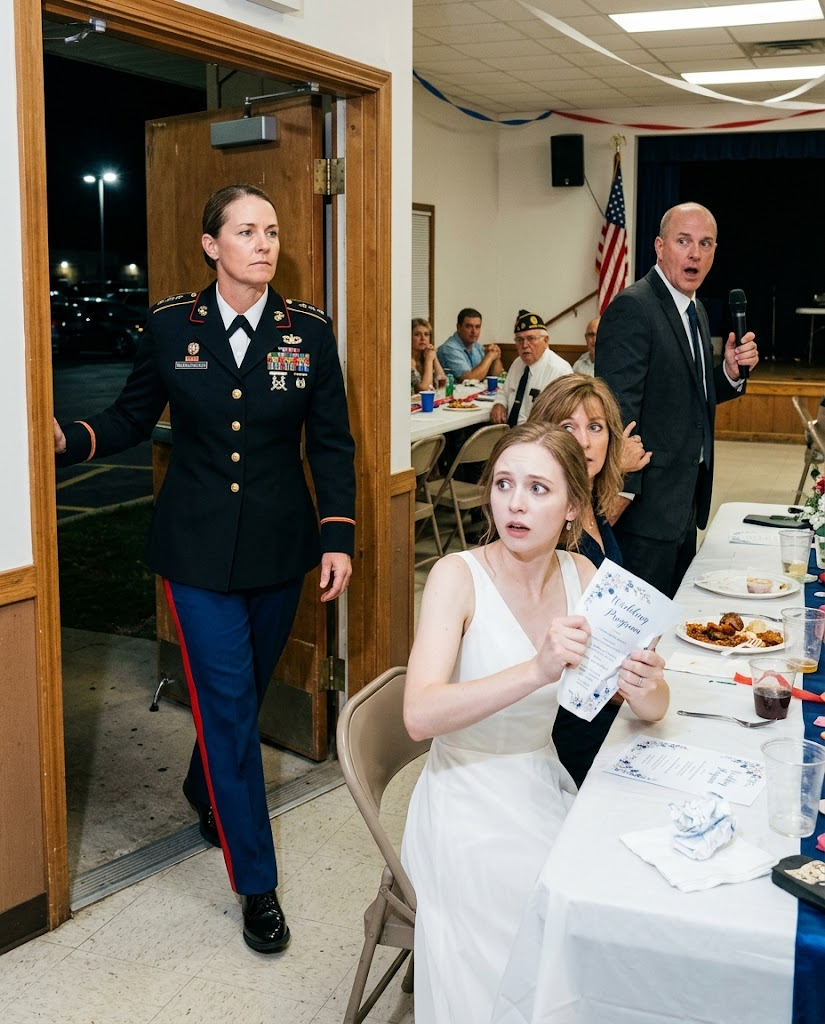
By 7:18 that evening, I was standing near the back of my father’s wedding reception while he looked straight at me and said into the microphone, “She’s nothing but a bastard.”

The word did not surprise me.

It landed like an old bruise pressed by a familiar thumb.

He did not mutter it.

He did not soften it with a joke.

He said it with a microphone in one hand, a champagne glass in the other, and a room full of relatives, neighbors, veterans, friends, and strangers waiting to see what would happen next.

Then he reached for Ashley.

Ashley was Denise’s daughter, newly polished by the day, standing near him with a folded wedding program in her hand.

My father drew her closer and said, “This is my real daughter. This is the one who carries my name the right way.”

The room froze around those words.

Read More

A glass stopped near Aunt Carol’s mouth.

Someone’s spoon kept tapping the edge of a bowl because the hand holding it had not caught up with the conscience attached to it.

An old Marine at the far table stared at the exit sign instead of at me.

Denise smiled.

It was the satisfied smile of a woman watching a door close behind somebody else.

Ashley stood a little taller for half a second because she thought the room had just applauded her new place in the family.

Then she looked around and saw faces dropping, eyes lowering, and napkins lifting to mouths that had nothing to cough about.

Silence can be a choice.

That night, it wore dress shoes and called itself manners.

I tightened my hand around the coffee cup until the cardboard bent.

There are insults meant to wound you, and there are insults meant to erase you.

My father had practiced both.

A wound says, “I want you hurt.”

Erasure says, “I want witnesses to agree you were never worth naming.”

For one hot second, I imagined walking to the stage, taking the microphone from his hand, and letting every person there learn exactly what authority sounds like when it stops being polite.

But my mother had not raised me to confuse volume with strength.

She raised me on double shifts, late rent, grocery lists written on envelopes, and a blue folder full of every piece of paper that proved I had kept moving.

Report cards.

School certificates.

Enlistment paperwork.

Promotion orders.

The first photograph of me in dress blues.

My mother believed paper could outlive gossip.

She believed records mattered because people who lied about your worth usually counted on you having no proof.

My father had moved through our lives like weather damage.

Promises first.

Damage next.

Absence after that.

When I was thirteen, I heard him tell my mother, “That girl won’t ever be more than you are.”

He meant it to crush both of us.

My mother wiped her hands on a dish towel and kept making dinner because some women survive by refusing to give an insult the satisfaction of seeing them stop.

I took his words differently.

I took them as a direction.

The Marine Corps did not rescue me from my childhood.

Nothing is that simple.

It did give shape to the discipline my mother had already taught me.

Show up early.

Keep your uniform squared away.

Take care of the people in your charge.

Know where your documents are.

Never let a loud person make you forget what is true.

That morning, I had worn my dress uniform for a ceremony that ran clean.

By evening, I had placed the jacket in a garment bag and driven to my father’s wedding because some daughters keep showing up long after it would make more sense not to.

People ask why you go.

Sometimes you go because you are hopeful.

Sometimes you go because you are weak.

And sometimes you go because you have become strong enough to stand there and finally see the truth without begging it to change.

I did not throw the coffee cup.

I did not raise my voice.

I set the cup on the table, turned, and walked outside.

The heat hit me like a wet towel.

Cicadas screamed from the dark trees beyond the parking lot.

Gravel shifted under my heels.

Two older veterans near the doorway glanced at me, recognized something in my shoulders, and looked away too fast.

Pity is soft until it lands.

My car sat under a flickering parking-lot light.

The trunk clicked open.

Inside was the uniform I had worn that morning, protected in a garment bag.

The shoes were cleaned.

The ribbons were aligned.

The order sheet was tucked into the side pocket.

United States Marine Corps.

Major General Laura Whitaker.

Commanding officer.

Guest speaker.

Signed and stamped.

Inside the hall, the music started again.

Laughter rose through the brick wall.

Families do that all the time.

They lower their eyes, refill the cups, pass the plates, and call it peace because accountability would ruin dessert.

I rested one hand on the trunk and let my anger go cold.

Anger that stays hot burns the person holding it.

Anger that cools can become a tool.

The garment bag zipper sounded too loud in the parking lot.

I changed in the narrow shadow between my car and the brick wall, button by button, careful and methodical.

The fabric settled across my shoulders with a familiar weight.

My hands were steady.

That mattered.

Rage makes noise.

Discipline makes evidence.

At 7:26, I closed the trunk.

The veterans near the doorway saw me coming before anyone inside did.

One of them straightened by instinct.

The other stepped aside without speaking.

No rescue.

No speech.

Just a silent clearing of the way.

I walked back into the hall.

The music was too bright for the room.

My father was still near the small stage, still holding the microphone like it belonged to him.

Denise stood close with her hand on his sleeve.

Her smile had returned.

That is how cruelty survives in families, not only through the person who says the worst thing but through the people who become comfortable beside him afterward.

Ashley was near the gift table.

She held the folded wedding program in both hands and looked bored in the polished way people learn when they are praised for standing next to power.

Then she saw me.

No one else turned at first.

A fork scraped a plate.

Someone laughed near the back.

The DJ leaned over his controls.

But Ashley’s face changed so fast it seemed to pull the air out of the hall.

The color drained from her cheeks.

Her fingers crushed the program.

Her eyes moved from my ribbons to my shoulder boards, then back to my face.

She looked like the floor had tilted and she was trying not to slide.

I knew that look.

I had seen young Marines wear it when they realized the person entering the room was not a name on a schedule but the officer who could change the temperature of the whole day.

Her lips parted.

“She’s my general,” she whispered.

The words were not loud.

They did not need to be.

Some sentences travel because every person in the room is already listening for the truth.

The music thinned.

The DJ’s hand paused.

Denise turned first.

Her expression shifted from annoyance to confusion to something colder.

My father turned last.

That was exactly like him.

He always believed a room would wait for him.

His eyes landed on the uniform before they landed on my face.

The ribbons.

The shoulder boards.

The proof he had not been able to insult out of existence.

The microphone stayed in his hand.

His champagne glass stayed lifted.

His new wife stood beside him.

His new daughter stood pale by the gift table, holding a crushed wedding program like it had become evidence against her.

And for the first time all night, my father’s smile disappeared.

He looked smaller without it.

Not weak.

Not sorry.

Just smaller.

Aunt Carol lowered her glass.

The spoon stopped tapping.

The old Marine at the far table pushed his chair back just enough for the metal legs to scrape the floor.

My father tried to recover because men like him always try to recover before they try to repent.

“Laura,” he said into the microphone, but his voice had lost its shine.

He looked around for the laugh that had protected him a few minutes earlier.

No one gave it to him.

Denise’s hand tightened on his sleeve.

Ashley still had not moved.

I did not hate her in that moment, and that surprised me.

A minute earlier, she had stood taller when he called her his real daughter.

Now I could see the math happening behind her eyes.

She was adding up the uniform, my name, my rank, her mother’s smile, my father’s insult, and the fact that she had just called me what I was in front of everyone.

Power feels safe until it points you at the wrong person.

My father said, “Don’t make a scene.”

That was when the room truly changed.

Everyone there had heard him make one.

Everyone there had watched him take a private cruelty and feed it into a microphone.

Now that I stood in front of him with proof on my shoulders, he wanted quiet.

I walked forward.

My shoes sounded sharp against the floor.

People leaned away from the aisle without quite meaning to.

I stopped close enough that he could not pretend I was hiding and far enough that he could not pretend I had come to hug him.

The microphone trembled a little in his hand.

I wish the sight had pleased me.

It did not.

All I felt was the ache of a lifetime spent trying to be recognized by a man who only respected me when strangers did first.

That is the cruelest part of certain parents.

They do not fail to see you because you are invisible.

They fail to see you because admitting you are real would make them answer for what they abandoned.

I looked at Ashley.

Her eyes were shining, but she held still.

She knew how to stand still.

That told me more than her whisper had.

Denise whispered, “Ashley?”

Ashley did not answer.

My father lifted the microphone higher and said, “Laura, this is my wedding.”

Not an apology.

Not embarrassment.

Ownership.

I looked at the microphone, then at the room.

All those relatives who had pretended not to hear were hearing every breath now.

The veterans by the door stood with their faces set.

I thought of my mother at the kitchen table with that blue folder open in front of her, smoothing report cards with the flat of her hand because she knew a day might come when my life would need witnesses.

Pride was not the loudest thing she gave me.

Endurance was.

A person can survive a long time on endurance, but there comes a day when survival is not the whole assignment.

I reached for the microphone.

My father pulled it back an inch.

It was not enough to stop me.

The whole room saw the flinch.

That tiny private admission that he knew the object in his hand had become dangerous only because he had used it first.

I did not grab it like a weapon.

I placed my hand over his and lowered it between us.

The speakers gave a soft thump.

Denise made a small sound beside him.

Ashley’s shoulders dropped as if her body had finally admitted the weight of what she had heard.

I said his name first.

Not Dad.

His name.

The room felt that choice.

So did he.

A father can use blood as a shield for years, but a name removes the shield and leaves the man standing there.

He stared at me.

I could see the apology he did not want to give, the excuse he wanted to use, and the anger he thought might still work if he dressed it as embarrassment.

I had known every one of those faces since childhood.

This time, none of them moved me.

“You called me that,” I said, “in front of your family.”

He swallowed.

“You called me that,” I said, “in front of your wife.”

Denise looked away.

“You called me that,” I said, “in front of a Marine who knows exactly who I am.”

Ashley’s breath caught.

A few heads turned toward her.

My father’s eyes flicked to Ashley, then back to me, and for the first time I saw fear that had nothing to do with rank.

It was fear of consequence.

He had built the night around a common lie.

The lie that a man can abandon a daughter, insult her mother, rewrite the family, and still decide who counts as real once enough people have gathered to clap for him.

But the uniform made the lie harder to hold.

Ashley’s whisper made it impossible to keep private.

“I came here as your daughter,” I said.

My voice did not shake.

“That was my mistake.”

The hall stayed silent.

Denise’s hand slipped from his sleeve.

Ashley bent slowly and picked up the crushed wedding program from the floor.

She held it like a document she wished she had read more carefully before signing her name to the day.

The old Marine near the table stood all the way up.

Another veteran near the door did the same.

No one made a speech.

That was the closest thing to thunder the room could have made without sound.

My father looked from them to me.

His face had gone pale around the mouth.

I thought of the little girl hearing him say she would never be more than her mother.

I wished my mother could have seen that room understand what she had known all along.

Then Ashley looked at him and whispered, “Sir, you should apologize.”

My father’s eyes snapped to her with a betrayal so sharp it almost made me laugh.

After all of that, he still thought loyalty meant silence.

But Ashley had been the first one to tell the truth in that hall, and once a truth leaves your mouth in public, it rarely agrees to go back inside.

I stepped away from the stage.

Not because I was finished.

Because I finally understood I did not have to beg the room to choose.

The room had already chosen by going silent.

And my father, standing there with a dead microphone and a wedding toast curdled in his mouth, had finally run out of places to hide.

Advertisement
info@teaytech

info@teaytech

74 articles published