
He Thought His Father’s Mansion Was His. Then The Doorbell Rang-thuyhien

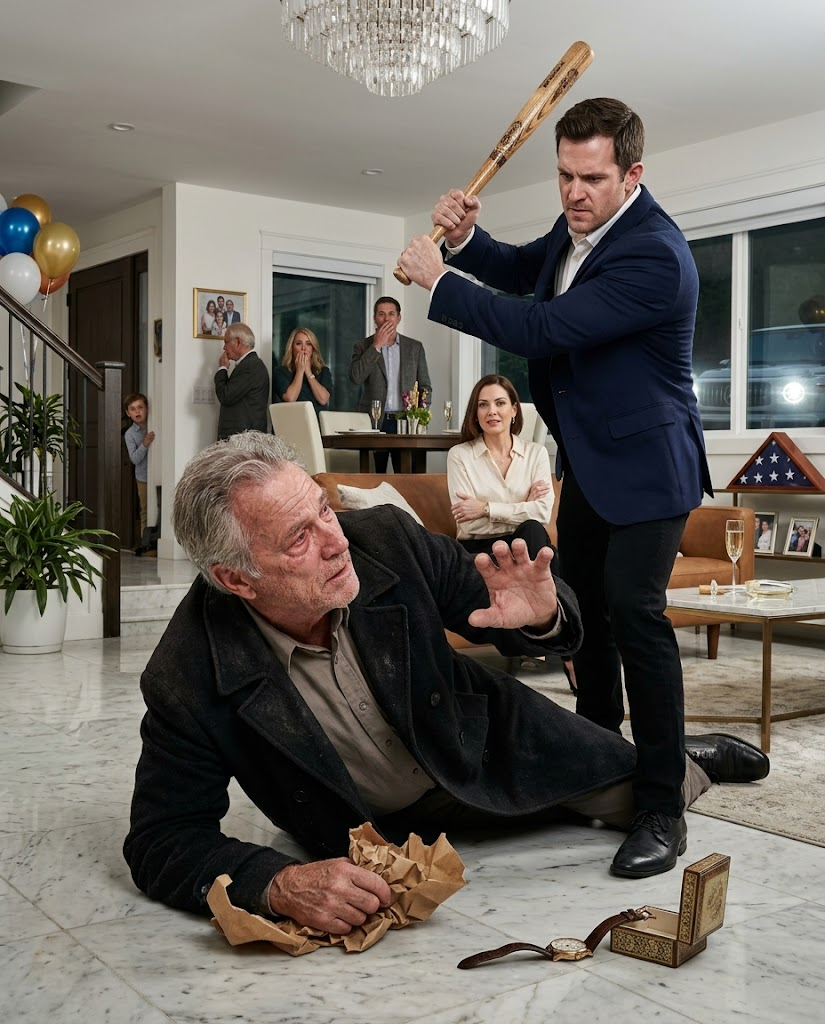
My son humiliated me for years in front of his wife and his own son, and they even celebrated it with applause.
The next morning, I sold the office building he rented.
Then I sold the house where he lived.
The worst part is that Derek never knew either one belonged to me.
I learned a long time ago that money can buy property, but it cannot buy character.
It can give a man a gate, a driveway, a leather couch, a view, and the kind of front door that makes visitors lower their voices before they knock.
It cannot teach him gratitude.
That lesson came to me on a cold Tuesday night in February, inside a Beverly Hills mansion I had paid for five years earlier.
I parked my old sedan two blocks away because the circular driveway was already full of luxury SUVs, black sedans, and cars so polished the porch lights flashed in their paint.
I remember the smell of wet pavement after a thin winter rain.
I remember the dry scratch of the brown paper in my hands.
I remember the little box inside it, wrapped badly because I never had the patience for ribbons.
It was Derek’s thirtieth birthday, and I had brought him a watch.
Not an expensive watch by his standards.
Not one of the status pieces he liked to photograph next to steak dinners and airport lounges.
It was an old model, the kind my father had wanted for most of his working life and never bought because there was always a bill, always a repair, always somebody else who needed something first.
I thought Derek might understand that.
That was my mistake.
When the housekeeper opened the door, the party noise spilled out around me.
Laughter, music, ice in glasses, the low murmur of people comparing vacations and markets and schools.
Ashley saw me first.
She was sitting on the sofa in a cream blouse, one leg folded neatly over the other, her smile set in place before I even crossed the room.
Derek stood near the dining table with a glass in his hand, wearing the easy confidence of a man who believed every surface under him was permanent.
“Dad,” he said, but only because other people were listening.
When Derek was ten, he used to wait for me by the garage door with a baseball glove in his hand.
When he was fifteen, I missed a major bid meeting because he had a fever and his mother was gone for the weekend.
When he graduated, I stood in the back of the auditorium in work boots because I had come straight from a bridge site, and he waved at me with both hands as if I were the only person in the room.
Trust dies strangely.
Not all at once.
It dies when your son jokes about your coat in front of his friends.
It dies when his wife asks whether your old car might be parked down the block instead of in the driveway.
It dies when your grandson starts laughing before he understands the joke, because children learn the shape of cruelty from the adults who practice it.
For years, I told myself Derek was young.
Then I told myself he was busy.
Then I told myself Ashley had changed the room around him and he was only trying to keep peace.
Fathers can turn denial into a craft.
I had built highways through rock, but I could not admit my son had become a stranger.
The mansion itself made the lie worse.
Five years before that birthday, after closing a large commercial project, I bought the Beverly Hills property in cash.
Derek had been struggling then, at least according to him.
Ashley wanted space.
They wanted a place that looked like the life they were trying to sell to other people.
So I let them move in.
I told them to treat it like home.
What I never told them was that the deed was held by Mastiff Investment Group.
Mastiff Investment Group was mine.
The office building Derek leased for his company had been folded into my holdings years earlier too, through a separate entity managed by the same property office.
He never asked.
People who believe they deserve everything rarely ask who signed the papers.
At the party, the first humiliation came before dinner.
Derek introduced me to a man in a gray suit as “a construction guy who got lucky.”
The man laughed in that polite, careful way people laugh when they do not know whether they are being invited to join a joke.
Ashley clapped lightly from the sofa.
Their son copied her.
That small applause sounded worse to me than open insult.
A child should not learn to measure his grandfather by the approval of cruel adults.
I said nothing.
I set the gift on the table.
Derek gave it a glance, still talking to the man in the gray suit, and peeled the brown paper back with two fingers as if it might leave dust on him.
When he saw the watch, he did not even lift it properly.
He let it drop against the box.
The sound was small.
The room heard it anyway.
“I am tired of you showing up like we owe you something,” he said.
I looked at him.
“Derek.”
“No,” he said, louder now, because an audience had always made him braver. “This house has nothing to do with you anymore.”
There it was.
Not a misunderstanding.
Not a bad mood.
Not wine talking.
A declaration.
The dining room froze in layers.
A woman near the kitchen island stopped with a cracker halfway to her mouth.
One man looked down at the cheese board as if he could disappear into it.
The chandelier hummed above us, and the heat pushed dry air across the room.
Ashley did not look shocked.
She looked pleased.
That was when I finally understood she had not been watching Derek become cruel.
She had been applauding the finished product.
I should have walked out then.
Instead, I gave my son one last warning.
“Be careful,” I said. “Do not forget who put the floor under your feet.”
He stepped toward me.
His face changed before his hand moved.
I had seen that look on job sites, in boardrooms, across bargaining tables, anywhere a man realizes he cannot win with words and decides to reach for force instead.
He shoved me.
My heel slipped on the marble.
I went down hard enough that my shoulder flashed white with pain.
For half a second, I thought that was the worst of it.
Then Derek turned to the wall and ripped down the decorative baseball bat he kept mounted like some expensive symbol of boyhood he had never earned.
The first strike knocked the air out of me.
The second made the room gasp.
By the third, I stopped listening to anyone else.
I counted because counting gave my mind somewhere to go.
One.
Two.
Three.
I remember the cold marble against my cheek.
I remember the copper taste in my mouth.
I remember Ashley’s arms still folded, her body angled comfortably into the couch.
I remember my grandson standing near the staircase, not clapping anymore.
By the fifteenth hit, pain was no longer the center of the room.
Clarity was.
I had spent years mistaking blood for obligation.
I had mistaken fatherhood for endless permission.
I had mistaken silence for love.
When Derek finally stopped, he stood over me breathing hard, his face red, his hand still tight around the bat.
He looked like a man who thought violence had settled something.
It had.
Just not in the direction he imagined.
I pushed myself up slowly.
No one helped me.
The guests stared at the floor, at their glasses, at the walls, anywhere but at the old man bleeding in the house he owned.
Ashley watched me wipe my mouth with the back of my hand.
Her smile was smaller now.
Not gone.
Just careful.
I picked up the watch.
Then I picked up the brown paper, too.
It is strange what a man reaches for after humiliation.
Not dignity.
Not revenge.
A piece of wrapping paper he does not want someone else to throw away.
I walked out without calling the police.
I walked past the porch, past the little flag in the planter Ashley had put there because it looked nice in summer photos, past the mailbox with Derek’s last name on it.
The mailbox had his name.
The deed did not.
The next morning, I woke before sunrise.
My ribs hurt when I breathed.
My shoulder felt stiff.
My face in the bathroom mirror looked older than it had the day before.
But my hands were steady.
At 8:06 AM, I called my attorney.
His name had been in my phone for thirty years, and he knew from my voice not to waste time with polite questions.
“I want the Beverly Hills property moved today,” I said.
He paused once.
Then he said, “Understood.”
At 8:23 AM, I called the property manager.
The office building came first.
Derek’s company leased three floors through an agreement that gave ownership broad rights during transfer.
He had signed those terms himself because the rent was favorable and he assumed favorable meant free.
At 9:10 AM, the mansion entered private sale.
The buyer had been waiting for months.
He had made quiet inquiries before, but I had never answered them because part of me still believed I might leave that house to Derek someday.
That part of me had died on the marble.
The price was 3.8 million dollars.
Not a penny less.
At 10:32 AM, the Fifth Avenue office file was updated for transfer review.
Lease documents.
Access notices.
Tenant estoppel request.
Nothing emotional.
Nothing dramatic.
Just paperwork doing what paperwork does best.
It turned fantasy into fact.
At 11:49 AM, I signed the final documents.
The pen felt heavier than it should have.
Not because I regretted it.
Because the signature closed a door I had held open for too long.
While I signed, Derek was sitting in his glass office on Fifth Avenue.
I could picture him there.
Shoes shined.
Phone face down on the desk.
Assistant outside his door.
A skyline behind him making him feel larger than he was.
He had no idea that the building under that office had just shifted beneath him.
He had no idea that the house Ashley decorated, posed in, and called theirs had already stopped belonging to the life they had invented.
It had never belonged to them.
That was the part Derek could not understand.
At 12:17 PM, my phone rang.
His name appeared on the screen.
I watched it buzz across the table.
Once.
Twice.
Three times.
Then it stopped.
A voicemail appeared.
I did not play it.
A minute later, Ashley called.
Then Derek again.
Then a text.
Dad, pick up.
I placed the phone face down.
For years, he had made me stand in rooms while he performed contempt for applause.
For once, he could stand in silence and wonder what was coming.
At the mansion, the doorbell had rung.
Ashley checked the camera first.
The man on the porch wore a navy jacket and held a slim folder against his chest.
He asked for Mr. Sterling.
Not Mr. Sterling’s son.
Not the homeowner.
Mr. Sterling.
Ashley opened the door because she still thought charm could stop consequences.
It could not.
The representative introduced himself calmly.
He explained that the property had entered a private sale process and that the buyer’s team had scheduled access.
Ashley laughed once.
People often laugh when reality arrives dressed as paperwork.
Then he showed her the first page.
Owner of record: Mastiff Investment Group.
Authorized principal: Alexander Sterling.
According to Derek’s voicemail, that was when Ashley stopped speaking.
She took a photo of the page and sent it to him.
Derek called me again thirty seconds later.
This time he left a message.
At first, his voice was angry.
“What the hell is this?”
Then it changed.
I could hear papers moving.
I could hear someone else talking in the background.
Then his voice dropped.
“Dad, call me back.”
By then, he had received the second photo.
The Fifth Avenue file.
The office lease.
The ownership transfer note.
The line that made clear the same old man he had thrown onto marble owned the roof over his company too.
That was when power finally became visible to him.
Not when I warned him.
Not when I built the home he lived in.
Not when I let him mock me and still showed up with a birthday gift.
Only when the documents spoke in a language he respected.
At 12:41 PM, my attorney called.
“Derek reached out,” he said.
“I assumed he would.”
“He is asking whether this is reversible.”
I looked out the window of my kitchen.
The morning light was flat and pale across the sink.
There was a coffee cup beside my hand, untouched and cold.
“No,” I said.
The attorney was quiet.
Then he asked the question he had avoided all morning.
“Alex, did something happen last night?”
I could have lied.
For a moment, I almost did.
Old habit again.
Protect the son.
Keep the family name clean.
Swallow the ugly thing because speaking it makes it real.
But my ribs hurt when I breathed.
My lip had split.
My own grandson had watched a room teach him that old men can be mocked until they fall.
“Yes,” I said. “Something happened.”
I did not call the police that morning.
I did ask my attorney to document what I told him.
I sent photos of my face, my shoulder, and the torn wrapping paper with the watch.
I sent the time of the party, the names I remembered, and the fact that there had been witnesses.
Documentation is not revenge.
It is memory with a spine.
By 2:15 PM, Derek showed up at my house.
He had never liked my house.
Too modest, he once said.
Too far from the right people.
There was no gate.
No marble.
No chandelier.
Just a driveway with oil stains, a porch light I had fixed myself, and a small American flag tucked near the step because my late wife had liked it there.
He stood outside the door in the same shirt from the party, wrinkled now, hair no longer perfect.
Ashley stayed in the SUV.
I saw her through the windshield, crying into one hand.
Derek knocked.
I let him knock twice before opening.
For a second, neither of us spoke.
The boy who used to wait by the garage door was gone.
The man on my porch looked frightened, but fear is not the same as remorse.
“Dad,” he said.
There was the word again.
Pulled out when useful.
I looked at him and waited.
“You cannot do this,” he said.
“I already did.”
His mouth opened.
Closed.
He looked past me into the hallway as if he expected to see someone who might talk me back into being soft.
There was no one.
“You are destroying my family,” he said.
That almost made me laugh.
Not because it was funny.
Because men like Derek can swing a bat at their father and still believe the first act of violence is a signed document.
“No,” I said. “I am removing my name from the lie you were living in.”
His face changed then.
Anger tried to come back.
But he was standing on my porch, not in his mansion.
There were no guests.
No wife smiling from the couch.
No child clapping because the adults had taught him when to do it.
Without an audience, cruelty looks smaller.
He lowered his voice.
“I made a mistake.”
I thought of the first hit.
Then the fifth.
Then the fifteenth.
“One shove is a mistake,” I said. “Fifteen hits is a decision.”
He looked down.
For a moment, I wanted him to cry in a way that would make me believe him.
He did not.
He asked about the office instead.
That was when the last piece of fatherly illusion left me.
Not because he cared about the building.
Because he asked about it before he asked whether I could breathe.
I told him the sale would proceed.
I told him his lease obligations would be handled through counsel.
I told him not to contact me directly again until my attorney had finished documenting the incident.
He stared at me like I had become someone unfamiliar.
Maybe I had.
Or maybe he had finally met the version of me that should have existed years earlier.
Ashley stepped out of the SUV then.
Her makeup had streaked.
She did not look polished anymore.
“Alexander,” she said, “please. Our son is scared.”
That reached me.
Not for her.
For the boy.
I looked past Derek toward the vehicle and saw my grandson’s small face in the back seat.
He was watching the porch the way children watch storms, trying to understand which adult controls the thunder.
I stepped outside and closed the door behind me.
“Then teach him the truth,” I said. “Teach him that what happened last night was wrong. Teach him that laughing at someone does not make you strong. Teach him that a man who hurts his father should not be clapped for.”
Ashley covered her mouth.
Derek looked away.
That was the first honest thing either of them did.
The sales did not fix my family.
Money rarely fixes what character broke.
The mansion moved forward without drama.
The buyer’s inspections happened.
The office building transfer continued.
Derek’s company had to renegotiate terms with people who did not mistake his last name for ownership.
For the first time in years, he could not use my quiet generosity as flooring beneath his pride.
A week later, my attorney sent me a formal statement Derek had written.
It was careful.
Probably edited.
It used words like unacceptable and remorseful and deeply regret.
I read it once.
Then I placed it in a folder with the deed copies, the lease notes, and the photos from the morning after the party.
I did not throw it away.
I did not forgive it either.
Some wounds do not require immediate forgiveness.
Some require boundaries, documents, locks changed, calls screened, and the courage to stop confusing endurance with love.
Months passed before I saw my grandson again.
He came with Ashley, not Derek.
He stood on my porch holding the old watch box with both hands.
The watch had been repaired.
Ashley said Derek found it in the mansion before they moved out and had it fixed.
I looked at the boy.
He would not meet my eyes at first.
Then he whispered, “I’m sorry I laughed.”
That was the only apology that hurt.
Because it was the only one I believed.
I knelt carefully, because my ribs had healed but my age had not disappeared.
“You learned that from grown-ups,” I told him. “Now you can learn something better.”
He nodded.
Ashley cried without making a sound.
I did not invite them in for a long visit.
Not that day.
But I took the watch.
I set it on my kitchen table after they left and stared at it for a long time.
My father had wanted a watch like that.
My son had thrown it aside.
My grandson had carried it back.
Life has a cruel way of handing the same object through three generations and asking each one what kind of man he intends to be.
I still own my modest house.
I still drive my old sedan.
My hands are still rough.
The difference is that I no longer mistake those things for shame.
Derek had spent years making rooms clap while he humiliated me.
In the end, applause did not protect him.
The deed did not have his name.
The office building did not have his name.
And the floor beneath his feet had always belonged to the father he thought was too old to matter.