He Visited My Grandpa Smiling, Then Asked For The One Thing I Feared-iwachan
My grandfather did not scare easily.
Walter had lived long enough to see people smile while lying, cry while manipulating, and show up with flowers when what they really wanted was a signature.
He had buried my grandmother, helped raise me after my mother died, and learned the difference between loneliness and silence without ever making a performance of either one.
So when he opened his apartment door that afternoon and went pale at the sight of me, my first thought was that something inside him had failed.
I was standing in the sixth-floor hallway of his Cherry Creek building with my purse strap cutting into my shoulder and the smell of someone’s reheated lunch drifting from down the hall.
The elevator had been broken again, so I had climbed the stairs and arrived warmer than I expected, annoyed in the small way people get annoyed before life changes.
Grandpa Walter stared at me like I had stepped into traffic.
“Grandpa?” I said.
He did not answer.
He reached out, grabbed my wrist, and pulled me inside with a strength that shocked me.
His hand had always been warm when I was a child, the hand that steadied me crossing streets and lifted me onto the old kitchen stool when Grandma let me help with pie crust.
That day, his fingers were cold.
He shut the door quietly behind me, turned the deadbolt, and leaned close.
I could smell coffee on his sweater and peppermint on his breath.
“Samantha,” he whispered, “go to the kitchen.”
I blinked at him.
“What?”
“Get under the table,” he said.
I stared because those words did not belong in a normal afternoon.
My grandfather’s apartment was not a place for hiding.
It was the place where I had done homework at the kitchen table while Grandma hummed, where I had eaten toast after sleepovers, where Walter had sat up with me after my mother’s funeral until the sun came through the blinds and made the dust look golden.
“Grandpa, you’re scaring me,” I said.
His grip tightened, not enough to hurt, just enough to make me understand.
“Good,” he whispered. “Then move.”
I went down the hallway without another question.
The kitchen looked almost exactly the way it had looked when I was eight.
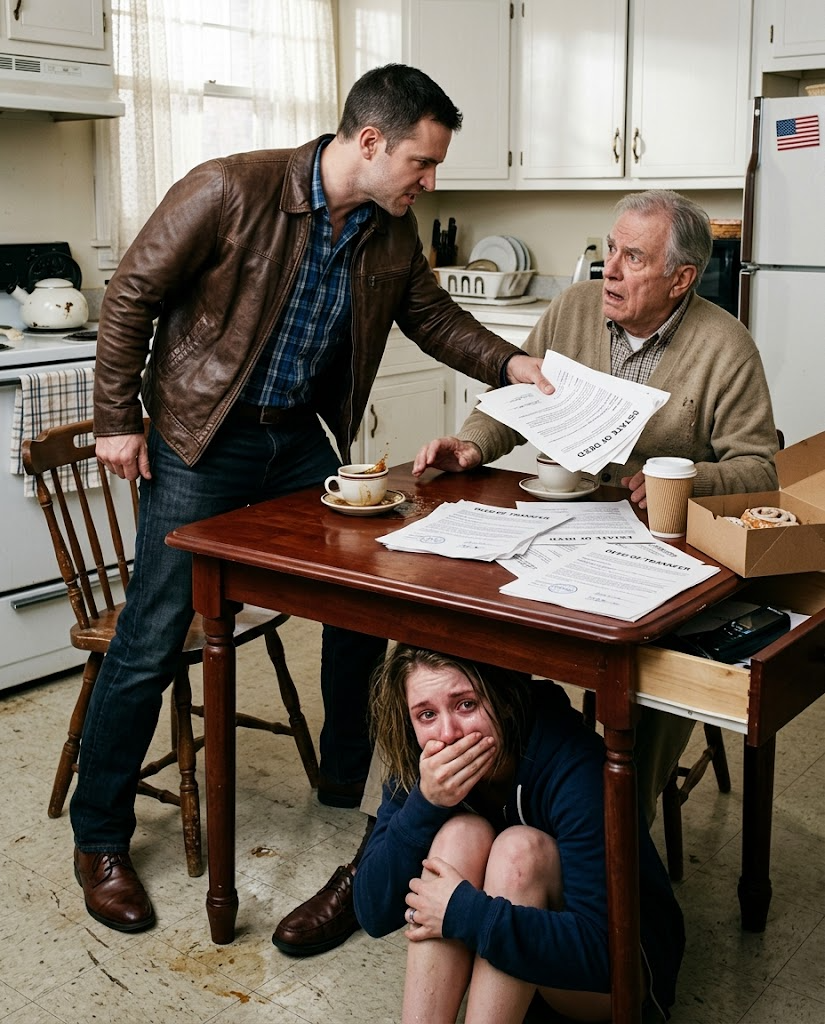
The heavy mahogany table sat in the middle of the room, too big for the space and too stubborn to be replaced.
The chipped white kettle waited on the stove, the curtain over the window glowed with thin afternoon light, and a box of cinnamon tea sat beside the sugar tin like nothing in the world could be wrong.
When I was little, that table had been my fort.
Grandma would drape quilts over it, and I would crawl underneath with a flashlight, a bowl of grapes, and the complete confidence that no monster could find me there.
At forty, I had to fold myself into a tight, aching shape.
My knees pressed into my chest, my shoulder hit the cold wall, and the underside of the table smelled faintly of wood polish and old dust.
From the hallway, I heard Grandpa moving carefully.
A drawer slid open.
Something clicked.
Then his slippers shuffled back toward the front door.
The doorbell rang.
My throat closed.
Grandpa opened the door, and the first voice I heard was my husband’s.
“Walter, good afternoon.”
William sounded cheerful.
Not loud, not forced, just gently pleasant, the way he sounded with neighbors and waiters and bank employees.
“I brought you those cinnamon rolls you like,” he said.
I looked down at my own hands in the dim space beneath the table, and they had already started shaking.
Grandpa’s voice came back steady.
“That was thoughtful of you. Come in. I’ll put coffee on.”
The door closed.
William’s footsteps crossed the entryway and moved into the living room.
I could picture him with painful ease.
Brown leather jacket, clean haircut, expensive watch, the faint smile he wore when he wanted someone to feel chosen.
He had worn that smile when we met twelve years earlier at a holiday party downtown.
I was twenty-eight then, still working as an accounting assistant, still carrying my mother’s death in places no one could see.
William had stood near the drinks with a beer in his hand and a patient look on his face, as if he had all the time in the world for whatever anyone needed to say.
I thought quiet meant gentle.
I thought attention meant love.
Three weeks later, he called me.
Four months later, we were together.
Two years later, I married him in a small ceremony with white roses and soft music, and Grandpa Walter walked me down the aisle because my father had vanished from my life long before.
People said I was lucky.
William had a steady job, good manners, and the kind of confidence that made other people relax.
He sent thank-you notes.
He remembered birthdays.
He put his hand on my back in crowded rooms and made it look protective.
I loved him.
That is not an excuse, but it is a fact.
Without that fact, the story sounds simple, and it was never simple.
Love made me patient when he came home tired from work trips and barely spoke through dinner.
Love made me laugh off the way he corrected me in public and then squeezed my shoulder as if the correction had been affectionate.
Love made me defend him when my best friend Amanda said, “Sam, he sounds like he rehearses before he walks into a room.”
I told her she was being unfair.
I told myself he was careful because life had taught him to be careful.
Sometimes the cage is built out of explanations that once sounded kind.
Grandpa passed the kitchen on his way to the stove.
He did not look under the table.
“He doesn’t know you’re here,” he whispered, barely moving his mouth. “Stay.”
Then he filled the kettle, and for a few minutes, the apartment sounded ordinary.
Water rushed into metal.
Cabinet doors opened.
William asked about Grandpa’s blood pressure and whether the new medication was still making him dizzy.
He mentioned the broken elevator, the mailroom light that flickered, and the Rockies game Grandpa had missed the night before.
If someone had been listening from the hallway, they would have heard a devoted son-in-law visiting an older man.
That was William’s gift.
He knew what a room wanted to hear.
Then, slowly, the warmth drained out of his voice.
“You know, Walter,” he said, “I worry about you living here alone.”
“I’ve lived here since 1984,” Grandpa said.
“That’s exactly my point.”
The kettle gave a small metal tick as it heated.
William continued, “It’s a big place. Old building. Expensive maintenance. You’re not getting younger.”
“No one is.”
William laughed softly, but there was no humor in it.
“I’m serious. Samantha doesn’t understand these things.”
My stomach tightened.
I had heard that sentence before, in different clothes.
Samantha worries too much.
Samantha thinks with her heart.
Samantha is good with numbers, sure, but money on paper is not the same as wealth.
Every version had been wrapped in concern.
Every version had made me smaller.
Grandpa said, “Sam is more practical than you give her credit for.”
“She works with numbers, Walter,” William said. “That doesn’t mean she understands assets.”
The word struck the room like a dropped knife.
Assets.
He did not say memories.
He did not say family.
He did not say home.
He said assets, and under the table I suddenly understood why Grandpa had looked afraid.
Grandpa’s chair creaked.
“What exactly did you come here to discuss?”
There was a pause.
Not long, but long enough that the air seemed to lean toward the answer.
“The condo,” William said.
My nails dug into my palm.
Grandpa’s apartment had never been a condo to me.
It was the smell of lavender sachets in the linen drawer because Grandma had tucked them there for years and Grandpa had never stopped replacing them.
It was the balcony where he grew basil in coffee cans and waved to me when I crossed the parking lot below.
It was the kitchen floor where my mother once sat laughing after dropping an entire pie face-down because Grandma said nobody in this family had the patience to mourn dessert.
After Mom died, it became the place where I could fall apart without being told to hurry up and heal.
To William, it was square footage.
To William, it was leverage.
Grandpa’s voice stayed level.
“My home is not your concern.”
“That’s where you’re wrong,” William said.
I stopped breathing.
The kettle began to hiss.
I could hear the small, uneven clink of cups on saucers.
Grandpa was moving slowly now, buying seconds or testing him, and William did not seem to notice.
He was too confident.
That was the thing about men like him.
They mistake someone’s silence for weakness, because silence is the only language they never learned to respect.
“You need a plan,” William said. “Samantha needs a plan, whether she admits it or not.”
“Sam and I have talked about my affairs.”
“No,” William said. “You and Samantha have talked about feelings. I’m talking about control.”
The word control made my mouth go dry.
Grandpa did not answer right away.
I could almost see him at the table, one hand on the rim of his mug, eyes narrowed behind his glasses.
“Control of what?”
“The property. The estate. The transfer.”
Paper slid across wood.
It was a small sound, but under that table it thundered through me.
I looked through the narrow gap between the chair legs and saw the edge of a white page hanging over the table.
William had brought papers.
Not brochures.
Not notes.
Papers.
Grandpa said, “Put that away.”
William’s tone sharpened for the first time.
“I came here because you keep delaying.”
“I keep saying no.”
“No,” William said. “You keep letting Samantha think this is about love and memories.”
My heart beat so hard I heard it in my ears.
Grandpa’s voice dropped.
“And what is it about?”
William exhaled, almost impatient, as if the old man was wasting his time by needing the truth spoken aloud.
“It’s about reality.”
The kettle screamed then, high and thin, and Grandpa turned it off.
For a second, the sudden quiet hurt worse.
William kept going.
“You built something. You held on to it. Fine. I respect that. But leaving it loose for Samantha to mismanage is irresponsible.”
“She would not mismanage it.”
“You don’t know that.”
“I know my granddaughter.”
“You know the girl you raised,” William said. “I know the woman who panics over every hard decision and calls it morality.”
A hot, ugly wave moved through me.
My first instinct was to crawl out from under that table and confront him.
I wanted to see his face when he realized I had heard every word.
I wanted to make him take my name out of his mouth.
But Grandpa had told me to stay, and the tremor in his whisper had been real.
So I stayed.
Rage can make a person reckless, but love can make her disciplined.
Grandpa said, “If you despise her so much, why did you marry her?”
The room went still.
That silence was different from the others.
It had weight.
It had history.
It had twelve years of dinners, anniversaries, vacations, tax returns, Christmas cards, and late-night promises folded inside it.
William did not answer at first.
I heard him shift in his chair.
When he spoke, his voice had lost the softness completely.
“Don’t be dramatic.”
“I asked you a question.”
“You know why I married her.”
The words were quiet.
They were not shouted.
That made them worse.
Under the table, my body went cold.
Grandpa said, “Say it.”
William gave a short laugh.
“You really want to do this?”
“I want to know what kind of man sits in my home and asks for my deed.”
Another paper scraped.
William must have pushed it closer.
“Twelve years is a long time, Walter.”
My eyes burned.
William said it again, lower.
“Twelve years.”
As if that number belonged to him.
As if those years of my life had been an investment account that had not paid out fast enough.
“I waited,” he said. “I was patient. I played the good husband. I came to your appointments. I brought groceries. I carried boxes. I listened to Samantha talk about grief like it was a second religion in this family.”
Grandpa made a sound, small and wounded.
William did not stop.
“And every time I thought you were finally ready to make a rational decision, you backed away because she got sentimental.”
Something inside me cracked, but not loudly.
It was the quiet kind of crack, the kind that changes the shape of a person without moving a single chair.
Grandpa said, “You married my granddaughter because of this apartment?”
William’s answer came too fast.
“Not just the apartment.”
That was when my hand flew to my mouth.
Not because I was surprised anymore.
Because some part of me still wanted to keep from making a sound for the man who had already destroyed me.
William lowered his voice, and I could hear the smile return.
It was not a happy smile.
It was the smile of a man who thought he had finally stopped pretending.
“You always knew she would inherit. Everybody did. I made a practical choice.”
Practical.
There it was.
The word he had used to explain away every coldness.
The word he had put over greed like a clean tablecloth.
My marriage did not end with screaming.
It ended under a kitchen table, with my knees pressed to my chest, while the man I had loved described twelve years of my devotion as patience on his part.
Grandpa’s chair scraped back.
For one terrifying second, I thought he might fall.
“Walter,” William said, suddenly alert.
Grandpa breathed hard.
The sound aged him more than any birthday ever had.
“You will leave,” Grandpa said.
William’s voice turned smooth again.
“Don’t be foolish.”
“You will leave my home.”
“No,” William said. “We are going to finish this.”
More paper moved.
I saw the edge of the deed slide farther over the tabletop.
The page trembled slightly, not because William’s hand was shaking, but because Grandpa’s was.
“Sign the transfer,” William said. “Put the estate where it can be protected.”
“Protected from Samantha?”
“Protected from emotion.”
Grandpa laughed once.
It was a bitter sound I had never heard from him.
“You mean protected from the woman you married.”
“I mean protected from bad decisions.”
“Like trusting you?”
The room went quiet again.
Then William stood.
His shoes came into view near the table, polished brown leather only inches from my hand.
I pulled myself farther into the shadow, every muscle screaming.
His voice was above me now, close enough to feel.
“You don’t want me as an enemy, Walter.”
The sentence was calm, but it was not a warning dressed as advice.
It was a threat dressed as concern.
Grandpa said nothing.
William leaned forward.
I saw his hand press flat on the table beside the papers.
The wedding band on his finger caught the kitchen light.
For twelve years, that ring had meant vows to me.
In that moment, it looked like evidence.
Grandpa’s other hand moved slowly.
Through the gap under the tablecloth, I saw him reach toward the drawer he had opened before William arrived.
The drawer was not shut all the way.
A thin red blink glowed from inside it.
My breath stopped.
William did not see it.
He was too busy believing he had won.
“Sign it,” he said.
Grandpa’s fingers found the drawer pull.
The old man who had once taught me how to balance a checkbook, change a tire, and never confuse politeness with trust lifted his chin.
Then he said, “Say the rest first.”
William’s shoes shifted.
“What?”
Grandpa’s voice was weak now, but it was steady.
“Say what you said about Samantha. Say what you said about why you married her. Say it while you still think no one who matters is listening.”
Under the kitchen table, I realized my grandfather had not hidden me because he was confused.
He had hidden me because he knew exactly who my husband was.
And as William leaned over the deed with that careful, beautiful, lying face, Grandpa opened the drawer.