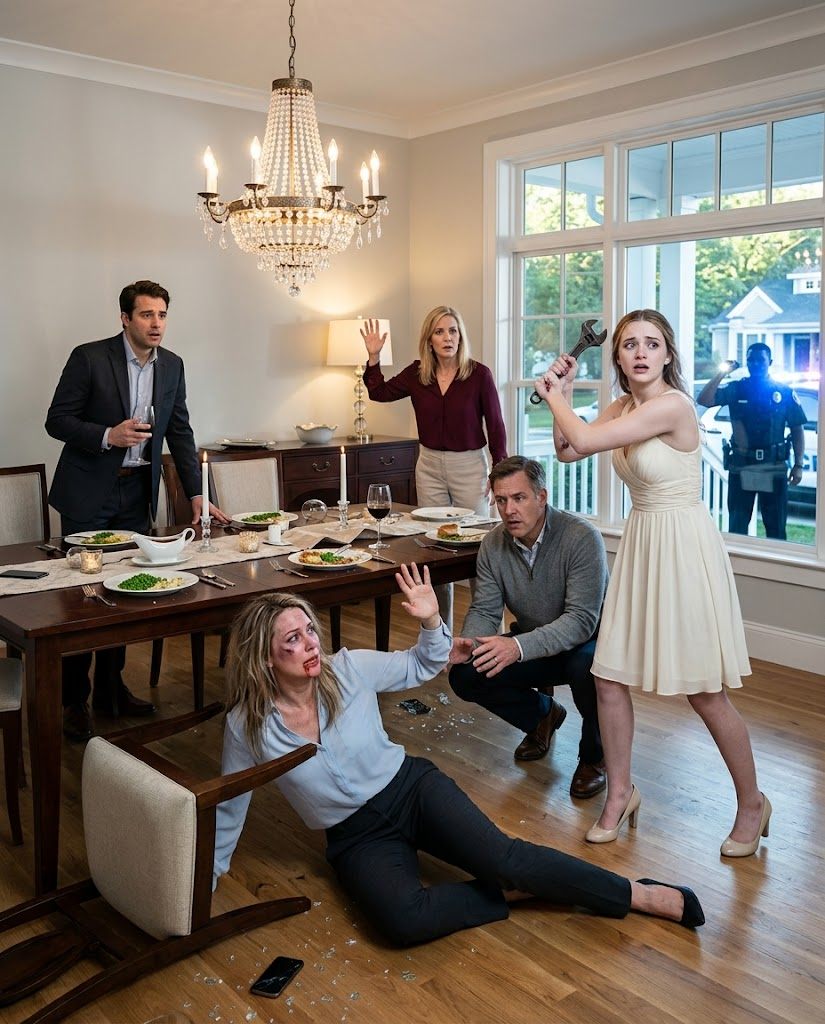
Her Family Laughed After the Wrench Hit. Then the Door Opened.-olweny
The good china only came out when my mother wanted strangers to believe we were a family worth admiring.
Eleanor called it tradition.
I called it theater.
That night, the plates were set in a perfect oval around the mahogany table, each one bordered with blue flowers so delicate they looked hand-painted by someone who had never raised her voice.
The silver had been polished until the handles caught the chandelier light.
The linen napkins stood beside each plate like folded white flags.
My mother had spent the afternoon moving through the house with the brittle focus she used before guests, straightening picture frames, wiping clean surfaces that were already clean, and giving me instructions as if I were staff.
Do not talk too much.
Do not look tired.
Do not make Madison uncomfortable.
That last one was always the real rule.
Madison had been the golden child since before either of us knew what gold meant.
She got the soft voice, the new clothes, the cameras at every school event, and the version of my parents that smiled in public.
I got correction.
I got the end seat.
I got the little laugh my mother used whenever I said something that mattered to me.
I became a social worker partly because I knew what rooms could do to a child when everyone inside them agreed to pretend nothing was happening.
I worked with at-risk youth in New Haven, and every day I sat across from kids who could read danger faster than adults could read a file.
They noticed doorways.
They noticed voices.
They noticed who touched the keys, who blocked the stairs, who laughed when someone flinched.
That afternoon, before the dinner, I had signed a 3:40 p.m. intake form for a sixteen-year-old girl who kept apologizing for taking up space.
She held a paper cup so tightly it split down one side.
When I told her she was safe for the night, she stared at me like safety was a language she had heard about but never been taught.
I thought about her while I slid my New Haven Youth Services badge into my work bag.
I thought about her when I saw the heavy iron wrench sitting on the mahogany sideboard, left there by my father after he claimed he had fixed a cabinet hinge.
The hinge still stuck.
The wrench stayed.
Madison arrived at 6:58 p.m., two minutes before my mother’s preferred version of prompt.
She walked in laughing, one hand curled around Travis’s arm, the diamond bracelet on her wrist flashing each time she moved.
Travis wore a dark suit with no tie and the expression of a man who expected rooms to rearrange themselves for him.
Madison introduced him as a senior investment banker at Goldman Sachs.
My mother repeated the job title twice before dessert had even been mentioned.
My father shook his hand too long.
I said hello.
Travis looked at me as if I were the only thing in the room he had not been warned about.
It was not attraction.
It was not warmth.
It was that measuring look I had seen from men in case files, the kind that moved over a person and tried to decide where pressure would hurt most.
Dinner began with Madison talking about restaurants, travel, and how exhausting it was to plan a vacation to Bali when every resort claimed to be exclusive.
My mother laughed too loudly.
My father asked Travis about markets as though saying Goldman Sachs enough times might make the walls more expensive.
I pushed buttered peas around my plate.
The room smelled of roasted meat, candle wax, and my mother’s perfume, floral and sharp.
I could feel a draft against my ankles from the old window near my seat.
It was always colder at the end of the table.
Travis waited until Madison had finished describing a villa pool before he turned toward me.
“So, Emily,” he said. “What exactly do you do?”
The silence came down immediately.
Not natural silence.
Family silence.
The kind everyone recognizes because it has rules.
“I’m a social worker,” I said. “I work with at-risk youth in New Haven.”
Travis leaned back.
“Oh, that’s… interesting. Why on earth would you choose that field?”
The question sounded polite, but the edge was not hidden.
Madison smiled into her wineglass.
My mother’s hand stilled near her fork.
I should have given the answer they wanted.
Something short.
Something harmless.
Instead, I thought of the sixteen-year-old girl with the split paper cup.
“It’s rewarding,” I said. “The system is broken, but we make a difference. Just last month, I helped place a sixteen-year-old girl who had been—”
“Don’t waste Travis’s time with your depressing, boring stories, Emily,” my mother said.
Her voice cracked across the table.
“Nobody wants to hear about those people while we are trying to eat.”
Those people.
The phrase hung there, ugly and perfumed.
My jaw tightened.
My hands were in my lap, fingers digging into each other hard enough that my nails left crescents in my skin.
The restraint was not calm.
It was training.
It was every dinner where I had swallowed a sentence because the cost of saying it out loud was always billed to me later.
Then I looked at Travis.
He was smirking.
My father was nodding.
Madison was waiting for me to fold.
Something in me did not.
“Actually, Mom,” I said. “It’s not boring. It matters. It actually helps people. Unlike planning overpriced vacations to Bali just to take photos for strangers on the internet.”
For half a second, the room was so still I heard a candle hiss.
Then my mother moved.
I did not see the wrench clearly until it had already become pain.
There was a dark blur from the sideboard.
There was the sound.
CRACK.
People describe violence as loud, but what I remember most is how complete it was.
The impact filled my skull with white light.
My chair tipped backward.
My shoulder hit the floor first, then my head, and the oak planks met me with a dull wet thud.
The taste came next.
Copper.
Salt.
Blood running over my teeth.
I tried to breathe and heard something broken in the sound.
Above me, the chandelier had split into bright pieces.
My mother stood over me with the heavy iron wrench in her hand.
There was blood on the metal.
There was blood on my blouse.
For one impossible moment, I waited for someone to gasp.
Someone did.
But it was from laughter.
Madison laughed first.
“At least now you’re finally pretty!” she shrieked.
She clutched her stomach as if delight physically hurt her.
“Oh my God, Travis, did you see her face? She looks like a Picasso!”
Then Travis laughed.
That was the detail that later replayed in my head more than the impact.
The banker my sister had brought home, the guest my mother had polished the house for, the man who had watched me all night like he was studying a weakness, threw his head back and laughed at the blood in my mouth.
My father did nothing.
He looked away.
The gravy boat sat between him and the truth, white porcelain gleaming beneath the chandelier.
The table froze around me.
Forks hovered.
Wineglasses hung in hands.
A candle guttered and righted itself.
My mother’s good linen runner had slipped crooked, and a pea rolled off Madison’s plate onto the floor.
Nobody moved.
Then Madison wiped under one eye like she had laughed herself into tears.
“I really think one hit wasn’t enough,” she said.
Something cold traveled through me.
I had been afraid of my family before, but fear had always come dressed as anticipation.
A slammed cabinet.
A voice down the hall.
A silence after I spoke.
This was different.
This was my mother holding a weapon and my sister asking for a turn while a guest laughed beside her.
They were laughing because hurting me had always been a family language.
I tried to crawl backward.
My heels slid in blood.
My left eye was swelling so quickly the room began to narrow.
I lifted one hand toward Madison, not because I thought she would stop, but because the body raises what it has left.
My work bag had fallen open near the overturned chair.
The Connecticut DCF referral packet had spilled partly out.
My employee badge had skidded under the sideboard, face-up, my photo staring toward the ceiling.
Later, the officer would photograph all of it.
The badge.
The cracked phone.
The blood trail across the oak.
The wrench.
At that moment, they were just fragments of a life I was trying not to lose.
My father stepped over me.
For one wild heartbeat, I thought he was going to help.
He did not.
He crouched down and clamped both hands around my wrists.
His grip was hard and practiced.
“Hold still, Emily,” he said.
His voice was calm.
That made it worse.
I could not speak.
My jaw did not feel connected to my face.
My mother turned the wrench in her hand and looked at Madison.
“Well, Maddie,” she said. “You have a go. Teach her some manners.”
She tossed it.
Madison caught the iron tool with both hands.
That was when everything changed.
Travis stopped laughing first.
Not because he had developed a conscience.
Because the front windows filled with blue-white light.
My mother’s smile drained from her face.
Madison looked toward the glass with the wrench still raised.
A uniformed man stood on the porch, flashlight angled through the window, eyes fixed on the blood on the floor and the weapon in Madison’s hands.
For a second, no one understood how he had gotten there.
Then my phone made a sound from beneath the overturned chair.
The screen was cracked across one corner.
The call was still connected.
The timer showed four minutes and twelve seconds.
A dispatcher’s voice came through the speaker, steady and clear.
“Ma’am, officers are at the residence. Can you move away from the weapon?”
Madison dropped the wrench.
The sound of iron hitting hardwood was smaller than the first crack, but everyone in the room flinched.
My father released one wrist.
Then the other.
The officer pounded on the door.
“Open it now.”
Eleanor tried to become my mother again in the old way, the public way, the voice she used with teachers and neighbors and store managers.
“This is a family matter,” she called.
The officer did not move.
“Open the door, ma’am.”
No one did.
So he tried the handle.
It was unlocked.
My mother had wanted the evening to look welcoming.
The door opened into cold air and blue light.
Two officers entered first, one with his hand near his radio, the other with his eyes on the wrench.
Behind them, porch light spilled across the foyer and made every polished surface look suddenly cheap.
The first officer told everyone to step back.
No one argued.
Madison started crying only when he told her not to touch the weapon.
Travis lifted both hands and said, “I didn’t know it was that bad.”
That sentence told me more about him than any laugh had.
Not that bad.
As if there were an acceptable amount of watching a woman be beaten on a dining room floor.
An officer knelt beside me and asked my name.
I tried to answer.
The sound came out wrong.
He told me not to move.
He told dispatch to send medical.
He told someone else to separate the witnesses.
Witnesses.
It was the first word that made my family look afraid.
Not daughter.
Not sister.
Witnesses.
Because that meant the room had changed ownership.
It no longer belonged to Eleanor’s version of events.
It belonged to documentation.
Photographs were taken before the paramedics lifted me.
The wrench was bagged.
The call log was preserved.
The dispatcher’s recording was marked with the time.
The officer wrote down the position of every chair, every visible blood mark, every person in the room.
My New Haven Youth Services badge was placed in an evidence envelope because it had landed near the blood trail.
My mother kept saying I had provoked her.
Madison kept saying she never swung.
My father kept saying he was restraining me for my own safety.
Travis said almost nothing.
At the hospital, I learned the left side of my face was fractured.
My jaw was injured badly enough that speaking became work.
The nurse who cleaned the blood from my hair did not ask why I had stayed so long in a family like mine.
I was grateful for that.
People think leaving is a door.
Sometimes it is a staircase in the dark, and every step has been greased with guilt.
I gave my statement the next morning.
It hurt to talk.
So the detective let me write parts of it.
I wrote about the dinner.
I wrote about the wrench.
I wrote the exact words I remembered.
“At least now you’re finally pretty.”
“One hit wasn’t enough.”
“Hold still, Emily.”
“Teach her some manners.”
The detective’s face did not change much, but his pen stopped once.
That was enough.
The dispatcher recording mattered.
So did the porch view.
So did the photographs.
So did the fact that Travis, when pressed, admitted he had laughed.
He tried to explain it as panic.
He said he thought it was “family drama.”
He said he had never expected Eleanor to actually hurt me again.
Again.
That word made the detective look up.
My mother was charged.
Madison was charged.
My father was charged for holding me down.
Travis was not charged the same way, but his statement followed him into places his suit could not protect him.
Goldman Sachs learned about the police report.
Madison learned that rich-boy laughter does not sound as charming in a transcript.
There was no grand courtroom speech where I became suddenly fearless.
Real life was slower.
It was forms.
Medical appointments.
Victim services calls.
A temporary protective order.
A permanent protective order.
A prosecutor asking if I was sure I could testify.
I was not sure.
I did it anyway.
When I walked into court months later, Eleanor looked smaller than she had at the dining table.
Madison would not look at me.
My father stared at the floor.
The prosecutor played part of the 911 call.
For the first time, a room full of strangers heard my family laugh while I bled.
Nobody laughed then.
My mother’s attorney tried to say I had been disrespectful.
The judge stopped him.
He asked whether the argument was that disrespect justified a wrench to the face.
The courtroom went quiet.
That silence felt different.
It did not protect them.
It held them still.
In the end, there were pleas and conditions and consequences that did not erase what happened but named it correctly.
Assault.
Restraint.
Endangerment.
Not misunderstanding.
Not family tension.
Not Emily being dramatic again.
Names matter.
They are how a room stops lying.
I did not go back to the house.
A victim advocate met me there once with an officer so I could collect what belonged to me.
My clothes were already in trash bags by the garage.
My mother had labeled them in black marker.
EMILY MISC.
I almost laughed.
Not because it was funny.
Because after everything, she still thought she got to decide what I was called.
I took my documents.
I took my grandmother’s small blue vase.
I took the framed certificate from my first year at New Haven Youth Services.
I left the family photographs.
In most of them, I had been standing at the edge anyway.
Healing did not make me noble.
It made me tired first.
Then angry.
Then clear.
I went back to work with a scar along my cheekbone that some teenagers noticed immediately and adults pretended not to see.
One girl asked me if it hurt.
I told her yes.
She asked if I was safe now.
I told her yes again.
That answer mattered more.
Months later, the sixteen-year-old girl with the split paper cup sent a note through her case manager.
It said she was still safe.
It said she had started sleeping with the light off.
I kept that note in my desk drawer beside my badge.
Not because it fixed anything.
Because it reminded me that I had told the truth at a table built to punish it.
My family used to believe silence made them powerful.
They were wrong.
Silence only works while everyone agrees to keep it.
The night of that dinner, a cracked phone under an overturned chair stopped agreeing.
So did I.
And when I think back to the good china, the polished silver, the candles, the wrench, and the way their smiles drained when someone finally saw them clearly, I no longer remember myself as the punchline.
I remember the officer at the door.
I remember the dispatcher’s voice.
I remember my own blood on the floor becoming evidence.
I remember surviving the room that raised me.
That is not pretty.
It is better than pretty.
It is proof.