Advertisement

Her Husband Wanted The Deed, But Grandpa Had Already Set The Trap-maily

The day my grandfather made me hide under his kitchen table, I thought age had finally found him.

Advertisement

Not the ordinary kind of age that bent shoulders or slowed steps.

Advertisement

Something sharper.

Something that made a strong man look afraid inside his own home.

Grandpa Walter opened the door to his Cherry Creek apartment and stared at me like I had arrived in the middle of a fire.

I had a paper coffee cup in one hand and a folder from work in the other.

The hallway smelled faintly of floor polish, old carpet, and somebody’s dinner heating two apartments down.

“Grandpa?” I asked.

He reached for my wrist.

His fingers closed around me with a strength I had not felt from him since I was a child crossing a busy street.

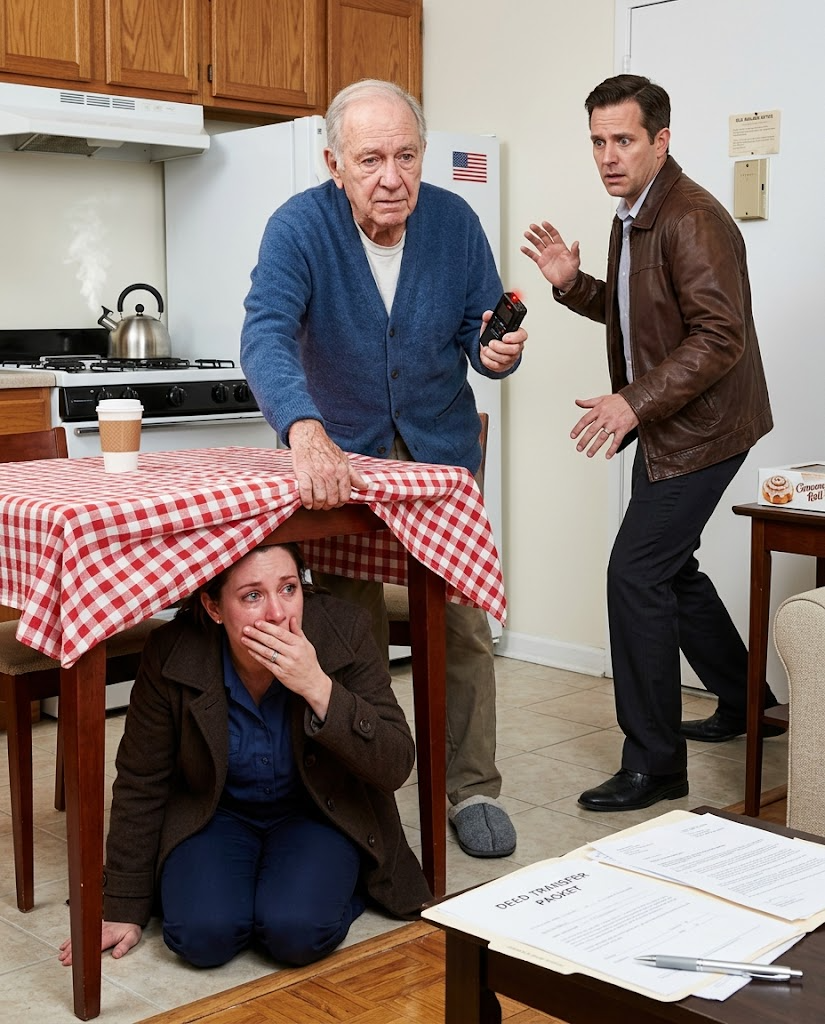
“Samantha,” he whispered, “go to the kitchen. Get under the table. Do not make a sound.”

I stared at him.

“What?”

“Now.”

It was not confusion.

It was not one of those wandering moments people warn you about when someone gets older.

Grandpa Walter was seventy-four, but he still remembered the name of every neighbor who had ever lived on his floor.

He remembered what a gallon of milk cost in 1986.

He remembered the exact date my mother died and the exact number of nights I slept on his couch afterward because I could not stand the silence in my own apartment.

That man did not scare easily.

So when he looked scared, I obeyed.

I moved down the hallway into the kitchen I had known since childhood.

The old mahogany table sat in the center of the room, heavy and polished, the same table where my grandmother had rolled pie crust and Grandpa had taught me how to count change when I was small.

The kitchen smelled like black coffee, peppermint, and the lavender sachets Grandma used to tuck into every linen drawer.

Late-afternoon light spilled across the tabletop, but underneath it was cold.

I folded myself down beneath it, pulling my knees to my chest.

At eight, I had built blanket forts there.

At forty, I was hiding from my husband.

I heard Grandpa move through the apartment with careful quiet.

A drawer opened.

Something clicked softly.

Then his slippers shuffled toward the front door.

The doorbell rang.

I held my breath.

The deadbolt turned.

My husband’s voice came in smooth and warm.

“Walter, good afternoon.”

For twelve years, that voice had been the roof over my life.

It had said I was loved.

It had said I was safe.

It had said, after every small correction and every quiet dismissal, that I was imagining the sting.

“I brought you those cinnamon rolls you liked,” William said.

Grandpa answered, “That was thoughtful. Come in. I’ll put coffee on.”

William stepped inside.

His shoes crossed the entry tile.

I knew the sound of them because I had heard those shoes in hotel lobbies, hospital halls, grocery aisles, and quiet restaurant corners where he leaned close and told me not to be so sensitive.

I could picture him without seeing him.

Brown leather jacket.

Neat haircut.

Clean smile.

The kind of man who looked like he knew exactly where he was going and expected doors to open when he arrived.

William had always been good at looking harmless.

I met him twelve years earlier at a holiday party downtown.

I was twenty-eight, working as an accounting assistant and carrying my mother’s death like a hidden bruise.

He stood near the drinks with a craft beer in his hand and a quiet expression on his face.

He looked like a man who noticed what other people missed.

Back then, I thought that meant depth.

Three weeks later, he called.

Four months later, we were exclusive.

Two years later, Grandpa Walter walked me down the aisle because my father had vanished from my life long before my wedding day.

I loved William.

That is the part people always want to skip when a marriage turns ugly.

They want betrayal to announce itself early.

They want the villain to laugh too loudly or slam doors or leave obvious fingerprints on the soul.

But my marriage did not feel like a trap at first.

It felt like relief.

William knew which restaurants I liked.

He kept a spare charger in his car because I was always forgetting mine.

He stood beside me at my mother’s grave the first time I brought him, hand warm between my shoulder blades.

He learned how Grandpa took his coffee.

He remembered my birthday.

He also corrected me in public.

He also made decisions and called them practical.

He also told me that because I worked with numbers, I should understand when he handled the bigger financial picture.

Love made me patient.

Love made me explain him to other people.

Love made me defend him when my best friend Amanda said, “Sam, something about him feels rehearsed.”

I told her she did not know him like I did.

Under that kitchen table, I started to wonder if maybe she had known something I refused to look at.

Grandpa passed the kitchen doorway on his way to the stove.

Without turning his head, he lowered his voice.

“He doesn’t know you’re here. Stay.”

Then he filled the kettle.

For a few minutes, nothing sounded dangerous.

William asked about Grandpa’s blood pressure.

He asked if the new medication caused dizziness.

He mentioned the broken elevator in the building and the maintenance notice near the mailboxes downstairs.

He sounded gentle.

Attentive.

Almost affectionate.

Then his voice changed.

“You know, Walter,” he said, “I worry about you in this place.”

“I’ve lived here since 1984,” Grandpa answered.

“That’s my point. It’s too much for one man. Big condo, old building, expensive maintenance. You’re not getting younger.”

“No one is.”

William laughed softly, but there was no humor in it.

“I’m serious. Samantha doesn’t understand these things. She thinks emotionally. I’m trying to think practically.”

My fingers tightened around the edge of my coat.

Samantha doesn’t understand.

I had heard softer versions of that sentence at dinner parties.

In the car.

In the kitchen after I asked a question he thought I should not ask.

Grandpa said, “Sam is more practical than you give her credit for.”

“She works with numbers, Walter. That doesn’t mean she understands wealth. There’s a difference.”

The words went through me slowly.

I had balanced books for years.

I had handled payroll disputes, tax documents, vendor invoices, and month-end reconciliations while William told people he took care of the serious things.

I could read a ledger better than he could read a room.

But in his mouth, competence became small when it belonged to me.

Grandpa’s chair creaked.

“What exactly did you come here to discuss?”

There was a pause.

Then William said, “The condo.”

Not Grandpa’s home.

Not Grandma’s kitchen.

Not the hallway where my school photos still hung in frames.

The condo.

Grandpa said, “Go on.”

Paper slid across the coffee table.

“I brought a deed transfer packet,” William said. “Nothing dramatic. It would simply put the property where it belongs before there are hospital forms, county clerk delays, family arguments. You sign it to Samantha today. I help manage it. Everybody avoids a mess.”

A deed transfer packet.

The phrase landed cold.

Grandpa asked, “Why today?”

“Because I saw the maintenance assessment letter last week. This building is about to get expensive. If Samantha inherits this place without a plan, she’ll panic. I’m trying to protect her.”

Protect.

That word.

In my marriage, protect often meant exclude.

It meant William took the meeting.

William handled the call.

William reviewed the papers.

William said, “Don’t worry your head about it,” and kissed my temple like I was sweet, not capable.

Grandpa was quiet.

The refrigerator hummed.

The kettle began to tremble on the stove.

Then he said, “You’ve been very interested in my paperwork lately.”

William sighed.

“Because I’m the only person in this family willing to talk like an adult.”

“Is that what you call it?”

“I call it being honest.”

Grandpa’s next question came softly.

“Were you being honest when you married my granddaughter?”

I stopped breathing.

William did not answer at first.

Then he laughed once.

“That’s an insulting question.”

“It is a simple one.”

“Walter.” William’s voice hardened. “I have spent twelve years doing everything expected of me.”

“Expected?”

“I married her. I stayed. I made her life respectable. Do you have any idea how many men would have walked away from a grieving woman with no father, no real family structure, and nothing but bookkeeping skills?”

The kitchen tilted without moving.

I put my hand over my mouth.

No real family structure.

Nothing but bookkeeping skills.

That was what my life became when he thought I could not hear him.

Grandpa asked, “And why did you stay?”

This time William’s answer came lower.

“Because I knew what she would inherit.”

The kettle started to whistle.

High and sharp.

Grandpa did not move to turn it off.

William kept talking.

“I knew you had this place. I knew you had investments. I knew you felt guilty about her mother. I was patient. I was respectful. I played the long game because someone in this family needed to think beyond feelings.”

I had thought my marriage had slowly eroded.

I had thought we had become tired, distant, imperfect.

But under that table, I understood something worse.

It had not gone wrong.

It had been designed that way.

Grandpa asked the question I could not have asked without breaking.

“Did you ever love her?”

William exhaled like love was an inefficient detail.

“Love is not the point. Stability is. I gave her stability. She gave me access to a future that would otherwise be wasted on sentiment.”

The whistle screamed through the kitchen.

My hand trembled against my mouth.

For one ugly heartbeat, I wanted to crawl out and throw the coffee cup at him.

I wanted one stain on his jacket.

One crack in the polished surface.

But Grandpa had told me to stay.

So I stayed.

William said, “Sign the deed, Walter. Today. Before Samantha starts asking emotional questions and turning this into some dramatic betrayal.”

Grandpa’s answer was calm.

“She’s already heard enough.”

The apartment went silent except for the kettle.

Then William’s chair scraped back.

“What did you say?”

Grandpa came into the kitchen doorway.

William followed.

From underneath the table, I saw my husband’s polished shoes stop inches from my hiding place.

Grandpa bent down and lifted the tablecloth with two fingers.

“Come out, sweetheart.”

For a second, I could not move.

My legs were numb.

My whole body felt like it belonged to someone who had been left outside in the cold too long.

Then William said my name.

“Samantha.”

He used the husband voice.

Soft.

Careful.

Public.

“This is not what it sounds like.”

I crawled out from under the table, one hand braced on the cold tile.

My wedding ring flashed in the kitchen light.

Grandpa reached into his cardigan pocket and took out a small black recorder.

Its red light was still blinking.

William stared at it.

“You recorded me?”

Grandpa turned off the kettle first.

That tiny ordinary action almost undid me.

Even then, even in the middle of my life splitting open, he would not let the kitchen burn.

Then he said, “Yes.”

William’s face rearranged itself.

I watched the calculation move behind his eyes.

Not remorse.

Not grief.

Strategy.

“Samantha,” he said again, “your grandfather manipulated this. He baited me. He has been paranoid for months.”

Grandpa walked to the counter and picked up a manila envelope.

My name was written across the front in my grandmother’s old fountain pen, the one Grandpa kept in his desk drawer.

“This was never only about the condo,” he said.

William looked at the envelope.

For the first time since I had known him, his confidence drained out of him without permission.

“What is that?” I asked.

Grandpa handed it to me.

“Read it.”

The envelope was heavier than paper should be.

Inside was a letter dated two weeks earlier, a copy of the deed packet William had tried to push, and a typed note from Grandpa describing each visit William had made.

May 3, 2:10 p.m.

May 9, 11:42 a.m.

May 14, 4:27 p.m.

Each entry was short.

What William asked.

What papers he brought.

What phrases he used.

Grandpa had documented every conversation.

He had saved every envelope.

He had written down the dates like a man building a fence before the wolves arrived.

Then I saw the first line of the letter.

Samantha, if you are reading this, then William finally said out loud what I have suspected for years.

My throat closed.

William stepped forward.

Grandpa lifted one hand.

“Do not touch her.”

It was not loud.

It did not have to be.

William stopped.

I kept reading.

Grandpa had not signed the deed packet.

He had never intended to.

The apartment was already protected by paperwork William did not know existed, and whatever future Grandpa meant to leave me was not sitting open on a coffee table for my husband to manage.

No exact institution name was written in the letter.

No dramatic legal speech.

Just instructions, copies, dates, and the clear steady voice of a man who had loved me long enough to prepare for the day I might not be able to protect myself.

William whispered, “Walter, don’t.”

I looked at him then.

Really looked.

Not at the man from the wedding photos.

Not at the man who brought soup when I had the flu.

Not at the man who had stood beside me at my mother’s grave.

I looked at the man who said he had played the long game.

The man who believed my grief was a weakness he could invest in.

The man who thought my grandfather’s home was a prize waiting for his patience to mature.

Grandpa said, “Samantha, you do not have to decide everything tonight.”

But one decision had already made itself.

I took off my wedding ring.

William’s eyes dropped to my hand.

“Sam,” he said, and now his voice cracked at the edges.

I placed the ring on the kitchen table.

It made a small sound against the wood.

Smaller than a gavel.

Louder than any argument we had ever had.

“Do not call me emotional again,” I said.

William reached for the recorder.

Grandpa moved first.

For seventy-four, he was still fast when it mattered.

He picked it up and slid it into my coat pocket.

“Take that with you,” he said.

William looked from Grandpa to me and back again.

“You are making a mistake.”

I almost laughed.

Twelve years of marriage, and he still thought the mistake was mine.

Grandpa said, “No, William. The mistake was walking into my home and confusing kindness with weakness.”

After that, the apartment became very practical.

I called Amanda from Grandpa’s bedroom.

My voice shook so badly she did not ask for explanations first.

She just said, “Where are you?”

I told her.

She said, “I’m coming.”

I packed only what belonged to me from the car downstairs when William finally left the building.

Grandpa stood by the window until the brown leather jacket disappeared through the lobby doors.

He did not look triumphant.

He looked tired.

The kind of tired that comes after staying awake for someone else for too many years.

That night, I slept on Grandpa’s couch beneath the old blue quilt Grandma had made.

At 1:17 a.m., I woke up and checked my phone.

William had sent nine messages.

The first three were apologies.

The next two were explanations.

The last four were warnings dressed up as concern.

I did not answer.

By morning, Amanda had brought a duffel bag, a spare toothbrush, and the kind of coffee that tasted like burnt gas station hope.

She hugged me in Grandpa’s hallway and said, “I’m sorry I didn’t push harder.”

I told her the truth.

“I wouldn’t have listened.”

Because love can make a locked door feel like shelter if the man holding the key kisses your forehead first.

The next weeks were not cinematic.

There was no single courtroom scene where everything became clean.

There were phone calls.

There were copies.

There were folders spread across Grandpa’s dining table.

There were bank statements I finally read without William leaning over my shoulder.

There were passwords changed, documents gathered, and quiet mornings where I felt foolish for missing what seemed obvious only after the damage had a name.

Grandpa never once said, “I told you so.”

That was not his way.

He made toast.

He labeled file folders.

He asked if I had eaten.

He sat beside me when I cried, not touching me unless I reached for his hand.

Care looked like that.

Not speeches.

Not control.

A plate set down without being asked.

A recorder clicked on because an old man knew his granddaughter might need proof more than comfort.

William tried to explain himself many times after that.

He said he had been under pressure.

He said Grandpa twisted his words.

He said marriage was complicated.

He said I was throwing away twelve years over one conversation.

But one conversation can be enough when it finally says the quiet part out loud.

It was enough for me.

Months later, when I walked back into Grandpa’s kitchen, the mahogany table was still there.

The underside still had the little scratch I carved into it with a bobby pin when I was nine.

The lavender smell was still in the drawers.

The room had not changed.

I had.

I stood beside that table and remembered the woman crouched underneath it, holding her breath while her husband priced her life like an asset.

I wanted to feel ashamed of her.

Instead, I felt protective.

She had stayed quiet because one person who loved her asked her to.

She had listened because the truth needed a witness.

And when the tablecloth lifted, she came out.

That mattered.

For twelve years, William thought patience meant ownership.

Grandpa knew better.

Patience can also be a trap.

And that day, my loving husband walked smiling into my grandfather’s apartment, carrying cinnamon rolls and a deed transfer packet, unaware that the woman he had underestimated was already under the kitchen table, listening to every word.

Advertisement
info@teaytech

info@teaytech

74 articles published