Her Parents Demanded A Party Bill While Her Child Was In The ICU-yilux
The pediatric ICU was too bright for a place where parents were supposed to fall apart quietly.
The lights hummed overhead with a thin electric buzz that made my jaw ache.
The air smelled like sanitizer, plastic tubing, burnt coffee, and fear that nobody was brave enough to name.
I sat in a vinyl chair that stuck to the backs of my legs and counted the beeps from my daughter’s monitor because counting was the only thing left that did not ask me to make a decision.
Emma was four years old.
She still slept with a stuffed rabbit missing one eye.
She still called yellow cheese square cheese.
She still thought the moon followed our family SUV home from the grocery store.
At 4:18 p.m. on a Thursday, she fell from the backyard treehouse behind our house.
One second, she was leaning over the railing with her blonde curls bouncing in the late afternoon light, yelling, “Mommy, look!”
The next, the wood cracked.
Her scream cut short.
Then came the sound I will never be able to describe without feeling my own body go cold.
Marcus was in the kitchen making grilled cheese.
I was near the laundry room with a basket under my arm.
We had looked away for the kind of minute every parent has looked away and then forgiven themselves for later.
Only later did not come clean for us.
By 5:06 p.m., the hospital intake desk had Emma’s name printed on a wristband.
By 5:41, a surgeon stood under the bright hallway lights and said words that belonged to other people’s nightmares.
Skull fracture.
Brain swelling.
Internal bleeding.
Emergency surgery.
Marcus held a paper coffee cup in both hands, but he never drank from it.
His fingers shook so hard the cardboard rim bent inward.
He had found her on the concrete patio.
He had been the one to scoop her up and shout her name until his voice broke.
“This is not your fault,” I told him over and over.
He nodded every time, but the nod never reached his eyes.
Guilt does not listen when the person you love most is small enough to disappear under a hospital blanket.
When my phone lit up with my father’s name, relief hit me so hard I nearly dropped it.
I had called him three times.
I had left voicemails that were not even words by the end, just breath and panic and please call me.
I thought he had finally listened.
“Dad, thank God,” I said. “Emma’s in surgery. It’s bad. I don’t know what’s happening.”
He exhaled like I had bothered him during dinner.
“Rebecca, your niece’s birthday party is Saturday. Your mother sent you the invoice. Why hasn’t it been paid?”
For a moment, the hallway blurred at the edges.
The vents kept humming.
A nurse pushed a cart past the family waiting room.
Somewhere, somebody’s sneakers squeaked against the polished floor.
But inside me, everything stopped.
“Dad,” I whispered, “Emma might not live through the night. Did you listen to my voicemail?”
“Children bounce back,” he said.
It was not comfort.
It was dismissal.
“Charlotte already booked the venue, the entertainment, and the custom cake,” he continued. “Madison is expecting a big day. Don’t embarrass this family over your dramatics.”
Charlotte was my sister.
She had always been the sun in our family, not because she warmed anyone, but because everything had to orbit her.
Her daughter Madison became the same kind of untouchable the day she was born.
Madison got framed school pictures on my parents’ mantel.
Emma got late birthday cards with the wrong age written inside.
Madison got sleepovers and shopping trips and handmade Easter baskets.
Emma got, “We’ve just been busy, sweetheart.”
I had made excuses for years because making excuses felt easier than admitting my child was learning the shape of being overlooked.
But I still believed there was a line.
A child in the ICU should have been the line.
Fifteen minutes after my father hung up, the invoice landed in my inbox.
Two thousand three hundred dollars.
A unicorn birthday party at the event space Charlotte wanted.
Balloon arch.
Dessert table.
Party favors.
Costumed performer.
At the bottom, my mother had typed, Payment required by Friday at 6 p.m. Madison is counting on you.
I read it until the words doubled.
Then I read it again because some part of me needed proof that grief had not made me misunderstand.
People like my parents do not ask for help.
They invoice obedience.
They put family in the subject line and control in the attachment.
That night, Charlotte started texting.
You always make everything about you.
Madison is crying.
Do you know how selfish this is?
I wrote back: Emma is in critical condition.
Charlotte replied: Kids fall all the time.
Then she sent another message.
Madison asked why Aunt Becca hates her.
I turned my phone facedown on the hospital blanket and looked through the glass at my little girl.
Part of Emma’s hair had been shaved.
Her face looked too pale under the oxygen mask.
Tubes ran from places I could not look at for long without feeling the floor move beneath me.
Marcus sat beside her and kept whispering, “I’m sorry, baby.”
Every time he said it, I wanted to take the words out of the air and give them back to him as something gentler.
Before sunrise, Marcus’s brother Josh came through the locked doors with chargers, hoodies, granola bars, bottled water, and the kind of quiet fury that makes a room feel less lonely.
He stood beside Emma’s bed and looked at her tiny hand wrapped in tape.
Then he looked at me.
“This isn’t normal,” he said. “None of this is normal.”
It was the first honest sentence anyone near my family had said in years.
The next day at 2:12 p.m., my father called again.
“That bill still isn’t paid,” he snapped. “What exactly is the hold up?”
Something inside me went colder than fear.
“My daughter is in intensive care,” I said. “If you ask me for one more cent while she is lying here, do not ever contact me again.”
He laughed under his breath.
“You don’t get to talk to us that way.”
I hung up.
My hand shook afterward, but not because I regretted it.
I should have known they would come anyway.
The following afternoon, I heard my mother’s voice at the nurses’ station before I saw her.
Sharp.
Offended.
Certain the world owed her an exception.
“I’m her grandmother,” she said, loud enough for the hallway to hear.
A nurse murmured something about immediate family and ICU rules.
My mother did not lower her voice.
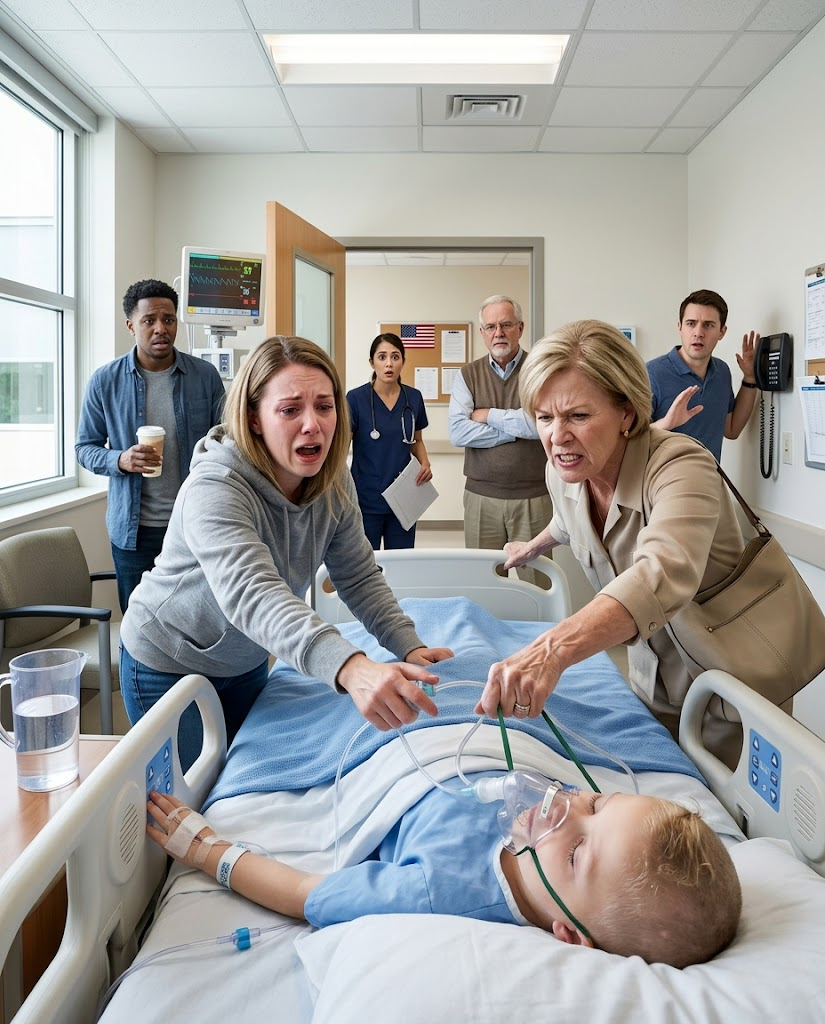
My parents swept into Emma’s room dressed like they were headed to lunch, not standing beside a child’s hospital bed.
My mother had an oversized purse hooked over one arm.
My father did not look at Emma first.
He looked at me.
“That bill wasn’t paid,” my mother said. “What’s the hold up?”
The room froze around that sentence.
The nurse in the doorway stopped with one hand on the chart.
Marcus’s paper cup crumpled in his grip.
Josh looked up from the wall phone like he was not sure he had heard a human being say that in a pediatric ICU.
Emma’s monitor kept beeping, steady and small, the only thing in the room still doing its job.
“Get out,” I said.
My voice sounded calm because anger had burned past language.
My father folded his arms.
“We drove all this way. The least you can do is stop acting hysterical and explain yourself.”
I looked at the plastic water pitcher by the sink.
For one ugly heartbeat, I imagined throwing it hard enough to make him finally hear me.
Instead, I kept my hand on the bed rail and pointed to my daughter.
“Look at her,” I said. “She almost died. She still might. Leave.”
My mother barely glanced over.
“She is asleep. Enough with the theatrics. Charlotte needs that money today.”
I reached for the call button.
That was when her face changed.
Not guilt.
Not fear.
Not even shame.
Calculation.
“You would not dare humiliate us,” she hissed.
Then she lunged toward Emma’s bed.
Her hand closed around the elastic strap before I could get my body between them.
The oxygen tubing stretched.
Emma’s eyelashes fluttered.
The steady beep on the monitor jumped into a hard alarm that split the room open.
“Stop!” I screamed.
The mask came loose and hit the floor near Marcus’s shoes.
My mother flung it away like it was trash.
Like it was nothing.
Like it had not been helping my four-year-old daughter breathe.
“Well,” she said, breathing hard, “she’s gone now. You can come with us.”
Marcus broke in a way I had never seen before.
Not anger.
Not shouting.
His knees hit the visitor chair and his hands flew to his mouth as if he could keep his whole body from coming apart.
Josh moved first.
He shoved my father back with one forearm, not hard enough to hurt him, just hard enough to clear space around the bed.
The nurse hit the wall button so hard her badge slapped against her scrubs.
Two more staff members appeared in the doorway.
Behind them came the charge nurse, calm in that terrifying way hospital people get when something is very, very wrong.
She looked at the oxygen mask on the floor.
Then she looked at my mother’s hand.
Then she looked at Emma’s numbers.
My father started talking fast.
“This is a family misunderstanding.”
The charge nurse did not look at him.
She picked up the mask with gloved hands while another nurse moved to Emma’s side.
“Sir,” she said, “step out of the room.”
“I said this is family,” he snapped.
“And I said step out.”
My mother’s confidence flickered for the first time.
It was small, but I saw it.
The mask went back over Emma’s face.
The nurse adjusted the strap with hands so gentle I nearly collapsed from the contrast.
The alarm kept screaming for a few more seconds, and then the sound changed.
The numbers began to climb.
I did not breathe until the nurse nodded once.
“She’s moving air,” she said.
Those three words did more for me than anything my parents had said in my entire life.
Hospital security arrived within minutes.
My mother tried to cry then.
Not because she was sorry.
Because the room had witnesses.
My father kept saying, “We are her grandparents,” as if the word itself should open doors and erase consequences.
The charge nurse documented everything.
The time.
The alarm.
The mask on the floor.
The statements made in the room.
There is a special kind of silence that happens when people who are used to controlling the story realize someone else is writing it down.
My mother looked smaller under the fluorescent lights.
My father looked older.
Neither of them looked at Emma.
Security escorted them out past the nurses’ station, past the family waiting room, past the small hospital flag decal near the corridor noticeboard.
My mother turned once and said, “You are going to regret this.”
I looked at her and realized I had already spent my whole life regretting the opposite.
Letting it go.
Explaining it away.
Teaching my daughter, by accident, that love meant staying quiet when people hurt you.
“No,” I said. “I’m done regretting myself.”
Charlotte called seventeen times that night.
I did not answer.
She texted that Madison’s party was ruined.
She texted that Mom was sobbing.
She texted that Dad was furious.
She texted that I had taken things too far.
I saved every message.
Then I forwarded the invoice, the timestamps, and the screenshots to myself because the nurse had been right about one thing.
When people try to turn cruelty into confusion, records matter.
Emma survived that night.
She survived the next one too.
Recovery did not look like a miracle in a movie.
It looked like nurses adjusting pillows.
It looked like Marcus learning the rhythm of every machine.
It looked like Josh sleeping in a plastic chair with his hoodie over his face.
It looked like me signing forms at the hospital intake desk with a hand that still shook when I saw my mother’s name on my phone.
When Emma finally opened her eyes, she did not ask about unicorn parties or invoices or grandparents who had confused control with love.
She looked at me and whispered, “Mommy?”
I put my forehead against her tiny hand and cried so quietly the nurse pretended not to notice.
Weeks later, people in my family still said I was cruel.
They said I should have handled it privately.
They said my mother had been emotional.
They said my father had been under stress.
They said Charlotte had only wanted her daughter to have a happy birthday.
But a child in the ICU should have been the line.
When it was not their line, I finally made it mine.
I did not pay the $2,300.
I did not apologize.
I did not take Emma to any more holidays where she would be treated like an afterthought.
The hospital incident report stayed in a folder with the invoice, the screenshots, and the discharge papers.
Not because I wanted to live inside what happened.
Because I needed proof for the days when old guilt tried to make the truth sound dramatic.
I still hear the alarms sometimes.
They come back in my sleep, sharp and bright and impossible to ignore.
But now, when I hear them, I remember something else too.
I remember the nurse’s hands putting the mask back where it belonged.
I remember Marcus standing again.
I remember Josh blocking the doorway.
And I remember my own voice, finally steady, telling my parents to leave my daughter’s room.
For the first time in my life, they had to go.