Her Sister Shattered The Door, But The Hidden Photos Changed Everything-jeslyn_

The hallway was warm with gold light, the kind people notice in real estate photos and Christmas cards.
It made the house look safe.
That was the first lie of the night.
My dress was hanging over the back of a kitchen chair, freshly ironed, the fabric still carrying the faint hot smell from the iron.
My mother had cleaned the counters with lemon spray.
Someone’s lawn mower hummed down the street.
Outside, the neighborhood looked like every quiet American suburb that teaches people not to ask questions when shouting comes from behind a closed front door.
My portfolio was waiting beside the entryway with my heels.
Inside were six pieces I had worked on for months.
Charcoal, acrylic, mixed media, one ugly little abstract piece that my teacher said had “a voice.”
I kept the printed acceptance email folded in my purse because I liked touching the paper when I got nervous.
The showcase started at 7:30 p.m.
It was the first public night of my life that was supposed to belong to me.
Natalie could not stand that.
She had always hated any room where I might be seen without her standing in front of me.
When we were younger, my parents called it jealousy.
When we got older, they called it stress.
By the time we were both old enough to know better, they had settled on one word that covered everything.
Pressure.
Natalie was under pressure when she slapped me for getting accepted into the arts program near her athletic center.
She was under pressure when she slammed my bedroom door so hard the frame cracked.
She was under pressure when she twisted my wrist in the laundry room because I had borrowed a sweater without asking, even though it was mine.
Pressure was the family word for every bruise.
It let my parents sound compassionate while doing nothing.
That afternoon, I found one of my charcoal pieces torn into strips across my bedroom floor.
The drawing had taken three weeks.
I had built it slowly, layer by layer, until the shape of a woman’s face appeared behind what looked like smoke.
Natalie had shredded it cleanly, almost carefully, as if she wanted me to understand it had not been impulse.
It had been a decision.
Black charcoal dust marked the carpet.
A corner of the paper was folded under her shoe print.
I stood in the doorway and stared at it until my eyes stopped understanding what they were seeing.
Then I called for my parents.
My mother arrived first with a dish towel in her hand.
My father came behind her, already looking tired.
Neither one looked shocked.
That was the part I remember most clearly.
Not the paper.
Not the dust.
Their faces.
My mother rubbed her forehead and said, “Your sister is under a lot of pressure.”
I looked at her and waited for the second sentence.
There was always a second sentence in normal families.
Something like, “But this is unacceptable.”
Or, “We’ll handle it.”
Or, “Are you okay?”
My mother did not say any of those things.
My father crouched, picked up one torn strip, and said, “Maybe you can still use some of it.”
That was when I understood they were not going to protect the night.
They were going to manage it.
They were going to smooth it down, explain it away, and ask me to be mature because maturity in that house always meant absorbing what Natalie could not control.
I went back into my room and closed the door.
I fixed my makeup with hands that would not stop shaking.
I changed into my dress.
I packed the pieces that had survived.
Then I opened the bottom drawer of my desk and checked the empty place where the shoebox used to be.
The box was not there because I had stopped trusting my family with the truth.
It was across the driveway at Micah’s house.
Micah was the boy next door.
We had grown up with the same cracked sidewalk between our houses, the same school bus route, the same summer evenings when his father grilled in the backyard and my mother pretended not to hear Natalie screaming upstairs.
Micah was quiet in a way that felt safe.
He never tried to fix things with big speeches.
He noticed.
One night the year before, I sat with him on his porch steps while the little American flag by his mailbox clicked against its pole in the wind.
My cheek was swollen.
I had put makeup over it, but not enough.
Micah looked at me for a long time and then said, “You should take pictures.”
I told him there was no point.
My parents would say I provoked her.
He shook his head.
“Evidence is not for them,” he said. “It’s for the day you need to remember you’re not crazy.”
That sentence became a door in my life.
I walked through it quietly.
I took photos.
I wrote dates.
At 10:14 p.m. on a Tuesday, I photographed the purple marks around my wrist.
On April 3, I wrote down what Natalie said after she shoved me into the laundry room door.
On May 19, I saved the text where my mother told me not to embarrass the family by “turning sister stuff into drama.”
I printed screenshots.
I dated journal pages.
I copied the showcase email and tucked it into the same folder as the picture Aunt Laura took last summer when she saw my wrist and asked, too loudly, why everyone in the house kept protecting Natalie.
After that, Aunt Laura was invited over less.
Family punishment is not always loud.
Sometimes it is a missing chair at Thanksgiving.
Sometimes it is a group text you are not included in.
Sometimes it is everyone pretending one woman became difficult because she was the only one willing to say the word violence.
I put everything into a shoebox and labeled it old art supplies.
Then I brought it to Micah.
He did not ask me to justify anything.
He slid the box under a shelf in his garage beside camping gear and paint cans.
His father saw it there once and did not ask questions either.
He only looked at me and said, “You ever need that back, you come here.”
By 6:40 p.m. on the night of the showcase, I thought I might make it out.
That sounds small, but in my house it was not.
Getting out the front door before Natalie could ruin something was a strategy.
A successful exit was a kind of victory.
I could hear my mother in the kitchen setting mugs into the sink.
My father was near the front room, pretending to check emails on his phone while watching the hallway.
The house smelled like lemon cleaner and hairspray.
My heart kept beating too fast.
I told myself to pick up the portfolio, put on the heels, and leave.
Then Natalie came down the hall.
She had a rejection letter crushed in one fist.
Her face was blotched red.
Her hair was pulled back too tightly.
Her breathing had that uneven edge I knew from every bad night, the kind that made my stomach recognize danger before my brain had words.
I saw the paper in her hand and understood what she had done with it.
She had turned it into permission.
Something had gone wrong for her, so something had to go wrong for me.
I stepped back.
She followed.
“Natalie, not today,” I said.
I heard how small my voice sounded.
I hated that.
“Please,” I added. “Not today.”
She laughed.
It was not loud.
That made it worse.
“You really think you get to walk out of here and have everybody clap for you?” she asked.
My father appeared at the end of the hallway.
My mother stood behind him.
They were both close enough to intervene.
That mattered later.
They were close enough.
Natalie moved faster than I expected.
She grabbed my wrist.
Her grip hit the same place as the old bruises, and my fingers went numb almost immediately.
I tried to pull back without making it look like a fight.
That was another skill I had learned.
Move carefully.
Speak softly.
Do not give the room an excuse to blame you for surviving.
“Let go,” I said.
Natalie shoved me into the wall.
A framed Christmas photo rattled beside my head.
In the photo, all four of us were smiling in matching sweaters.
My mother had mailed copies to relatives that year.
No one looking at it would have known that Natalie had screamed for forty minutes before we took it because I had accidentally stood on her preferred side.
The frame clicked against the wall.
My mother said, “Natalie, stop.”
She said it softly.
Soft enough to be ignored.
Natalie leaned in close.
Her fingers dug into my shoulder.
Her breath was hot against my face.
Her eyes were bright and wet, but not with sadness.
“You should have never been born,” she whispered.
For one ugly heartbeat, I wanted to hit her.
I pictured it with a clarity that scared me.
My hand across her face.
Her shock.
My parents finally seeing something they could not call pressure.
I did not do it.
I stepped back instead.
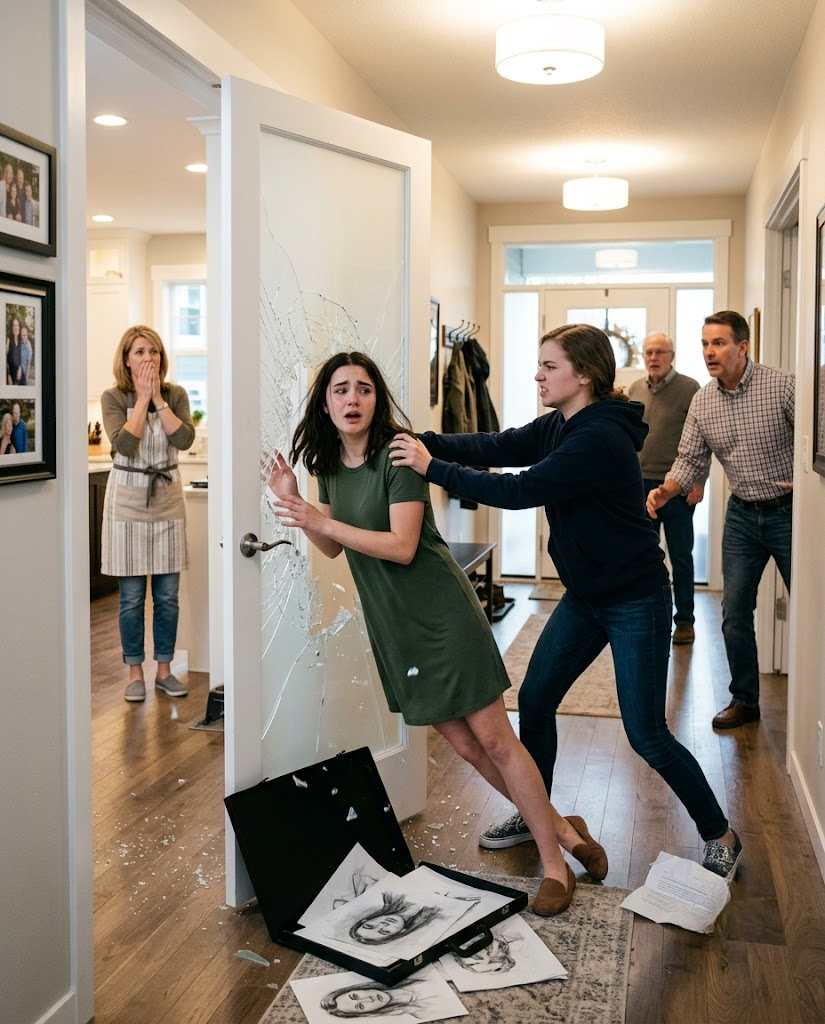
Behind me was my mother’s decorative glass office door.
She loved that door.
It had frosted panels, a brass handle, and a delicate pattern she said made her home office look professional when clients stopped by.
Inside the office, a small desk lamp glowed beside a pencil cup.
A tiny American flag stuck out from the pens because my mother liked rooms to look respectable.
My father’s voice sharpened.
“Natalie.”
He said it like a warning.
He said it too late.
Natalie lunged.
Both hands hit my shoulders.
The glass gave way before I could lift my arms.
The sound was white and bright and final.
Not like a crash in a movie.
Cleaner.
Meaner.
A crack that opened the whole house.
My body went backward through the door.
Glass burst around me.
My portfolio flew out of my hand.
One heel slipped off and hit the baseboard.
Sketch papers slid across the office floor.
For half a second, the whole world held still.
My mother froze with her hand over her mouth.
My father’s face emptied.
Natalie stood in the hallway breathing hard, the rejection letter crushed between her fingers.
From the kitchen, a faucet dripped once into the sink.
Then again.
Then again.
Nobody moved.
Pain arrived after the silence.
It came all at once, sharp and everywhere.
I remember trying to breathe and realizing my body did not know how.
I remember my mother saying my name.
I remember my father saying it louder.
Then Natalie started crying.
“She made me angry,” she sobbed. “She always makes me angry.”
That was the sentence that followed me into the dark.
Not an apology.
Not my name.
A defense.
The side door opened.
Micah’s father shouted for towels.
He had been in his yard and heard the glass.
He pushed past my parents like the house belonged to common sense for once and knelt near me.
“Call 911,” he snapped. “Now.”
My mother said something I could not understand.
My father kept repeating my name.
Micah appeared behind his father, pale and frozen for half a breath.
Then he ran.
At the time, I thought he was running away.
Later, I learned he was running home for the box.
I did not wake up in the ambulance.
I did not wake up in surgery.
I came halfway back somewhere under the dark, where voices moved in and out like people standing in a hallway outside a room.
The air smelled like antiseptic and plastic.
A monitor beeped beside me.
Something tugged at my arm.
My mouth felt dry.
I heard paper.
I heard the words “hospital intake.”
Then “police report.”
Then “incident statement.”
Those words should have scared me.
Instead, they steadied something inside me.
Documented things are harder to bury.
That is why people who depend on silence hate paper.
My mother’s voice cut through the rest.
“Please,” she whispered. “We can’t let this ruin Natalie’s future.”
I was not fully awake, but I understood her perfectly.
There I was in a hospital bed because my sister had shoved me through a glass door, and my mother was still standing guard over Natalie’s life like mine was the inconvenient object in the room.
My father said, “Maybe we should just say it happened during an argument.”
An argument.
That word floated above me like another piece of glass.
Natalie had pushed me.
My parents had watched.
And they were already looking for softer language.
Then I heard Micah.
“I brought the box,” he said.
His voice shook.
His hands did not.
The room changed.
Even with my eyes only half-open, I felt it.
A different silence settled over everyone.
Not shock.
Recognition.
Micah placed the shoebox on the counter near the officers.
The lid came off.
Plastic sleeves moved.
Someone lifted a photo.
I knew which one from my mother’s sound.
It was the wrist picture from 10:14 p.m. on a Tuesday.
Natalie’s fingerprints had bloomed purple around my skin.
My mother whispered, “Oh God.”
Micah said, “There are dates on everything.”
One officer asked, “Who took these?”
“She did,” Micah said. “Because no one believed her.”
My father said, “Micah, this is family.”
Micah’s father answered before Micah could.
“No,” he said. “This is evidence.”
That was when the second envelope appeared.
I did not know about that one.
Micah’s father placed it beside the shoebox and said, “Laura gave me this last summer. Said if things ever got worse, someone needed to have it.”
Aunt Laura.
My aunt had not disappeared from our lives because she was dramatic.
She had been removed because she had seen too much.
Inside the envelope were two photos, a signed note, and a printed message from my mother.
I learned the exact wording later, but one line became the sentence my father could not stop seeing.
Stop making family business sound criminal.
The officer read it silently.
Then he looked at my parents.
Natalie had stopped crying by then.
That was how I knew she was afraid.
My mother tried to speak, but her mouth opened and nothing useful came out.
My father sank into a plastic chair.
For the first time in my life, he looked less worried about Natalie’s future than about everything he had done to protect it.
The officer picked up Aunt Laura’s note.
He read the first line.
Then he asked, “How long has everyone in this family known?”
Nobody answered.
That silence told the truth before any of them did.
Over the next hours, the story my parents wanted to tell fell apart.
The hospital intake notes matched the glass injuries.
The officers photographed the office door.
Micah gave a statement about hearing the shove and the crash.
His father gave a statement about entering immediately after and seeing Natalie standing over me.
My journal pages were copied.
The photos were logged.
Aunt Laura was called.
She arrived the next morning wearing the same plain gray cardigan she always wore when she was trying not to shake.
She came straight to my bed and took my hand.
“I should have pushed harder,” she said.
I could barely speak, so I squeezed her fingers.
She shook her head.
“No,” she whispered. “Don’t comfort me. You don’t have to make adults feel better anymore.”
That sentence broke something open in me.
Not because it was dramatic.
Because it was practical.
Because nobody had ever said it that plainly.
My parents tried to talk to me separately.
The nurse did not allow it.
Micah’s father asked that all visits be cleared through staff until I was stable enough to decide.
A social worker came in with a clipboard.
She asked questions in a voice that did not flinch.
Had this happened before?
Did I feel safe going home?
Were there weapons in the house?
Did my parents minimize Natalie’s behavior?
I answered what I could.
When my voice failed, Aunt Laura answered only facts she had witnessed and let the documents do the rest.
The police report did not use my mother’s word.
It did not say pressure.
It said assault.
It said prior documented incidents.
It said witness statements.
Those words looked cold on paper, but I loved them for their coldness.
Cold words do not beg to be liked.
They stand there and tell the truth.
Natalie was not dragged away in some dramatic scene like a movie.
It was quieter than that.
She was interviewed.
She contradicted herself.
She said I had stepped backward on my own.
Then she said I had grabbed her first.
Then she said she did not remember touching me.
Then an officer asked why my shoulder fabric had stretched marks where two hands had grabbed it.
After that, she stopped talking.
My parents hired language before they offered me remorse.
They said “misunderstanding.”
They said “family conflict.”
They said “emotional episode.”
But by then, there were too many pages.
Too many dates.
Too many photos in clear sleeves.
Too many witnesses outside the family script.
Aunt Laura stayed.
Micah stayed as much as the hospital allowed.
He brought my sketchbook three days later.
The cover had a bent corner from the fall.
Inside, the first blank page looked enormous.
“I didn’t know if you’d want this,” he said.
I touched the paper.
For a long moment, I did not.
Then I did.
My hand shook so badly the first line came out crooked.
I drew the hallway.
Not the pretty gold version.
The real one.
The Christmas photo on the wall.
The glass door.
The tiny flag in the pencil cup.
The portfolio falling open.
A girl going backward through the one thing everyone kept polished.
When my art teacher visited, she cried without making it about herself.
She looked at the sketch and said, “This is yours whenever you want it to be.”
I asked what happened to the showcase.
She said they had left my space open.
Not empty.
Open.
Two weeks later, Aunt Laura drove me there.
I was still moving carefully.
I still had bandages under my sleeve.
My parents did not come.
Natalie did not come.
That should have hurt more than it did.
Instead, the quiet felt clean.
Micah and his father were waiting outside the community arts center.
My teacher had hung the surviving pieces along one wall.
In the center, she had placed the new hallway drawing.
No title card at first.
She asked me what I wanted to call it.
I thought about “Pressure.”
I thought about “Family Business.”
Then I wrote one word on the card.
Evidence.
People stood in front of it for a long time.
Some of them did not know the story.
Some probably guessed pieces of it.
I watched strangers look at the drawing and understand what my own family had refused to see while living inside it.
That was when I finally cried.
Not in the hospital.
Not when the officer read Aunt Laura’s note.
Not when my parents chose Natalie’s future over my body one more time.
I cried in a public room under bright lights because, for once, the truth was allowed to hang on a wall without apologizing for taking up space.
My parents tried to repair things later.
They sent messages through relatives.
They said they loved both their daughters.
They said they had made mistakes.
They said they never realized how bad it was.
But the hardest part of healing is accepting that some people did realize.
They just hoped you would keep surviving quietly because your silence made their lives easier.
Natalie faced consequences I will not pretend were simple or satisfying.
There were charges.
There were hearings.
There were statements.
There were words like probation, evaluation, restitution, and no-contact order.
There were also family members who said I had gone too far by letting outsiders see private pain.
Aunt Laura answered that better than I ever could.
“Private pain is still pain,” she said. “And private violence is still violence.”
I moved in with her for a while.
Micah brought the shoebox back to me one Sunday afternoon.
It sat on Aunt Laura’s kitchen table between two mugs of coffee.
The cardboard was scuffed at the corners.
The label still said old art supplies.
He asked if I wanted to throw it away.
I looked at the box for a long time.
Then I said no.
Not because I wanted to live inside what happened.
Because there are days when memory gets soft around the edges and guilt tries to sound reasonable.
On those days, evidence is not for other people.
It is for the part of you that still wonders whether you deserved to be saved.
I did not deserve what Natalie did.
I did not deserve what my parents excused.
I did not deserve a house where violence had to break glass before anyone called it by its name.
The hallway had taught me what I was allowed to survive.
The box taught me what I was allowed to prove.
And the first drawing I made after that night taught me something even better.
A story does not become true when a family admits it.
It becomes free when the person who lived it stops hiding the proof.