
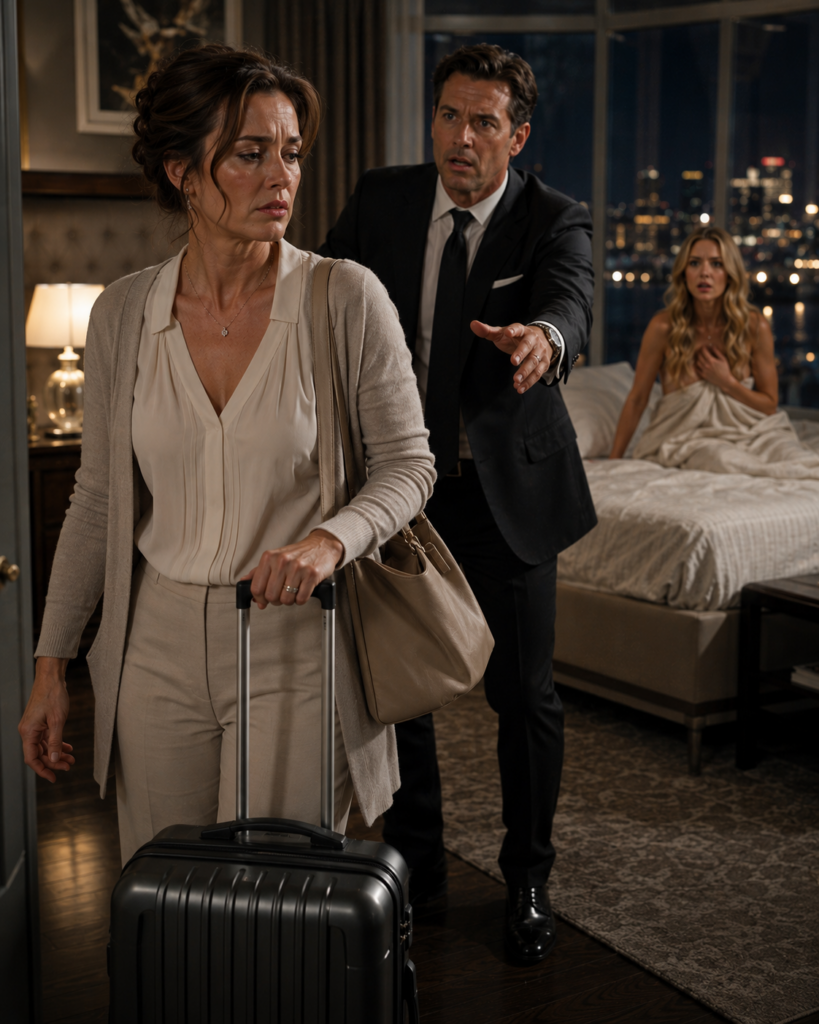
His Wife Grabbed Her Suitcase After Seeing His Mistress… And the Billionaire Panicked

Nine years of marriage ended in the four seconds it took me to open my kitchen door.
Another woman was sitting at my island, wearing my silk robe and drinking from my favorite mug.
My husband was upstairs, still believing money could protect him from the sound of a wife finally leaving.
The first thing I noticed was the perfume.
Not the robe.
Not the mug.
Not even the woman.
The perfume came first because it did not belong in my house. It hung in the conditioned air of the River Oaks mansion like a sweet bruise: expensive, heavy, young, the kind of scent a woman wears when she wants every room to understand she has arrived. I paused in the corridor with my carry-on beside me, my coat still damp from the humid Houston night, and let the smell settle inside my chest.
After nine years married to Richard Rivers, I had learned the art of noticing what men hoped women would politely ignore.
I had flown back from Chicago two days early because I missed the idea of home. That was the humiliating truth. Not Richard, exactly. I had stopped missing Richard in any pure way long before I admitted it to myself. I missed the magnolia trees I had planted our first year of marriage, the quiet shine of the black granite kitchen counters after the housekeeper left, the hour just after sunrise when the mansion stood still and beautiful before phones began ringing from three different time zones. I missed the piano in the small music room even though I had not truly played it in years. I missed the version of myself who used to believe that silence inside a marriage was peace.
Richard had ignored all three of my texts from the airport.
Landed early. Don’t send the driver. I’ll take a taxi.
Then:
Home in thirty.
Then, stupidly:
Are you there?
No answer.
George, the estate doorman, opened the front door when I arrived. He was sixty years old, formal in his navy uniform, and normally so steady that hurricanes seemed less dramatic around him. That night, his smile lasted half a second before melting into shame. His hands tightened around the hem of his jacket. His gaze dropped to the Italian marble floor of the foyer.
“Good evening, Mrs. Rivers,” he said.
“Good evening, George. Is my husband home?”
He swallowed.
“Yes, ma’am.”
The pause after ma’am told me everything I did not yet know.
I could have asked. I could have made him confess whatever terrible mercy his face was trying to spare me. But for nine years, I had cultivated the painful skill of not asking questions when I feared the answer would require me to become someone new.
So I only nodded.
“Thank you.”
I carried my own suitcase up the sweeping staircase Richard had imported from Europe three years earlier after deciding the original railing was “too provincial.” The golden rail curved upward beneath a chandelier that looked like frozen rain. The architect had called it “dramatic.” I had always found it beautiful and cold.
The house was too still.
The hallway sconces glowed at their usual evening warmth. The abstract blue painting I had chosen from a Dallas gallery hung precisely centered. Every vase, sculpture, and framed photograph sat in its perfect place. Our home had always looked like a luxury magazine had taken a deep breath and refused to exhale.
Then came that perfume again.
I stopped outside the kitchen door.
For one second, I thought about turning around, going upstairs, pretending I had not noticed, letting Richard arrange the lie himself and present it in some polished shape later.
But my body was tired of being used as a storage room for things he did not want to say.
I pushed open the heavy oak door.
Ivy Fontaine was sitting at my kitchen island.
Twenty-eight years old, dark hair spilling over one shoulder, legs crossed on the leather bar stool where I drank coffee every morning while reading the financial pages I pretended not to care about. She wore my champagne-colored silk robe, the one Richard had given me for our seventh anniversary, the one he had once tied at the waist himself with a little complicated knot because he said he liked the way it looked. Ivy had knotted it exactly the same way.
That was the detail that finished the marriage.
Not her bare feet resting against the brass footrail.
Not the lipstick mark on my favorite mug.
Not her initial panic when she saw me, or the way she quickly rearranged her face into something rehearsed and pitiful.
The knot.
Richard had tied it for her.
The digital clock on the double oven glowed 10:43 p.m. The refrigerator hummed. Somewhere on the third floor, my husband remained in his executive study, probably finishing a video call with Dallas investors, unaware that the architecture of his double life had collapsed in the kitchen beneath him.
For four seconds, no one spoke.
Ivy’s fingers tightened around the mug. She looked at me, then at the robe, then back at me. I saw terror flash in her eyes before calculation replaced it.
“Victoria,” she said, as if we had been introduced at a fundraiser and this were only awkward, not obscene.
I did not scream.
I did not throw anything.
I did not ask why she was there, why she was wearing my robe, why she had one of my mugs, or why the doorman looked as though shame had aged him ten years in one hour.
I only looked at the robe’s knot.
Then I nodded once, like a judge accepting a piece of evidence too clear to dispute.
I turned and walked out.
“Victoria, wait,” Ivy called behind me.
I kept walking.
My heels made a controlled rhythm against the marble. Down the hallway. Up the stairs. Past the framed photographs of galas, groundbreaking ceremonies, ribbon cuttings, and one anniversary portrait where Richard stood behind me with one hand resting lightly on my shoulder like a man presenting property he was proud to own.
I entered the master closet.
It was larger than the first apartment I had ever rented after college. Custom walnut cabinets. A velvet jewelry drawer. Soft recessed lighting. A climate-controlled section for gowns Richard’s stylist insisted I needed for corporate dinners where my job was to look elegant and say very little. I pulled down the black suitcase I had purchased in Milan four years earlier and placed it on the packing bench.
My hands trembled.
Only my hands.
The rest of me had gone quiet in a way I did not trust yet.
I packed what mattered: three blouses, two pairs of trousers, a simple black dress, my music composition notebooks, a framed photograph of my mother, my passport, my grandmother’s worn gold bracelet, and the flat shoes Richard hated because he said they made me look “less finished.”
At the velvet jewelry drawer, I paused.
Diamonds. Emeralds. Platinum. Anniversary gifts. Apology gifts. Gifts given after he missed dinners, after he forgot birthdays, after he came home smelling faintly of perfume and airport lounges. He had once told me, while sliding a diamond necklace around my throat, “Price doesn’t matter.”
He had been wrong.
Price had mattered too much.
Value had mattered too little.
I left every piece.
Including the platinum wedding ring.
The footsteps came before his voice.
Richard’s footsteps were familiar: quick, heavy, confident, the stride of a man accustomed to entering rooms that reshaped themselves around him. But tonight the rhythm was fractured. Panic had entered his body before humility could.
He appeared in the closet doorway wearing the white shirt from his video calls, sleeves rolled to his forearms, tie loosened. His face had no color.
“Victoria.”
I placed my composition notebooks into the suitcase.
“Stop,” he said. His voice dropped into the tone he used with hostile board members. Commanding. Controlled. Ridiculous in this room.
I folded a scarf.
“Whatever you saw downstairs, I can explain.”
I turned then.
That was when his expression changed.
I think he had prepared for anger. Tears. Accusations. A scene he could manage, apologize through, contain with promises and lawyers and another piece of jewelry from the vault he confused with affection.
He had not prepared for absence.
“Explain what?” I asked.
His mouth opened.
No words came.
Exactly.
“You don’t need to explain the robe,” I said. “Or the mug. Or the perfume. Or George’s face. You don’t need to explain anything, Richard. I understood enough in four seconds.”
“Victoria, please.” He stepped closer. “It was a terrible mistake.”
“No.” I closed the suitcase. “A mistake is forgetting my flight was tonight. A mistake is leaving your phone in the car. A mistake is overcooking salmon.” I looked at him with something colder than rage. “You put another woman in my robe.”
He flinched.
“Ivy means nothing.”
“Then you destroyed something real for nothing.”
That sentence finally landed.
I lifted the suitcase.
He moved as if to take it from me.
I stopped him with one look.
“I’m not going anywhere dramatic,” I said. “I’m simply going home.”
“This is your home.”
“No, Richard. This is your monument.”
He stared at me.
I walked past him.
In the foyer, George stood near the staff corridor, face lowered. I did not blame him. Houses like ours taught employees silence the way old churches taught prayer.
I stopped beside him.
“George.”
He looked up, eyes wet with loyalty he could not speak in front of his employer.
“Please make sure the magnolias are watered tomorrow. The west bed dries out faster.”
“Yes, Mrs. Rivers.”
Richard followed me down the stairs, calling my name once, then twice, each time with less authority.
I did not turn around.
The heavy mahogany front door closed behind me with a sound so soft it felt almost merciful.
Lucy opened her apartment door before I knocked twice.
She had been my closest friend since we were sixteen, back when we wore too much eyeliner and believed heartbreak was something that happened only to people who did not read enough novels. Lucy was small, fierce, unmarried by choice, and allergic to billionaires in general, though she had tolerated Richard because she loved me.
She took one look at my face and opened the door wider.
“I’ll make coffee.”
“It’s nearly midnight.”
“Then I’ll make angry coffee.”
I laughed once, unexpectedly, and nearly cried from the sound.
Her apartment in Montrose had peeling white trim, a leaning bookshelf, too many houseplants, and an old Yamaha upright piano buried under candles, picture frames, and a tragic amount of dust. The whole place could have fit inside Richard’s master bathroom. It also felt more alive than the mansion had in years.
Lucy put sheets on the guest bed and did not ask for details until I sat at her kitchen table with my hands wrapped around a chipped mug.
I told her everything.
The perfume.
The robe.
The knot.
When I finished, she reached across the table and took my hand.
“You are not going back tonight.”
“No.”
“Good. Because I would have blocked the door with my body, and I’m very tired.”
At seven the next morning, Richard stood outside Lucy’s apartment building with a blue velvet box in his pocket and ninety minutes of terrible sleep behind his eyes.
Lucy answered the door.
I heard his voice from the guest room.
“Lucy, I need to see my wife.”
Lucy’s answer was calm enough to be lethal.
“Your priorities have always been backward.”
“It’s important.”
“No, Richard. It’s urgent for you. Important for her is rest.”
“Please.”
The silence that followed felt like Lucy was measuring whether kicking him down the stairs would violate the terms of her lease.
Then the door closed.
I sat on the edge of the bed and stared at a crack in the plaster ceiling.
For the first time in nine years, nobody needed me to be polished before breakfast.
At the mansion, Richard’s world began failing in humiliatingly ordinary ways.
His mother, Catherine Rivers, arrived at noon. She was seventy-two, elegant as a blade, and refused to use a cane despite two doctors and one furious son telling her otherwise. She had always liked me more than Richard deserved. I think she saw too much of her younger self in me: women who knew how to stand beside powerful men without becoming furniture, until one day the difference became too exhausting.
According to George, Catherine entered the house like judgment in silk.
She made Richard confess.
All of it.
Months with Ivy. Late nights. The “secretarial overtime” that was not secretarial. The business retreats Ivy attended because he claimed she understood investor relations better than anyone. The calculated little choices that, piece by piece, had created the image I walked into the night before.
Catherine listened without interrupting.
Then she said, “Money is what men use when they have no soul left to offer.”
Richard said nothing.
“Scrub this house of her perfume,” Catherine continued. “Every robe, every sheet, every mug she touched. And send every piece of Victoria’s that matters to Lucy’s apartment. Not the diamonds. She left those for a reason.”
By three in the afternoon, Richard received one text from me.
Water the magnolias. West bed first. No one else does it properly.
He stared at the phone for several minutes, then walked into the Houston heat in his shirtsleeves and spent ten frustrating minutes hunting for the green hose because I was the one who always coiled it correctly.
He watered the magnolias alone.
Later, he would tell me that was the moment loss became physical.
Not romantic.
Not dramatic.
Physical.
He stood under the blooming trees with water darkening the soil and realized he did not know how to care for anything in that house that was alive.
Over the next seventy-two hours, the mansion began punishing him with perfection.
The staff did not rebel. They did not gossip openly. They did not resign. They performed their duties with flawless, chilling politeness. Arthur the cook served meals exactly on time, without the extra rosemary potatoes Richard liked but never asked for because I always remembered. The cleaning staff returned every room to immaculate order, but not warmth. George opened doors with professional silence. Everyone called him Mr. Rivers instead of sir.
Small change.
Devastating.
Ivy tried to return on the second morning with a small overnight bag and a smirk she must have practiced on the drive.
Richard met her in the foyer.
“Leave.”
Her face faltered. “Richard, we need to talk.”
“No.”
“You can’t just—”
“I can. I did. You are terminated from the company and barred from this property. All communication goes through Mr. Ford.”
“You told me you loved me.”
Richard looked at her then, really looked, and saw not youth, not escape, not admiration, but the cheapness of a woman who had been willing to sit in his wife’s robe.
“I was very stupid,” he said. “Don’t mistake that for love.”
By the third day, he had retreated to his executive study with a glass of whiskey at three in the afternoon, staring at financial spreadsheets that suddenly felt like documents from a language he no longer understood. Fourteen unanswered messages from him sat in my phone. I did not read most of them.
I did read the fifteenth.
The magnolias are doing well.
I hated that it made my chest tighten.
On Wednesday morning, I woke in Lucy’s guest bed and felt the strange absence of a weight I had carried so long it had become part of my posture.
No dinner schedule.
No investor wives.
No urgent stylist asking whether Richard preferred me in blue or ivory.
No staff needing me to soften his mood before he entered the dining room.
No CEO husband whose silence required interpretation.
Just the ceiling crack, Lucy’s terrible coffee, and the old Yamaha piano under a mountain of neglected houseplants.
I stood in the doorway of the living room for several minutes before touching it.
When I lifted the first candle off the lid, dust marked my fingers. One by one, I cleared the surface. Picture frames. Coasters. A dead succulent. A stack of mail Lucy had pretended was “filing.” Beneath everything, the piano waited, out of tune but intact.
I sat.
My hands hovered over the keys.
For nine years, Richard had called my music a hobby. Then, gradually, an old hobby. Then something I used to do. Early in our marriage, I taught intermediate piano at the Houston Cultural Arts Center. I loved it with the kind of private intensity that does not need applause to become oxygen. Richard convinced me to quit in our third year.
“Just for now,” he had said. “My schedule is brutal. I need you with me at events. Once things stabilize, you can go back.”
Things never stabilized.
Empires only learn to demand more.
I placed my fingers on the keys and began with Hanon scales from childhood. The first notes were clumsy, stiff, almost embarrassing. My wrists ached. My ring finger hesitated. Then memory woke in muscle and bone. I moved into a Chopin nocturne I had mastered at twenty-two, not perfectly, not yet, but with enough of myself that Lucy appeared in the hallway and began crying without a sound.
“What?” I asked when I finished.
She wiped both cheeks.
“I thought he had buried you.”
I looked at the piano.
“So did I.”
The next morning, I called Alice Monroe, director of the Houston Cultural Arts Center.
She answered on the second ring.
“Victoria Rivers?”
“Hello, Alice.”
A pause.
“Oh my God,” she said. “Are you calling to donate money or save my department with your hands?”
Despite everything, I smiled.
“I was wondering if you still need instructors.”
“Three intermediate slots have been empty since February. If you are serious, I will personally fight anyone who gets in the way.”
“I’m serious.”
“When can you start?”
“Monday.”
I spent the weekend at Lucy’s kitchen table with black coffee and lesson plans, feeling the most ridiculous kind of joy while sharpening pencils and organizing binders. On Monday, I walked into the arts center wearing a linen skirt and sensible low heels, carrying music books instead of diamond clutches, and stepped into my first classroom with the confidence of a woman speaking her native language after years of pretending to be fluent in someone else’s.
There were nervous teenagers.
Retirees who had waited sixty years to learn.
A construction worker with scarred hands who said he wanted to play something for his daughter’s wedding.
A widow who cried when she managed her first clean chord because her late husband used to hum that progression while making breakfast.
I corrected posture. Counted rhythm. Circled fingerings. Adjusted bench height. Applauded small victories with more sincerity than I had offered at any billionaire gala in years.
When I left that afternoon, purpose expanded in my chest like a lung taking its first honest breath.
The viral video happened by accident.
On Friday, Alice let me use the main rehearsal hall for thirty minutes with the center’s prized Steinway. I had a melody haunting me, something in B minor that I started twelve years earlier and abandoned after marrying Richard. The room was empty, or so I thought. Sunlight fell across the polished black instrument. Dust floated in the high windows. I closed my eyes and played.
At first, the piece was only memory.
Then it became grief.
Then fury.
Then something larger than both.
I played the robe. The mug. The magnolias. The years of dinners where I smiled so Richard could look stable. The nights I sat beside him while he stared at his phone. The way Lucy’s apartment smelled of coffee and rescue. The terrifying sweetness of waking up no longer needed by a man who had forgotten how to see me.
I did not know Sophia, the twenty-three-year-old administrative assistant, had slipped through the back door and recorded one minute and forty seconds of the finale.
That evening, she posted it with the caption:
Someone please tell me who this woman is because I just heard a soul come back to life.
By Saturday morning, the video had eighty thousand views.
By Sunday, four hundred thousand.
By Monday, strangers were calling the arts center asking about “the woman at the Steinway.”
Alice met me at the reception desk with her phone vibrating in her hand and an expression halfway between institutional pride and panic.
“You are viral.”
“I beg your pardon?”
“You. The piano. The B minor piece. The internet has discovered you, and apparently everyone is having feelings.”
The office phone rang nonstop.
On Tuesday, it was Edward Vale, a legendary producer with four Grammys and a reputation for turning obscure talent into global names while terrifying everyone in a ten-foot radius. Alice ran down the hallway to interrupt my senior citizen class, then passed me a sticky note with hands shaking.
Call. Now. Producer. Huge.
I finished correcting William’s posture before stepping into the corridor.
The call lasted twenty-seven minutes.
Edward did not flatter. He asked questions like a man evaluating architecture: training, compositions, catalog, willingness to record, performance stamina, contract expectations, management representation.
“Why did a musician of your caliber disappear for a decade?” he asked.
I looked through the window at the cracked asphalt parking lot.
“Life dragged me in the wrong direction,” I said. “Moving forward, I’m the only person authorized to hold the compass.”
He laughed once.
“Good answer.”
“I need time before discussing contracts.”
“Take time. But not too much. The world moves.”
“So do I,” I said, and hung up before he could pretend he was the only one with power.
I leaned against the plaster wall, hand to my chest, and felt the undeniable truth.
I no longer needed a black suitcase to escape.
I had built an entirely new room inside myself, and this time, no one else had the key.
While I was rebuilding, Richard was discovering the affair had not merely ruined his marriage.
It had opened the side door to a corporate ambush.
His younger brother, Robert, was thirty-eight, an independent architectural consultant with the kind of quiet industry connections that mattered more than titles. Unlike Richard, Robert listened before rooms forced him to. Two weeks after I left, he began tracking rumors about Gregory Altemar, a minority stakeholder in Richard’s construction empire. Gregory held twenty percent, enough to matter, not enough to control, and had lately been moving with the strange confidence of a man holding someone else’s knife.
Robert’s informant confirmed meetings between Gregory and executives from Meridian Group, a Chicago conglomerate desperate to break into the southern construction market. Three hotel meetings. Private. Undisclosed. Suspicious.
Then came the detail that turned suspicion into alarm.
Meridian knew about Richard’s domestic collapse before the society blogs did.
They knew the timing.
They knew Ivy’s name.
They knew Richard had been distracted, emotionally volatile, and making poor decisions.
Robert sat in his dark office for forty minutes connecting pieces Richard had been too arrogant to see: Ivy’s access to Richard’s private files, her proximity to his devices, Gregory’s sudden strategic knowledge, Meridian’s timing, Richard’s affair functioning less like romance and more like a door left open.
He drove to Richard’s glass tower and pulled him out of an engineering meeting.
“We need a secure room,” Robert said.
Richard frowned. “I’m in the middle of—”
“Then interrupt yourself for once.”
Inside the executive suite, Robert laid three documents on Richard’s desk.
Hotel meeting logs.
Email routing evidence.
Budget access records tied to Ivy’s internal credentials.
Richard read in silence.
Color drained from his face.
Robert did not comfort him.
“Victoria was not collateral damage in your pathetic affair,” he said. “She was targeted. Your marriage became the distraction. Ivy was not just sleeping with you. She was feeding Gregory access while you mistook being admired for being loved.”
Richard stared out at the Houston skyline he had spent twenty-five years dominating.
For the first time, his own empire looked back at him without admiration.
“I traded my wife,” he said slowly, “for a corporate spy.”
Robert’s jaw tightened.
“You traded your wife for ego. The spy part is just how expensive that ego became.”
Ivy texted Richard that same night.
We need to talk immediately. It’s about our future. Life-changing.
Richard sat at his mahogany desk with Robert’s folder under his left hand and felt something inside him go cold.
His answer was brief.
All future communication will occur at corporate headquarters in the presence of Mr. Ford and legal counsel.
She called twelve times.
He did not answer.
Over the weekend, Richard’s legal machinery began moving. Forensic accountants. Digital security. Mr. Ford, whose hourly rate could have purchased a small car, sat in the private boardroom Monday morning and outlined the damage: confidential budgets forwarded to Gregory’s server, private construction estimates leaked, scheduling intelligence passed to Meridian through intermediaries, and enough evidence to trigger a hostile buyout clause and a civil suit worth forty-three million dollars.
Richard authorized everything with one exhausted nod.
Winning felt hollow.
Every night he returned to an eighty-thousand-square-foot mansion that smelled like sterilized regret.
At nine on Wednesday morning, Gregory was served legal papers in a downtown coffee shop full of lawyers, assistants, and witnesses. He panicked, called Ivy, and threatened to expose her role if she did not help him neutralize Richard’s lawsuit.
Ivy, sitting alone in a cheap apartment with the walls closing in, finally understood she was out of moves.
Her leverage had expired.
So had her usefulness.
My first public recital sold out in three weeks.
Intermediate piano recitals do not usually fill historic theaters with four hundred velvet seats, but the video had become something larger than me. Morning radio interviews. A Houston Chronicle feature calling me “the hidden genius of River Oaks.” Comment sections full of strangers saying the B minor piece sounded like a woman walking away from a burning house without looking back.
Alice secured the Independence Theater downtown and asked if I was ready.
“No,” I said.
She blinked.
“But I’ll do it anyway.”
The night of the recital, I wore a deep blue dress and no diamonds.
Not one.
Richard bought the last available ticket.
I did not know until later.
He sat in the shadowed twentieth row without entourage, security, or the protective architecture of wealth. For ninety minutes, he listened. He did not understand every structure, every harmonic turn, every reference. But he understood enough. He understood that the woman he had reduced to a silent ornament had been carrying a cathedral inside her hands.
When I ended with the B minor composition, the theater rose.
The standing ovation lasted four minutes.
I returned to the stage three times, flowers pressed into my arms by crying strangers, and every time I bowed, I felt less like someone being applauded and more like someone being returned to herself.
After the theater emptied, Richard waited in the side corridor near the artist exit.
I came out laughing with Alice and Sophia, still holding flowers, still warm from the stage lights. Then I saw him.
For one second, the hallway narrowed.
Then peace settled over me.
Not forgiveness.
Not yet.
Peace.
I turned to Alice. “Give me a moment?”
She looked at Richard like she might bite him, but nodded.
Richard stepped forward.
He looked smaller without the mansion around him. Not poor. Not weak. Just human, which might have been the hardest costume for him to wear.
“Your performance,” he said, voice stripped of command, “was the most beautiful thing I have ever witnessed in my life.”
“Thank you.”
“I came only to listen. Not to ask you to come home. Not to convince you. I just wanted to hear you.”
I held the flowers tighter.
“You heard me for ninety minutes,” I said. “You missed me for nine years.”
His eyes filled.
“I know.”
That mattered.
Not enough.
But it mattered.
“I am no longer your wife, Richard,” I said softly. “Not in the way you mean when you say that word.”
His face tightened as if he had earned the sentence and hated that he could not appeal it.
“I understand.”
“I have found my freedom.”
“I can see that.”
For once, he did not try to buy, argue, or manage the silence.
I walked out into the warm Houston night without looking back.
The following Tuesday, Robert met me in a small coffee shop away from River Oaks and away from the arts center. He sat across from me with two coffees, no sugar for either because he remembered I took mine black, and spent forty minutes giving me the truth Richard had been too late to understand.
Ivy.
Gregory.
Meridian.
The leaked budgets.
The strategic use of Richard’s affair.
The humiliating fact that my heartbreak had been useful to people who viewed me as a disposable piece on a corporate chessboard.
I listened without crying.
The information made everything uglier, yes. It also clarified something.
Richard’s affair had been his choice.
The corporate exploitation had been theirs.
Both truths could stand.
“I’m sorry,” Robert said. “On behalf of my family. On behalf of my idiot brother. On behalf of every room where people saw you and underestimated what they were looking at.”
I took a sip of coffee.
“Thank you for treating me like someone who could survive the truth.”
He nodded once.
“Richard finally understands what he lost.”
“No,” I said. “Richard understands that he lost it. What he lost will take longer.”
Robert looked at me for a long moment.
Then he smiled faintly.
“You always were too intelligent for that house.”
That afternoon, I went back to Lucy’s apartment and played until my hands ached.
Not sorrow this time.
Defiance.
Hope.
A stubborn, indestructible hope nobody could steal again.
Richard wrote the letter on a Sunday.
He told me later it took twelve drafts. That made sense. He had spent his adult life writing contracts, aggressive legal memos, deal terms, investor letters, statements designed to control outcomes. Apology required a language he had avoided learning.
At five that evening, he stood in Lucy’s hallway holding a sealed envelope.
I opened the door but did not invite him in.
His shoulders were slumped. He held no flowers. No jewelry box. No attorney. No proposal dressed as regret.
“This contains no demand,” he said. “No expectation of a reply. No request that you return. I only wanted to give you something physical proving that I have finally learned to see what I refused to see.”
He handed me the envelope.
Then, before I could answer, he stepped back.
“Whatever you decide, Victoria, I am burying the man who thought your silence meant you were satisfied.”
He turned and walked down the stairs.
I sat alone in Lucy’s living room at 10:20 that night and opened the envelope.
His platinum wedding band slid into my lap.
The letter was three pages.
He did not write about Ivy’s betrayal. Not Gregory. Not Meridian. Not the lawsuit. Not the corporate war he was already winning.
He wrote about dinners where I sat across from him and he stared at his phone.
He wrote about asking me to quit teaching piano because his empire needed my presence.
He wrote about the magnolias, and how he had never once known which beds dried faster.
He wrote that his greatest sin was not the affair, though it was unforgivable, but the thousands of smaller abandonments that made the affair possible.
He wrote:
I did not lose you the night you found Ivy in the robe. I lost you every time you entered a room and I did not look up.
I read the letter twice.
I did not cry.
I placed his wedding band on Lucy’s coffee table and let the strange comfort of being accurately seen settle into my bones.
The decision came weeks later during an ordinary piano lesson.
William, my seventy-one-year-old beginner, had spent ten minutes trying to play a simple left-hand pattern without collapsing into frustration. His fingers were stiff from arthritis. His pride was fragile. But each time he failed, he adjusted and tried again.
“Why don’t you quit?” I asked gently, meaning the exercise, not the piano.
He gave me a look.
“Mrs. Rivers, I’m seventy-one. If I quit every time something came too late, I’d have nothing left to learn.”
That night, I called Richard.
We met at a modest restaurant with scratched wooden tables, no investors, no staff, no cameras, no valet. He arrived early. I arrived exactly on time.
For two hours, we abandoned every illusion.
I told him the mansion was not home to me anymore.
He said he knew.
I told him my music would never again be treated as decorative.
He said he would fund nothing, manage nothing, claim nothing, unless invited.
I told him emotional neglect would not be forgiven simply because he had learned to name it.
He said he did not expect forgiveness on a schedule.
I told him I did not know whether I could love him again.
He said, “Then I will learn how to be someone you could trust, even if I never benefit from it.”
That was the first answer that did not sound like Richard Rivers trying to win.
Three months later, we had Sunday dinner at Catherine’s house.
Not the mansion.
Never the mansion.
Catherine’s home was warm, crowded, full of old books, imperfect lamps, and enough food for twice the number of people invited. Lucy came because Catherine insisted and because she wanted to judge Richard’s progress in person. Robert came late with a bottle of wine and a grin. Richard arrived carrying nothing but a lemon tart he had made badly himself because Catherine said store-bought desserts were for cowards.
I arrived from rehearsal in a simple green dress, no diamonds, no armor.
Richard stood when I entered.
Not dramatically.
Not possessively.
Just because respect had finally taught his body what arrogance never had.
At dinner, he asked about my students and listened to the answer.
He asked whether William had mastered his left-hand pattern.
He remembered Sophia’s name.
He did not check his phone once.
Small things do not repair large betrayals.
But large repairs are made of small things repeated honestly.
Forgiveness, I learned, is not a door opening in one miraculous swing. It is a corridor. Some days you take three steps. Some days you sit on the floor and refuse to move. Some days the person who hurt you waits quietly beside the wall without demanding progress.
Richard and I did not return to what we were.
That marriage was gone.
But something else began, not because betrayal deserved reward, but because truth had finally entered the room and stayed there.
I signed Edward’s recording contract six weeks later—with my own attorney, my own terms, my own name. The B minor piece became the title track of my first album. The magnolias still bloomed at River Oaks, though I no longer lived beneath them. Richard watered them himself every Friday morning because I told him once that living things do not care whether regret is busy.
I kept teaching.
I kept playing.
I kept Lucy’s guest room in my heart as the place where I returned to myself.
And when people asked if I regretted walking into the kitchen that night, I always said no.
A woman can spend years fearing the door that will show her the truth.
Then one day she opens it and discovers the truth was not the ending.
It was the exit.
I walked through mine with a black suitcase, a broken heart, and my grandmother’s bracelet tucked in the side pocket.
On the other side, there was music.
There was freedom.
And, eventually, there was love again—slower, humbler, less glittering than diamonds, but finally honest enough to live in the same room as me.