
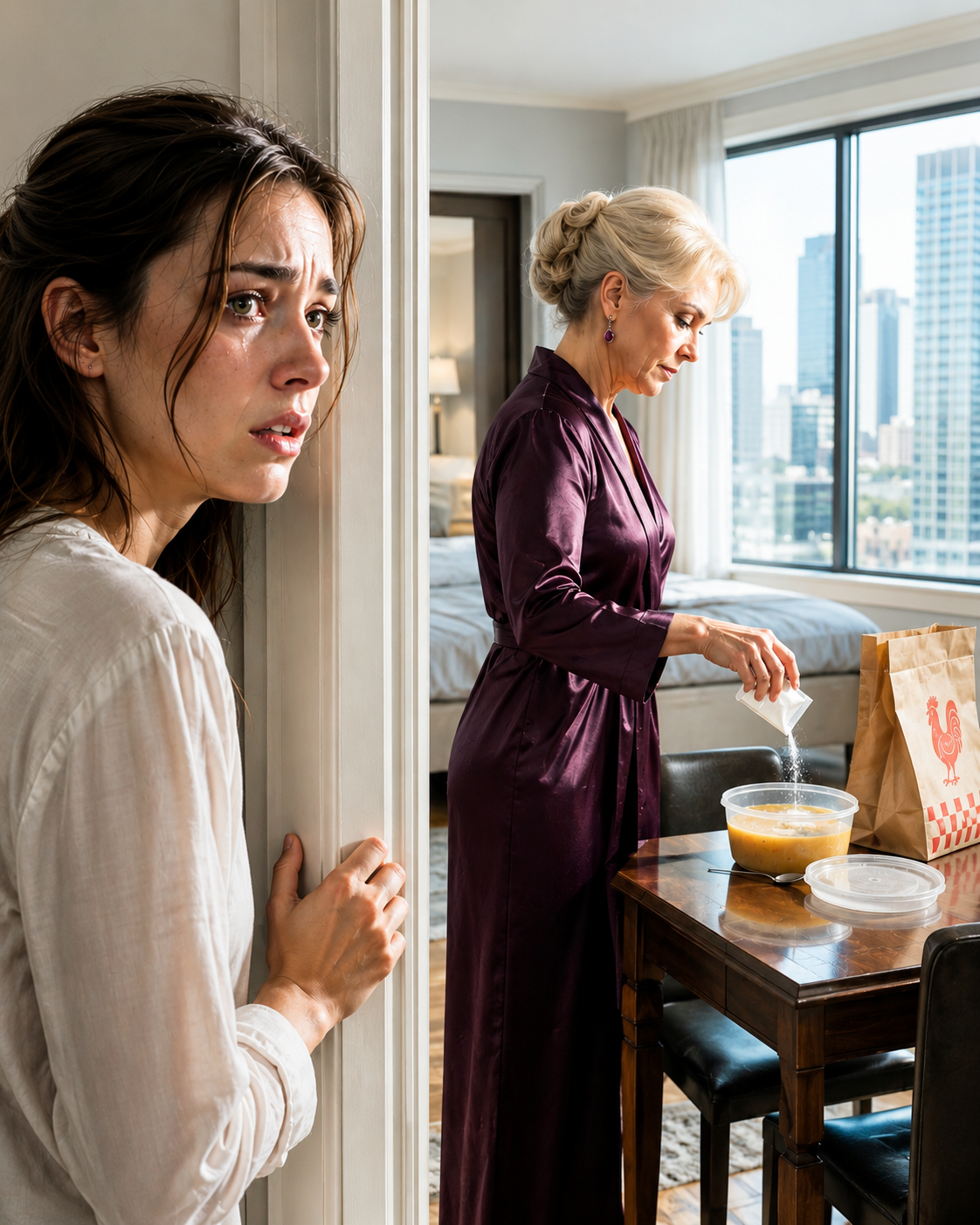
I caught my mother-in-law slipping white powder into my dinner at 1:07 in the morning.

I Caught My MIL Sneaking White Powder Into My Meal. Without Making A Sound, I Served That Exact Same Dinner To My Husband And His Mistress. At 3 AM, We Got A Call From The Hospital. The Moment She Saw The Body, She Collapsed On The Floor.
Part 1
The night my mother-in-law tried to poison me, Chicago sounded like it was holding its breath.
It was a little after one in the morning, that dead slice of time when the city stops pretending to be alive. The buses were gone. The laughter outside the corner bar had dried up. Even the radiators in our old pre-war apartment building had settled into a low, tired hiss.
I had just come home from a double shift at the hospital pharmacy, my hair flattened by my wool hat, my feet aching inside clogs that had carried me through thirteen hours of fluorescent light and white tile. My hands still smelled faintly of antiseptic, gloves, and crushed tablets. That smell followed me everywhere, like my job had stitched itself into my skin.
All I wanted was soup.
Not a conversation. Not another lecture. Not another look from Valerie Peterson, my mother-in-law, as if my empty womb had personally disgraced her bloodline.
Just soup.
Chicken noodle, extra broth, black pepper, no celery. I had ordered it from the little diner three blocks away because I was too tired to boil water. When the driver texted that he had left it outside my door, I took the trash downstairs first, one of those small chores I did automatically—like wiping counters, folding Derek’s shirts, or pretending I didn’t know when my husband lied.
When I came back up, the paper bag sat outside our door, steam curling from the folded top. My stomach cramped with hunger.
Then I saw movement in the mirror.
Derek had bought that long antique mirror two years earlier and hung it above the console table across from our front door. He said it made the entryway look “elevated.” Valerie said it made the apartment look “less like a clinic.”
I hated that mirror.
It showed you things before you were ready to see them.
In its dim reflection, our bedroom door cracked open.
At first, I thought it was Derek, even though he had texted earlier that he was “stuck at the office.” Then a plum-colored sleeve slid into view.
Valerie.
She stepped out barefoot, moving with the careful stiffness of someone who had rehearsed being quiet but not practiced enough. Her silver hair was pinned crookedly. Her silk robe caught the hallway light like spilled wine. Between her fingers, she held something small.
A plastic packet.
I stopped with my key halfway out of my purse.
Valerie looked toward the front door. I lowered my head quickly, pretending to search for something, my body tucked into the shadow beside the coat closet. My pulse began beating in strange places—my throat, my wrists, behind my knees.
She crossed to the dining table, where the soup sat inside the delivery bag.
Her movements were not confused.
Not sleepy.
Not accidental.
She opened the container. The smell of chicken broth drifted through the apartment, rich and salty. Valerie tore open the little packet with her teeth. A fine white powder slid into the soup.
For a moment, the whole apartment seemed to shrink around that bowl.
She stirred it slowly with one of my teaspoons, scraping the bottom so nothing clumped. A dusting of powder stuck to the rim. She wiped it away with a napkin, shoved the napkin into her robe pocket, then leaned over the bowl and whispered with the sharpness of a knife drawn across a plate.
“Eat it and die already, you barren weed.”
My hand tightened around my keys so hard one edge cut into my palm.
Valerie put the lid back on, turned, and vanished into the bedroom.
I stood there in my own hallway, breathing through my mouth, staring at a bowl of soup that had been ordinary thirty seconds earlier.
And when I finally stepped inside and smelled what she had put in it, I realized the powder was not what a frightened wife would expect.
It was worse.
Part 2
I locked the door behind me without making a sound.
That was the first thing my body decided for me.
Not scream. Not run. Not throw the bowl into the sink and wake the building.
Lock the door.
The old brass bolt slid home with a soft click. In the quiet apartment, it sounded final.
I walked to the dining table. The soup container sat in the middle of the polished wood, innocent as a church donation. I lifted the lid.
Steam touched my face.
Chicken. Onion. Pepper. Parsley.
And underneath, a sharp medicinal bite.
Most people would have missed it. Derek would have missed it. Valerie had counted on me missing it. But I was a clinical pharmacist. Smells were part of how I survived my work. I could tell when tablets had been crushed too long before mixing. I could catch the metallic tang of certain compounds through layers of packaging. My father used to joke that I had the nose of a bloodhound and the patience of a coroner.
The powder was not rat poison.
Not arsenic.
Not bleach.
Not anything dramatic enough to make a true crime audience gasp.
It smelled like a crushed antibiotic. Heavy. Bitter. Familiar.
For one foolish second, relief almost loosened my shoulders.
Then my mind did what it was trained to do.
Medication to body. Body to condition. Condition to consequence.
A high dose of that particular class of antibiotic could make a person violently ill. Under the wrong circumstances, with alcohol in the bloodstream, it could become something much uglier. A person might flush red, vomit, lose pressure, collapse before anyone understood what was happening.
Derek loved whiskey.
No, that was too gentle.
Derek performed whiskey. He ordered it neat, spoke about oak and smoke as if he had invented both, and drank when he entertained clients, celebrated deals, lost deals, or wanted to prove he was the kind of man other men envied.
My phone buzzed on the counter.
Derek: Still stuck in meetings. Don’t wait up. Love you.
I stared at the message until the words separated from meaning.
He had sent something similar at seven, but I had checked his location. Derek’s little blue dot had not been at his office. It had been at the Caledonia Residences downtown, a luxury building where his “meetings” required cologne, cash withdrawals, and lies.
I rarely confronted him anymore.
Confronting Derek was like punching fog. He would smile, kiss my forehead, tell me I was exhausted, tell me infertility grief was making me paranoid, tell me his mother was harsh only because she cared about family.
Family.
Valerie’s favorite word.
She had moved in six months earlier after “a blood pressure scare,” though her blood pressure only seemed to rise when I entered a room. She called me “poor Chloe” in front of guests. She left fertility brochures on my pillow. She brewed bitter herbal teas and stood over me until I drank them.
“Women used to know their duty,” she once said. “Now they want careers and excuses.”
For three years, I had swallowed insults with the same discipline I used to swallow vitamins. I told myself Derek loved me. I told myself grief made people cruel. I told myself I could endure anything if it kept my marriage intact.
But Valerie had not insulted me tonight.
She had prepared my death and wiped the evidence from the rim.
I looked at the soup.
Then at Derek’s text.
Then at the bedroom door, behind which Valerie was probably lying awake, waiting to hear me choke.
My medical ethics rose up first.
Do no harm. Preserve life. Call the police. Preserve evidence.
But another voice answered, colder and older.
She made the bowl.
She chose the powder.
She whispered the prayer.
My hands moved before my heart could stop them. I opened the DoorDash app and called the driver.
He answered groggily. “Ma’am? Everything okay?”
“I’m so sorry,” I said, my voice almost normal. “Could you come back upstairs? I need that order delivered to a different address. I’ll tip you fifty dollars cash.”
While I waited, I texted Derek.
Honey, your mom got worried when she heard you were working late. She made sure I sent you my soup so you’d have something hot. Please eat it. Don’t hurt her feelings.
I read it twice.
Then I hit send.
When the driver arrived, I handed him the sealed bag with a folded fifty tucked under the receipt. He thanked me without looking closely at my face.
I closed the door and sat on the couch in the dark.
From the bedroom, Valerie coughed once.
The clock ticked toward three, and I waited for the universe to decide who it wanted to punish.
Then my phone rang.
Part 3
The ringtone cut through the apartment like a scalpel.
For a second, I couldn’t move. The sound bounced off the dark windows, the framed wedding photos, the glass vase of dried eucalyptus on the coffee table. My whole life looked normal in the blue-black light before dawn, and that normalness felt obscene.
I picked up on the fifth ring.
“Chloe?” a man’s voice said. “It’s Dr. Reinhart from Chicago Med.”
The hospital.
My tongue stuck to the roof of my mouth.
“Yes?”
“You need to come in immediately. Derek Peterson was brought into the ER in critical condition. Cardiac and respiratory arrest. We’re doing everything we can.”
I closed my eyes.
There are moments when you expect emotion to arrive like weather—rain, thunder, something violent.
But what came over me was not grief.
It was a hollow, ringing pressure, as if the air had been sucked out of the room.
“I’m on my way,” I said.
Valerie’s bedroom door opened before I reached the hallway. She stood there clutching her robe at the throat.
“Who was that?”
“The hospital,” I said.
For the first time since I had known her, she looked truly afraid.
We drove separately. She refused to ride with me. At the ER entrance, bright light spilled over wet pavement. Inside, the waiting area smelled of disinfectant, burnt coffee, and fear.
Valerie was already there.
She was on the floor.
Not sitting. Not kneeling.
Rolling.
“My son,” she wailed. “My only son.”
When she saw me, she scrambled up and lunged, fingers curved like claws toward my hair. A security guard stepped between us.
“You,” she screamed. “What did you do? Why didn’t you eat it?”
The room went quiet.
I let that sentence hang.
A nurse I knew from overnight shifts stared at Valerie, then at me. I brought a trembling hand to my mouth.
“What?” I whispered.
Valerie realized too late what she had said. Her face went slack, then twisted again.
“You killed him,” she shrieked. “You killed my Derek.”
Before she could say more, Dr. Reinhart came through the double doors. I had seen him pronounce strangers dead with the grave tenderness doctors save for families, but tonight his eyes flicked toward me with something extra.
Recognition.
Pity.
Unease.
“Mrs. Peterson,” he said.
I already knew.
Still, my knees softened when he said it.
“We did everything possible. The reaction was severe and rapid. His blood alcohol level was very high, and the medication interaction caused catastrophic cardiovascular collapse. Time of death was three a.m.”
Valerie made a sound I hope never to hear again. It was not crying. It was the sound of a person being torn down the middle.
Then Dr. Reinhart hesitated.
That hesitation changed the temperature of the room.
“There was someone with him,” he said carefully.
Valerie froze.
“A young woman. Samantha Miller. She had also consumed the soup and wine. She was pregnant.” He drew in a slow breath. “We could not save her or the fetus.”
Pregnant.
The word moved through the ER like smoke.
Valerie’s mouth opened. No sound came out.
I watched the knowledge hit her in pieces.
Soup. Derek. Samantha. Pregnancy. Grandchild.
Her grandchild.
The baby she had hissed about when she thought I was not listening. The heir. The proof. The replacement.
Two gurneys rolled past behind the doctor, each covered in a white sheet.
Valerie stared at them.
Her face emptied.
Then she collapsed.
I stood against the wall while nurses rushed to her. Someone guided me into a chair. Someone put water in my hand. I watched the cup tremble and realized my fingers were doing that.
A police officer arrived twenty minutes later.
He asked who had handled the food.
Valerie, revived and wild-eyed on a hospital bed, lifted one shaking finger toward me.
And that was when I understood the night was not over.
It was only learning my name.
Part 4
The interrogation room smelled like stale coffee and old nerves.
I had been inside police stations before, but only for medication disposal programs and hospital outreach meetings. Sitting on the other side of the table was different. The chair was too hard. The fluorescent light made every pore feel exposed.
Two detectives sat across from me.
Detective Harris was older, his face built from long nights and bad news. Detective Ruiz was younger, sharp-eyed, with a notebook open and her pen still capped. That detail comforted me. People who want to trap you uncapped pens quickly.
“Mrs. Peterson,” Harris said, “your mother-in-law claims you ordered the soup, received it, then arranged for it to be delivered to your husband. Is that true?”
“Yes.”
“She also says you knew he was with another woman.”
“I suspected my husband was having an affair,” I said. “I didn’t know who he was with tonight.”
“Were you angry?”
I almost laughed.
Angry was for spilled wine on carpet. Angry was for canceled plans. What I felt toward Derek had long ago become something layered and sedimentary, pressure turning pain into stone.
“I was tired,” I said. “I had just worked a double shift. I ordered soup because I hadn’t eaten.”
“And then?”
“And then I sent it to my husband because his mother said he should have something hot.”
Harris watched me.
“You’re a pharmacist.”
“Yes.”
“So you understand medications. Interactions. Toxicity.”
I lifted my eyes. “Which is exactly why I would never use food ordered from my own account to harm someone. If I wanted to commit murder, Detective, I would not pick the dumbest possible method and leave a digital receipt.”
Ruiz’s mouth twitched slightly.
Harris did not smile.
“Can you prove Valerie touched the soup?”
I had been waiting for that question.
Derek had installed a small indoor camera near the entry shelf, angled toward the door. He said it was for security. I knew it was surveillance. He liked knowing when I left, when I came home, whether I talked too long to the neighbor.
He had built a cage and forgotten cages keep records.
I opened the app and slid my phone across the table.
“Timestamp twelve thirty-five a.m.”
The video loaded.
There I was, half visible near the door. Then Valerie appeared in her plum robe. Small packet. Soup lid. White powder. Stirring. Napkin wiping the rim.
The camera microphone caught her voice clearly.
“Eat it and die already, you barren weed.”
Ruiz whispered, “Jesus.”
Harris’s jaw tightened.
I took my phone back.
“My mother-in-law hated me because I didn’t have children,” I said. “She blamed me for everything. She gave me teas, supplements, powders. I thought if I tolerated it, she would eventually soften.”
My voice cracked.
“She didn’t soften.”
By sunrise, Valerie was under arrest.
I saw her in the precinct hallway, handcuffed to a bench, hair loose around her face. When she saw me, she surged forward so violently the metal cuffs clanged.
“You knew,” she spat. “You sent it to him because you knew.”
An officer stepped between us.
I paused.
Everything in me should have walked away. But grief has strange cousins, and one of them is cruelty.
I leaned close enough for only her to hear.
“Valerie,” I whispered, “one bowl of soup, and you erased your entire bloodline.”
Her eyes rolled back. Her mouth opened in a dry, soundless scream.
I left her there.
The apartment looked smaller when I returned. Dawn pushed weak gray light through the blinds, showing dust on the console table, a lipstick stain on a wineglass, one of Derek’s ties slung over a chair.
Evidence of a marriage.
Or a crime scene.
Sometimes there is no difference.
The police returned Derek’s personal items in a sealed bag. His watch. His wallet. His phone, cracked at one corner.
For three years, Derek had guarded that phone like it contained state secrets. He changed passwords often. He tilted the screen away when I entered rooms. He told me privacy was healthy in marriage.
But men like Derek were sentimental where they thought themselves clever.
I typed in 051820.
May 18, 2020.
The day he proposed.
The phone unlocked.
His wallpaper was not our wedding photo.
It was an ultrasound.
A six-week-old fetus circled in red.
My hand went cold around the phone, and before I could prepare myself, a notification banner slid down from a locked Apple Note.
Retirement Plan.
Part 5
The title sat there like a joke told by a corpse.
Retirement Plan.
For a while, I did not tap it. I sat on the edge of the sofa with Derek’s phone in my palm and watched morning light crawl across the hardwood floor. Outside, a garbage truck groaned at the curb.
The world continued with disgusting confidence.
Finally, I opened the note.
It asked for a password.
I tried Derek’s birthday. Wrong.
His mother’s birthday. Wrong.
Our anniversary. Wrong.
Then something cold and humiliating moved through me.
I typed my birthday.
The note opened.
I read the first line and forgot how to breathe.
Max out accidental death policy after contestability period.
Below that were bullet points. Dates. Amounts. Reminders. My allergy history. My morning routine. The brand of protein powder I used after workouts. A note about switching my EpiPen with an expired one so emergency response would fail.
He had not written in anger.
That was the worst part.
There were no curses. No messy confession. No drunken rant.
It was business language.
Clean. Efficient.
A project plan for removing a wife.
My severe mango allergy was listed like an asset. My trust in him like a tool. My life insurance payout like revenue.
I put the phone down and ran to the bathroom. Nothing came up but acid. I gripped the sink and stared into the mirror.
Derek had been planning to kill me.
Valerie had merely gotten impatient.
That was when the first real sob came out of me. Not for Derek. Not for Samantha. Not even for the marriage. I cried for the woman I had been twelve hours earlier, the one who still believed betrayal had limits.
After that, I stopped crying.
Work steadies me. Always has. Trauma scattered me; tasks put me back together.
I went through his phone.
Messages with Samantha were pinned at the top. He called her Sammy. She called him D. There were baby emojis, hotel confirmations, jokes about my “clinic smell,” photos I refused to look at for more than a second.
Then came money.
Venmo. Zelle. Bank transfers. Credit card statements. Debt notices. Payday loans. Overdraft warnings.
Derek, my polished sales director husband with tailored suits and a leased BMW, had four hundred and seventeen dollars in checking and more than eighty thousand in unsecured debt. The house of cards had already collapsed. He had simply trained me not to look at the floor.
Transfers to Samantha appeared every month.
Rent help.
Spa day.
New dress.
Doctor visit.
Then larger amounts: ten thousand for her parents’ kitchen remodel, eight thousand for her brother’s car, five thousand marked “family emergency.”
My money.
My savings.
The joint investment account he had insisted he manage because “markets stressed me out.”
I found a payment to Samantha’s mother for five hundred dollars.
Happy birthday to the best future mother-in-law.
On my own mother’s birthday that year, Derek had brought home gas-station carnations and said we needed to tighten spending.
I printed everything.
Bank statements. Screenshots. Messages. The Apple Note. Insurance documents. Transfers. By afternoon, the dining table had disappeared beneath paper.
Rage, properly filed, becomes evidence.
Then I called Marcus Sterling.
He was not the kind of attorney people found on billboards. He was the kind old hospital donors used when they wanted problems solved quietly. Silver hair. Calm hands. A voice that made panic feel embarrassing.
When he arrived, he spent two hours reading.
At the end, he took off his glasses.
“Chloe,” he said, “your husband was not just unfaithful.”
“I know.”
“He was planning your murder.”
“I know.”
“He may also have committed financial fraud through his company.”
That, I had not known.
Sterling tapped one transfer. “If Samantha worked in accounting, and these payments connect to vendor manipulation, there may be more here than marital theft.”
I looked at the neat piles of paper.
Derek had wanted to turn me into a ghost, cash the check, and move his mistress into the life I paid for.
But dead men still leave fingerprints.
Two days later, at his funeral, I stood beside his casket in a black dress and watched the first vultures come through the chapel doors.
They were carrying Samantha’s photograph.
Part 6
Funeral homes try very hard to make death tasteful.
Soft carpet. Low music. Flowers that smell too sweet. Men in dark suits who speak like librarians. Everything arranged to convince the living that grief can be managed with enough lilies and polished wood.
I chose a respectable chapel in the suburbs, not because Derek deserved it, but because appearances mattered. People believe widows who behave properly. They comfort women who stand straight beside caskets. They doubt women who scream.
So I stood straight.
Derek’s coworkers came first, murmuring condolences while hunting for scandal. Neighbors came after, whispering that Valerie was in jail and wasn’t it awful. A few hospital colleagues hugged me hard enough to hurt.
I thanked everyone.
I did not look into the casket longer than necessary.
Derek looked expensive and false, exactly how he had looked alive.
At ten seventeen, the chapel doors burst open.
Samantha’s mother entered like an actress missing her cue but determined to steal the scene. She wore a black sweater covered in lint, leggings, and sunglasses pushed into her hair. Her husband followed, broad and red-faced, with two younger men behind him.
The Millers.
Mrs. Miller clutched a framed photo of Samantha.
“My baby,” she cried before anyone spoke to her. “My poor baby girl.”
Every head turned.
She marched down the aisle and slammed Samantha’s photo onto the memorial table beside Derek’s portrait.
A cousin gasped.
Mr. Miller pointed at me.