
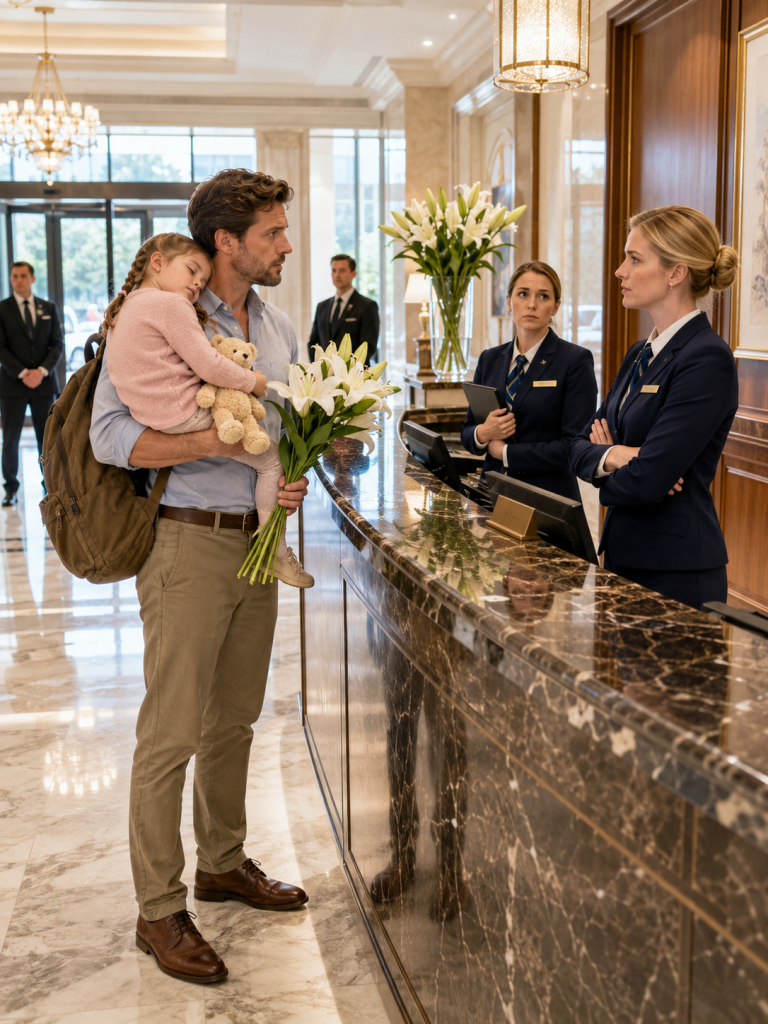
I Walked Into My Own Hotel Wearing A Gray Hoodie, Carrying My Sleeping Daughter After A Storm Delayed Our Flight.

- Part 1 — A Tired Father In A Gray Hoodie
- Part 2 — The Rule Behind The Desk
- Part 3 — The Name That Changed The Room
- Part 4 — The Morning After Marble
- Part 5 — Ruth’s Standard
Part 1 — A Tired Father In A Gray Hoodie
No one in the lobby of the Harrington Regent Hotel imagined that the man they were about to refuse was the same person whose signature appeared on the ownership papers, the employee contracts, the renovation plans, and the brass service charter mounted behind the front desk.
It was nearly midnight when Nathaniel Brooks stepped through the revolving doors with his daughter asleep against his shoulder. He wore a faded gray hoodie, dark jeans softened by travel, and plain sneakers still marked with rain from the curb. A black backpack hung from one hand, while seven-year-old Emma held a stuffed rabbit against his chest, her cheek pressed into the hollow of his neck with the complete trust of a child who believed her father could solve any problem after a long day.
Their flight from Denver had been delayed for hours because of thunderstorms moving across the East Coast. Nathaniel had spent the past three months traveling quietly through hotels owned by Brooks Hospitality, visiting properties without advance notice to see what customers experienced when no one knew the founder was watching. He wanted only a clean room, a warm shower, and enough quiet for his daughter to sleep until morning.
He could have called the regional director. He could have asked the general manager to prepare the penthouse suite. He could have stepped out of a chauffeured car in a tailored suit and watched the entire lobby transform itself into polished obedience.
He chose not to.
Nathaniel had learned long ago that a company reveals its soul most clearly when it believes no powerful person is present. His mother, Ruth Brooks, had worked as a hotel housekeeper for twenty-nine years, scrubbing bathrooms in places where guests would speak past her as though courtesy were a luxury reserved for people with luggage that looked expensive.
“A person does not show character by how they treat a millionaire,” she used to tell him. “They show it when they think the tired man at the door has nothing to offer them.”
When Nathaniel built Brooks Hospitality, he wrote that principle into every training manual. It appeared in orientation videos, employee handbooks, and on a brass plaque behind every front desk: Every guest must be treated with dignity before they are asked to prove status, wealth, or belonging.
The plaque stood directly behind the night clerk now looking at Nathaniel’s hoodie before looking at his face.
The clerk’s name was Kyle Mercer, according to the silver name tag on his navy uniform. He was young, neat, and handsome in the way that suggested he had been praised too often for looking appropriate in expensive rooms. His professional smile lasted only until his eyes reached Nathaniel’s sneakers, the sleeping child, and the worn backpack.
“Good Evening,” Nathaniel said quietly, careful not to wake Emma. “I Need A Room For Tonight. One Room Is Fine, Whatever You Have Available.”
Kyle tapped at his keyboard, though his eyes did not really move across the screen.
“Sir, The Harrington Regent Primarily Accommodates Guests With Confirmed Reservations.”
“I Understand,” Nathaniel said. “Our travel changed because of weather, but I can pay now.”
Kyle’s smile tightened.
“This Is Not Really A Walk-In Property.”
The words were quiet enough to sound polite, yet loud enough for the couple near the lobby bar to hear. Nathaniel felt the sentence land with the old familiarity of being measured and dismissed before any question had been answered.
“I Am Asking Whether A Room Is Available,” he said.
Kyle’s fingers moved again.
“Unfortunately, We Are Fully Committed Tonight.”
Nathaniel glanced toward the glowing screen reflected faintly in the marble behind the desk. He did not need the system to know that a hotel of this size almost always held rooms aside for emergencies, loyalty upgrades, or late corporate arrivals.
“There Is Nothing At All?”
“Nothing Suitable,” Kyle said, then corrected himself too late. “Nothing Available.”
Emma shifted against his shoulder.
“Dad?” she murmured. “Are We There Yet?”
Nathaniel kissed her hair.
“Almost, sweetheart. Give me one more minute.”
Before he could speak again, the revolving doors turned behind him. A well-dressed couple entered laughing softly, the man in a tailored coat, the woman carrying a designer overnight bag and wearing diamond earrings bright enough to catch the lobby lights. They approached the desk without luggage tags or reservation papers.
“We Do Not Have A Reservation,” the man said, smiling easily. “But We Need A Room Tonight.”
Kyle straightened as though someone had pulled a string through his spine.
“Welcome To The Harrington Regent,” he said warmly. “Let Me See What I Can Arrange For You.”
Nathaniel stood beside the desk, his daughter asleep in his arms, and watched Kyle find a room in less than two minutes. He watched him describe breakfast hours, spa access, skyline views, and late checkout. He watched him hand over two key cards with both hands and a smile that had not existed moments earlier.
The couple thanked him and walked toward the elevators.
Nathaniel turned back to the desk.
“I Would Like To Speak With The Night Manager.”
Kyle swallowed. “Sir, I Have Already Explained Our Availability.”
“Please Call The Manager.”
Part 2 — The Rule Behind The Desk
The night manager appeared from an office behind the front desk after Kyle whispered to him. His name tag read Martin Blake. He was in his late forties, with carefully combed hair, a crisp suit, and the controlled impatience of a man who had confused authority with superiority for many years.
He approached Nathaniel already decided.
“Sir, I Understand You Are Upset,” Martin said. “However, My Staff Has Informed You That We Cannot Accommodate You.”
“Your Staff Just Accommodated Two Guests Without A Reservation.”
Martin’s mouth curved into a small smile that did not contain kindness.
“Our Team Uses Discretion In Determining When Certain Requests Can Be Met.”
“Discretion Based On What?”
The manager’s gaze moved briefly over Nathaniel’s hoodie.
“Several Factors.”
Nathaniel looked at the brass plaque behind the desk. His mother’s rule shone under warm lobby lighting, surrounded by polished stone, fresh orchids, and staff members who were being paid to betray it.
“I Would Like Your Full Name And Position.”
Martin’s jaw tightened.
“Martin Blake, Night Operations Manager.”
“Thank You.”
Nathaniel took out his phone and typed the name. Then he walked to a seating area near the lobby windows and sat down with Emma still curled against him. He did not leave.
Martin remained near the desk with his arms crossed. Kyle pretended to study the computer. A concierge named Olivia Grant rearranged brochures without turning a single page. A bartender watched from across the room. Several guests lowered their voices and glanced toward the father and child sitting under the chandelier as though a private discomfort had become public.
After a few minutes, Martin crossed the lobby.
“Sir, I Am Going To Be Direct,” he said. “This Is A Private Establishment. You Have Been Told We Cannot Serve You, And You Cannot Occupy The Lobby Indefinitely.”
Nathaniel looked up.
“I Am Sitting Quietly With My Sleeping Daughter.”
“That Is Not The Issue.”
“Then What Is The Issue?”
Martin’s expression sharpened.
“The Issue Is That You Were Asked To Leave.”
Emma stirred awake as two security guards appeared near the bar entrance. She opened her eyes, saw the uniforms, and tightened both arms around Nathaniel’s neck.
“Daddy,” she whispered, “why are they mad at us?”
The younger guard looked down at the floor. The older guard kept his face blank.
Nathaniel adjusted Emma carefully in his lap.
“They Are Not Mad At You,” he said softly. “You Did Nothing Wrong.”
Emma looked at Martin with the bewilderment only a child can bring into a room full of adults avoiding truth.
“If This Is A Hotel,” she asked, “why won’t they let tired people sleep here?”
No one answered.
Her question stripped away every polished phrase Martin had been using. It was no longer about policy, discretion, suitability, or private standards. It was a tired little girl asking why a place built for shelter had chosen judgment instead.
Martin felt the lobby turning against him, and rather than soften, he became colder.
“Escort Them Outside,” he ordered.
The younger guard hesitated.
“Mr. Blake, Maybe We Should—”
“Now.”
Nathaniel stood slowly, holding Emma close. He did not move toward the door. Instead, he took out his phone, dialed one number, and spoke in a voice so calm that everyone nearby listened.
“Come Down To The Lobby Immediately. Bring Legal, Human Resources, And The Regional Director. Yes, It Is Me.”
He ended the call.
Martin gave a short, disbelieving laugh.
“Sir, Whatever Performance This Is, It Will Not Change The Policy.”
Nathaniel met his eyes.
“This Is Not A Performance. It Is An Audit.”
Part 3 — The Name That Changed The Room
The elevator bell rang three minutes later.
Ordinary sounds can become unforgettable when everyone understands they are about to divide one moment from the next. The doors opened, and Rebecca Shaw, the regional director for Brooks Hospitality’s Northeast properties, stepped into the lobby wearing a coat over business clothes and the expression of someone who had been pulled from sleep into a disaster. Behind her came the head of legal and the senior human resources officer assigned to the property.
Rebecca did not glance at Martin or Kyle first. She walked straight to Nathaniel.
Then she stopped, lowered her head slightly, and said, with visible distress, “Mr. Brooks, I Am So Sorry You Had To Wait.”
The lobby went still.
Kyle’s face lost all color. Martin took one uneven step backward. Olivia stopped pretending to sort brochures. Emma looked from Rebecca to her father.
“She Knows You?” Emma asked.
Nathaniel brushed a hand over her hair.
“Yes, sweetheart. She works with me.”
Rebecca turned toward the gathered staff and guests, her voice steady but tense.
“For Clarity, This Is Nathaniel Brooks, Founder And Majority Owner Of Brooks Hospitality Group. The Harrington Regent, This Building, This Brand, And The Employment Agreements Of Everyone Standing Behind That Desk Exist Under His Ownership.”
The jazz playing softly in the bar suddenly sounded absurd.
Martin opened his mouth.
“Mr. Brooks, If We Had Known Who You Were—”
Nathaniel raised one hand, and Martin stopped.
“That Is Exactly The Problem,” Nathaniel said. “You Did Not Know Who I Was, So You Treated Me The Way You Believed You Could Treat Someone Without Influence.”
Martin’s lips moved as he searched for safer words.
“There Was A Miscommunication In Applying Guest Standards.”
“No. Kyle Refused Me A Room, Then Immediately Found One For Guests Whose clothing suggested they belonged here. You defended him without reviewing the facts. Then you ordered security to remove a quiet father and child from the lobby.”
Emma pressed her face into Nathaniel’s shoulder, and his voice lowered, though it did not weaken.
“You Did This Beneath A Plaque Written From My Mother’s Words.”
He turned toward the brass sign behind the desk.
“Ruth Brooks cleaned hotel rooms for nearly three decades. She came home with cracked hands and tired feet, but she never allowed exhaustion to make her cruel. I built this company because I wanted elegance without humiliation. Luxury without contempt. Standards without prejudice.”
No one spoke.
Nathaniel looked at Martin.
“You Are Terminated Effective Immediately.”
Martin stared at him, stunned by the absence of shouting. A loud dismissal might have given him something to resist. Nathaniel’s calm made the decision feel already filed, signed, and sealed.
The legal officer stepped forward. “Mr. Blake, Please Surrender Your Access Card And Name Tag. We Will Escort You To Retrieve Personal Items.”
Martin removed the name tag with trembling fingers. His face showed anger first, then embarrassment, then something close to understanding, though understanding had arrived too late to preserve authority.
Nathaniel turned to Kyle.
The young clerk’s eyes were wet.
“Mr. Brooks, I Am Sorry. I Truly Am.”
“I Believe You Are Sorry Now,” Nathaniel said. “But Your Apology To Me Is Not The First One That Matters. What Matters Is The Next Tired Person Who Walks Through That Door Wearing Clothes You Do Not Respect.”
Kyle lowered his head.
“You Will Be Removed From Front Desk Duty Immediately,” Nathaniel continued. “You Will Complete retraining in dignity-based service, bias recognition, and guest care. After that, you will spend two weeks working with housekeeping, maintenance, and overnight support staff, not as punishment, but because you need to understand the hotel from the side you have been trained not to see.”
Kyle nodded, crying quietly.
“Yes, Sir.”
Nathaniel then turned to Olivia, who had been watching with guilt and fear.
“You Saw This Was Wrong.”
She clasped her hands.
“Yes, Mr. Brooks.”
“Did You Want To Intervene?”
“Yes.”
“Why Didn’t You?”
Her voice shook.
“I Was Afraid I Would Lose My Job.”
Nathaniel’s expression softened.
“Then Leadership Failed You Too. A company where employees fear punishment for stopping humiliation is not a company living by its values.”
Olivia’s eyes filled.
“From Tomorrow, You Will Serve As Interim Guest Experience Supervisor. Your first responsibility is not luxury. It is dignity.”
Rebecca nodded in support, and Olivia covered her mouth, overwhelmed.
“I Won’t Waste The Chance,” she said.
Nathaniel looked toward Rebecca.
“Prepare A Standard Room.”
Rebecca blinked. “Mr. Brooks, We Can Open The Presidential Suite Immediately.”
“A Standard Room,” he repeated. “That Is What I Asked For When I Came In.”
Emma tugged at his hoodie.
“Can We Sleep Now?”
For the first time all night, a few guests smiled with relief instead of discomfort.
Nathaniel kissed her forehead.
“Yes, Em. Now We Can Sleep.”
Part 4 — The Morning After Marble
The room on the sixth floor was simple, quiet, and perfectly clean. Nathaniel placed Emma on the bed, removed her sneakers, and tucked the stuffed rabbit beneath her arm. She blinked sleepily at him while rain tapped the window.
“Daddy?”
“I Am Here.”
“Why Did That Man Think We Did Not Belong?”
Nathaniel sat beside her, measuring the answer carefully because children deserve truth without adult bitterness.
“Sometimes People Look At Clothes, Bags, Or Shoes And Forget To Look At The Person Wearing Them.”
Emma frowned.
“That Is Not Smart.”
He smiled despite the ache in his chest.
“No, It Is Not.”
“If I Had A Hotel, I Would Let Tired People In First.”
The sentence nearly broke him.
“Then Your Hotel Would Be Better Than Mine Was Tonight.”
Emma’s eyes closed again.
“Maybe It Can Still Become Better.”
Long after she slept, Nathaniel sat by the window with his phone in his hand and the weight of the night pressing against him. He did not enjoy dismissing Martin. He did not enjoy watching Kyle cry. Power used in anger had always made him uncomfortable because he had seen wealthy guests use it carelessly against workers like his mother. Yet allowing cruelty to remain employed behind a polished desk would have been its own form of violence against every guest who lacked the armor of money.
At six in the morning, he met Rebecca, legal, human resources, housekeeping leadership, security, and the day manager in a conference room. He wore the same hoodie. No one mistook it for weakness anymore.
“Last Night Was Not An Isolated Incident Unless We Make It One By Refusing To Look Deeper,” he said. “I Want Complaint Logs, Walk-In Refusals, Security Calls, Guest Demographics Where Legally Reviewable, Employee Exit Interviews, And Training Records For The Last Two Years.”
The day manager looked nervous.
“That Will Be A Significant Review.”
“Yes,” Nathaniel said. “Humiliation Is Usually Significant Once Someone Finally Counts It.”
The review took weeks. It uncovered patterns hidden beneath phrases like “not a good fit,” “unsuitable presentation,” and “security concern.” Families traveling after canceled flights had been turned away while wealthier walk-ins were accommodated. Service workers attending nearby conferences had been directed elsewhere. Guests with worn luggage were asked for additional deposits not required from others.
The Harrington Regent had not been failing because it lacked luxury. It had been failing because luxury had become an excuse for sorting human beings.
Nathaniel ordered policy changes across every Brooks property. Walk-in availability had to be documented in real time. Denials required manager sign-off and review. Security could not be called for presence alone. Every employee, including executives, had to complete dignity-based service training led partly by housekeeping, maintenance, and overnight staff. A guest advocate position was created for each property, with authority to intervene when policy became a disguise for prejudice.
He named the program Ruth’s Standard.
Part 5 — Ruth’s Standard
Three months later, rain fell again over Washington, D.C., though this time it arrived in the afternoon. Nathaniel and Emma entered the Harrington Regent quietly, without announcement, as they always did. Emma carried the same stuffed rabbit under one arm. Nathaniel wore a navy sweater this time, but he still moved through the lobby like a man more interested in watching than being recognized.
The marble floors still shone. The orchids still stood fresh near the front desk. The chandeliers still cast warm light across expensive furniture. The brass plaque behind the desk had been polished until Ruth Brooks’s words seemed newly engraved.
But the lobby felt different.
A family entered through the revolving doors, soaked from the storm and visibly nervous. The father wore a work jacket with paint on the sleeve. The mother carried a sleeping toddler and a plastic grocery bag filled with snacks. An older boy dragged a small suitcase with one broken wheel. They paused near the entrance, uncertain whether they had made a mistake by stepping into a room that beautiful.
Olivia saw them before they reached the desk.
She came around the counter, not with suspicion, but with towels.
“Welcome To The Harrington Regent,” she said warmly. “You Look Like The Rain Found You Before We Did. Let’s Get Everyone Dry And Comfortable.”
The father’s shoulders lowered as though he had been carrying more than luggage.
“We Do Not Have A Reservation,” he said carefully. “Our bus connection was canceled, and the station told us to try hotels nearby.”
“Then I Am Glad You Came Here,” Olivia replied. “Let Me Check What We Can Do.”
She did not look at their shoes first. She did not look at the plastic bag. She looked at their faces.
Kyle, now back on limited front desk duty after retraining, stood nearby. He glanced once toward Nathaniel, then returned to the family with a quiet steadiness that had not existed months earlier.
“I Can Bring Warm Water For The Children,” he said. “And We Have A Room Available With Two Beds.”
The mother’s eyes filled with relief.
Nathaniel watched from near a column while Emma leaned against his side.
“It Feels Different Now,” she whispered.
“Yes,” he said. “It Does.”
“Grandma Ruth Would Like It?”
Nathaniel looked at the plaque, remembering his mother’s tired hands, her shoes by the apartment door, and the way she still greeted neighbors by name after cleaning rooms for people who never learned hers.
“I Think She Would Feel Welcome Here,” he said.
Emma considered that seriously.
“Then It Is Working.”
Nathaniel smiled.
Later, Olivia noticed him and approached with the composed confidence of someone no longer afraid to stand for what was right.
“Mr. Brooks, We Have The Monthly Ruth’s Standard Report Ready For You.”
“Tell Me The Most Important Part First.”
She looked toward the family now sitting with towels, warm drinks, and a check-in form.
“People Are Starting To Believe Us When We Say They Belong.”
That answer mattered more than occupancy numbers, more than luxury rankings, more than investor praise. It was the kind of metric his mother would have understood without needing a spreadsheet.
That evening, Nathaniel and Emma took the elevator to a standard room on the sixth floor again, because Emma insisted it was their lucky floor now. Before bed, she placed her stuffed rabbit on the pillow and looked at her father.
“Daddy, When I Grow Up, Can I Help With Ruth’s Standard?”
“You Can Help Now,” he said. “You Already Asked The Question That Started It.”
She looked proud for half a second, then sleepy.
“The Question About Tired People?”
“Yes.”
Emma yawned.
“Hotels Should Be Good To Tired People.”
Nathaniel turned out the lamp, but he stood for a moment in the doorway, watching his daughter sleep. He thought about the night they had nearly been pushed back into the rain, not because there was no room, but because someone had decided their appearance made them unworthy of one. He thought about his mother, who had taught him that dignity was not a service upgrade. It was the foundation.
He had not built Brooks Hospitality to prove he belonged among polished lobbies and private suites. He had built it so that no one else would have to beg for recognition beneath a chandelier.
The Harrington Regent was still a luxury hotel. It still had marble floors, velvet chairs, curated flowers, and rooms priced beyond ordinary reach. But it had become something rarer than luxury. It had become accountable.
And for Nathaniel Brooks, that was the only kind of elegance worth inheriting.
THE END