I was sitting beside my 7-year-old daughter’s hospital bed

My Parents Chose My Sister’s Party Over My Daughter’s Hospital Day. Years Later, They Needed My Signature.
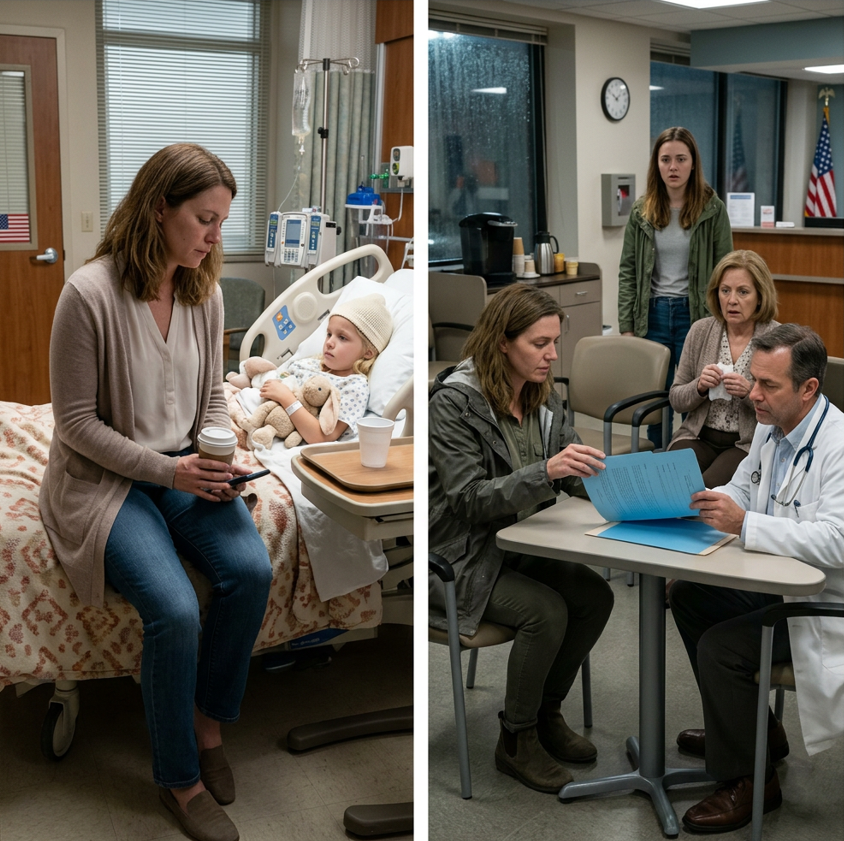
The hospital hallway smelled like coffee, warm blankets, and the kind of clean air that never feels comforting, no matter how brightly the floors shine. I sat beside my seven-year-old daughter, Lily, in the pediatric pre-op area at Mercy General, turning a paper cup between my hands until the cardboard softened at the rim.
The coffee had been hot when the nurse brought it to me. By then, it was room temperature and bitter. I kept taking small sips anyway because it gave my hands something to do.
Lily looked almost swallowed by the blanket. Her blond hair was tucked under a soft blue cap, and her stuffed rabbit, Captain Floppy, rested under one arm as if he had been officially assigned to hospital duty. A monitor beside her bed kept a calm, steady rhythm, the kind of rhythm adults pretend not to hear because every little sound starts to feel like a message.
“Mom?”
Her voice was small and sleepy.
“I’m right here, sweetheart.”
“You look tired.”
I laughed once, mostly because I did not know what else to do. “That’s because I am.”
“You should drink your coffee.”
That was Lily. Seven years old and still trying to take care of me.
I brushed my thumb across her knuckles. “I’m drinking it.”
“It smells bad.”
“It tastes worse.”
She smiled a little. Then her eyelids sank lower.
The anesthesiologist had already explained the process twice. The surgeon had reviewed the plan. The nurse had checked Lily’s wristband and my signature on forms so many times that I could have recited the last four digits of her patient number in my sleep.
I was an Army medical logistics officer. I knew hospitals. I knew emergency planning, supply chains, medical documentation, and crisis protocols. I knew how to stay calm while other people panicked. I knew how to ask the right questions and find the missing detail in a stack of paperwork.
None of that made it easier to sit beside my child and wait.
My phone vibrated on the small tray table.
Mom.
For one brief second, relief moved through me.
Maybe they were already driving. Maybe Dad had finally decided that showing up for his granddaughter mattered more than whatever my younger sister Chloe had scheduled. Maybe, for once, my parents had looked at the situation and chosen the person who actually needed them.
I opened the message.
Sarah, honey, unfortunately…
That was all it took.
Unfortunately.
The word arrived dressed politely, but I knew what it meant. I kept reading anyway because some part of me still wanted to be wrong.
Chloe’s summer networking brunch had run into last-minute problems. The florist had delivered the wrong shade of white centerpieces. The catering manager needed supervision. Several guests were important contacts. The mimosa fountain had been delayed. The deposit was non-refundable. There were too many moving pieces for Mom and Dad to leave.
The message went on and on. Flowers. Seating. Catering. Social connections. Money already paid.
Not one sentence asked how Lily was doing.
Not one sentence asked if I was holding up.
Not one sentence said, “We are sorry we are not there.”
The catering deposit was $8,500.
My daughter was about to be wheeled toward a pediatric operating room, and my parents were worried about floral arrangements and brunch traffic.
The worst part was not even the decision. The worst part was how familiar it felt.
This was not a shocking betrayal. It was simply the latest page in a family story I had been reading my entire life.
When Chloe wanted horseback riding lessons, my college fund became a “temporary adjustment.” When Chloe wanted a destination engagement celebration, everyone’s plans moved around her. When Chloe decided to reinvent herself as a lifestyle consultant, holidays became photo opportunities. If Chloe was anxious, everyone softened. If Chloe was busy, everyone waited. If Chloe wanted attention, the room rearranged itself.
Nobody called it favoritism.
They called it support.
My phone vibrated again.
A photo appeared.
Chloe stood beside a long table covered in pale flowers, smiling perfectly in a cream-colored dress, holding a glass as if the whole morning had been designed to prove how easy life could look when other people handled the inconvenient parts.
My mother had typed: Look how lovely it turned out. Wish you could see it.
I locked the phone and placed it face down.
A nurse stepped in with a clipboard. “How are we doing in here?”
“Good,” I said automatically.
The nurse smiled with the gentle skepticism of someone who had watched too many parents say “good” while barely holding themselves together. She adjusted Lily’s blanket and checked her wristband again.
“She’s a brave kid,” the nurse said.
“She came that way,” I replied.
The nurse’s expression softened. Then she left us alone again.
Lily stirred. “Grandma coming?”
I swallowed carefully. “Not yet, baby.”
“Grandpa?”
“They had something they couldn’t leave.”
Her eyes opened a little. “More important?”
I had spent seven years teaching my daughter not to lie, and in that moment, I understood how difficult honesty could be.
“No,” I said quietly. “Not more important.”
That seemed to settle something in her. She closed her eyes again and kept holding my hand.
A few minutes later, my phone buzzed one last time.
You’re the strong one, Sarah. You always handle these medical things so well.
There it was.
The sentence my family had used for years as if it were a compliment.
You’re the strong one.
When my grandfather passed and everyone needed paperwork handled, I was the strong one. When Dad needed insurance forms completed, I was the strong one. When my mother wanted someone to argue with a billing department, I was the strong one. When Chloe needed someone to quietly fix the things she had ignored until they became urgent, I was the strong one.
It sounded like praise.
It was really a job assignment.
Strong people were expected to absorb inconvenience. Strong people were not supposed to need comfort. Strong people certainly were not supposed to need their parents.
I turned my phone over and did not answer.
The surgical doors opened down the hall. A nurse approached Lily’s bed and asked me to walk with them as far as I could. My daughter squeezed my hand once, trusting me completely because that is what children do when they believe the adults around them will protect them.
I walked beside her until the nurse gently told me this was where I had to stop.
Lily looked at me. “You’ll be here when I wake up?”
“Every second,” I said.
She nodded as if that solved everything.
Then the doors closed, and I stood in the hallway with my empty coffee cup and the strange understanding that I had been waiting my whole life for my parents to become different people.
That morning, I stopped waiting.
The waiting room at Mercy General had the kind of furniture chosen by people who never had to sit in it for long. Plastic chairs, thin armrests, a television mounted too high on the wall with the sound turned down. Families sat scattered across the room pretending to read, pretending to answer emails, pretending not to stare at the double doors every time they opened.
Nobody was fooling anybody.
We were all waiting for strangers in scrubs to tell us how the rest of the day would look.
Lily’s procedure took hours. I watched the update board until the letters blurred. I drank more bad coffee. I forgot to eat. I folded and unfolded my Army jacket over the chair beside me. My phone stayed quiet.
No calls from my parents.
No message from Chloe asking how Lily was.
No apology.
Just silence.
At some point in the afternoon, rain began tapping against the windows. Then it turned heavier, sliding down the glass in long streaks. I had been awake almost thirty hours by then, and exhaustion had settled behind my eyes like sand.
That was when I heard boots in the hallway.
Not dress shoes. Not hospital clogs. Boots.
Master Sergeant David Ross came around the corner carrying a duffel bag in one hand and a takeout bag in the other. His pant legs were damp from the rain, and his sleeves were dark at the cuffs. He looked like he had walked straight out of a storm because, apparently, he had.
“Still breathing?” he asked.
I stared at him for one second.
Then I laughed. “Barely.”
“Good enough.”
That was David. No dramatic entrance. No speech. Just presence.
He set the takeout bag on the table in front of me. Real food. Brisket, mashed potatoes, rolls, and something that smelled like actual comfort.
“Eat,” he said.
“I’m not hungry.”
“That wasn’t the instruction.”
I opened the bag because arguing with David took too much energy.
“You drove all the way here in this weather?” I asked.
“Roads were annoying.”
“That’s your full report?”
“Yes.”
He pushed the duffel bag toward me. “Clean clothes. Toothbrush. Charger. Also socks, because you forget socks when you panic.”
“I did not panic.”
“You called a hand sanitizer dispenser a coffee machine when I texted you.”
I closed my mouth.
“Eat,” he repeated.
So I did.
For the first time all day, my hands stopped shaking.
David sat beside me for hours. He did not ask me to explain my family. He did not tell me everything would be fine because people who say that usually cannot guarantee it. He did not fill the air with empty encouragement.
He simply stayed.
He watched the doors when I was too tired to keep looking. He brought me coffee that was not terrible. He told me he had fed my dog, paid the utility bill I had left on my counter, and put a pizza in my freezer for later.
“You broke into my apartment,” I said.
“You gave me a key.”
“Two years ago.”
“I’m efficient.”
When the surgeon finally appeared, I stood so fast my knees almost forgot their job. The doctor smiled before speaking, and that smile gave me back air I had not realized I was holding.
Lily’s procedure had gone well. There were no major complications. Recovery would take time, patience, and a long list of follow-up appointments, but she was stable. She was safe.
I sat down because my legs insisted on it.
David quietly placed the coffee cup closer to my hand.
Later, in recovery, Lily opened her eyes slowly. She was groggy and pale, but she was there. She blinked at me, then looked around the room.
“Grandma?”
My heart folded in on itself.
Before I could answer, David stepped forward, rested one hand on the bed rail, and lowered his voice like he was sharing classified information.
“I had to recruit them for security.”
Lily frowned weakly. “What?”
“This room needed protection. Your mom was busy being the command center, and the nurses were busy being professional. So your grandparents accepted a special assignment.”
“What assignment?”
“To stop cookie thieves.”
Lily’s mouth twitched. “Cookie thieves?”
“The worst kind.”
She gave the smallest laugh, then closed her eyes again, still smiling.
I looked at David sitting there beside her bed, tired and damp and completely unbothered by the inconvenience of caring. In that moment, the definition of family changed for me.
Family was not always the people who shared your name.
Sometimes family was the person who drove through a storm with hot food, clean socks, and no expectation of applause.
Three years passed.
Lily recovered in slow, ordinary, extraordinary ways. Physical therapy twice a week became once a week, then once a month, then occasional checkups. She grew taller. She joined a soccer team. She developed strong opinions about science documentaries and became convinced that every mystery on television could be solved faster if adults asked better questions.
Our life became peaceful.
Not perfect. Peaceful.
I did not cut my parents off with a grand announcement. I did not send a long message. I did not demand an apology. I simply stopped doing all the work.
I stopped calling first.
I stopped reminding them of Lily’s appointments.
I stopped responding to Chloe’s group-chat photo albums with hearts and compliments.
The first month, nobody noticed.
The second month, Chloe sent thirty-two pictures from a resort weekend.
The third month, my mother posted a garden renovation and wrote a caption about protecting her peace.
David read it over my shoulder and said, “That phrase is doing a lot of heavy lifting.”
I laughed harder than I expected.
The silence told me what years of excuses had tried to hide. I had not been missed. I had been useful.
Those are very different things.
One rainy Thursday evening, I pulled my fire-safe document box from the hall closet because Lily’s college account needed updating. A promotion at work had changed my income, and organization was my favorite form of stress relief. Some people light candles. I revise beneficiary forms.
I spread documents across the dining room table. College savings statements. Insurance policies. Property records. Military benefit files. Tax forms. The usual collection of adult responsibilities that made life feel less chaotic when arranged in neat stacks.
Near the bottom of the box, my fingers touched a folder I had not seen in years.
Blue backing. Thick paper. Notary seal.
Medical Proxy and Advance Directive: Arthur Jenkins.
My father.
I stared at the cover.
Five years earlier, Dad had called me repeatedly for nearly two weeks because his veterans’ benefits paperwork had confused him. It involved medical directives, long-term care planning, healthcare representatives, and financial authority connected to medical decisions. Dad disliked paperwork. He disliked legal fees even more.
So, naturally, the work became mine.
I remembered sitting at my parents’ dining room table while Dad complained about attorney costs and Mom checked her phone for updates from Chloe. I remembered explaining the difference between a healthcare proxy and a general power of attorney. I remembered pointing where everyone needed to sign.
“You’re the organized one,” Dad had said.
At the time, I barely noticed the phrase because I was busy making sure the forms were complete.
Now, years later, I opened the folder and read carefully.
The document was valid. Properly executed. Notarized. Witnessed.
Then I reached the section that mattered.
Arthur Jenkins designated Sarah Jenkins as sole healthcare proxy with connected authority over medical placement and related care decisions.
Not secondary.
Not backup.
Sole.
His signature pressed deep into the page, the blue ink almost carved into the paper.
I read it twice.
The irony was not funny. It was precise.
For decades, my father had treated me like unpaid administrative support. Then, because paperwork bored him and details annoyed him, he had legally handed me decision-making authority over some of the most important parts of his future.
Across the table, Lily looked up from homework. “What’s that?”
“Old paperwork.”
“Important old paperwork?”
“Possibly.”
“That sounds like adult code for boring.”
“It is extremely boring.”
She nodded and returned to her math.
I slid the folder back into the box.
I did not feel angry. I did not feel triumphant. I simply knew the document existed.
A week later, my phone rang at 11:42 p.m.
The number belonged to a hospital.
My body understood before my mind did. Hospitals do not call that late to share casual updates.
I answered while drying my hands on a kitchen towel. The nurse on the other end spoke quickly and carefully. Male patient. Sixty-two. Serious neurological event. Emergency transport. Stabilized but critical. Family requested immediate contact with designated healthcare proxy.
There it was.
Not wife.
Not daughter.
Proxy.
The hospital had found the paperwork.
I grabbed my keys, texted David to stay with Lily, and was halfway to the door when his reply appeared.
Already on my way. Pizza in oven. Go.
Of course.
By the time I reached Saint Jude’s Medical Center, the rain had returned. The parking garage smelled like wet pavement and old concrete. I walked through the lobby in jeans, running shoes, and a gray hoodie, following signs toward critical care.
I heard my family before I saw them.
Raised voices. Tense questions. The kind of panic that creates a lot of noise and very little information.
My mother sat near the coffee station clutching a tissue. Her makeup was carefully distressed, as if even panic had to look presentable. Chloe paced near the windows with her phone pressed to one ear.
“No, cancel Aspen,” Chloe said sharply. “I don’t care about the fee right now. My father had a medical emergency. Yes, a real one. Why would I make that up?”
She sounded less like a worried daughter and more like someone managing a luxury travel inconvenience.
Neither of them noticed me at first.
Then Chloe looked up.
Relief crossed her face, but not the kind of relief that comes from missing someone. It was the relief of a person watching the solution walk into the room.
“Sarah.”
My mother stood so quickly her purse slipped off her lap. “There you are.”
I nodded once. “How is he?”
Neither of them answered.
That was a bad sign.
People who listen to doctors can usually answer basic questions.
“What did imaging show?” I asked.
Blank looks.
“Has neurology spoken with you?”
More blankness.
“Medication? Timeline? Any change in speech or mobility?”
My mother pressed the tissue to her mouth. Chloe looked annoyed, as if my questions were making the situation more complicated on purpose.
A nurse stepped into the waiting room. “Major Sarah Jenkins?”
“That’s me.”
The nurse’s shoulders lowered in visible relief. That told me everything I needed to know. She was not relieved because I was family. She was relieved because someone capable of answering questions had arrived.
Before I could follow her, my mother grabbed my sleeve.
“Thank goodness you’re here. You need to handle the doctors. You need to handle the insurance. Chloe is entirely too stressed.”
I looked at Chloe, who was now texting with both thumbs, apparently strong enough to handle vacation logistics.
I gently removed my mother’s hand from my sleeve.
Not angrily. Not dramatically. Just firmly.
She stared at me as if boundaries were a language she had never studied.
I turned to the nurse. “Can you brief me?”
For the next several minutes, I received actual information. Dad had experienced a major neurological crisis. He was stabilized, but the next twenty-four hours were important. There could be long-term changes to speech, mobility, and cognitive function. Independent living might no longer be realistic. Skilled care was likely.
I listened. I took notes. I asked specific questions. I confirmed the attending physician’s name, current medications, test results, and likely next steps.
By the time the nurse finished, I knew more in six minutes than my mother and Chloe had learned in several hours.
Not because I was smarter.
Because I was listening.
Dr. Harrison Vance entered the waiting room soon after. He looked tired, composed, and careful with every word. Experienced doctors know that families often hear only the pieces they can tolerate.
He explained Dad’s condition in calm, clear language. Dad was stable. That was the good news. The rest was harder. He would likely need ongoing therapy, medical supervision, and assistance with daily life. The road ahead would be complicated.
Then Dr. Vance said the phrase that changed the temperature of the room.
“Long-term skilled nursing care is a strong possibility.”
My mother blinked. “What does that mean?”
“It means professional care with medical support, therapy services, medication management, and assistance throughout the day and night.”
Chloe frowned. “For how long?”
“Possibly permanently.”
The word settled over the room.
Permanently.
Not a few difficult weeks. Not a minor inconvenience. Not something that could be hidden behind good lighting and optimistic language.
Permanent care meant costs. Planning. Sacrifice. Reality.
My mother’s expression changed as soon as the doctor mentioned expenses. I recognized that look. It was the look people get when numbers begin interfering with the life they planned.
Dr. Vance began explaining possible care settings, facility evaluations, insurance limitations, and waiting lists. My mother was no longer listening to him. She was looking at me.
I knew that look too.
It was the look she used when assigning my future.
“Sarah,” she said softly.
There it was.
My name, used as an instruction.
“Your apartment is on the ground floor.”
I said nothing.
“You work from home part of the week.”
Still nothing.
“It only makes sense that you take him in.”
The way she said it made the decision sound complete. As if my home, my schedule, my daughter, my privacy, and my life were details that could be moved around to protect everyone else from discomfort.
“We’ll help,” she added.
Of course.
The same way they had helped at Lily’s hospital day.
Chloe nodded quickly. “My house just isn’t set up for that.”
Naturally, the explanation came fast.
“We have white carpet, and Ethan is only three. Medical equipment everywhere would be too much. Plus, we’re barely settled.”
Chloe’s house had five bedrooms and more space than my entire apartment building floor. But space had never really been the issue.
Convenience was.
Nobody asked about Lily.
Nobody asked whether a twelve-year-old girl should share her home with round-the-clock medical needs.
Nobody asked if I could afford the time, the emotional weight, or the disruption.
The plan had formed without me.
That was how my family operated. Create a problem. Locate Sarah. Assign responsibility. Call it love.
My mother folded her hands. “Family sacrifices for family.”
For a second, I looked at her and saw all the years at once. Every form I filled out. Every call I answered. Every emergency I managed. Every time I had been called strong when what they meant was available.
Then I turned toward Dr. Vance.
“What are Arthur’s long-term care options?”
My mother’s expression tightened.
That was not the answer she expected.
Dr. Vance began outlining options: rehabilitation facilities, neurological recovery programs, skilled nursing centers, transition units. Each had different requirements, costs, waiting periods, and levels of care.
My mother interrupted him.
“Why are we discussing facilities? She’s taking him home.”
Not asking.
Declaring.
Dr. Vance stayed professional. “We need to discuss all appropriate options.”
“There is no discussion,” my mother said. “I am his wife.”
The doctor nodded. “I understand. However, final placement decisions must follow legal authority. That may be next of kin or the designated healthcare proxy, depending on documentation.”
The room went still.
My mother straightened with immediate confidence.
“I make the decisions,” she said. “And I say he goes with Sarah.”
I slowly unzipped my bag.
Nobody paid attention at first. Chloe was still nodding. My mother was still confident. Dr. Vance was waiting.
I removed the blue-backed folder and placed it on my lap.
Then I opened it to the relevant section, stood, and handed it to the doctor.
“Paragraph four,” I said.
Dr. Vance adjusted his glasses and read.
The room became quiet in a different way. Not shocked. Suspended.
My mother’s confidence began to fade one breath at a time.
Chloe looked between us. “What is that?”
“A medical proxy,” I said.
Her eyes narrowed. “Why do you have that?”
“Because Dad gave it to me five years ago.”
My mother stared at the pages as if the folder had become a stranger.
Dr. Vance turned to the signature page, the notary seal, the witness section. Then he looked up.
“This appears valid.”
My mother stood. “Excuse me?”
“The documentation appears properly executed.”
“No. I’m his wife.”
“I understand,” Dr. Vance said. “But legally, this document gives Sarah the authority to make these decisions.”
The words were not loud.
They did not need to be.
My mother looked at the paper again, then at her own signature near the bottom. Recognition arrived slowly. She remembered the dining room table. The notary. The stack of forms she had barely read. The afternoon she treated as another chore Sarah would handle.
Paperwork does not care whether you paid attention.
Chloe recovered first, and she recovered into outrage.
“This is ridiculous. She’s taking advantage of the situation.”
I did not answer.
“She’s doing this to punish us.”
“No,” I said calmly. “I’m doing what the document requires.”
My mother’s voice changed. Softer now. Not gentle. Desperate.
“Arthur needs family.”
“Arthur needs medical care.”
“From family.”
“From professionals.”
Dr. Vance quietly mentioned a list of recommended facilities. One name stood out immediately: Ridgeway Neurological Recovery Center.
Private skilled care. Neurological rehabilitation. Physical therapy. Speech therapy. Occupational therapy. On-site specialists. Strong outcomes. Excellent reputation.
Expensive.
Exactly the kind of place I would choose for anyone under my care.
“I’d like Ridgeway,” I said.
Dr. Vance nodded. “That is an excellent facility.”
My mother’s eyes narrowed. “How much?”
The doctor checked his tablet. “Approximately twelve thousand four hundred dollars per month, depending on final needs.”
Chloe blinked. “Per month?”
“Yes.”
My mother slowly sat down.
“We can’t afford that.”
I looked at her carefully. “That is not accurate.”
The room tightened.
Dad and Mom owned their home outright. They had retirement funds, savings, joint accounts, certificates, and assets. The problem was not affordability. The problem was priority.
My mother knew it too, because she changed the argument.
“The house has to be protected.”
Not Dad.
The house.
Chloe added, “And Mom needs access to their accounts.”
There it was.
The real concern.
I kept my voice even. “Arthur’s care comes first. Insurance and Medicare will cover what they cover. The rest comes from available assets connected to his care. That is what the law requires, and that is what I will authorize.”
My mother stared at me.
“You can’t drain our accounts.”
“I’m not draining anything. I’m approving medical care.”
“You’re abandoning us.”
I let the word sit there.
Us.
Not him.
I thought of Lily waking up and asking for grandparents who had chosen centerpieces over her. I thought of my mother calling me strong because it made my needs easier to ignore. I thought of every year I had spent mistaking usefulness for love.
Then I answered quietly.
“You chose a party over Lily’s hospital day. I am choosing the best care for my patient.”
Nobody spoke.
There are moments when people expect anger because anger gives them something to argue with. They expect tears because tears give them something to dismiss. They expect guilt because guilt has always worked before.
Calm facts leave them with nowhere to go.
Dr. Vance handed me the transfer authorization packet. I signed where required. Medical release. Facility referral. Insurance coordination. Temporary care authorization. My hand moved steadily from page to page.
I was not signing out of revenge.
I was signing because Dad needed professional care, and professional care existed.
My mother watched every signature.
I could see the realization settling over her. For decades, she had treated me as a convenience. A reliable person to call when life became too complicated. She had assumed I would always absorb the hard parts so she and Chloe could preserve the comfortable ones.
Now the reliable person had read the rules.
When the final page was complete, Dr. Vance took the folder and nodded. “We’ll begin arrangements immediately.”
I stood.
The meeting was over.
My mother stood too. “Sarah.”
For one second, I thought she might apologize.
Instead, she asked, “When can we visit him?”
The question surprised me because it was practical. For the first time all night, she sounded like someone dealing with reality instead of negotiating with it.
“When the facility allows visitors,” I said. “They’ll give a schedule after intake.”
She nodded.
No argument. No speech. No guilt.
Maybe exhaustion had finally won. Maybe she knew there was nothing left to push. Maybe she simply did not know what to do now that the old script had stopped working.
Chloe said nothing. That might have been the most surprising part of the night.
I placed the blue folder back into my bag and walked toward the exit. Nobody followed.
The hallway stretched under bright hospital lights. Nurses moved between rooms. A maintenance worker adjusted a ceiling panel. A transport aide pushed a cart of clean linens. Necessary work continued all around me, the kind nobody notices until it is not done.
Halfway to the elevator, I realized I did not feel victorious.
That surprised me.
People imagine moments like this with dramatic satisfaction, as if setting a boundary should feel like winning a scene in a movie. It did not feel like that.
It felt clean.
Like setting down a box I had carried so long I no longer remembered how heavy it was.
Outside, the storm had passed. The parking lot lights shimmered on the wet pavement.
My phone buzzed.
David.
A photo filled the screen.
My living room had turned into the largest blanket fort ever built by two people with questionable engineering credentials. Every chair had been recruited. Every blanket stretched across the room. Lily sat inside wearing a paper crown, holding a mug of hot chocolate. David sat beside her with a serious expression, also wearing a paper crown, because apparently the fort had a leadership structure.
The message said: Security upgrade complete. Cookie thieves contained.
I laughed.
Not politely. Not tiredly.
Really laughed.
Then I drove home.
Behind me, the hospital continued handling crisis and consequence. Ahead of me, a blanket fort waited in a living room filled with the people who had chosen to be there.
That was the difference.
The following week, Ridgeway called to confirm Dad’s intake. I approved the transfer, reviewed the care plan, and asked the questions my mother and Chloe did not want to hear. Medication schedule. Therapy frequency. Visitor rules. Billing cycle. Insurance coordination. Asset review. Patient advocacy contact.
The coordinator on the phone paused after my fifth question.
“You’re familiar with this process,” she said.
“Enough.”
“That helps.”
I almost laughed. It always helped. That was the problem.
When I arrived at Ridgeway for the first family care conference, my mother and Chloe were already there. Chloe wore sunglasses indoors, which felt like a choice made for an audience. My mother sat with her purse in her lap and her posture straight, the way she always sat when she wanted the room to remember she deserved importance.
Dad was not in the conference room yet. A nurse explained that he was finishing a therapy assessment and would be brought in briefly if appropriate.
Chloe leaned toward me before the staff entered. “You know this is creating a lot of stress for Mom.”
I opened the folder in front of me. “Dad’s condition is creating stress.”
“You know what I mean.”
“I do. That’s why I answered accurately.”
Her jaw tightened.
My mother lowered her voice. “Sarah, we need to be reasonable.”
That word again.
Reasonable usually meant I was about to be asked to make someone else more comfortable at my own expense.
“I am being reasonable,” I said. “He is in a qualified facility with professional staff.”
“It’s too expensive.”
“It is appropriate care.”
“You keep saying that as if money doesn’t matter.”
“Money matters,” I said. “That’s why it should be spent on what he needs.”
Chloe sighed. “You’re being very cold.”
I looked at her. “No, I’m being precise.”
The care team entered before she could answer.
A case manager, a physical therapist, a speech therapist, a nurse, and a billing coordinator sat around the table. They introduced themselves and began explaining Dad’s plan. It was detailed, structured, and realistic. There would be goals. Some short term. Some uncertain. Some dependent on progress nobody could promise.
My mother listened this time.
Not perfectly, but enough.
When the billing coordinator explained monthly costs and account procedures, Chloe asked three questions in a row about whether there were less expensive options.
The coordinator remained polite. “There are lower-cost facilities, but the level of neurological rehabilitation is not the same.”
Chloe looked at me. “Maybe that’s enough.”
The room went still.
I kept my eyes on the care plan. “We are not lowering his care because it preserves convenience.”
My mother whispered, “That is unfair.”
I turned one page. “No. It is uncomfortable. Those are different.”
The staff stayed carefully neutral, but the case manager’s pen paused just long enough for me to notice.
Dad was brought in near the end of the meeting. He looked smaller than I remembered. Not weak in a dramatic way, just changed. His face held frustration more than fear. His words came slowly, and one side of his body was less responsive than the other. The therapist stood beside him with practiced patience.
My mother began crying immediately.
Chloe looked away.
I watched Dad’s eyes move across the room until they found me.
For a moment, he looked confused. Then embarrassed. Then annoyed.
That was the most familiar expression of all.
He tried to speak. The words came unevenly, but I understood enough.
“Home.”
My mother leaned forward. “See? He wants to go home.”
The therapist gently clarified, “Many patients say that early in recovery. It’s understandable. The goal right now is safety and progress.”
Dad looked at me again.
I walked closer and kept my voice steady. “You’re at Ridgeway. They’re going to help you work on strength, speech, and daily function. I’ll review your care plan every week.”
His eyes sharpened. He understood more than he could say.
“Home,” he repeated, frustrated.
“I know,” I said. “Not yet.”
My mother made a soft sound behind me, something between grief and protest.
I did not turn around.
For the first time, I understood that doing the right thing could still be painful. Boundaries did not make you heartless. They simply prevented other people’s discomfort from becoming your assignment.
After the conference, Chloe followed me into the parking lot.
“You’re enjoying this,” she said.
I stopped beside my car. “No.”
“You finally have control, and you’re enjoying it.”
I looked at my sister for a long moment.
Chloe had always believed attention and control were the same thing. If the room looked at her, she was winning. If people rearranged themselves around her, she felt loved. She could not imagine authority without performance.
“This is not control,” I said. “This is responsibility.”
She crossed her arms. “You always make yourself sound noble.”
“I’m not noble. I’m consistent.”
“Mom is falling apart.”
“Then help her.”
Chloe stared at me.
The suggestion seemed to confuse her.
“You live fifteen minutes from her,” I continued. “You have staff, childcare, space, and a flexible schedule when you want one. If Mom needs emotional support, you can provide it.”
“That’s not fair.”
“Why?”
“Because you’re better at this.”
There it was.
The cleanest version of the truth.
Not because you care more. Not because you are closer. Not because you owe us.
Because you are better at this.
I unlocked my car. “Being capable does not make me available.”
Her face flushed. “You’ve changed.”
“Yes,” I said. “That part is true.”
I drove away before she could turn that into an argument.
At home, Lily was sitting at the kitchen table building a model for science class. David was cutting cardboard with the focus of a man defusing a tiny engineering problem.
“How was it?” Lily asked.
“Complicated.”
“Grandpa okay?”
“He’s getting care.”
She nodded slowly. Lily knew more than most adults thought children knew. She remembered who had shown up and who had not. She remembered being small in a hospital bed and asking a question nobody wanted to answer.
“Are Grandma and Aunt Chloe mad?”
“Yes.”
“Because you said no?”
“Because I said the right no.”
She considered that. “Is there a wrong no?”
“Yes. A no used to avoid responsibility. But there’s also a right no. A no that protects what matters.”
David looked up from the cardboard. “That’s going on a mug.”
Lily smiled, then returned to her project.
A month later, Ridgeway sent the first full billing statement. It was large. My mother called within ten minutes.
“You need to come over,” she said.
Not hello. Not how are you. Just an instruction.
“I’m not available tonight.”
“This is urgent.”
“Then explain it on the phone.”
There was a pause. She was not used to being asked to adapt.
“The statement arrived,” she said. “I don’t understand why so much is being drawn from the joint account.”
“Because the joint account is an available asset for his care.”
“But I use that account.”
“I know.”
“I have expenses.”
“So does Dad.”
Her breathing changed. “You sound just like one of those administrators.”
“I’ll take that as a compliment.”
“Sarah.”
The old tone tried to return.
I looked across the kitchen at Lily reading on the sofa and David washing dishes he had not dirtied.
“No,” I said before she could continue.
“No what?”
“No to whatever you were about to assign me.”
Silence.
Then, very quietly, my mother said, “I don’t know how to do all this.”
For the first time, she sounded less manipulative and more honest.
I leaned against the counter. “Then you can learn. I’ll send you the billing contact, the case manager’s email, and the visitor schedule. They can answer basic questions.”
“You won’t come over?”
“Not tonight.”
“But I need help.”
“You need information,” I said. “That is different from needing me to take over.”
Another long silence.
“I don’t like this version of you,” she whispered.
I closed my eyes for a second.
“I know.”
The call ended without resolution.
That was the thing about boundaries. People often wait for them to soften. They push, pause, and push again, hoping the old version of you will step forward and apologize for becoming inconvenient.
But the old version of me had spent a lifetime being useful to people who treated usefulness as love.
She was tired.
She was allowed to rest.
Over the next several weeks, things changed in small, measurable ways. My mother learned to call Ridgeway herself. Chloe attended one care conference and complained afterward that the parking was confusing. Dad made slow progress in therapy, then had plateaus, then small improvements again. Recovery was not a straight line. It was a series of difficult days connected by stubborn effort.
I reviewed the care plan every Friday morning. I approved necessary expenses. I declined unnecessary requests. I kept records so clean that even the billing coordinator complimented them.
My mother still tried to insert emotion where policy belonged.
“Your father would hate knowing the money is being used this way,” she said during one call.
“Dad signed the document allowing this care.”
“He didn’t know this would happen.”
“None of us know the future when we sign important papers. That’s why we sign them carefully.”
“He trusted you.”
“Yes,” I said. “And I’m taking that seriously.”
That ended the conversation.
One afternoon, Ridgeway invited family to observe part of Dad’s therapy session. I arrived early and found my mother sitting alone in the hallway. No Chloe. No designer tissue. No performance. Just my mother, looking smaller than usual.
“He asked for you,” she said.
I sat beside her. “Did he?”
She nodded. “He gets frustrated when he can’t say what he means.”
“That makes sense.”
My mother looked down at her hands. “I didn’t know Lily asked for us that day.”
The hallway seemed to quiet.
I did not answer immediately.
“She did,” I said.
Mom’s lips pressed together. “I told myself you understood.”
“I did understand.”
She looked at me.
“I understood exactly what you chose.”
Her eyes filled, but I no longer felt responsible for managing what happened next.
“I thought Chloe needed us,” she said.
“Lily needed you.”
“I know that now.”
I looked toward the therapy room doors.
There were a hundred things I could have said. I could have listed every disappointment. I could have described the coffee, the waiting room, the sound of Lily’s small voice. I could have turned the moment into a trial and forced my mother to sit through the evidence.
But clarity does not always need a speech.
“Knowing now doesn’t change then,” I said. “But it can change what you do next.”
She nodded, crying quietly.
For once, I let her.
Dad’s therapy session began. He worked with a speech therapist on simple phrases, and every word seemed to require patience I had never seen him practice before. When he managed my name, imperfect but clear enough, my mother covered her mouth.
“Sarah.”
I stepped closer.
Dad looked embarrassed again, then stubborn. He pushed the words out slowly.
“Good… care.”
I nodded. “Yes.”
His eyes moved to my mother, then back to me.
“Thank… you.”
The words were rough and uneven. They did not erase anything. They did not repair years of being overlooked. They did not rewrite Lily’s hospital day or my childhood or the family pattern that had shaped me.
But they were real.
I accepted them for exactly what they were.
“You’re welcome,” I said.
That evening, I went home and found Lily on the floor with homework spread around her like a paper storm.
“How’s Grandpa?” she asked.
“He said thank you today.”
She looked surprised. “Really?”
“Really.”
“Did it make you feel better?”
I thought about that.
“A little. Not because it fixed everything. Because it was honest.”
Lily nodded with the seriousness of a twelve-year-old who had learned too early that adults were complicated.
“Are we visiting him?” she asked.
“Only if you want to.”
She chewed on the end of her pencil. “Maybe once. Not because I have to.”
“That’s the only reason I would allow.”
David walked in carrying groceries. “I heard we are making decisions with emotional maturity in here. Should I leave?”
Lily threw a pencil at him. It bounced off his sleeve.
“Careful,” he said. “This household has a strict pencil safety policy.”
Lily laughed.
The sound filled the apartment, easy and bright.
I looked around at the small kitchen, the cluttered table, the groceries, the homework, the man who showed up without being asked three times, and the daughter who was learning that love should never require self-erasure.
This was the life I had protected.
Not from hardship. Hardship finds everyone.
I had protected it from becoming a dumping ground for other people’s refusal to carry their own weight.
Months later, people in the extended family had plenty of opinions. Some said I had been too firm. Some said I should have brought Dad home because “that’s what daughters do.” Some said money should stay in the family. Some said my mother had suffered enough.
I noticed how few of them volunteered their own homes.
That taught me another lesson.
People who demand sacrifice from a distance are usually very generous with resources that are not theirs.
I stopped explaining myself.
Explanations can become another form of labor. If someone truly wants to understand, they ask in good faith. If they only want to argue, no explanation will be enough.
So when relatives called, I said the same thing each time.
“Arthur is receiving appropriate medical care. The decision was made under legal authority and medical guidance.”
Clean. Boring. Final.
Chloe hated it.
“You sound like a press release,” she snapped during one call.
“Good. Press releases are hard to manipulate.”
She hung up.
I slept wonderfully that night.
The last major confrontation happened at Ridgeway during a family review. The case manager explained that Dad’s care would continue at the same level for at least six more months. My mother looked tired, but she did not protest. Chloe did.
“There has to be another option,” she said.
“There are always options,” the case manager replied. “But the medical recommendation remains skilled care.”
Chloe turned to me. “You could still take him.”
I looked at her, then at my mother, then at Dad sitting quietly in his wheelchair near the window.
“No,” I said.
Chloe’s mouth tightened. “Just like that?”
“Yes.”
“Don’t you feel guilty?”
“No.”
That answer seemed to unsettle her more than any speech could have.
I continued, not for Chloe, but for the room.
“I feel responsible for making sure he gets care. I do not feel responsible for sacrificing my daughter’s home, my work, my health, or my peace to make the rest of you more comfortable.”
My mother closed her eyes.
Chloe whispered, “You’re not the person you used to be.”
This time, I smiled faintly.
“No,” I said. “I finally am.”
Dad looked toward me. His speech had improved enough that he could speak short sentences when he had the energy.
“Sarah… right.”
Chloe froze.
My mother looked at him.
Dad repeated, slower but clear. “Sarah right.”
No one argued after that.
On the drive home, I thought about what people mean when they talk about justice. They imagine a perfect moment where the people who overlooked you suddenly understand everything. They imagine apologies, regret, maybe even a dramatic reversal where everyone admits they were wrong.
Life is usually quieter.
My mother did not become a different person overnight. Chloe did not transform into someone self-aware and considerate. Dad did not suddenly rewrite our family history. There was no perfect ending wrapped in warm music.
There was only a line.
And for once, I kept it.
That was enough.
When I got home, Lily was waiting at the kitchen table with two mugs of hot chocolate. David was on the sofa pretending not to watch the hallway.
“How was it?” Lily asked.
“Done,” I said.
She slid one mug toward me. “Cookie thief prevention meeting?”
“Something like that.”
David looked over. “Were the thieves contained?”
“For now.”
Lily raised her mug. “To contained thieves.”
I tapped mine against hers.
The apartment was small. The table had scratches. The blanket fort era had left one chair slightly wobbly. The life inside those walls was not glamorous enough for Chloe’s photos or impressive enough for my mother’s holiday letters.
But it was honest.
It was safe.
It was ours.
And that was the part I wish I had understood sooner: peace is not always something you find. Sometimes it is something you defend. Sometimes it begins with one quiet no. Sometimes it begins when you stop answering every call as if love is measured by how much of yourself you are willing to give away.
My parents taught me that being needed can feel like being loved.
Lily taught me the difference.
David proved it.
And when my father’s paperwork placed the decision in my hands, I did not use that authority to punish anyone. I used it to protect the person who needed care, the child who needed peace, and the woman I had become after years of being told she was strong enough to carry everything.
I am strong.
But not because I carry what does not belong to me.
I am strong because I finally know what to put down.