Just Before I Left For A Business Trip, My Six-Year-Old Daughter Clung To Me And Said, “Daddy, Please Stay.

- Part 1 – The Warning Beside the Suitcase
- Part 2 – What the Blood Test Proved
- Part 3 – The House Was Never Really the Goal
- Part 6 – Recovery Was Not a Courtroom Scene
- Part 7 – The Key Grace Left Behind
Part 1 – The Warning Beside the Suitcase
My six-year-old daughter stopped me fifteen minutes before I was supposed to leave our house in San Diego for a business trip to Denver.
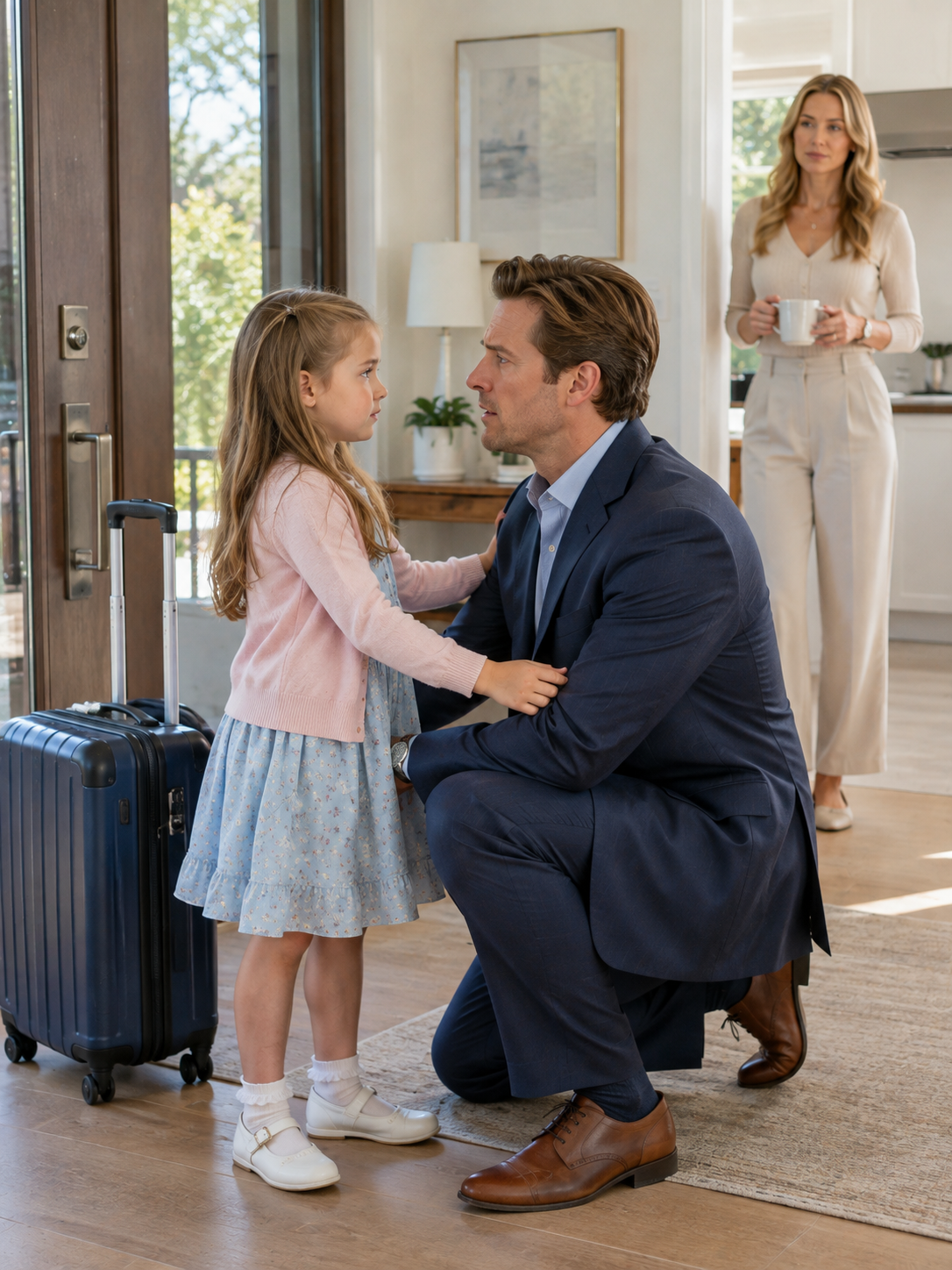
Nora Blake wrapped both arms around my waist while my suitcase stood beside the front door, and the fear in her face immediately made the flight, the meetings, and every other obligation disappear from my priorities.
“Daddy, please do not leave today, because Vanessa gives me something in my juice whenever you travel, and afterward my hands shake and I cannot make my brain slow down.”
Vanessa had been my wife for ten months.
My first wife, Grace, died several years earlier, and I spent nearly two years functioning as a father while quietly believing the happiest part of my life had already ended. Vanessa arrived gradually, never demanding that I remove Grace’s photographs and never complaining when Nora talked about her mother.
I had interpreted that patience as kindness.
Now Nora glanced toward the kitchen before continuing.
“She says the drops are vitamins, but then she records me when I get angry and tells people I am sick.”
I crouched until we were eye level.
“Has she ever told you why she records those videos?”
Nora nodded reluctantly.
“She says someday you will understand that I need to live somewhere else, and if I tell you what she does, you might send me away because she will prove I am crazy.”
My instinct was to walk into the kitchen and confront Vanessa immediately.
Then Nora added something that forced me to remain still.
“There is also a man named Colin, and they talk about Mommy’s beach house. He said they only need two more bad videos before you will sign the papers.”
Grace had inherited a house overlooking the ocean near Coronado from her grandmother. After Grace died, the property passed into a protected arrangement for Nora, with me responsible for managing it until she became an adult.
Its value exceeded seven million dollars.
Vanessa appeared from the kitchen carrying coffee.
“Someone certainly does not want Daddy leaving today.”
I kissed her cheek, picked up my suitcase, and forced myself to smile.
“I will call after I land.”
Outside, I told the driver to stop two blocks away.
Then I canceled the flight and called Caleb Price, a private security specialist who had helped me after a burglary several years earlier.
Within ninety minutes, Caleb had reviewed the existing home-security system, preserved accessible logs, and identified several interior smart-camera recordings that Vanessa apparently did not realize remained automatically backed up.
One clip showed her standing over Nora’s breakfast drink with a small unmarked bottle.
Another showed her recording Nora during an episode of unusual agitation while repeatedly telling the child to “show Daddy how impossible you become.”
I did not wait for another episode.
At 1:20 that afternoon, I returned home unexpectedly.
Vanessa was preparing to leave for lunch.
“My Denver meeting was postponed, so I am taking Nora to spend the afternoon with Louise.”
Louise was Grace’s mother.
Vanessa’s smile tightened.
“She has homework, Ethan, and changing her routine usually makes her behavior worse.”
I looked at my daughter.
“Get your backpack, sweetheart. You are coming with me.”
Nora moved before Vanessa could answer.
This time, I did not walk away without her.
Part 2 – What the Blood Test Proved
I drove Nora directly to a children’s hospital rather than Louise’s house, although I told Vanessa otherwise until my daughter was safely inside the emergency department.
A pediatric toxicology team examined Nora and ordered blood and urine testing. I gave them the recordings Caleb had preserved, explained what Nora had reported, and made it clear that nobody in the household had permission to administer undisclosed medication.
Several hours later, the physician returned with a preliminary finding.
Nora had been exposed repeatedly to an unprescribed stimulant capable of producing sleeplessness, rapid heartbeat, agitation, trembling, and behavioral changes.
The physician chose his words carefully.
“These results do not support diagnosing your daughter from somebody’s phone videos, particularly when there is evidence that an outside substance may be producing the behavior being recorded.”
I felt ashamed that such an obvious statement needed to be spoken aloud.
Nora was not suddenly becoming difficult.
Someone was making her appear difficult.
I called Daniel Reeves, my longtime attorney, and explained everything while hospital staff made the required child-safety reports. Daniel immediately advised me not to sign, transfer, authorize, or discuss any property transaction involving Nora’s inherited house until the situation had been fully reviewed.
Louise arrived shortly afterward.
When Nora saw her grandmother, she finally began crying.
“Can I stay with Grandma where nobody puts things in my drinks?”
Louise looked at me with horror.
“As long as you want, sweetheart.”
I knelt beside Nora.
“You are staying somewhere safe tonight, and nobody is taking you anywhere without me knowing.”
She searched my face.
“Do you believe me now?”
The question wounded me because I realized she had apparently spent weeks wondering whether truth would be enough.
“I believe you, Nora. I should have noticed sooner, but I believe you.”
That evening, I returned home alone.
Vanessa appeared relieved to see me.
She had already prepared her argument.
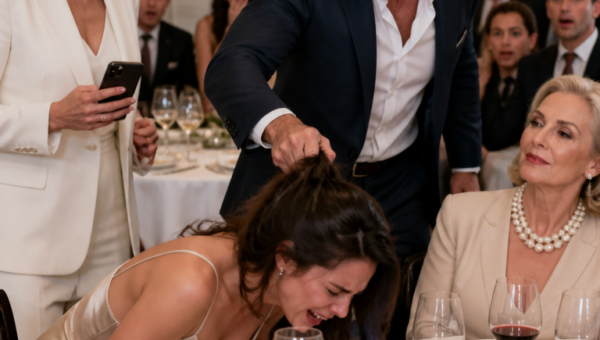
Three edited videos showed Nora yelling, throwing a toy, crying uncontrollably, and knocking a glass from the counter. Vanessa sat beside me with rehearsed concern.
“Ethan, I cannot keep pretending this is normal. Nora needs residential psychiatric care before she becomes dangerous to herself.”
I forced myself to remain calm.
“What would something like that cost?”
Vanessa lowered her voice.
“A specialized program could be incredibly expensive, but Grace’s Coronado property gives us an option. We could sell it and use the proceeds for treatment.”
Then she mentioned Colin.
Apparently, he knew people who could arrange a rapid sale.
“If we move quickly, we could have everything signed before the end of next week.”
I looked at the woman I had married ten months earlier.
“Ask Colin to prepare whatever he thinks we would need.”
For the first time since Nora spoke to me, Vanessa smiled naturally.
She believed the plan was working.
Part 3 – The House Was Never Really the Goal
Caleb’s team recovered additional material from devices and accounts I legally controlled, while Daniel coordinated with investigators and the appropriate child-protection authorities.
The emerging picture was uglier than a simple attempt to sell a house.
I had spent several days preparing explanations about security recordings, preserving evidence, and making sure Vanessa did not destroy everything before investigators understood what was happening.
None of those explanations mattered to a six-year-old who had watched her father carry a suitcase through the door after she finally told him she was afraid.
“I thought pretending to leave would help me understand what Vanessa was doing, but I should have told you immediately that I believed you and taken you somewhere safe.”
Nora frowned.
“Even if she hid the bottle?”
“Even if every bottle disappeared, because finding evidence was an adult problem and keeping you safe was my job.”
Her expression softened.
“So you made a mistake?”
The question almost made me smile through the shame.
“Yes, sweetheart. I made a serious mistake, and being your dad does not make me too important to admit it.”
She held out her smallest finger.
“Next time, you protect me first.”
I hooked my finger around hers.
“Every time, and I will also listen before you need to become terrified enough to convince me.”
That promise became more important than anything that happened inside the legal case.
Part 6 – Recovery Was Not a Courtroom Scene
The criminal and family proceedings continued for months rather than ending in one dramatic afternoon.
Investigators examined the substances, forged authorization, financial communications, treatment records, and proposed property transfer. Vanessa and Colin eventually faced serious consequences through separate proceedings, while attorneys handled the end of my ten-month marriage.
I did not follow every development obsessively.
Nora needed a father more than she needed an amateur prosecutor.
Her pediatric team monitored her until the substances had fully cleared her system. A child therapist helped her understand that the frightening sensations and emotional episodes had been real physical reactions, but they did not mean anything was fundamentally wrong with her mind.
That distinction mattered because Vanessa had spent months teaching Nora to distrust herself.
The first time Nora became angry during an ordinary homework disagreement, she immediately looked terrified.
“Daddy, am I doing the bad thing again?”
I put the pencil down.
“Being angry is not the bad thing. You are allowed to feel angry without somebody turning that feeling into evidence against you.”
Slowly, our household stopped organizing itself around fear.
I also changed the way the Coronado property was managed. Daniel helped establish additional independent oversight so that no future spouse, relative, or even I could casually redirect Nora’s inheritance without transparent review.
The house remained hers.
Not because I was powerful enough to protect it forever, but because systems should not depend upon one parent never making another mistake.
Louise visited constantly.
Caleb remained involved only as long as the investigation required, then returned to his private security work after handing me several recommendations for safer household systems.
Daniel continued handling the estate.
Melissa eventually closed the child-protection case after Nora’s living environment was determined safe and stable.
For the first time since Grace died, I stopped trying to solve grief by immediately rebuilding the shape of a traditional family.
Nora and I were already a family.
That realization should have arrived much earlier.
Part 7 – The Key Grace Left Behind
The following spring, Nora and I returned to the Coronado house with Louise.
The property had remained mostly closed during the investigation, and ocean air rushed through the rooms when I opened the windows.
Grace’s photographs still stood on the upstairs shelves.
Nothing had been sold.
Nothing had disappeared.
Nora walked onto the patio overlooking the water and stared at the garden, where several neglected flower beds had become crowded with weeds.
“Vanessa told me this house was going away because sick children cost too much money.”
I sat beside her on the steps.
“This house belongs to you because your mother wanted you to have something connected to her family. Nobody gets to convince you that being sick, frightened, or difficult means you owe them your belongings.”
I placed a small brass key in her hand.
She looked surprised.
“Is this really mine?”
“The adults still handle the legal responsibility until you are older, but the house is being protected for you.”
Nora closed her fingers around the key.
Then she asked whether we could plant something for Grace.
Her mother had loved white peonies, so we spent the afternoon placing several plants along the sunny edge of the patio while Louise directed both of us with considerably more confidence than gardening experience justified.
Near sunset, Nora ran toward the lawn with dirt on both knees.
For the first time in months, watching her disappear behind a hedge did not immediately make fear tighten my chest.
She came back carrying a small seashell.
“Daddy, do you think Mommy would like the flowers?”
I looked toward the house Grace had left behind and the daughter she had trusted me to raise.
“I think she would care most that you feel safe here.”
Nora considered that answer.
“I do now.”
Those three words mattered more than every legal victory that followed.
For months, I had believed the most frightening part of the story was learning that someone had deliberately manufactured symptoms in my daughter while attempting to profit from her inheritance.
Eventually, I understood something harder.
The most important moment happened before any camera recording, toxicology result, attorney meeting, or investigation.
A six-year-old child had gathered enough courage to tell her father that she was afraid.
My first responsibility had not been to construct the perfect case.
It had been to make sure she never regretted speaking.
I could not change the minutes when Nora watched me carry my suitcase through the door after telling me the truth.
I could change what every day afterward taught her.
That afternoon, while the Pacific reflected the last light beyond the patio, Nora pressed Grace’s old house key into the soil beside the new flowers, then immediately pulled it back out because she decided burying important keys was a terrible idea.
I laughed.
She laughed with me.
Nothing about the sound needed to become evidence of anything.
She was simply six years old again.
That was enough.
THE END