
Minutes After The Divorce, My Ex’s Mother Arrived With Moving Trucks And Said,

The House They Thought Was Waiting
The judge had barely finished dissolving my marriage when my phone lit up in my lap.
Motion detected at front gate.
I was still sitting on a polished wooden bench outside the family court in Stamford, Connecticut, holding the signed papers inside a cream-colored folder while my hands rested so still on my knees that they almost did not feel like mine. Across the hallway, my former husband, Preston Vale, stepped out of the courtroom first, adjusting the cuffs of his expensive gray suit as if he had just survived an unpleasant business meeting instead of five years of carefully polished lies, private humiliations, and a kind of silence that had slowly taught me to disappear inside my own home.
His mother, Cynthia Vale, was waiting near the elevator in dark sunglasses, pearl earrings, and the satisfied little smile she wore whenever she believed the world had finally arranged itself in her favor.
“Well,” she said, loud enough for me to hear, “at least now you can have your life back.”
Preston did not answer. He only tightened his jaw and kept walking.
I looked down at my phone.
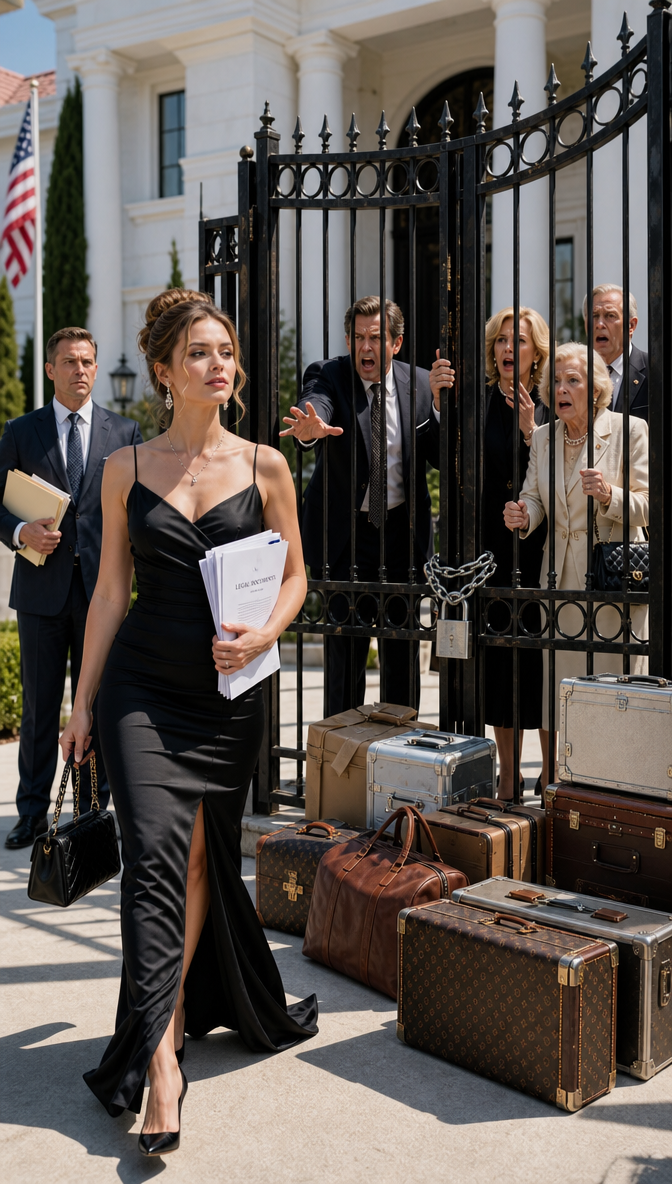
The security camera showed two moving trucks parked in front of my property in Riverside. Behind them stood Cynthia, Preston’s sister Audrey, his brother Nolan, and several movers in matching navy shirts, all gathered outside the iron gate of the house I had bought three years before I ever met Preston, the house I had kept after my parents were taken from me in a highway incident, the house Preston had never paid for, never maintained, and yet had used for years as the background of every image he wanted the world to believe.
I blinked once, then again, because sometimes the mind needs an extra second to accept insult when it arrives wearing a moving company logo.
A second alert appeared.
Manual access attempt at front gate.
On the screen, Nolan was pressing buttons on the keypad as if stubbornness might unlock what ownership could not. Audrey was filming with her phone, probably preparing some tearful post about family, betrayal, and how difficult rich people could make themselves look inconvenienced. Cynthia stood beside the trucks, pointing at my house with the calm authority of a woman assigning rooms in a hotel she had not booked.
Then a text came from a number I had deleted months ago but still recognized.
Open the gate, Claire. Don’t make this harder than it has to be. Mom only wants the guest suite while things settle.
It was Preston.
I almost laughed.
While things settle.
As if my life were a waiting room.
As if the divorce had been nothing more than the paperwork required for his family to move into my home.
I typed back one sentence.
I’ll meet you at the gate.
Then I called my attorney, Caroline Mercer.
“They’re there,” I said when she answered.
There was a tiny pause on the other end.
“With trucks?”
“Two.”
Caroline exhaled slowly, and I could almost see her closing her leather folder with a patient little snap.
“Good. That means they arrived with witnesses, intent, and truly remarkable confidence. I’m on my way.”
By the time I reached Riverside, the scene had grown into the kind of neighborhood spectacle people pretend not to watch while watching every second. Two patrol cars were parked along the curb. A few neighbors stood halfway hidden behind hedges. Audrey was still recording. Nolan had kicked a loose stone into the grass and was pacing like the driveway itself had offended him. Cynthia was speaking to an officer with the rigid dignity of someone deeply unused to being told no.
The iron gate remained closed.
Behind it, my house looked exactly as it always had from the outside, graceful and quiet, with pale stone walls, tall windows, climbing ivy, and the soft afternoon light sliding across the slate roof. From the curb, it still looked like the same elegant home where Preston had hosted clients, where Cynthia had arranged charity luncheons, where Audrey had taken pictures beside my kitchen island and pretended not to crop out my family photographs.
But they had no idea what was waiting inside.
I stepped out of my car.
Cynthia turned toward me as though I were a late employee.
“Finally,” she said. “Open the gate, Claire. You’ve made quite enough drama for one day.”
I walked slowly to the iron bars and stopped on the other side.
“Good afternoon, Cynthia.”
“Don’t use that calm voice with me. Preston lived here for five years. This is his home, too.”
“No,” I said.
Audrey lifted her phone higher.
“Everybody see this?” she said toward the screen. “My former sister-in-law thinks she can throw an entire family out after taking everything from my brother.”
I looked at her.
“Audrey, if you’re going to film, make sure you keep the whole video.”
Her smile stiffened.
Nolan came closer to the gate, broad-shouldered and red-faced in a linen shirt that probably cost more than a month of groceries for most people.
“Come on, Claire. Open up. We’ve got furniture to bring in. Mom’s taking the main bedroom for now. I’ll use the study until my condo closes, and Audrey says the big closet has the best light for her content.”
He said it as if selecting spaces from a floor plan.
A strange calm moved through me then, cool and sharp and almost clean. It was not anger, not exactly. Anger had lived in me for years, hot and useless, rising every time Cynthia opened my refrigerator without asking, every time Audrey borrowed a coat and returned it smelling like someone else’s perfume, every time Nolan drank my wine and told me Preston would replace it, which of course Preston never did.
This was different.
This was clarity.
For years, the Vales had treated my home like a branch of their family name. Cynthia rearranged flowers before dinners as if my taste required supervision. Audrey filmed little lifestyle clips beside my pool, never once mentioning that the house was mine. Nolan invited friends into Preston’s office, which was really my late father’s library, and bragged about the “family property.” One Thanksgiving, Cynthia handed me an apron in front of twelve guests and said, “Maybe this will help you learn how to run a proper home.”
Preston laughed.
And I laughed too, because back then I still confused peace with swallowing whatever people handed me.
Not anymore.
The officer approached me carefully. He was a middle-aged man with kind eyes and the tired patience of someone who had seen too many families turn property lines into battle lines.
“Ma’am, are you the owner of the residence?”
“I am. Claire Whitaker Bennett.”
I handed him the folder Caroline had prepared for me weeks earlier.
Cynthia leaned forward, trying to see over his arm.
“Check every page, Officer. She lies beautifully. My son is a senior partner at Vale Sterling Private Wealth. He paid for this house. She has probably arranged some paperwork trick.”
The officer glanced up.
“Ma’am, please step back.”
Cynthia froze.
“Excuse me?”
“Step back, please.”
For the first time that afternoon, she closed her mouth.
He reviewed the deed, the purchase records, the property tax receipts, the maintenance accounts, and the prenuptial agreement Preston had signed four days before our wedding, back when he used to tell me that love did not need shared assets because love was better than paperwork.
The truth was simple.
I had bought the Riverside house before Preston.
I had paid for it with money from the sale of my family’s restoration company and the estate my parents left behind.
Preston had never paid the mortgage, the insurance, the taxes, the repairs, the landscaping, or even the replacement of the boiler he complained about every winter.
But he had posed in front of it like it belonged to him.
The officer closed the folder and turned to Cynthia.
“Mrs. Vale, this property belongs solely to Ms. Bennett. Your son does not have ownership rights to this residence.”
The neighbors heard every word.
Audrey lowered her phone.
Nolan muttered, “That can’t be right.”
“It can,” I said. “And it is.”
Cynthia recovered quickly, because people like her rarely stop at the truth if there is still another angle to try.
“He lived here,” she said. “That gives him rights.”
“Not ownership rights,” the officer replied. “Not after a divorce, and not without the owner’s permission.”
Audrey crossed her arms.
“Then let us get Preston’s things.”
Nolan jumped in quickly.
“Right. His suits, watches, golf clubs, screens, wine, speakers. The big television in the den was basically his.”
Basically his.
That was how the Vales described anything they wanted but had not purchased.
I turned to the officer.
“To avoid confusion, I’ll allow them to enter under police supervision and collect only Preston’s personal belongings. I want it understood that I’m not preventing him from retrieving his things.”
The officer nodded.
“That’s reasonable.”
Cynthia smiled.
She thought she had won.
She even leaned toward Audrey and whispered, not nearly softly enough, “Once we’re inside, we’re not leaving.”
Nolan cracked his knuckles.
I heard her.
So did the officer.
I opened the gate from my phone.
The iron panels moved inward with a slow mechanical hum, and Cynthia rushed forward before they had even fully opened. Audrey followed with her phone in hand. Nolan barked at the movers, “Be ready. We’re unloading today.”
I said nothing.
I walked behind them through the garden, past the ivy, the empty fountain, and the stone steps leading to the double front doors.
Nolan reached the entrance first and pushed it open.
“We’re in,” he called.
Then his voice vanished.
Cynthia crossed the threshold and stopped so suddenly that Audrey bumped into her back.
“What in the world…”
Then they all saw it.
Nothing.
The foyer was empty.
No marble console. No antique mirror. No Persian rug. No chandelier. No framed photographs. No fresh flowers in the silver bowl Cynthia had always claimed made the house “feel civilized.” There were only polished floors, pale walls, and the echo of their breathing.
Nolan ran into the living room.
“Where is everything?”
The great room, once filled with deep sofas, walnut shelves, art pieces, lamps, and the enormous curved television Preston loved to stand beside during video calls, was bare from wall to wall. Afternoon sun poured through the windows and stretched across the floor, bright and indifferent.
It was not minimalist.
It was empty.
Cynthia moved through the room as if she had entered the wrong house.
“Claire, what did you do?”
Audrey hurried into the kitchen and began opening cabinets.
“There’s nothing in here. There isn’t even a refrigerator.”
Nolan thundered upstairs. His footsteps echoed above us, frantic and heavy.
“The bedrooms are empty,” he shouted. “The closets too.”
Cynthia turned back to me, her face pale beneath her perfect makeup.
“You stole the furniture.”
“No,” I said. “I sold my furniture. Every item in this house was bought by me, invoiced to me, insured by me, or inherited by me. Preston’s personal belongings are in the garage, boxed and labeled. His clothing is in four containers. His golf clubs are beside the door. His expired protein powder is also there, unfortunately.”
Someone outside laughed.
Cynthia’s hands curled at her sides.
“You spiteful little—”
“Careful,” the officer said.
Audrey returned from the kitchen looking genuinely unsettled.
“There’s no stove. No dishwasher. No appliances. How is anybody supposed to live here?”
I tilted my head.
“That sounds like a question for someone who planned to live here without permission.”
That was when Cynthia’s face truly changed. Not because she was embarrassed, although she was. Not because the neighbors were watching, although they were. She looked shaken because, for the first time, the fantasy she had carried for years had failed to become reality.
She had imagined my main bedroom becoming hers. She had imagined luncheons by the pool, Audrey filming in the closet, Nolan using the study, Preston returning whenever he pleased, the family name stretched comfortably across property they had never earned.
To them, my divorce had not been the end of a marriage.
It had been moving day.
But the house gave them nothing.
Only space.
Only heat.
Only the sound of their own entitlement coming back at them.
Then Audrey began fanning herself.
“Why is it so warm in here?”
Nolan jabbed at the thermostat.
“It’s not turning on.”
Audrey opened the kitchen faucet. The pipes gave a dry cough and nothing more.
“Is there no water?”
Cynthia stared at me.
“What did you do to the utilities?”
“I canceled them,” I said. “I don’t live here anymore. Electric, water, cable, internet, all of it. The property is being renovated.”
Nolan looked more offended by that than by the legal documents.
“There’s no internet?”
For some reason, that hit Audrey hardest.
“No Wi-Fi?”
I almost smiled.
“No Wi-Fi.”
And there, inside a multi-million-dollar house with no furniture, no appliances, no water, no air conditioning, no internet, and no legal right to stay, the Vale family’s beautiful little plan began to melt.
The Price of Waiting
The movers became the next problem Cynthia had not considered. They had been sitting outside for nearly three hours, and working men with trucks do not generally appreciate being hired into a family fantasy without payment. Their foreman, a large white-haired man named Hank Porter, walked up to Cynthia with a clipboard and asked whether they were unloading or heading back.
Cynthia waved him off.
“Not today. We’ll reschedule.”
Hank looked at her as if she had just asked the sun to reschedule sunset.
“Ma’am, the contract covers two trucks, crew time, waiting time, return mileage, and canceled unloading. Total comes to forty-eight hundred dollars.”
Cynthia gave a dry laugh.
“For doing nothing?”
“For showing up because you told us to,” Hank replied.
Nolan tried stepping toward him.
“You don’t want to push us.”
Hank looked at him once, slowly, and Nolan’s confidence thinned like cheap paper.
The officer explained that the moving bill was a civil matter, but the contract appeared valid. Cynthia eventually opened a small designer purse and counted out payment with hands that trembled more than she wanted anyone to notice. Each bill seemed to hurt her.
That interested me.
Cynthia dressed like money. Gold bracelets, oversized sunglasses, expensive handbags, shoes that clicked across stone like punctuation marks. But much of it was performance. Preston had been moving funds to his family for months before the divorce, not as gifts but as hidden transfers from accounts Caroline had already begun tracing. My attorney called it “a pattern worth discussing in front of a judge,” which was Caroline’s polite way of saying Preston had been careless with his own arrogance.
When the movers finally drove away with Cynthia’s furniture still inside the trucks, Nolan discovered that his SUV had been immobilized. He had parked half of it on my lawn, because to a Vale, rules were suggestions whenever the grass looked nice enough. My private security company had placed a bright yellow lock on one wheel and a notice under the windshield wiper.
“This is my brother’s house,” Nolan shouted.
The officer, now visibly tired, said, “No, sir. It is not.”
I explained that the release fee was twelve hundred dollars, plus damages to the lawn and an additional charge if the vehicle remained overnight.
Nolan kicked the tire lock, then immediately grabbed his foot and hopped backward.
Audrey stood by the curb, near tears because her phone battery was down to three percent. Cynthia sat on the edge of the sidewalk with the broken dignity of a queen who had misplaced her country.
At 7:42 that evening, Preston’s black Mercedes turned onto the street.
He stepped out with his tie loosened and fury arranged across his face like a mask he had practiced in mirrors. Cynthia rushed toward him, talking so fast that even he seemed unable to follow. He looked at the empty curb where the moving trucks had been, Nolan’s immobilized SUV, Audrey holding a powerless phone, his mother seated in front of neighbors she had hoped to impress, and finally at me standing behind my gate.
Then he opened the trunk and took out a baseball bat.
Curtains moved along the street.
Audrey whispered, “Preston, don’t.”
He ignored her and struck the gate once, hard enough to make the iron ring.
“Claire, open this gate before I take it down.”
I lifted my phone, started recording, and began a live stream.
“Good evening,” I said calmly to the camera. “This is Preston Vale, my former husband, outside my private property with a baseball bat, after his family attempted to move into my house without permission.”
Preston froze.
That was the thing about him. He cared less about right and wrong than he cared about how right and wrong looked online.
“Turn that off,” he said.
“Would you like to repeat that?”
Cynthia snapped, “Stop filming my son.”
I looked toward Audrey’s dark phone.
“Audrey spent the afternoon recording me and telling people I stole from your family. I assumed public performance was a family tradition.”
Before Preston could lift the bat again, a calm voice came from behind him.
“I’d advise against that.”
Caroline Mercer had arrived in a dark sedan, wearing a navy suit, low heels, and the peaceful expression of a woman about to ruin several people’s evening with paperwork. Two private security consultants stood beside her.
Caroline opened a folder.
“Claire asked me to come because she suspected Mr. Vale might appear.”
Preston tried to smile.
“Caroline, this is a family matter.”
“No,” she said. “It is a property matter, a financial matter, and possibly a harassment matter. Family is what people call it when they want consequences to sound impolite.”
Then she began reading.
Over the previous fourteen months, Preston had transferred significant amounts from marital accounts into accounts connected to Cynthia, Nolan, and Audrey. There were invoices from Nolan’s inactive consulting company. Credit card payments made for Audrey from accounts tied to Preston’s firm. A large deposit on a vacation property Cynthia had nearly purchased under a shell company. There were also photographs from a hotel in Miami showing Preston with a woman from one of his client conferences, and on her wrist was a diamond bracelet he had once told me was a client gift.
Cynthia studied the photos with more irritation about the bracelet than the betrayal.
Caroline closed the folder.
“Here is the offer. Mr. Vale returns two hundred fifty thousand dollars within forty-eight hours as an initial settlement toward hidden assets. Every member of this family signs a no-contact agreement. Mr. Vale covers today’s security expenses, property damages, and legal fees. In exchange, Ms. Bennett will consider resolving this quietly.”
Preston swallowed.
“You’re bluffing.”
Caroline gave him a small smile.
“I charge too much to bluff.”
Another patrol car turned the corner. Someone had called about the bat.
Preston let it fall to the pavement.
The sound was hollow.
I thought that night might be the end of it.
I was wrong.
At 12:18 in the morning, Audrey climbed over the back fence wearing black leggings, a baseball cap, a backpack, and carrying bolt cutters.
The Gate That Held
I did not sleep that night. People think getting even tastes like champagne, but most of the time it tastes like cold coffee, tight nerves, and the strange metallic fear that follows you even when you know you are right.
Caroline had urged me to stay at a hotel.
I refused.
Not because I was brave. I was simply tired of leaving places that belonged to me.
I sat in the security room and watched six cameras glow in the dark. When the rear sensor flashed, I saw Audrey drop awkwardly into the garden, land in the ivy, and crouch as if she were starring in a movie where every viewer had already changed the channel.
I activated the exterior lights.
The backyard flooded bright as noon.
Audrey screamed, dropped the bolt cutters, and stumbled into a shrub.
Security arrived in four minutes. The police arrived in seven. In Audrey’s backpack were gloves, a screwdriver, and a printed screenshot of the old garage keypad, taken from a video she had posted years earlier while pretending my home was hers.
When the officer asked why she had the tools, Audrey said, “I was just looking for Preston’s documents.”
I said, “Those documents were already sent electronically to his attorney.”
The officer looked at the bolt cutters.
“Then what were these for?”
Audrey stared at me with mascara streaking down her cheeks.
“Because she ruins everything.”
For one brief moment, I almost felt sorry for her.
Almost.
Audrey had spent years filming in my kitchen, beside my pool, in front of my closet, careful never to say the house was not hers. That night, the fantasy finally became something official enough to put in a police report.
By morning, Cynthia had called thirty-eight times.
I did not answer.
At 8:05, Caroline and I met Preston at the police station. He looked as though the night had aged him in public. Cynthia was there too, smaller somehow without her sunglasses, begging me not to press the matter with Audrey because her daughter was “sensitive” and “under pressure.”
She reached for my hand.
“Claire, please. We’re family.”
I stepped back.
“No. We were paperwork.”
Preston said he would sign whatever was necessary if I agreed not to make Audrey’s situation worse. Caroline opened her folder again, because that was Caroline’s love language.
The final agreement was stricter than the one offered at the gate. Full no-contact terms for the entire family. Payment for property damage, security, and legal fees. Initial repayment for hidden assets. Cooperation with the financial review. Written acknowledgment that the Riverside house belonged only to me.
Nolan objected until Caroline mentioned the backyard entry and the tools in Audrey’s backpack. After that, the room grew very quiet.
Within two hours, they signed.
Preston found the money by liquidating investments he had failed to disclose, selling an apartment held under one of his firm’s entities, and admitting just enough to his partners that the rumor arrived before he did. By Monday, Vale Sterling had placed him on leave. The man who once told me I was nothing without his name lost his office before I picked out new curtains.
The Riverside house was renovated that fall, not for parties, not for clients, not for Cynthia’s approval, but for me. The living room became warm instead of impressive. The kitchen turned bright and practical, with deep drawers, copper pans, and a round breakfast table where no one felt small. The dining room where Cynthia had spent years correcting me became a library with soft chairs, oak shelves, and lamps that made the evenings feel gentle. The main bedroom was painted ivory, with linen curtains and warm lights, and for the first time since my marriage began, I slept there without feeling watched.
Months later, I started the Bennett House Legal Fund in honor of my parents, offering emergency legal support to women leaving marriages where money had been used as a leash.
The first woman we helped was a nurse whose husband had hidden her passport. The second was a teacher whose in-laws tried to push her out of a house she had bought before marriage. The third was a grandmother whose adult children had quietly drained her savings and called it “helping manage things.”
Every time I signed an assistance approval, I remembered Cynthia standing at my gate, insisting my house belonged to her son.
No.
My home was mine.
My name was mine.
My life was mine.
Two years later, the Riverside house appeared in a regional magazine as the headquarters of the Bennett House Legal Fund. The writer described it as “warm, serene, and quietly powerful.” I laughed when I read that. If those walls could speak, they would tell stories about Preston’s bat, Nolan’s locked SUV, Audrey tumbling into the ivy, and Cynthia discovering there was no Wi-Fi in the mansion she meant to claim.
But they would also tell better stories.
They would tell about women arriving with shaking hands and leaving with folders, plans, phone numbers, and just enough courage to take the next step. They would tell about coffee brewed late into the evening, attorneys volunteering after work, neighbors dropping off blankets for clients who had left home in a hurry, and the strange, holy relief that comes when someone finally says, “Let’s look at the documents before we believe what he told you.”
One afternoon, a letter arrived from Cynthia. She had moved to a smaller town in Vermont. The handwriting was stiff but recognizable.
She wrote that she understood now the house had never been hers to enter, arrange, or claim. She did not exactly apologize. Cynthia was not built for that kind of surrender. But she admitted the truth, and for her, perhaps that was as close as she could come.
Caroline asked whether I wanted to respond.
I said no.
Some admissions arrive too late to deserve a door.
On the anniversary of my divorce, I hosted dinner in the library that used to be the dining room. My friends came, along with several women the fund had helped, Caroline, and Hank Porter, the moving foreman who had made Cynthia pay for the trucks that never unloaded.
We ate roast chicken, warm bread, and lemon cake. We laughed harder than the occasion required, which is sometimes the best proof that healing has entered the room without asking permission.
At the end of the night, Caroline raised her glass.
“To Claire,” she said, “who turned an attempted takeover into a movement.”
After everyone left, I walked alone into the garden. The gate stood at the end of the drive, black iron shining beneath the trees, firm and quiet as it had been on the day the Vales arrived with trucks and confidence.
Once, that gate had kept the wrong people out.
Now, it helped the right people find their way in.
My phone vibrated with an alert from the fund. A woman had sent a message through the emergency form.
My husband says everything belongs to him. I don’t know what’s true anymore.
I looked back at the glowing windows of my house, the library lights warm behind the glass, the garden finally peaceful around me.
Then I typed back.
That’s often the first thing they say. Now let’s look at what the truth says.
And that was when I understood that my story had not ended in the courthouse, or at the gate, or even in the empty mansion that made Cynthia Vale lose her smile.
It ended the day I stopped asking why they had tried to take my life apart and began using that life to help other women put theirs back together.