Advertisement

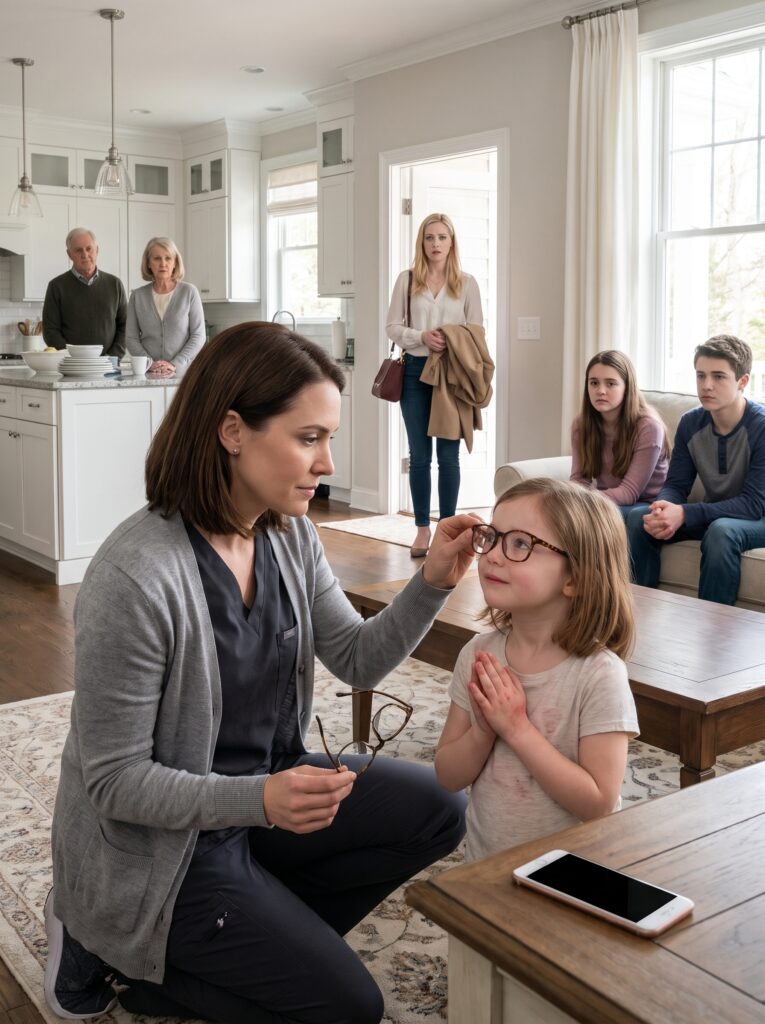
my 7-year-old daughter Grace was sitting on the rug without her visual aid glasses.

Part 3 – Ending:

For a few seconds after Michael Harris said the number, I could not speak.

Advertisement

$240,000.

Advertisement

Not promised.

Not theoretical.

Owed to my daughter.

Grace had been sitting on my parents’ living room rug without her glasses while the same adults who called themselves family had been sitting on money that belonged to her.

And Lauren had reacted to one accidental glance at her phone like Grace had uncovered a state secret.

Because she had.

Michael’s voice stayed calm.

“Your parents were named trustees,” he said. “There is no record of a distribution to your branch of the family.”

I sat down because my legs no longer trusted me.

“So they just kept it?”

Michael paused.

“Based on what I can see, yes.”

The words landed with a force I felt behind my ribs.

For years, I had paid bills to keep peace.

I had helped with little expenses. I had covered gaps. I had let my parents and Lauren talk about family loyalty while Grace was treated like an inconvenience at the edge of the room.

Meanwhile, Uncle Ray had left my child a future.

And they had quietly decided she did not deserve it.

“What happens now?” I asked.

“We demand a full accounting,” Michael said. “We file in court if necessary. We seek removal of trustees and recovery of funds.”

“And criminal?” I asked.

Another pause.

“If there was intentional withholding or misuse of trust funds, you can make a formal report. That process is separate from the civil action.”

I looked at the broken glasses on my kitchen table.

The lens still caught the light in one sharp crack.

“Do it,” I said.

Michael did not ask if I was sure.

He just said, “All right.”

After that, everything became paperwork.

Formal letters.

Certified mail.

Requests for accounting.

Copies of the trust documents.

Dates, signatures, responsibilities, balances.

The kind of boring paper trail people underestimate until it turns into a map of what they did.

I also made the report.

Not about the kitchen.

Not about the humiliation.

About the money.

About trustees who had withheld $240,000 from a visually impaired child and kept it quiet until that child saw one word on a phone.

The officer taking the report looked up twice.

“Your parents were the trustees?” he asked.

“Yes.”

“And your daughter only found out because she saw something on your sister’s phone?”

“Yes.”

“And your sister responded by damaging her glasses?”

I looked at him.

“Yes.”

He sat back for one second.

Then he clicked his pen and kept writing.

That small sound did something to me.

Not satisfaction.

Not revenge.

Recognition.

For once, what happened was being written down by someone who was not going to turn it into a family misunderstanding.

When the notices went out, the silence from my family lasted less than twenty-four hours.

Then came the knock.

I looked through the peephole and saw my mother standing on my porch with a plate of cookies.

Dad stood behind her, hands in his jacket pockets, staring at the ground.

Lauren was slightly off to the side with her arms crossed and a smile so tight it looked painful.

Cookies.

Because apparently nothing says please do not involve the legal system like chocolate chips.

I opened the door but did not invite them in.

Mom lifted the plate.

“Erin, honey, we just want to talk.”

“Interesting timing,” I said.

Mom blinked.

“We don’t know what you mean.”

I looked at Lauren.

“Just like you don’t know what happened to Grace’s glasses?”

Lauren’s smile cracked.

“This is ridiculous. You’re blowing up the family over nothing.”

“Over nothing?” I repeated. “Two hundred forty thousand dollars is nothing now?”

Dad finally looked up.

“Erin…”

I raised one hand.

“Talk to Michael Harris.”

Mom’s face tightened.

“We’re family.”

“I noticed,” I said. “That’s the problem.”

Lauren stepped forward.

“You don’t understand what you’re doing.”

That made me almost laugh.

For most of my life, my family had counted on me not understanding.

Not understanding why Lauren always got excused.

Not understanding why Mom’s version of discipline always seemed to land on the quietest person in the room.

Not understanding why Dad’s silence was treated like neutrality instead of permission.

But I understood now.

Perfectly.

Mom’s voice sharpened.

“You are humiliating us.”

“That’s funny,” I said. “Grace’s hands were bruised from cleaning your kitchen while you watched.”

Lauren snapped before she could stop herself.

“She shouldn’t have looked at my phone.”

There it was.

Not a denial.

A justification.

Mom hissed, “Lauren.”

But Lauren was already unraveling.

“She was disrespectful,” she said. “She needed to learn. And now Erin is trying to take money away from our kids.”

I tilted my head.

“From your kids?”

Mom stepped forward, eyes flashing.

“Do you have any idea how unfair this is? Grace is one child. Lauren has three.”

The porch went still.

Dad looked down again.

Lauren froze.

And I finally saw the math they had been doing in private.

It had never been about respect.

It had never been about discipline.

It had never even been about Grace glancing at a phone.

It was about the fact that Uncle Ray had left money to my daughter and not to Lauren’s children.

Grace’s future had looked unfair to them because it was not divided the way they wanted.

“So that’s the motive,” I said softly.

Mom’s face went pale.

Lauren glared at me.

“You’re really going to do this?”

“Yes,” I said. “I am.”

Mom’s voice changed then. It lost the sharpness and became desperate.

“Erin, please. Don’t do this.”

I looked at her for a long moment.

“You did this,” I said. “When you decided my daughter’s future belonged to someone else.”

Then I stepped back and closed the door.

Not hard.

Not loud.

Just closed.

The weeks after that moved slowly.

Legal time is strange. Nothing seems to happen, and then everything happens at once.

Michael demanded the trust accounting.

My parents tried to delay.

Lauren sent three messages I did not answer.

Mom called from unknown numbers.

Dad left one voicemail that began with a sigh and ended without an apology.

Michael kept everything focused.

Dates.

Documents.

Trustee duties.

Missing distributions.

The court eventually removed my parents as trustees.

The $240,000 was recovered and placed into a protected account for Grace, with an independent fiduciary and safeguards my parents could not touch.

That part mattered most.

Not punishment.

Protection.

Because trustee is not a family title.

It is a legal responsibility.

And they had failed it.

There were consequences beyond the civil case too.

No one went to prison. This was not a movie.

But there were charges, fines, probation, and community service. Enough for the story to stop being a whisper and become something people could verify.

Court filings have a way of ruining family myths.

The wider family found out.

Invitations stopped.

Calls slowed.

People who used to nod along when Mom talked about discipline suddenly became very careful about being seen with her.

Lauren’s life got smaller.

Not destroyed.

Smaller.

There is a difference.

Her children’s activities were not suddenly my responsibility anymore. The shortfalls were hers. The fees were hers. The little emergencies that used to land in my bank account stayed where they belonged.

Dad remained quiet.

That was the one thing about him that never changed.

But after everything, I stopped pretending his quiet meant he had not chosen.

Silence can be a choice.

It can be the softest-looking form of permission.

Grace’s new glasses arrived three weeks later.

They looked almost identical to the ones Lauren damaged, but Grace treated them differently. More carefully. Not because she was careless before, but because someone had taught her that a thing she needed could be taken from her if an adult was angry enough.

That lesson took longer to undo than the bruises on her hands.

The redness faded first.

Then the flinching.

Then, slowly, the apology reflex.

For a while, Grace said sorry for everything.

Sorry when she asked for water.

Sorry when she bumped the table.

Sorry when she needed help reading something across the room.

Every time, I said the same thing.

“You do not have to apologize for needing what you need.”

At first, she nodded like she did not believe me.

Then she started believing me a little.

One night, months later, I found her at the kitchen table drawing.

Her glasses were sliding down her nose.

She pushed them up and looked at me.

“Mom?”

“Yeah, baby?”

“Are we okay now?”

I wanted to say yes immediately.

That is what mothers want to do.

We want to make the world simple. Safe. Done.

But Grace deserved better than a quick lie.

So I sat beside her.

“We’re safe,” I said. “And we’re getting okay.”

She thought about that.

Then she nodded.

“I like that better.”

So did I.

Because healing did not happen when the money came back.

It did not happen when my parents were removed as trustees.

It did not happen when Lauren stopped texting.

It happened in small, ordinary moments.

Grace leaving her backpack in the hallway without asking if it was okay.

Grace laughing too loudly at a cartoon.

Grace telling me she did not want to go to Grandma’s house anymore and not apologizing afterward.

That was the victory.

Not the paperwork.

The space.

The right to take up space without paying for it.

Michael sent the final confirmation on a rainy Thursday afternoon.

The funds were secured.

The trustee change was complete.

The account was protected until Grace reached the age set in Uncle Ray’s documents.

I printed the confirmation and placed it in a folder.

Then I put that folder in the same drawer where I kept the photographs of her broken glasses.

Not because I wanted to remember the pain.

Because I never wanted to forget the lesson.

People who are comfortable hurting your child do not get second chances because they share your blood.

People who steal from your child’s future do not get soft landings because they say family.

And people who stand by while harm happens are not neutral.

They are witnesses who chose the wrong side.

I never took Grace back to my parents’ house.

Lauren never reimbursed the glasses directly.

The court process handled more than $800 ever could.

But I did receive one envelope months later.

No return address.

Inside was a money order for $800.

No note.

No apology.

I deposited it into Grace’s account and did not ask who sent it.

Some answers are not worth chasing.

Uncle Ray’s photo sits on our bookshelf now. In it, he is sitting beside Grace at her sixth birthday party, listening seriously while she explains the plot of a book that had at least three dragons and, according to her, not enough maps.

He was the only adult in that family who spoke to her like she was whole.

I think he knew.

Maybe not everything.

Maybe not the exact shape of what would happen.

But he knew enough to leave her something protected.

He just did not know the people he trusted to protect it would be the ones who tried to keep it away.

That part still hurts.

It may always hurt.

But pain is not the same as doubt.

I know what happened.

I know what I did.

And I know I did not go too far.

I did not shout in that living room.

I did not argue on the porch.

I did not beg my parents to understand.

I took pictures.

I found the trust.

I called the lawyer.

I made the report.

I closed the door.

That is what protection looked like for me.

Quiet.

Documented.

Final.

Grace is eight now.

She has purple glasses because she chose them herself. She says they make her look like someone who solves mysteries, and honestly, she is not wrong.

Sometimes when she pushes them up her nose, I still see the cracked frame on my kitchen table.

Then I look at her.

Her shoulders are not hunched anymore.

Her hands are not tucked into her lap like they might get her in trouble.

She takes up space.

She asks questions.

She laughs without checking the room first.

That is the only ending I care about.

My sister tried to teach my daughter respect by taking away the thing that helped her see.

But all she really did was show me exactly what had been hidden in plain sight.

A broken pair of glasses led me to a trust.

A child’s quiet memory exposed $240,000.

And a door I should have closed years ago finally shut for good.

We are okay now.

Not because they apologized.

Because they no longer have access to the child they thought they could hurt, shame, or steal from.

Grace can see clearly.

And so can I.

Disclaimer : This content may be created by AI for entertainment purposes. Any resemblance to real persons, events, or places is coincidental.

Advertisement
info@teaytech

info@teaytech

1056 articles published