
My Brother Mocked My Desk Job Until a Four-Star Admiral Saluted Me Before Our Family…-haohao

The petty officer looked from the four-star admiral to me, then back toward the tablet where my family had carefully erased my name.
His face had gone completely pale, because the woman he was ordered to deny access now stood receiving a salute from his highest superior.
“Rear Admiral Stone,” Admiral Nathaniel Ward repeated, lowering his hand only after I returned the salute beneath my brother’s frozen stare.
“I apologize for the confusion at the gate, ma’am; your security detail informed me you intended arriving without ceremony this morning.”
Marcus had stopped beneath the stone archway, one polished shoe still lifted slightly, as though his body had forgotten how walking worked.
My father turned slowly, searching my uniformless trench coat for evidence supporting the impossible title the admiral had spoken aloud.
Mother gripped Paige’s arm so tightly her pearl bracelet slid down her wrist, catching sunlight like something suddenly sharp and accusing.
The petty officer cleared his throat, struggling to regain composure while scrolling urgently through access lists that could no longer explain anything.
“Admiral Ward, sir, she was not entered under family attendance,” he stammered, humiliation tightening every word he managed to release.
Ward glanced once at the screen, then toward Marcus, whose confident recruiting-poster expression had already begun collapsing beyond repair.
“She is not family attendance,” Ward answered evenly. “She is the presiding flag officer, and this ceremony exists because of her.”
The sentence fell across the courtyard with the force of a dropped anchor, silencing even the warm-up notes from the distant brass band.
For years, my family had perfected the art of forgetting me whenever memory threatened the hierarchy built around my brother.
Now they stood beneath Academy stonework, realizing they had not merely excluded me from an event they believed belonged to Marcus.
They had left the guest of honor outside her own ceremony, then laughed while the Navy’s senior leadership came searching for her.
Admiral Ward motioned toward the checkpoint, and the petty officer opened the barrier with hands trembling visibly despite his disciplined posture.
“Welcome home, Sophia,” Ward said quietly, his tone softening as we stepped through the gate together beneath watching eyes.
I had walked those grounds first as a midshipman, carrying books, insecurities, ambition, and the impossible hope my father might finally notice.
Richard Stone had been a Navy captain, a man whose stories always began with command and ended with applause.
He believed sons inherited service naturally, while daughters admired it politely before choosing more sensible, decorative, manageable lives.
When Marcus received his Academy appointment, Father displayed the framed letter in our hallway before Marcus even packed his first bag.
When I received mine two years later, Father said it was wonderful I had found something structured to occupy my energy.
Mother bought Marcus an engraved watch before Induction Day, then gave me white socks and advice about avoiding unnecessary competition.
Marcus thrived visibly, volunteering for ceremonies, appearing in photographs, and learning early that confidence often receives credit before competence.
I learned differently, studying longer, speaking less, and choosing intelligence work because hidden threats never cared who looked impressive afterward.
At graduation, Marcus received a full family celebration, complete with rented restaurant room, embossed menus, and speeches about Stone naval tradition.
Two years later, my commissioning dinner became takeout after Father said traveling twice for similar ceremonies seemed financially excessive.
I remembered swallowing that hurt while fastening my first insignia, promising myself service would never require their understanding to remain honorable.
Still, promises made at twenty-one do not completely silence the child who keeps wondering why excellence never makes her lovable.
My early assignments carried me from Norfolk to Bahrain, then aboard ships where intelligence reports could determine whether entire crews returned safely.
I learned to interpret patterns inside intercepted transmissions, commercial vessel movements, satellite fragments, and weather windows hostile forces expected us to miss.
Every threat I prevented vanished quietly, leaving no dramatic footage, only ordinary mornings sailors survived without knowing why they remained safe.
Marcus collected visible achievements, his photographs reaching family walls while my deployments appeared as vague locations Mother mispronounced during holiday calls.
Whenever I missed Thanksgiving because of operations, Paige posted family pictures captioned with gratitude for the people who always showed up.
Frankly, I began preferring encrypted rooms to dining rooms, because classified silence hurt less than deliberate exclusion disguised as tradition.
Seven years earlier, everything changed during a night the Navy later prohibited me from discussing outside secure operational channels.
An American oceanographic vessel disappeared near contested waters while carrying civilian scientists, naval technicians, and sensitive undersea mapping equipment.
The ship’s distress beacon stopped abruptly, and early reports suggested pirates, until intercepted messages revealed a coordinated foreign seizure operation.
At the time, I was a commander inside a maritime intelligence fusion cell, overseeing analysts younger than Marcus’s favorite bottle of bourbon.
Our task seemed impossible: locate hostages without triggering international escalation, protect classified technology, and prepare rescue forces before captors relocated everyone.
For thirty-one hours, my team lived on coffee, protein bars, and whispered calculations beneath blue screens and sealed concrete ceilings.
A junior analyst noticed a fishing vessel transmitting unusual refrigeration data, while I connected its route with tidal limitations and encrypted traffic.
The pattern led us toward an abandoned fuel platform hidden beyond commercial lanes, exactly where hostile forces believed surveillance would remain weakest.
I recommended an extraction corridor through violent weather, using storm interference to conceal aircraft movement while redirecting patrol vessels harmlessly elsewhere.
Senior officers challenged every assumption, because lives depended upon certainty, and certainty is expensive whenever intelligence remains incomplete and fragile.
Admiral Ward, then a vice admiral overseeing regional operations, asked me one question before authorizing the mission I designed.
“If your brother were aboard that vessel,” he asked, “would you still choose this corridor with these margins tonight?”
I answered yes, because rescue decisions cannot change according to the surname of the person waiting inside danger.
The operation recovered thirty-four hostages alive, secured the sensitive equipment, and prevented an international crisis nobody publicly learned occurred.
Three sailors were wounded during extraction, and one civilian scientist later sent me a thank-you letter cleared only enough to say sunlight mattered again.
For my role, I received a classified commendation, then returned home for Christmas where Marcus mocked my “basement spreadsheet deployment” over dessert.
Father laughed, Mother told him not to be cruel while smiling into her wine, and I said nothing because clearance required silence.
That evening taught me something harsher than any operational briefing: my family preferred believing I failed rather than discovering I surpassed Marcus.
Years followed, along with promotions, commands, additional missions, and a growing distance I stopped attempting to explain to people committed to misunderstanding.
I became a rear admiral after leading a naval intelligence task force protecting carrier groups, humanitarian corridors, and underwater defense systems.
My promotion occurred inside a secure installation because my assignment remained sensitive, yet invitations were still sent to my parents and brother.
Nobody attended, though Mother later told an aunt she believed the event was merely a retirement luncheon for government analysts.
Marcus had known differently, because as an active-duty officer he received official notice confirming my promotion and new command authority.
He never corrected them, and until that morning at Annapolis, I never understood how carefully he protected the lie.
Admiral Ward and I crossed the courtyard as Academy staff hurried into formation, responding instinctively to the unexpected delay in proceedings.
My family remained several steps behind, no longer moving confidently, their earlier laughter replaced by whispers they could not control.
“Sophia,” Father called eventually, his voice carrying the old command tone he used whenever affection threatened his authority.
I stopped, not because he ordered it, but because some confrontations deserve daylight, witnesses, and nowhere convenient to hide.
“What is this?” he demanded, gesturing toward Ward, the assembled officers, and the seating arrangement suddenly changing around us.
“It is my ceremony,” I answered. “The ceremony you arrived to attend without ever asking whose name appeared on the program.”
Mother stepped forward, blinking rapidly, insisting they believed Marcus was receiving a commendation during a routine Academy leadership gathering that morning.
Marcus did not speak, which told me immediately that her explanation had originated wherever his pride stored its most useful distortions.
Admiral Ward looked toward his aide, who quietly handed him a printed program embossed with the seal of the Navy.
He passed it to Father, allowing the first page to explain what none of them had ever bothered confirming.
Change of Command and Distinguished Service Recognition: Rear Admiral Sophia Stone, Maritime Intelligence Operations Command.
Father read the line twice, lips moving silently, while Marcus stared toward the podium as if it had betrayed him personally.
Paige whispered that Marcus told her he would be introduced during the ceremony because his contributions had supported an intelligence initiative.
I finally looked at my brother directly, observing the tiny muscle jumping against his jaw beneath the cold Annapolis air.
“What did you tell them?” I asked, though I already understood the answer through his unwillingness to meet my eyes.
He squared his shoulders, attempting to recover the authority his uniform usually provided around relatives and unsuspecting civilians.
“I said I was involved,” he answered defensively. “I did not know this entire spectacle was supposed to revolve around you.”
Admiral Ward’s expression cooled instantly, and several officers nearby turned toward Marcus with unmistakable concern rather than family curiosity.
“Lieutenant Stone,” Ward said, “your involvement consisted of scheduling transportation inventories for one domestic support exercise last autumn.”
Marcus flushed violently, because one sentence had reduced the heroic narrative he apparently fed our family for months into administrative truth.
Father looked from Marcus toward me, and for the first time I saw confusion beginning to resemble shame inside his face.
“You knew she was a rear admiral?” he asked my brother, voice lower now, stripped of the certainty he trusted.
Marcus hesitated before admitting he knew my rank, though not the full reason the Navy arranged such an elaborate ceremony.
“You told us Sophia abandoned the family for some obscure desk career,” Mother whispered, tears arriving only after important witnesses appeared.
He answered that I never corrected anyone, as though my silence transferred responsibility for every lie he chose to preserve.
“That is enough,” Admiral Ward said firmly, ending the family performance before it contaminated the ceremony waiting beyond us.
He offered me his arm symbolically rather than physically, signaling that the Navy would proceed whether my relatives recovered their composure.
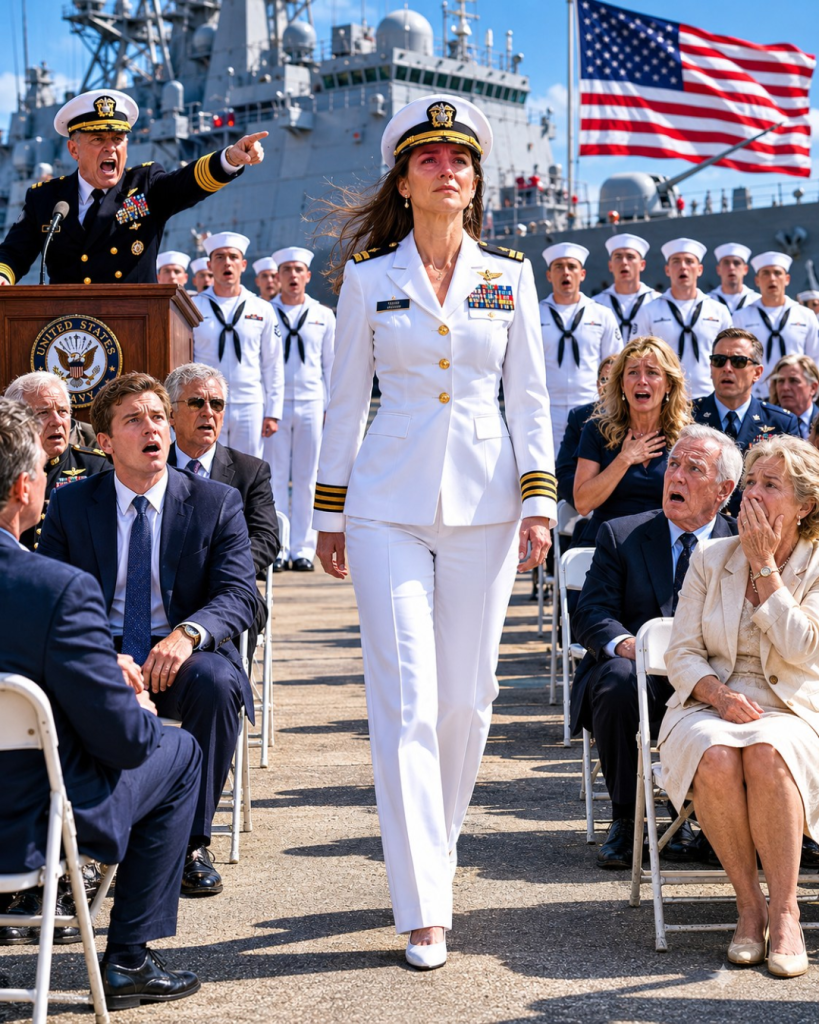
We entered the main courtyard together, passing rows of seated officers, midshipmen, civilian officials, and invited families turning toward us.
The master of ceremonies stepped to the microphone, requesting all guests rise for the arrival of Rear Admiral Sophia Stone.
Hundreds of people stood beneath the white Maryland sky, while my family remained stranded in an aisle they suddenly did not deserve.
I walked toward the platform, each step carrying years of excluded dinners, skipped ceremonies, unanswered invitations, and insults swallowed for national security.
At the front waited the Secretary of the Navy, two admirals, my former command master chief, and a folded flag display.
The secretary shook my hand warmly, thanked me for patience at the gate, then glanced toward the rear where my family stood.
“Your guest list appeared strangely incomplete,” she said softly, “so we added seats once Admiral Ward explained the misunderstanding.”
I understood her kindness immediately; she had chosen not to make my family’s humiliation part of the formal record unless necessary.
There was power in that restraint, the kind my family mistook for weakness because they never practiced it themselves.
The ceremony began with colors, invocation, and announcements honoring sailors serving abroad in places families might never fully comprehend.
Then Admiral Ward stepped to the podium, unfolded a citation, and looked toward me with the solemnity secrecy had postponed.
“For fifteen years,” he began, “Rear Admiral Stone served where successful work often becomes visible only through disasters that never occur.”
He described intelligence coordination without exposing protected methods, speaking of captured civilians, disrupted attacks, escorted convoys, and sailors returned alive.
He spoke of the night at the offshore platform, calling it one of the most precise maritime recovery operations he witnessed.
The courtyard remained completely silent, except for wind pulling lightly at flags and my mother’s sudden broken sob somewhere behind me.
Ward said my recommendations saved lives, protected allied trust, and shaped intelligence doctrine now taught across naval operational communities.
Then the secretary opened a velvet case containing the Navy Distinguished Service Medal, its ribbon bright against the waiting uniform.
“For exceptionally meritorious service,” she read, “and for leadership whose consequences reached far beyond the visibility of public recognition.”
As she pinned the medal onto my dress uniform, applause rose through the courtyard, gathering strength until it felt like weather.
I did not turn toward Marcus, yet I could feel his carefully built identity shrinking beneath every word once withheld from him.
When applause faded, Ward announced my assumption of command over a newly unified maritime intelligence operations directorate headquartered in Norfolk.
That was the reason the ceremony existed, not Marcus’s routine assignment, not Father’s legacy, and certainly not family photographs.
I approached the podium for remarks, my prepared speech resting beneath one hand while another truth waited heavier inside me.
I thanked sailors, analysts, mentors, families of deployed personnel, and the midshipmen preparing to serve beyond public applause.
Then I looked beyond the official seats toward four people whose absence shaped me almost as completely as the Navy did.
“Many forms of service are quiet,” I said. “They occur behind screens, below decks, beneath oceans, and outside easy recognition.”
“The people doing that work should never confuse invisibility with insignificance, especially when others choose not to understand their contribution.”
No names were spoken, but Marcus visibly looked down, while Father stiffened beneath a sentence finally impossible to dismiss.
“I learned early that belonging cannot depend upon whether others make room for you at a gate or table.”
“Sometimes duty means walking forward anyway, because the mission, the people beside you, and your own dignity deserve that courage.”
A second wave of applause arrived, slower and deeper, and I finished without allowing emotion to damage the clarity of my salute.
After the formalities, officers gathered near reception tables while my family remained apart, isolated without anyone instructing them to be.
Admiral Ward intercepted Marcus first, requesting a private conversation regarding misrepresentation of ceremonial purpose and unauthorized family-access submissions.
Marcus protested immediately, saying leaving my name off his family list represented personal tension, not an official integrity issue whatsoever.
Ward replied that submitting false information to installation access personnel became official the moment security relied upon it at a checkpoint.
My brother’s expression changed then, because career consequences finally reached the place empathy had failed to touch within him.
Paige stepped away quietly, holding her handbag against her ribs, suddenly unwilling to share proximity with his unraveling explanations.
Father approached me near the memorial fountain, no longer standing as Captain Richard Stone, only as an aging man.
“I did not know,” he said, and the words sounded inadequate even before the wind carried them between us.
“You did not ask,” I replied, because sometimes the shortest truth contains every missed birthday, invitation, and proud opportunity.
He closed his eyes, accepting the sentence like an impact he recognized himself as having earned long before that day.
“I thought Marcus was following my path,” he whispered. “I thought you had chosen something safer because I pushed too hard.”
“No,” I answered. “You decided my achievements must be smaller because seeing them clearly would have required seeing me clearly.”
Mother arrived beside him, weeping now, apologizing for believing Marcus whenever he described my career as insignificant, administrative, and lonely.
I asked whether she ever considered telephoning me directly, attending one ceremony, or opening one envelope before choosing his version.
Her tears became quieter, and that silence told me she understood love had required almost nothing she had actually offered.
Marcus joined us despite Ward’s aide requesting he remain nearby, his face flushed with panic and anger poorly concealed.
He told me I enjoyed this, that I could have corrected everything sooner, and that family humiliation was unnecessarily cruel.
I looked at the brother my parents celebrated without condition, finally hearing the fear beneath every joke he ever sharpened.
“You did not fear that I was failing,” I said. “You feared that I was succeeding somewhere you could not dominate.”
His mouth tightened, but no denial arrived, because truth can become unbearable precisely when it sounds completely familiar.
Paige removed her engagement ring from her right hand, not her wedding ring, then corrected herself with shaking fingers.
“I cannot stand here while you blame her for the lie you made me live inside,” she told Marcus.
He reached for her, but she stepped toward Mother instead, crying as though marriage suddenly contained a stranger.
Admiral Ward’s aide returned, informing Marcus that his command had been notified and he would provide a written statement immediately.
My brother glared at me then, still searching for the enemy easiest to accuse rather than the choices hardest to confront.
I felt no triumph, only the heavy sadness of realizing he would rather lose everything than admit I never stole it.
The reception continued around us with polite movement, coffee cups, handshakes, photographs, and conversations lowered by obvious respect.
My former command master chief approached wearing retirement ribbons and a grin I remembered from difficult mornings aboard a carrier.
“Admiral,” Chief Morales said, “I heard somebody forgot to put your name on the list, so we fixed your table.”
He pointed toward a reception table filled with analysts, sailors, aviators, and interpreters whose faces carried years of shared missions.
There was an empty chair between them with my name printed clearly across a white card beneath the Navy seal.
For one terrible, beautiful moment, I could not speak, because belonging arrived so simply where my family made it impossible.
Morales hugged me carefully, ignoring formal expectations, then told everyone our admiral needed coffee before she started reorganizing the entire Navy.
Their laughter felt different from Marcus’s laughter, warm rather than weaponized, because affection never requires somebody else to shrink.
I sat among them while my relatives remained across the courtyard, finally unable to replace reality with their preferred family story.
Two days later, Marcus received formal notice of an inquiry concerning false access information and conduct inconsistent with officer integrity requirements.
His career did not end that morning, but the fast-tracked assignment he advertised proudly was removed pending review and counseling.
Paige separated from him temporarily, telling Mother she needed time to decide whether confidence could ever again resemble honesty.
My parents returned home without photographs beside the podium, without introductions to admirals, and without the son they expected honoring them.
Father wrote first, three pages without excuses, admitting his pride in Marcus became cruelty whenever my achievements complicated his assumptions.
Mother wrote later, beginning with apologies, then listing memories she wished she had attended before finally stopping herself.
I answered neither immediately, because apology is a beginning only when the wounded person receives space to decide what follows.
Weeks later, my command office opened in Norfolk, occupying several floors above secure operations rooms where young analysts worked without recognition.
I kept the reception place card inside my desk, beside the medal citation and a weathered photograph of my Academy class.
Whenever a junior officer apologized for an invisible role, I told them hidden work remains honorable even when families understand only parades.
One afternoon, a young ensign remained after briefing, admitting her father considered cyber warfare less meaningful than her brother’s aviation career.
She said she worried her accomplishments would remain permanently invisible at every holiday table where family stories became rank competitions.
I handed her a seat beside my window overlooking ships moving slowly across Hampton Roads beneath a hard silver sky.
“Your family’s imagination does not establish the boundaries of your service,” I told her. “Neither does their applause determine your worth.”
Her eyes filled, and I recognized the child inside her still waiting at a gate where somebody forgot her name.
Months later, I agreed to meet my father at a quiet Annapolis coffee shop overlooking the river where my ceremony began.
He arrived early, wearing no captain’s ring, no academy tie, and none of the posture that once kept daughters distant.
“I should have looked for you at the gate,” he said, before coffee arrived or polite conversation offered escape.
I studied his lined face, remembering how he walked past me while Marcus laughed and a petty officer apologized helplessly.
“Yes,” I answered. “You should have looked for me long before there was a gate.”
He nodded, crying quietly, and for once did not ask forgiveness before allowing the harm its full legitimate weight.
Mother required more time, because she still spoke about missing information before speaking honestly about years of deliberate emotional absence.
Marcus never apologized directly, though his written statement admitted he knowingly minimized my rank and omitted my name from access requests.
Perhaps that was as close to truth as he could stand without the entire identity he borrowed from Father finally collapsing.
I stopped waiting for more, because healing should not depend upon apologies from people still negotiating with their own envy.
The Navy eventually promoted me again, and at the ceremony, my front row held Chief Morales, analysts, sailors, and Paige.
Father attended quietly in the second row, after asking permission, and saluted only after everyone else rose around him.
I accepted that gesture without rewriting history, because change can be acknowledged without pretending it arrived early enough to prevent wounds.
Afterward, he told me my grandfather would have been proud, and I answered that I already knew he would have.
Outside, the Severn River moved beneath winter light, indifferent to old betrayals, changing ranks, and families struggling to become honest.
I remembered the first morning, my name absent from the tablet while Marcus walked past believing exclusion proved superiority.
He had assumed a chair inside the ceremony mattered more than the woman standing quietly outside its gates in cold wind.
But the Navy had not forgotten me, the mission had not forgotten me, and the lives protected by hidden work had not forgotten.
When Admiral Ward saluted, he did not give me an identity my family withheld; he simply recognized one they refused seeing.
I was Rear Admiral Sophia Stone before the security barrier opened, before my father turned around, before Marcus nearly stopped breathing.
And once those gates finally parted, I never again mistook somebody else’s failure to welcome me for evidence I did not belong.