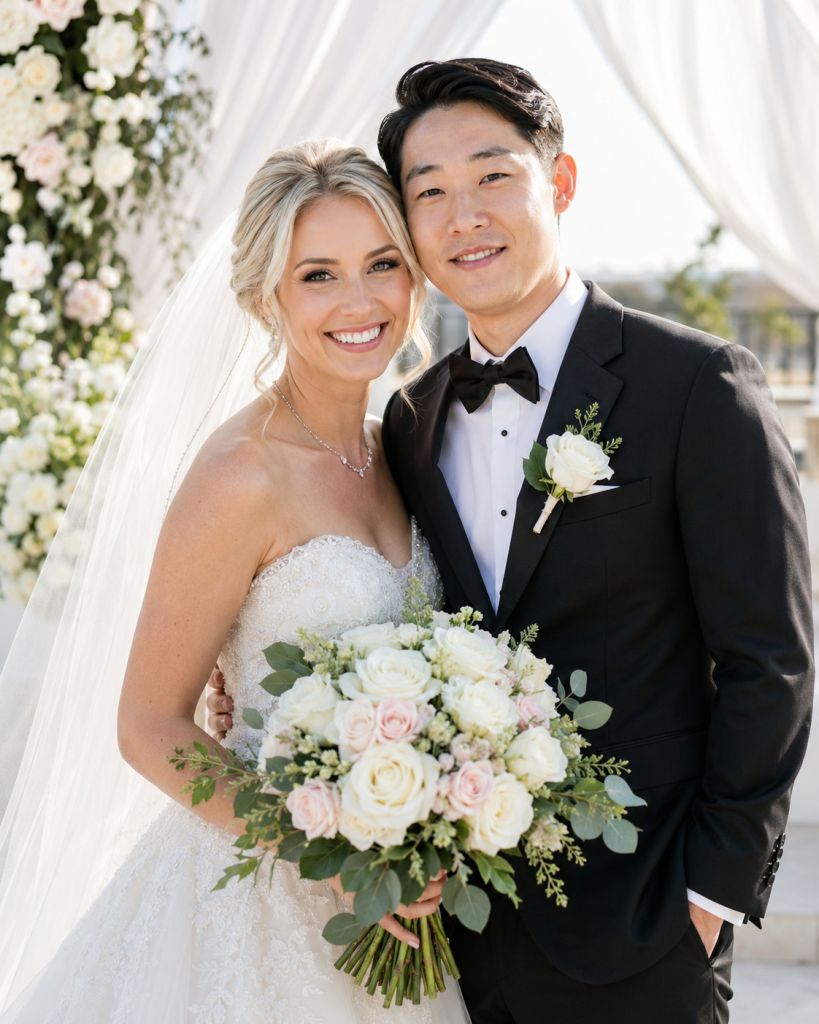
My daughter left for South Korea after marrying a Korean man at 21. For twelve years, she never came home—only sent me $80,000 every year. This Christmas, I showed up unannounced, and what I found behind her front door left me speechless.
- PART 1: The Daughter I Lost to Distance
- PART 2: The House With No Husband and the Secret Hidden Upstairs
- PART 3: The Day I Bought My Daughter’s Freedom
PART 1: The Daughter I Lost to Distance
My name is Theresa Collins. I’m sixty-three years old, and for most of my life, it was just me and my daughter against the world.
I became a widow when Mary Lou was still very young. Losing my husband was devastating, but I never allowed myself the luxury of falling apart. My daughter needed a parent, and I was all she had. So I worked long hours, stretched every dollar, and did everything I could to give her opportunities I never had.
She was a remarkable child.
Bright.
Kind.
Determined.
The kind of girl teachers remembered years later.
The kind of girl who could walk into a room and make people smile without even trying.
As she grew older, everyone told me the same thing.
“That girl is going places.”
I believed it too.
I just never imagined those places would take her so far away from me.
Mary Lou was twenty-one when she met Kang Jun.
He was Korean.
Successful.
Sophisticated.
And nearly twenty years older than she was.
I tried to keep an open mind, but something about the situation worried me from the beginning.
It wasn’t his nationality.
It wasn’t even his wealth.
It was the age difference.
The imbalance.
The feeling that my daughter was entering a world she didn’t fully understand.
We argued more during those months than we ever had before.
Not because she stopped loving me.
Because she was determined.
And when Mary Lou made up her mind, there was very little anyone could do to change it.
I saw that same stubbornness she inherited from her father.
When she told me they planned to marry, I begged her to slow down.
To think.
To wait.
But love has a way of making warnings sound like obstacles.
And every concern I raised only seemed to push her closer toward the decision she had already made.
The wedding was small.
Simple.
Beautiful.
I smiled in every photograph.
But inside, I was terrified.
Not because I thought she was making a mistake.
Because I knew that once she boarded that plane, everything would change.
A month later, I drove her to the airport.
I can still remember every detail.
The smell of coffee from a nearby café.
The overhead announcements.
The way she squeezed my hand while we stood near security.
When they called her flight, she hugged me tightly.
Then tighter.
Neither of us wanted to let go.
“I’ll come home soon, Mom.”
She was crying.
So was I.
But I smiled anyway.
Because that’s what mothers do.
We smile while our hearts break.
I watched until she disappeared around the corner.
Then I sat in my car and cried the entire drive home.
At first, I told myself she would be back within a year or two.
Maybe three.
Families do this all the time.
Children move away.
Life happens.
Then they return.
But the years passed.
And she didn’t come back.
One year.
Then two.
Then five.
At first, she called regularly.
We talked about ordinary things.
The weather.
Food.
Her new neighborhood.
The language she was learning.
The places she visited.
Then the calls became shorter.
Less frequent.
More distant.
Eventually, something strange started happening.
Every year, on exactly the same date, money appeared in my account.
Eighty thousand dollars.
Every single year.
Not seventy.
Not ninety.
Always eighty thousand.
And every transfer included the same message.
“Mom, take care of yourself. I’m doing well.”
That word haunted me.
Well.
Because the people who are truly happy rarely need to repeat it.
Whenever I asked when she might visit, she always had a reason.
Work.
Schedules.
Responsibilities.
Travel restrictions.
Something.
Always something.
Years later, we finally managed a video call.
I remember sitting in my kitchen preparing for it.
I cleaned the house twice.
Changed my blouse three times.
Practiced smiling in the mirror.
When her face finally appeared on the screen, my heart stopped.
She was still beautiful.
Still my daughter.
Still the little girl I raised.
But something was different.
The light in her eyes had faded.
She smiled.
But the smile never reached her eyes.
She seemed tired.
Exhausted.
Like someone carrying a burden she refused to share.
I asked the question that had lived in my heart for years.
“Why don’t you come home?”
Silence.
For several seconds she said nothing.
Then she forced a smile.
“I’m very busy, Mom.”
That was all.
And for the first time in my life, I was afraid to ask another question.
Because sometimes mothers become cowards.
Not because we’re weak.
Because we’re terrified of hearing an answer we can’t survive.
So I stopped asking.
The years continued.
The money continued.
Life continued.
My house improved.
Neighbors told me how fortunate I was.
People said my daughter was taking wonderful care of me.
Maybe they were right.
But every Christmas, I still set an extra place at the table.
Every Thanksgiving, I cooked her favorite dishes.
Every birthday, I stared at old photographs.
And every night, I ate alone.
Twelve years.
Twelve years without hugging my daughter.
Without hearing her laugh in person.
Without knowing if she was truly happy.
One morning, I woke up and realized something.
If I waited any longer, I might spend the rest of my life wondering.
So I made a decision.
The craziest decision I’d ever made.
At sixty-three years old, I bought my first international plane ticket.
I didn’t tell Mary Lou.
I didn’t ask permission.
I didn’t announce my plans.
With trembling hands and a heart full of fear, I packed a suitcase.
Because after twelve years, I was finally going to find my daughter.
PART 2: The House With No Husband and the Secret Hidden Upstairs
The flight to South Korea felt longer than any journey I had ever taken.
Part of it was the distance.
Most of it was fear.
For twelve years, I had imagined seeing my daughter again. In some versions of that dream, she greeted me at the airport with tears and laughter. In others, she introduced me to children I had never met. Sometimes I imagined a busy life, a loving husband, and a family too occupied to travel.
What I never imagined was the feeling waiting for me when I finally arrived.
The taxi ride took nearly an hour.
The driver followed the address Mary Lou had given me years earlier.
As the city disappeared behind us, neighborhoods became quieter.
More isolated.
More expensive.
Yet strangely empty.
When we finally stopped, I looked through the window and felt an immediate sense of unease.
The house was beautiful.
Large.
Modern.
Perfectly maintained.
But it didn’t feel lived in.
No children’s toys.
No bicycles.
No signs of neighbors visiting.
No flowers.
No laughter.
No life.
Just silence.
The driver helped me with my suitcase.
I thanked him and stood alone on the sidewalk staring at the property.
For several minutes, I couldn’t move.
I had waited twelve years for this moment.
Then I finally walked toward the front door.
I knocked.
Nothing.
I waited.
Then knocked again.
Still nothing.
The curtains didn’t move.
No footsteps approached.
No voices answered.
A knot formed in my stomach.
Maybe she wasn’t home.
Maybe she was working.
Maybe—
I reached for the handle.
The door opened.
Unlocked.
A strange chill ran through me.
Slowly, I stepped inside.
The interior was spotless.
Almost unnaturally so.
Every surface looked perfect.
Every object seemed carefully arranged.
It felt less like a home and more like a display room.
I walked through the kitchen first.
The refrigerator contained very little food.
A few containers.
Some bottled water.
Basic ingredients.
Nothing that suggested family dinners or shared meals.
The dining table had only one chair regularly used.
I could tell from the wear pattern.
One chair.
Not two.
Not three.
One.
My heart sank.
I moved into the living room.
Again, the same feeling.
No family photographs.
No wedding pictures.
No signs of a husband.
Nothing.
I climbed the staircase slowly.
Every step made me more nervous.
At the top floor, three rooms branched off from the hallway.
The first appeared to be a bedroom.
Women’s clothing filled the closet.
Mary Lou’s clothing.
The second looked like a small office.
A desk.
A laptop.
Several filing cabinets.
Almost unused.
Then I reached the third room.
The final door stood partially open.
Something felt wrong immediately.
Very wrong.
I pushed the door wider.
And my legs nearly gave out beneath me.
Boxes.
Dozens of boxes.
Stacked from floor to ceiling.
Every one filled with cash.
Bundles upon bundles of money.
Thousands.
Hundreds of thousands.
Perhaps millions.
I stared in disbelief.
Unable to understand what I was seeing.
My mind raced.
Where was her husband?
Why was there so much cash?
What kind of life was she living?
Nothing made sense.
Then I heard the front door downstairs open.
A voice echoed through the house.
One word.
“Mom.”
I froze.
I would have recognized that voice anywhere.
Even after twelve years.
I ran.
Down the stairs.
Through the hallway.
Toward the sound.
And there she was.
My daughter.
Older.
Thinner.
More tired than I had ever seen her.
But still my daughter.
The moment our eyes met, neither of us spoke.
We simply held each other.
Years of loneliness.
Years of worry.
Years of unanswered questions.
All collapsing into one embrace.
Eventually I pulled back enough to look at her face.
Up close, the changes were impossible to miss.
The exhaustion.
The sadness.
The weight she carried behind her eyes.
My heart broke.
“What happened to you?”
Her smile trembled.
“Mom…”
Then she looked away.
I glanced upstairs.
Toward the room full of money.
Then back at her.
“What kind of life is this?”
The question hung between us.
For several seconds she said nothing.
Then she whispered the words that shattered everything I believed.
“Mom…”
A tear rolled down her cheek.
“I never got married.”
The world stopped.
I stared at her.
Unable to process what she had said.
“What?”
“I never married Kang Jun.”
The room spun.
Every memory from the past twelve years suddenly felt uncertain.
The wedding.
The photographs.
The move.
The money.
All of it.
“What are you talking about?”
Mary Lou sat down slowly.
As though she no longer had the strength to remain standing.
Then she told me the truth.
There had never been a marriage.
No husband.
No family.
No happy life waiting on the other side of the ocean.
Instead, there had been a contract.
A carefully designed agreement that promised enormous payments in exchange for twelve years of her life.
Twelve years.
Twelve years of isolation.
Twelve years of control.
Twelve years of sacrifice.
The money she sent me wasn’t from a wealthy husband.
She earned every dollar herself.
And every payment cost her another piece of her freedom.
I felt physically sick.
The cash upstairs.
The empty house.
The loneliness.
The sadness in her eyes.
Suddenly everything made sense.
“There are two years left.”
Her voice cracked.
“If I leave now, I owe almost a million dollars.”
I looked at my daughter.
Then at the empty house surrounding us.
And for the first time in twelve years, I finally understood why she never came home.
Because she couldn’t.
PART 3: The Day I Bought My Daughter’s Freedom
That night, for the first time in twelve years, my daughter and I slept under the same roof.
Neither of us slept much.
There were too many lost years between us.
Too many questions.
Too much pain that had never been spoken aloud.
We sat together in the kitchen until almost sunrise, drinking tea and talking about everything we had missed.
At one point, I looked at her and asked the question that had been haunting me since I arrived.
“Were you happy?”
Mary Lou stared into her cup.
For a long time she said nothing.
Then she answered honestly.
“No.”
The single word hurt more than anything else she had told me.
Not because it surprised me.
Because I had known.
Deep down, I had always known.
A mother knows when something isn’t right.
Even from thousands of miles away.
“I thought I was helping you.”
Her voice trembled.
“I thought if I sent enough money, you wouldn’t struggle.”
I reached across the table and took her hand.
“Sweetheart, I never needed the money.”
Tears filled her eyes.
“I know that now.”
For years, she had convinced herself she was sacrificing her freedom for me.
That every lonely holiday.
Every missed birthday.
Every year spent trapped inside a life she never wanted.
Was somehow worth it.
Because she believed she was protecting me.
The realization broke my heart.
All those years.
All that suffering.
And neither of us had been honest about what we truly needed.
I didn’t need financial security.
I needed my daughter.
The next morning, I made a decision.
One that shocked Mary Lou.
“I’m ending this.”
She looked up immediately.
“What?”
“This contract.”
Her face paled.
“Mom, you don’t understand.”
“No.”
I squeezed her hand.
“I understand perfectly.”
Then I looked around the empty house.
At the expensive furniture.
The spotless floors.
The silence.
And I realized something.
This place wasn’t a home.
It was a cage.
A beautiful cage.
But a cage nonetheless.
Over the next several days, I began selling everything I owned back in the United States.
My house.
My savings.
My investments.
Everything.
Friends thought I had lost my mind.
Maybe I had.
But some things are worth more than money.
And my daughter’s life was one of them.
When everything was finished, we gathered the funds.
Then we scheduled a meeting with Kang Jun.
For twelve years, he had been the shadow hanging over our lives.
The man who controlled the contract.
The man whose name I had blamed for taking my daughter away.
Part of me expected a confrontation.
Anger.
Threats.
Arguments.
Instead, the meeting was strangely quiet.
Kang Jun sat across from us in a sleek office overlooking the city skyline.
Older now.
Tired.
More fragile than I expected.
Mary Lou remained beside me.
Not behind me.
Beside me.
For the first time in years, she looked like someone reclaiming her own life.
I placed the documents on the table.
Then the money.
“It’s over.”
Those were the only words I spoke.
Kang Jun stared at the paperwork.
Then at Mary Lou.
For several long moments, nobody moved.
Finally, he sighed.
A deep, exhausted sigh.
And nodded.
“It’s over.”
No drama.
No shouting.
No negotiations.
Just acceptance.
Perhaps he knew he had held on too long.
Perhaps he understood that keeping someone physically close doesn’t mean they belong to you.
Whatever the reason, he signed.
And just like that…
Twelve years ended.
When we walked out of the building, the sun was shining brightly over Seoul.
Mary Lou stopped on the sidewalk.
Closed her eyes.
Then took the deepest breath I had ever seen her take.
When she opened her eyes, tears were running down her cheeks.
“I’m finally free.”
Three simple words.
But they were worth every sacrifice.
Every flight.
Every dollar.
Every difficult decision.
A month later, we returned to the United States together.
Neither of us knew exactly what came next.
We only knew we wanted a different life.
A real life.
Eventually, we rented a small building near our hometown.
Nothing fancy.
Nothing expensive.
Just a modest restaurant.
A few wooden tables.
A handwritten menu.
Fresh soup every morning.
Homemade bread.
Simple meals.
The first customer walked in during our opening week.
He ordered soup.
Finished every spoonful.
Then smiled.
“This is wonderful.”
For the first time in over a decade, I saw something return to my daughter’s eyes.
Light.
Real light.
Months passed.
The restaurant slowly became part of the community.
Truck drivers stopped by before dawn.
Office workers came during lunch.
Students gathered after class.
Retirees stayed for coffee and conversation.
People weren’t just buying food.
They were finding comfort.
And somehow, so were we.
Eventually, customers started giving the restaurant a nickname.
“The Second Life.”
At first, we laughed.
Then we realized it was perfect.
Because that’s exactly what it had become.
One afternoon, I watched Mary Lou standing in the sunlight outside the restaurant.
No rush.
No anxiety.
No fear.
Just peace.
She turned toward me and smiled.
A real smile.
The one I thought I had lost forever.
“Mom?”
“Yes?”
“If you hadn’t come to find me…”
Her voice softened.
“I think I’d still be there.”
I walked over and hugged her.
No speeches.
No grand lessons.
Just gratitude.
Because sometimes the greatest gift a parent can give isn’t money.
It isn’t advice.
It isn’t protection.
Sometimes it’s simply refusing to stop looking for the person they love.
For twelve years, I believed my daughter had built a happy life across the ocean.
The truth was far different.
But when I finally knocked on that door in South Korea, I didn’t just find Mary Lou.
I reminded her that she still had a home.
She still had a family.
And she still had a way back.
Life doesn’t always give us a happy beginning.
Sometimes it gives us loss, mistakes, loneliness, and years we can never recover.
But every once in a while, life gives us something else.
A second chance.
And in our little restaurant, serving hot soup to strangers and sharing meals together at the end of each day, we finally learned what happiness really looked like.
It wasn’t wealth.
It wasn’t sacrifice.
It wasn’t survival.
It was simply being together.