
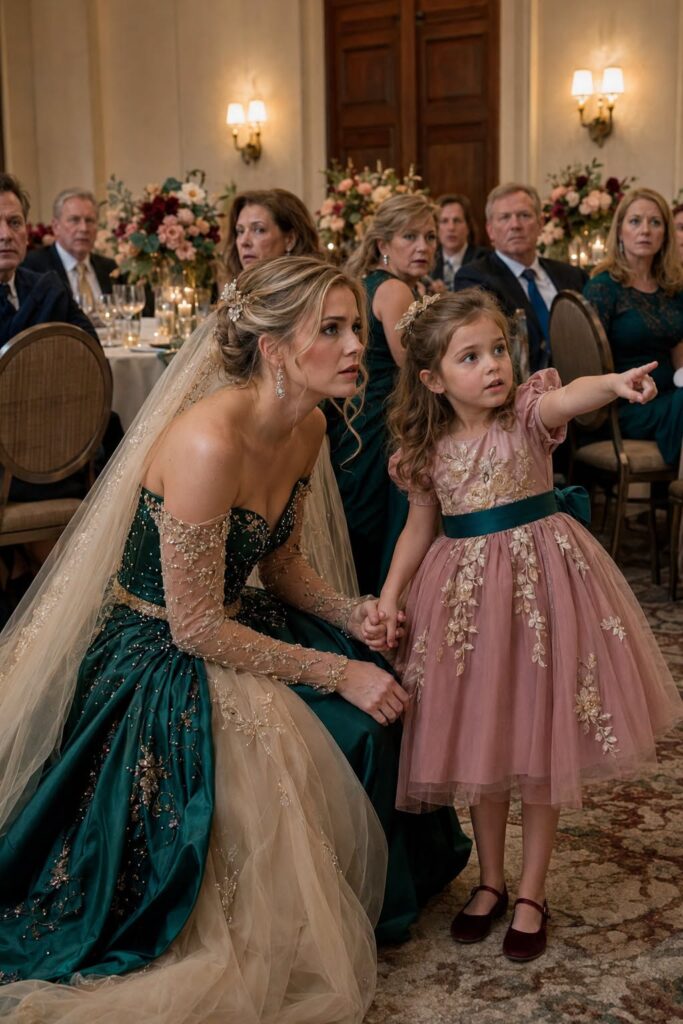
My daughter tugged on my wedding

My daughter tugged on my wedding
The Wedding I Stopped With One Sentence
Part 1
My daughter was five, and I had spent eight months teaching her to call Evan by his name.
Not Dad.
Not Daddy.
Just Evan.
Her real father had died when she was two, and I never wanted Sophie to feel as though a man could simply step into that place because I wore a white dress and everyone clapped.
But on my wedding day, while two hundred guests watched me smile beside the man I thought had saved us, Sophie tugged hard on the lace at my hip.
“Mommy,” she whispered.
I bent down carefully, trying not to crush my veil.
Her flower crown had slipped sideways. One white shoe was missing. There was frosting on the front of her little dress, and her eyes were so serious that the music around us suddenly felt far away.
“What is it, baby?”
She looked across the ballroom.
Evan stood near the wedding cake, laughing with my older brother Peter. Both held champagne flutes like they already owned the room.
Sophie’s fingers tightened around my dress.
“I saw new Daddy and Uncle Peter do something bad.”
The jazz band kept playing.
The guests kept eating.
Someone near the dance floor laughed at something I could not hear.
Evan lifted his glass toward a group of his colleagues near the head table.
My smile froze.
“What do you mean?”
Sophie pressed her face against my skirt.
“I was told not to tell. But you said I have to tell you everything.”
“That’s right, honey.”
I lowered my voice.
“So tell me what happened.”
Her mouth trembled.
“I went looking for my other shoe. I saw Uncle Peter and Evan in the little room by the kitchen.”
“The service hallway?”
She nodded.
“They had Daddy’s blue box.”
Every sound in the ballroom disappeared.
Not literally.
The music still played. Glasses still touched. Someone’s chair scraped against the polished floor.
But inside my head, there was only one sentence.
Daddy’s blue box.
The box belonged to my late husband, Michael.
It was a small fireproof case, navy blue with a silver lock. Michael kept it in the top cabinet of the study at our home. It held copies of his will, Sophie’s trust documents, the original ownership certificates from Hartwell Materials, and a handwritten letter he had left for Sophie when she was old enough to read it.
No one should have had that box.
Not Peter.
Not Evan.
Not anyone except me.
“What did they do with it?” I asked.
Sophie lifted her face.
“Uncle Peter opened it. Evan took Daddy’s papers with the gold tree on top.”
The Hartwell Materials ownership documents had a gold oak tree stamped in the corner.
My stomach turned.
“And then?”
“Uncle Peter said, ‘Once Lena signs tonight, we own the rest.’”
I stared at her.
She repeated the words exactly.
Children did not understand the meaning of certain sentences.
But they remembered the sound of adults saying them.
“Did Evan say anything?”
Sophie nodded.
“He said, ‘She’ll sign it after the first dance. She thinks it’s a sweet surprise.’”
My heart began pounding hard enough that I could feel it beneath the bodice of my dress.
For the last three months, Evan had been urging me to “simplify” the financial arrangements Michael had made for Sophie. He claimed the trust was too complicated. He said Peter was overwhelmed as co-trustee. He suggested we create a “family legacy plan” after the wedding.
Every time I asked for details, he smiled and told me not to worry about paperwork on my wedding day.
I had mistaken that smile for kindness.
Across the ballroom, Peter noticed us.
His face changed first.
Not guilt.
Warning.
He touched Evan’s arm, and Evan turned toward me with that same careful expression he used whenever he wanted strangers to believe he was patient and gentle.
The man I had trusted to help me raise my daughter.
The man who had held me while I cried after Michael’s funeral.
The man who had said he would never try to replace Sophie’s father.
I stood slowly.
Sophie held my hand.
“Mommy,” she whispered, “are they in trouble?”
I looked at Evan.
Then Peter.
Then at the guests who had come to watch me begin what they thought was a new life.
“No,” I said softly.
“They are about to be honest.”
I walked toward the stage.
The band saw my face and stopped playing.
The photographer lowered his camera.
I reached for the microphone beside the champagne tower, turned to face two hundred guests, and took one slow breath.
Then I said the sentence that made Peter drop his glass.
“Before anyone leaves, I need Evan Cole and my brother Peter to bring the black case they hid in the service hallway to this table—because the marriage license will not be signed until every page they stole from my daughter is opened in front of all of you.”
Part 2
The champagne flute hit the marble floor with a sharp crack.
For one second, no one moved.
Then the ballroom broke into whispers.
The kind that spread fast and low, moving from table to table like wind through dry leaves.
Evan stared at me from beside the cake.
Peter had gone completely white.
My mother stood near the dance floor with both hands pressed against her necklace. She looked at me as though I had lost my mind.
“Lena,” she said, too loudly, “what are you doing?”
I looked at her.
“Protecting my daughter.”
Evan began walking toward the stage.
His face was calm, but I knew him well enough to see the small signs underneath. His jaw was tight. His shoulders were stiff. His right hand kept opening and closing at his side.
He had always believed control made him look powerful.
He did not understand that sometimes control was only fear wearing a suit.
“Sweetheart,” he said softly when he reached the stage. “Sophie misunderstood something.”
Sophie stepped closer to me.
Her little fingers wrapped around mine.
Evan noticed.
His eyes moved to her, and he smiled.
“Hey, Sophie. You know we were just looking at grown-up papers, right?”
She shook her head.
“You said I couldn’t tell Mommy.”
The entire room became still.
Evan’s smile fell apart.
Only slightly.
But enough.
Peter stepped forward from the crowd.
“Lena, don’t embarrass yourself,” he snapped. “The kid saw paperwork. That’s all.”
“Then bring it here,” I said.
“It isn’t yours.”
My voice stayed quiet.
“It was inside my home. It belongs to my late husband’s estate. It belongs to my daughter.”
Peter looked around at the guests.
At our cousins.
At his business friends.
At the church women Mom had invited.
He tried to laugh.
“You’re making a scene at your own wedding.”
“No,” I said. “You made the scene when you stole documents from my daughter’s trust.”
The event manager, a tall woman named Dana, stood near the kitchen entrance. I had hired her because she was organized, discreet, and impossible to intimidate.
“Dana,” I said, “please have one of your staff bring the black case from the service hallway. And call venue security.”
Evan stepped closer.
“Lena, this is insane.”
I looked at him.
“Is the case not there?”
He did not answer.
That was all I needed.
Dana nodded and disappeared through the kitchen doors.
My mother hurried toward the stage.
“Lena, please,” she whispered. “Think about Sophie. Think about what people will say.”
I looked down at my daughter.
Sophie was standing straight now, even though her flower crown was still crooked and one shoe was still missing.
“I am thinking about Sophie,” I said.
“You are scaring her.”
“No. They scared her. I am listening to her.”
My mother’s face tightened.
She had never liked it when I said things plainly.
She preferred the version of family where pain became “misunderstanding” and betrayal became “something we handle privately.”
But Michael’s death had taught me something.
Private was where dangerous things grew when nobody challenged them.
Evan lowered his voice.
“Can we please discuss this upstairs?”
“No.”
“Lena.”
“No.”
He stared at me, and I saw a flash of the man underneath the tenderness.
Not the man who had brought Sophie hot chocolate after nightmares.
Not the man who had held my coat when I came home from work.
The other man.
The one who believed he could decide what I deserved to know.
“Please,” he said, and this time his voice carried something close to anger. “Do not make me look like a criminal.”
I looked toward the kitchen doors.
“Then you should not have acted like one.”
Dana returned with a black leather document case.
A venue security officer walked behind her.
The case was still zipped.
Peter stared at it as though he could will it to disappear.
Dana placed it on the table in front of me.
“Would you like me to open it?” she asked.
“No,” I said.
I looked at Evan.
Then Peter.
“You open it.”
Neither man moved.
Sophie looked up at me.
“Mommy, that’s the case.”
I nodded.
“I know, baby.”
Then Peter took one step backward.
And ran.
Part 3
Peter did not get far.
He made it three steps across the dance floor before venue security caught his arm near the gift table.
The room erupted.
My aunt Margaret stood up so fast that her chair tipped backward. Someone near the bar gasped. A child began crying at one of the back tables.
My mother shouted Peter’s name.
Evan did not run.
That was his first mistake.
He stayed beside the stage, probably believing he could still talk his way through it. He had always been good with words. He was a financial consultant by profession, the kind of man who could sit across from a worried widow, lower his voice, and explain why signing something was “the responsible thing.”
He had done it to me for almost two years.
But he had never done it in front of two hundred witnesses.
The security officer brought Peter back toward the table.
“Sir,” he said, “you need to remain here until law enforcement arrives.”
“Law enforcement?” my mother cried. “This is a family issue.”
“No,” I said.
I touched the black document case.
“This stopped being a family issue when someone took legal documents from a child’s trust.”
Evan looked at me.
“Lena, I know you are upset, but there is no reason to involve police.”
“Then why did Peter run?”
He glanced toward my brother.
Peter’s face had become slick with sweat.
For a second, neither man spoke.
Then Evan tried a new expression.
Hurt.
He looked at Sophie.
“Sweetheart, did you see Uncle Peter put something in the case?”
Sophie shook her head.
“I saw you take Daddy’s papers.”
The words hit him harder than anything I could have said.
Evan’s lips pressed into a thin line.
He looked at me again.
“She’s five.”
“Yes,” I said. “And she told the truth.”
I unzipped the case.
Inside were three folders, a silver flash drive, and Michael’s blue fireproof box.
The box had been forced open.
The lock was bent.
My hands went cold when I saw it.
Michael had bought that box after Sophie was born. He said the world could take plenty from a person, but no one should be allowed to take their child’s future because the adults around her were careless.
I opened the first folder.
It contained copies of Sophie’s trust agreement.
The second folder contained something I had never seen before.
A proposed amendment to the trust.
At the top was a title in formal black letters:
Petition to Replace Surviving Parent as Sole Guardian and Co-Trustee.
My breath caught.
Below that were pages naming Peter as sole trustee and Evan as “financial oversight partner.”
The document claimed I had become emotionally unstable after Michael’s death and was “unable to manage the child’s long-term interests.”
I stared at the words until they blurred.
Evan had planned to convince people I was unfit.
At my wedding.
On a night designed to make me trust him.
Sophie tugged at my dress.
“Mommy?”
I took her into my arms.
“I’m here.”
The third folder contained a purchase agreement.
Hartwell Materials, the company Michael had built with his business partner, owned a small industrial property outside Atlanta. It was held partly in Sophie’s trust. Michael’s share was worth millions.
The purchase agreement showed that Evan’s private investment company, Cole Ridge Holdings, intended to buy Sophie’s trust interest for less than half its appraised value.
The buyer signature was Evan’s.
The approving trustee signature was Peter’s.
And at the bottom, waiting for me, was a blank line labeled:
Surviving Parent Consent.
My name had been typed beneath it.
All they needed was my signature.
My eyes moved to the silver flash drive.
Evan reached for it.
“Don’t,” he said sharply.
The change in his voice made several guests gasp.
I looked at him.
“What is on this?”
“Nothing relevant.”
“Then you will not mind if we find out.”
He stepped toward me.
The security officer moved between us.
And for the first time that night, Evan looked afraid.
Part 4
The police arrived before the cake was cut.
Two officers entered through the ballroom doors while guests stood pressed against tables, phones lowered, faces pale.
I hated the sight of it.
I hated that Sophie was seeing uniforms at what was supposed to be a celebration.
But I hated something else more.
The idea that I would teach my daughter to stay quiet because adults were uncomfortable with the truth.
Officer Ramirez took the report first.
I explained about the box, the trust documents, the proposed guardianship petition, and the purchase agreement.
Evan’s attorney was called.
Peter demanded to call his wife.
My mother cried in the corner near the Christmas-white centerpieces, repeating, “This cannot be happening.”
But it was happening.
And every page in that black case made it worse.
The flash drive contained financial spreadsheets.
At first, the names and numbers meant little to me. Then I saw a series of transfers from Hartwell Materials into companies I had never heard of.
Pine State Consulting.
Ridgeway Events.
Blue Harbor Leasing.
Each company had a connection to Peter or Evan.
One was registered to Peter’s wife.
Another listed Evan’s business partner.
A third paid for an expensive lake house I had once been told belonged to a client.
The transfers went back fourteen months.
Before Evan proposed.
Before he moved into our home.
Before he began telling Sophie that he would “always take care of us.”
I felt sick.
He had not fallen in love with a widow and her daughter.
He had studied an opportunity.
Officer Ramirez asked Evan whether he had authorization to possess the documents.
Evan looked directly at me when he answered.
“I was helping Lena organize the estate.”
“No,” I said. “You were hiding it.”
“Lena, please.”
“You made copies of trust documents that you were not authorized to access.”
“I was trying to protect you.”
“By calling me emotionally unstable?”
His face hardened.
“You have been struggling.”
The room reacted all at once.
My mother covered her mouth.
My cousin Jessica whispered, “Oh my God.”
Evan went on.
“Michael’s death destroyed you. You have not been yourself. You barely leave the house unless you’re working. Sophie needs stability.”
Sophie clung to my waist.
I looked at him for a long moment.
Then I said, “You came into my life when I was grieving. You held my hand while I learned to sleep alone. You watched me fight to give my daughter a normal childhood. And while I trusted you, you built a file to use my grief against me.”
He looked away.
That was the moment the room turned.
Not because everyone suddenly knew every fact.
But because they saw who he was when he was challenged.
The gentle man disappeared.
The protector disappeared.
All that remained was a man angry that his plan had been interrupted by a five-year-old girl in a flower crown.
The officers did not arrest them that night. Not immediately.
But they took statements.
They photographed the documents.
They collected the case and flash drive as evidence.
And they instructed Evan and Peter not to leave the county.
As guests began gathering coats, Evan stood near the ballroom doors.
He looked at me with an expression I had never seen before.
Not regret.
Not love.
Hatred.
“You are going to regret humiliating me,” he said.
I held Sophie closer.
“No,” I replied. “You are going to regret underestimating her.”
Part 5
The wedding license remained unsigned.
That mattered more to me than I could explain.
The ceremony had happened.
The flowers had been arranged.
The vows had been spoken.
But the legal document that would have tied me to Evan sat untouched in the bridal suite, still waiting beside a silver pen.
Dana brought it to me before we left.
“Do you want me to destroy it?” she asked.
I looked at the paper.
At Evan’s name.
At mine.
At the blank signature lines.
“No,” I said. “Keep it for the record.”
I wanted proof of how close I had come to giving my life to a man who had planned to take my daughter’s future.
Sophie and I left the venue through a side entrance.
My maid of honor, Tessa, drove us home because my hands were shaking too badly to hold the steering wheel.
Sophie sat in the back seat, clutching her stuffed rabbit.
For twenty minutes, she said nothing.
Then she asked, “Mommy, did I ruin your wedding?”
The question broke something open inside me.
I turned around in my seat.
“No, baby.”
“But everyone was sad.”
“Some people were sad because they learned something bad. That is not your fault.”
“I told because you said secrets that make you scared are not good secrets.”
“That’s right.”
“Are you mad at Evan?”
I looked out at the passing streetlights.
“I am disappointed in Evan.”
“Is he my daddy now?”
“No.”
“Was he ever?”
I swallowed.
“No. He was someone I hoped would be kind to us.”
Sophie considered that.
“Daddy Michael was kind.”
“Yes.”
“He didn’t make secrets.”
“No, sweetheart. He didn’t.”
When we got home, I walked through the front door and saw the life Evan had quietly made himself part of.
His coat hung beside mine.
His shoes sat near the mat.
A framed photo of him and Sophie at the zoo rested on the hallway table.
I wanted to throw everything into a box and drag it to the curb.
Instead, I called Tessa, Natalie Park from Michael’s estate office, and a lawyer named Camille Reed whom Natalie recommended.
By midnight, Evan’s belongings were placed in sealed storage boxes.
The locks were changed the next morning.
Camille came to my kitchen with a legal pad, a calm voice, and a stack of questions.
“Did Peter have legitimate access to any trust documents?” she asked.
“Only as co-trustee, with my participation.”
“Did Evan have authority?”
“No.”
“Did you ever authorize a guardianship petition?”
“No.”
“Did you sign the purchase agreement?”
“No.”
“Did you know Cole Ridge Holdings intended to acquire Sophie’s interest in Hartwell Materials?”
“No.”
Camille wrote for several minutes.
Then she looked at me.
“Lena, this looks like a coordinated attempt to gain control of your daughter’s trust and sell a major asset below value. The estate documents and financial records may reveal more.”
“How much more?”
“I do not know yet.”
That was the hardest answer.
Not knowing.
Because once you have been betrayed, your mind begins searching every memory for warning signs.
Every dinner Evan canceled.
Every time Peter asked about the company.
Every conversation where they told me I was too stressed to understand financial details.
I started to see everything differently.
Evan had always pushed me to use his accountant.
Peter had always offered to “take paperwork off my hands.”
They had encouraged me to sell the industrial property because “it was too much responsibility for a single mother.”
They had called the trust too complicated.
They had called me tired.
They had called me grieving.
They had used every normal consequence of loss as evidence that I should give up control.
At 2:07 in the morning, my phone lit up with a message from Evan.
You have no idea how much danger you are putting Sophie in.
A minute later, another message appeared.
Peter is not the problem. Your husband knew what he was doing before he died.
I stared at the screen.
Then I forwarded both messages to Camille.
Because for the first time, I understood that Michael’s death might not have been the only thing Evan and Peter had lied about.
Part 6
Camille asked me to bring every document Michael had left behind.
I brought tax records, company files, trust statements, insurance paperwork, old notebooks, and the small wooden box where I kept letters he wrote me during our first year of marriage.
For two full days, her team sorted through the material.
On the third morning, Camille called.
“You need to come in,” she said.
Her voice was controlled, but I could hear urgency underneath.
I brought Sophie to Tessa’s house and drove to Camille’s office alone.
The conference room table was covered in charts.
Hartwell Materials had not been failing, as Peter had claimed.
It was growing.
The industrial property Evan wanted to buy had been quietly evaluated by a national logistics company. If the sale went through under normal market conditions, Sophie’s trust interest would have been worth nearly nine million dollars.
Evan’s offer through Cole Ridge Holdings was less than four million.
The difference was not an unfortunate valuation.
It was theft.
But that was not the worst part.
Camille handed me a printed email.
It was from Peter to Evan, dated four months before Evan proposed.
Peter wrote:
She will never sell voluntarily. Michael made her suspicious of me before he died. You need to make her feel safe.
Evan’s response came two hours later.
I can handle Lena. She wants someone who makes Sophie feel protected. That is the only door we need.
I could not breathe.
There are lies that make you angry.
Then there are lies that rearrange your whole understanding of your life.
Evan had not merely taken advantage of my grief.
He had entered it deliberately.
He had studied me.
He had learned what frightened me.
He had made himself necessary to Sophie because he knew I would trust anyone who treated her gently.
“He knew Michael was suspicious of Peter?” I asked.
Camille nodded.
“We found something else.”
She opened a scanned copy of a letter Michael had written to his attorney six weeks before he died.
In it, he expressed concern about irregular transactions from Hartwell Materials. He had not accused Peter directly, but he asked that the trust documents be strengthened if anything happened to him.
At the bottom, Michael wrote:
If Peter pressures Lena, remind her that protecting Sophie is not disloyalty. It is my final responsibility as her father.
My hands trembled.
Michael had known something was wrong.
He had tried to protect us.
And Peter had spent three years acting like the grieving brother-in-law who wanted to help.
Camille leaned forward.
“There is another issue. We need to investigate the accident that killed Michael.”
I stared at her.
“The accident was ruled a mechanical failure.”
“Yes,” she said. “But the records show Peter’s company handled the maintenance contract for the crane involved.”
My throat closed.
“He was not there.”
“I know. But his company approved the maintenance reports.”
My mind returned to the day Michael died.
The phone call.
The hospital hallway.
The police officer saying there had been an accident at the warehouse site.
Peter holding my shoulder as I fell apart.
Peter saying, “I’ll take care of everything.”
I had thought he meant paperwork.
Now I wondered whether he meant evidence.
Camille was careful.
“We do not know that Peter caused Michael’s death. We need facts, not assumptions. But the maintenance documents, the financial transfers, and Michael’s concerns justify a full review.”
I nodded.
Then I looked through the office window at the gray Atlanta sky.
For three years, I had believed grief was the worst thing that could happen to me.
I was wrong.
The worst thing was discovering that someone had stood beside me during my grief and quietly counted what they could take.
Part 7
The investigation took eight months.
Eight months of subpoenas, forensic accountants, archived emails, company interviews, and sleepless nights where I replayed every memory of Michael’s last week.
The truth did not arrive all at once.
It came in pieces.
A missing maintenance invoice.
A deleted text message recovered from Peter’s old phone.
A former employee who finally admitted he had been ordered to sign off on a crane inspection he never completed.
The crane that failed the day Michael died had a damaged hydraulic line.
The repair had been marked complete.
But it was never done.
Peter’s maintenance company billed Hartwell Materials for the work anyway.
The money had gone into an account connected to one of the shell companies found on Evan’s flash drive.
Peter had not personally caused the crane to fail with his own hands.
But he had approved false maintenance records.
He had diverted funds meant for repairs.
And he had let Michael walk into a danger he had the power to prevent.
When the prosecutors filed formal charges, my mother came to my house.
She looked older than she had at the wedding.
Not because time had passed.
Because denial had finally run out.
“I didn’t know,” she said.
I stood in the doorway.
“You knew Peter was having money problems.”
“Yes.”
“You knew Michael was worried about the company.”
“Yes.”
“You knew Evan was asking questions about Sophie’s trust.”
She looked down.
“Yes.”
“Then what did you think was happening?”
Her tears came quietly.
“I thought Peter made mistakes. I thought Evan was helping you. I did not want to believe my son could do something terrible.”
“Because believing it would have required you to choose.”
She nodded.
“I failed you.”
The words should have felt satisfying.
Instead, they felt late.
“I need you to understand something,” I said. “You did not fail me only when Michael died. You failed Sophie at the wedding too. You wanted me to stay quiet because the truth embarrassed the family.”
“I know.”
“You cared more about the guests than you did about the child standing beside me.”
“I know.”
She looked past me into the living room.
Sophie sat on the floor building a cardboard castle with Tessa’s son.
“Can I talk to her?”
“Not today.”
My mother closed her eyes.
“Will you ever forgive me?”
“I do not know.”
She nodded slowly.
“That is fair.”
It was the first time she had said those words without trying to use them against me.
The criminal case against Peter grew larger as investigators examined his company accounts. The false maintenance work had not been a single incident. He had used shell companies, altered invoices, and manipulated contract payments for years.
Evan was charged separately for conspiracy, attempted trust fraud, theft of estate documents, and financial misconduct connected to Cole Ridge Holdings.
His attorney tried to argue that the wedding interruption was an emotional misunderstanding.
That defense ended when Sophie’s statement was recorded with a child advocate present.
She never exaggerated.
She never changed her story.
She simply explained that she saw Evan take papers from her father’s blue box and heard Uncle Peter say they would own everything after Mommy signed.
The prosecutor later told Camille that Sophie’s statement helped establish the timeline.
When I heard that, I sat in my car outside her school and cried.
Not because I wanted my child involved in any of it.
But because she had been brave when the adults around her had not been.
That night, I held her close and said, “You did exactly the right thing.”
She looked up at me.
“Because I told?”
“Yes.”
“Even when people got mad?”
“Especially then.”
Part 8
Peter accepted a plea agreement before the trial began.
He admitted to falsifying maintenance records, diverting company funds, and attempting to gain control of Sophie’s trust assets through fraud.
He did not admit that he wanted Michael dead.
No one could prove that.
But the court made something clear.
His greed had created conditions that led directly to Michael’s death.
That truth followed him into every hearing.
Evan fought longer.
He claimed he loved me.
He claimed the trust documents were meant to protect Sophie.
He claimed Peter manipulated him.
But the emails were too clear.
I can handle Lena.
She wants someone who makes Sophie feel protected.
That is the only door we need.
Those words appeared in court on a large screen.
Evan looked at me when the prosecutor read them aloud.
I did not look away.
For so long, I had imagined confronting him and asking why.
Why Sophie?
Why me?
Why use Michael’s death as a doorway?
But by then, I no longer needed an answer.
Greed had its own language.
It did not need a reason beyond what it wanted.
Evan was convicted on several counts and ordered to repay funds tied to the attempted property transfer and related financial schemes. Cole Ridge Holdings was dissolved. Assets were frozen. The lake house, the cars, and the accounts he had hidden behind other names were seized or sold.
The money recovered did not erase anything.
But it strengthened Sophie’s trust.
Camille helped me restructure it so that no single family member could ever control it again. An independent corporate trustee would manage the financial side. I would remain Sophie’s guardian, but major decisions would require outside review.
At first, I hated that.
It felt like losing another piece of control.
Then I understood it was not about distrust.
It was about protection.
The industrial property was eventually sold through an open market process at its true value. The trust received more than twice what Evan had tried to pay.
I did not tell Sophie the number.
She was still a child.
What mattered was that she would have options.
School.
A home.
A future not dependent on the kindness of people who might demand something in return.
On the first anniversary of the wedding, Sophie and I did not revisit the ballroom.
Instead, we went to the lake where Michael used to take her for picnics when she was small.
She carried a little yellow notebook.
“I wrote Daddy a letter,” she told me.
“Do you want to read it?”
She nodded.
“Dear Daddy, Mommy stopped the bad guys. I told her because she said I could always tell. I miss you. I am learning to ride my bike. Love, Sophie.”
I could not speak for a moment.
Then I kissed the top of her head.
“He would be so proud of you.”
“Do you think he knows?”
“I do.”
She looked out across the water.
“Will you get married again?”
The question surprised me.
“Maybe someday,” I said. “But only to someone who makes us feel safe without asking us to give up who we are.”
Sophie thought about it.
“Can they still be nice to Daddy Michael?”
“Yes.”
“Okay.”
Then she took my hand.
And together, we walked back toward the car.
Part 9
Two years later, Sophie stood on a small stage at her elementary school and read a story she had written for a class project.
The assignment was called “A Person Who Is Brave.”
I sat in the second row beside Tessa and my mother.
Mom had changed slowly.
Not with one apology.
Not with tears.
With actions.
She went to counseling. She stopped defending Peter. She accepted that Sophie’s visits would happen only when Sophie wanted them. She never pressured me to “move on.” She learned to listen without interrupting.
It did not restore the mother-daughter relationship we should have had.
But it created something quieter.
Something more honest.
On the stage, Sophie held her paper with both hands.
“My brave person is my mommy,” she said.
The room went still.
“She is brave because she listens when people tell the truth. She is brave because she protects me. She is brave because she said no when bad people wanted our stuff. And she is brave because she still makes pancakes when she is sad.”
The teachers smiled.
Tessa covered her mouth.
My mother began crying beside me.
I did too.
Not because I needed applause.
Not because I had won against Evan or Peter.
I cried because my daughter had learned the lesson I wanted most for her.
Love was not supposed to make you silent.
Family was not supposed to make you small.
Safety was not supposed to come with conditions.
After the recital, Sophie ran into my arms.
“Did I do okay?”
“You did perfect.”
She looked toward the doorway.
A man from her soccer team, Coach Martin, was helping several children gather their backpacks. He waved at Sophie and told her he would see her at practice.
Sophie waved back.
Then she looked at me.
“Mommy?”
“Yes?”
“Coach Martin is nice.”
“He is.”
“He doesn’t act like Evan.”
“No,” I said. “He doesn’t.”
She nodded with satisfaction.
“That’s good.”
Outside, the afternoon sun spilled across the school parking lot. My mother stood nearby, holding Sophie’s paper flower project. Tessa was talking about lunch. Children raced around us with coats flapping behind them.
It looked ordinary.
That was the miracle.
For years, I thought a perfect life meant a beautiful wedding, a full ballroom, a man who promised to rescue us, and a family smiling for photographs.
I was wrong.
A beautiful life was not built from appearances.
It was built from truth.
It was built from a child who knew she could speak.
It was built from a mother who believed her.
And it was built from the courage to stand in front of two hundred people, stop the music, and refuse to sign away the future that belonged to her daughter.
Sophie slipped her small hand into mine.
“Can we go home now?”
I looked down at her.
“Yes,” I said.
And this time, home was not a place where secrets waited in locked boxes.
It was the place where we were safe enough to tell the truth.