
My Husband Changed The Locks While I Was Giving Birth And Told Me To Stay Somewhere Else With Our Newborn —

- The Night I Came Home With My Baby
- The Phone Call That Changed Everything
- The House Was Never His
- A Quiet Decision
- The Sale
- Patrick Comes Home
- The Last Call
- One Year Later
The Night I Came Home With My Baby
When Audrey Barlow left the hospital with her newborn son in her arms, she thought the hardest part was finally behind her.
She was wrong.
The winter sky over Providence, Rhode Island, had turned pale gray by the time the car pulled up in front of the old cedar-shingled house on Blackstone Boulevard. The house had white columns, tall windows, and a wraparound porch her grandfather had built with his own hands decades ago.
It was not just a house.
It was Audrey’s inheritance. Her safety. Her last piece of family history.
And now, as she stepped carefully out of the car with her sleeping baby tucked against her chest, all she wanted was warmth, silence, and her own bed.
Her body still ached from labor. Her legs felt unsteady. Her hair was tied in a loose knot, and her hospital bag kept slipping from her shoulder.
Baby Elliot made a tiny sound inside his blanket.
Audrey whispered, “We’re home, sweetheart. Just a few more steps.”
She climbed the porch slowly, every movement pulling at her sore body. Then she reached into her purse, found her key, and pushed it into the lock.
It did not turn.
She blinked.
She tried again.
Nothing.
The key scraped against metal that felt unfamiliar. Audrey leaned closer and saw it clearly.
The lock was new.
For a few seconds, she simply stared at it, too tired to understand what her eyes were telling her.
Then Elliot began to cry.
The Phone Call That Changed Everything
Audrey pulled her coat tighter around the baby and called her husband, Patrick Sloane.
He answered after several rings.
Music played in the background. People laughed. Glasses clinked.
Patrick sounded relaxed.
“Audrey? What is it?”
Her voice trembled from the cold. “Patrick, my key isn’t working. The lock is different. I’m outside with Elliot. We just came home from the hospital.”
There was a short pause.
Then he laughed.
Not nervously. Not apologetically.
Casually.
“Oh, right. I changed the locks before I left.”
Audrey felt the porch tilt beneath her.
“You changed the locks?”
“Yeah,” Patrick said, as if she were being dramatic. “I didn’t want the house sitting unsecured while you were at the hospital. My equipment is in there, Audrey. My camera gear, my monitors, all my expensive stuff.”
Audrey looked down at her newborn son, whose small face was turning red from crying.
“I am standing outside with your baby.”
Patrick sighed.
“Just go to your sister’s place for a few days. I’m still in Palm Springs, and honestly, when I get back, I need quiet. I’ve been under a lot of pressure. A newborn crying all night isn’t exactly good for my headspace.”
Audrey did not speak.
Her whole marriage seemed to pass in front of her in one cold breath.
The missed appointments.
The unpaid bills.
The way Patrick lived in her house, drove her car, used her credit cards, and still acted as if she owed him more.
Then he said the words that ended everything.
“We’ll talk when I’m back. Don’t make this a whole thing.”
The call ended.
Audrey stood on the porch of the house she owned, holding the child he had not even asked about.
And something inside her went completely still.
The House Was Never His
Patrick had always liked people to believe the house belonged to him.
At dinners, he called it “our estate.”
Online, he posted pictures of the porch, the garden, the marble fireplace, and the renovated kitchen as if he had paid for any of it.
But Audrey knew the truth.
Her grandfather had left the property to her five years before she married Patrick. His name was not on the deed. Not on the mortgage documents, because there was no mortgage. Not on the tax records. Not on the insurance.
Patrick had only moved in with two suitcases and a charming smile.
Over time, the smile faded.
The entitlement stayed.
Audrey did not call her sister.
She did not sit on the porch and cry.
She opened a rideshare app with shaking fingers and ordered the closest warm car available.
When the driver arrived, he looked at her with concern.
“Ma’am, are you okay?”
Audrey held Elliot close.
“Yes,” she said quietly. “Please take us to the Ocean House Hotel.”
As the car pulled away from the curb, Audrey looked at the dark windows of her home for the last time.
Then she opened her contacts and called the one person Patrick would never expect.
A Quiet Decision
Dane Whitford answered on the second ring.
He was a private real estate investor Audrey had worked with years earlier on a commercial design project. He bought high-value homes quickly, paid in cash, and never asked emotional questions unless they affected the paperwork.
“Audrey Barlow,” he said. “This is unexpected.”
Audrey looked at her sleeping baby.
“Dane, are you still buying private residential properties for fast closing?”
There was a pause.
“Depends on the property.”
“Blackstone Boulevard. Cedar-shingled historic home. Fully renovated. Clear title. No debt. No liens. I want it sold immediately.”
Now Dane was silent.
“That house is worth at least two point four million.”
“I’ll take one point six cash if you close tomorrow.”
“That is a very serious discount.”
“Then consider yourself lucky.”
Dane’s voice became sharper, businesslike.
“Is there a spouse on title?”
Audrey looked out the window as snow began to fall softly over the city.
“No.”
“Any legal restriction?”
“No.”
“Any tenant?”
Audrey’s face hardened.
“No legal tenant. Only belongings belonging to someone who chose to lock the owner out with her newborn baby.”
Dane understood enough.
“Send me the deed.”
Audrey ended the call and rested her cheek against Elliot’s blanket.
For the first time in days, she did not feel helpless.
She felt clear.
The Sale
The next morning, Audrey sat in a quiet hotel suite wearing soft clothes, her son asleep in a bassinet beside her.
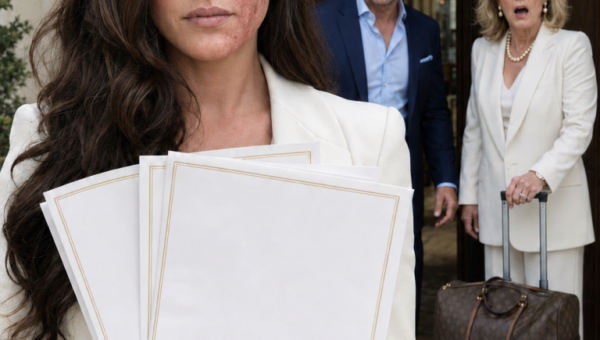
Dane arrived with two attorneys, a title officer, and a stack of documents.
No one raised their voice. No one asked her to explain her pain.
They simply did the work.
Audrey signed every page with a steady hand.
By noon, the house was no longer hers.
By one o’clock, Dane’s private security team arrived at the property.
By three, the locks were changed again.
By sunset, Patrick’s expensive lighting kits, designer sneakers, gaming chair, tripods, jackets, speakers, and unopened boxes of things he had bought with Audrey’s money were packed into storage bins and placed neatly under a covered section of the driveway.
Nothing was damaged.
Nothing was hidden.
Everything was documented.
Audrey had learned from years of working in architecture that strong structures were not built with emotion.
They were built with precision.
That evening, Patrick sent her a photo from a resort restaurant.
A steak. A cocktail. A pool glowing blue behind him.
His message read:
“Flight lands Friday. Make sure the house is clean when I get back. Also, don’t put the baby in our room. I need real sleep.”
Audrey read it once.
Then she placed the phone facedown.
Patrick Comes Home
Patrick arrived back in Providence on Friday afternoon, sun-tanned and smug, dragging a designer suitcase behind him.
Audrey watched from her hotel suite through the old porch camera that had not yet been disconnected.
He walked up the front path like a man returning to a kingdom.
Then he stopped.
The lock was different again.
He frowned, pulled out his key, and tried it.
Nothing.
He tried again.
Nothing.
Then he yanked the handle.
The door did not move.
Patrick stepped back and shouted, “Audrey!”
No answer.
He pounded on the door.
“Audrey, open the door! This isn’t funny!”
Then he noticed the storage bins.
He walked toward them slowly, opened the first lid, and froze.
Inside were his clothes.
The next bin held his speakers.
The next held his camera gear.
His face changed from confusion to anger, then from anger to fear.
The front door opened.
A tall security manager in a dark jacket stood in the doorway.
Patrick pointed at him.
“Who are you? Why are you in my house?”
The man answered calmly.
“This property is privately owned by Whitford Residential Holdings.”
Patrick laughed in disbelief.
“No. I live here.”
“Not according to the title transfer.”
“My wife owns this house.”
“Former owner,” the man said. “The sale was completed two days ago.”
Patrick’s mouth opened, but no words came out.
The security manager handed him an envelope.
“Your belongings have been packed and inventoried. You have until six this evening to remove them from the driveway.”
Patrick’s voice cracked.
“She sold the house?”
The man looked at him without sympathy.
“Yes, sir.”
That was when Patrick finally understood.
He had not locked Audrey out of his house.
He had locked himself out of her life.
The Last Call
Audrey’s phone rang minutes later.
Patrick.
She almost ignored it.
Then she answered, because she wanted him to hear her calm.
His face filled the screen, red and panicked.
“Audrey, what did you do?”
She sat beside Elliot’s bassinet, wrapped in a cream blanket, her voice steady.
“I sold my house.”
“Our house!”
“No, Patrick. My house.”
He shook his head wildly.
“You can’t just do that. I live there. My things are there. My life is there.”
Audrey looked at her newborn son, sleeping peacefully.
“Your life was there because I allowed it to be.”
Patrick’s breathing became uneven.
“Where am I supposed to go?”
For one brief second, Audrey remembered the woman she used to be. The woman who would have fixed it. Apologized. Sent money. Found him a hotel. Made herself smaller so he could feel comfortable.
But that woman had been left on a frozen porch with a newborn baby.
And she was not coming back.
Audrey said softly, “You told me to stay with family until you got back. I think you should take your own advice.”
Patrick’s eyes widened.
“Audrey, please. Don’t be like this. Let me see my son.”
Her expression did not change.
“You didn’t ask his name when he was born. You didn’t ask if he was healthy. You didn’t ask if I was safe. You only asked for quiet.”
He began to cry.
“I made a mistake.”
“No,” Audrey said. “You made a choice. I made mine.”
Then she ended the call.
And blocked him.
One Year Later
One year later, Audrey lived in a bright modern home outside Newport, close enough to the water that morning light filled every room.
The house was smaller than the old one, but warmer.
There were soft rugs, baby books, framed family photos, and a sunny playroom where Elliot learned to walk while laughing at his own tiny feet.
Audrey’s design firm was growing. Her days were busy, but peaceful.
The divorce had been difficult, but clear.
Patrick tried to argue. He tried to blame stress. He tried to say he had been misunderstood.
But paperwork tells the truth in a way excuses cannot.
The messages. The property records. The hotel receipts. The lock change. The call logs.
Everything showed exactly who he had chosen to be.
Audrey received full custody.
Patrick moved back into his mother’s small guest room in Cranston and sent occasional long emails through lawyers, each one filled with regret that sounded more like self-pity than love.
Audrey rarely read them.
One afternoon, while Elliot stacked wooden blocks in the living room, her attorney forwarded another message from Patrick.
He wanted forgiveness.
He wanted a conversation.
He wanted “a chance to explain.”
Audrey deleted the email.
Then Elliot lifted a blue block and smiled proudly.
She clapped for him.
“That’s my boy.”
He laughed and reached for her.
Audrey picked him up and held him close, breathing in the sweet scent of baby shampoo and sunshine.
For a long time, she had believed losing a marriage meant losing a home.
Now she understood the truth.
Home was not a man’s approval.
Home was not a locked door.
Home was peace.
Home was safety.
Home was the child in her arms.
And Patrick had not taken that from her.
He had only shown her exactly where it was.
Sometimes the coldest moment of your life becomes the exact moment you finally stop begging for warmth from someone who never intended to protect you.
A person who leaves you alone in your most vulnerable season should not be trusted with access to the peaceful life you are trying to build.
Love should never require you to shrink, suffer, or explain why basic kindness matters, especially when a child is depending on your strength.
When someone mistakes your patience for weakness, the most powerful answer is not revenge, but a calm decision that protects your future.
A home is not truly safe because of its walls, its windows, or its beautiful rooms; it is safe because the people inside know how to love without cruelty.
The moment you stop covering for someone’s selfish choices is often the moment everyone finally sees the truth you survived in silence.
No one loses a good partner by setting boundaries; they only lose the person who benefited from having none.
A mother’s strength does not always look loud or dramatic; sometimes it looks like signing papers quietly while holding her baby close.
The person who locks you out may think they have taken your power, but sometimes they have only handed you the reason to walk away forever.
Peace is expensive, but staying with someone who keeps breaking your heart will always cost more.