My Husband Said Our Daughter Was Faking—Then the Scan Changed Everything-jeslyn

I knew something was wrong before anyone else in our house wanted to admit it.
For weeks, my fifteen-year-old daughter, Maya, had been telling me her stomach hurt. Not once in a while. Not only before school or when she had something stressful coming up. She felt sick almost every day, and the pain was becoming harder for her to hide.
My husband, Robert, had an answer for all of it.
“She’s faking it,” he kept saying. “Don’t throw money away on hospitals.”
At first, I tried to tell myself he might be right about one small part of it. Maya was fifteen. School could be overwhelming. Teenagers could lose sleep, skip meals, get anxious, and feel physical symptoms because of stress.
But I was her mother, and I was watching her change in front of me.
The nausea came first.
Then she began complaining about a sharp pain low in her stomach. Some mornings she would stand at the kitchen counter with one hand wrapped around a glass of water and the other pressed against her hoodie, waiting for the pain to ease before she could move.
Then came the dizzy spells.
Twice, I saw her catch herself against the hallway wall because she suddenly felt as though the floor had shifted beneath her worn sneakers.
She was fifteen, but lately she looked younger.
Maya had always been the kind of kid who seemed unable to stay indoors when the weather was decent. She would kick a soccer ball against the garage door until somebody complained about the noise. She took blurry sunset pictures over our mailbox because she insisted every sunset looked different if you paid attention.
She laughed loudly with her friends. She left cups on the coffee table. She forgot where she put her phone while holding it in her hand.
Then, little by little, all of that disappeared.
She started coming home and going straight to her room.
The soccer ball stayed in the garage.
Her friends still texted, but some evenings her phone would light up beside her while she slept through the notifications.
At dinner, she pushed food around her plate until it was cold.
I noticed every one of those things.
Robert noticed them too. He simply explained them differently.
One Thursday night, the kitchen smelled like reheated leftovers and dish soap. Maya was sitting across from us, staring at her plate. She had eaten maybe three bites.
Robert barely looked up from his phone when I said I wanted to schedule a doctor’s appointment.
“She’s putting on an act,” he said.
Maya’s fork stopped moving.
I looked at him. “She’s been sick for weeks.”
“Teenagers make everything dramatic. We’re not wasting money on hospitals because she wants attention.”
There was something about hearing him say it with Maya sitting right there that made my anger rise faster than usual.
“She is telling us she’s in pain.”
Robert finally looked up.
“Maya is stressed about school. If you keep babying her, she’ll keep doing it.”
Maya lowered her eyes to her plate.
That bothered me almost as much as his words did.
She did not argue with him anymore.
She did not insist that the pain was real.
She just sat there as if she had already learned that being believed was something she had to earn.
The next afternoon, I found her asleep after school with her sneakers still on.
Another morning, I watched her bend down to tie those same shoes and suddenly freeze. Her face tightened. One hand went to her stomach, and she stayed bent over for several seconds before slowly straightening again.
“You okay?” I asked.
She nodded too quickly.
That frightened me.
Maya had stopped trying to convince us.
She was beginning to endure it instead.
Meanwhile, Robert treated every mention of a doctor like a financial threat. Every appointment meant a bill. Every test meant another bill. Every hospital visit became, in his mind, an unnecessary expense we could avoid if Maya would simply stop being dramatic.
I understood worrying about money. I worried about it too.
But I could not understand watching your child hurt and deciding the possibility of a bill mattered more than finding out why.
Then Monday came.
At 2:13 in the morning, I woke because I heard something from Maya’s bedroom.
It was not a scream.
That might have been easier to understand.
It was a breath—thin, broken, wrong.
I was out of bed before I had fully processed what I had heard.
The hallway was dark except for the faint light coming from beneath Maya’s door.
I opened it and found her curled on her side beneath the desk lamp, both arms wrapped around her stomach.
Her gray hoodie was twisted beneath her hands. Her knuckles had gone white from gripping the fabric.
Tears had soaked the edge of her pillow.
For one second, I just stood there.
There are moments when your mind tries to protect you by refusing to name what your eyes are seeing. I had spent weeks wondering whether I was overreacting, whether Robert was right that stress could explain everything, whether I should wait another day and see if Maya improved.
All of those questions disappeared when she looked at me.
“Mom,” she whispered, “please… make it stop hurting.”
That was enough.
I sat beside her and brushed the hair away from her face.
“I’m taking you in tomorrow.”
She looked toward the bedroom door before looking back at me.
“What about Dad?”
That question told me more than I wanted to know.
She was hurting badly enough to cry in the middle of the night, and she was still worried about whether Robert would think the doctor cost too much.
“I’ll handle Dad,” I said.
I did not wake him.
I did not ask permission.
By morning, I had made my decision.
The next afternoon, Robert was still at work when I drove to Maya’s school.
At 1:42 p.m., I signed her out through the school office.
The attendance clerk checked my ID, slid the checkout sheet toward me, and printed a dismissal slip with the time stamped across the top.
I remember that detail because everything felt strangely ordinary.
A printer hummed.
Someone answered a phone behind the counter.
A student walked past carrying a backpack covered in keychains.
Meanwhile, I felt as though I were quietly breaking some enormous rule simply by taking my own daughter to a doctor without telling my husband.
Maya came out slowly.
She had one hand pressed beneath her hoodie.
“You sure you can walk?” I asked.
“I’m okay.”
She was not okay.
We both knew it.
I buckled her into our family SUV and drove straight to Riverside Medical Center without calling Robert.
Maya leaned against the passenger window as strip malls, gas stations, and yellow school buses moved past us.
Normally she would have complained about my driving or changed the radio station without asking.
That afternoon she barely spoke.
At intake, a woman handed me a stack of patient forms.
There was a consent line.
Insurance information.
An identifying sticker that immediately made me think about exactly what Robert had been warning about: bills.
My stomach tightened.
I signed anyway.
For weeks, Robert had made money the center of every conversation about Maya’s health.
Standing there with a pen in my hand, I realized I had allowed his certainty to delay my own instincts longer than I wanted to admit.
If this turned out to be nothing serious, I could live with an unnecessary bill.
What I could not live with was taking Maya home without trying to understand what was happening to her.
A nurse called her name.
Maya stood carefully.
The nurse wrapped a blood pressure cuff around her thin arm and asked routine questions while watching her face.
Then she printed a plastic wristband with Maya’s name on it and fastened it around her wrist.
That simple band made the situation suddenly feel more real.
By 3:08 p.m., they had ordered bloodwork and an ultrasound.
My phone buzzed while we waited.
Robert.
Where are you?
I stared at the message.
I could already imagine the argument.
Why had I taken her without telling him?
Why had I agreed to tests?
Did I know how much this could cost?
What if the hospital found nothing?
I turned the phone facedown in my lap.
Maya saw me do it.
“Is that Dad?” she asked.
“Yes.”
“Is he mad?”
“I don’t know.”
That was not entirely true.
I knew Robert would be angry once he found out where we were.
For the first time, I did not care enough about that anger to let it change what I was doing.
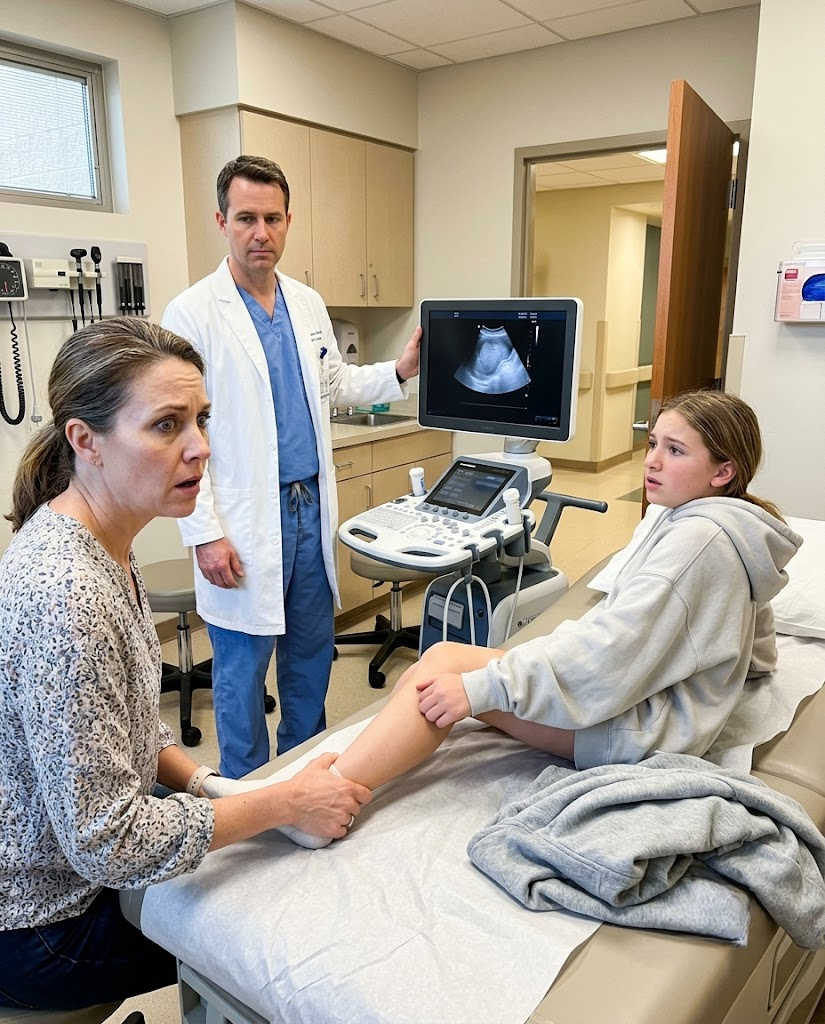
When they brought us into the exam room, Maya climbed onto the table and lay back beneath a thin paper sheet.
Her hoodie was folded beside her.
Without it, she looked even smaller.
She gripped the mattress edge while we waited.
The ultrasound technician came in and explained what she needed Maya to do.
The machine gave off a low hum.
The technician moved the wand across Maya’s stomach while watching the monitor.
At first, I watched Maya’s face.
Then I began watching the technician’s.
I had expected the kind of neutral expression medical workers use when they are concentrating.
Instead, I noticed her becoming quieter.
She moved the wand again.
Paused.
Adjusted the angle.
Took an image.
Then another.
Maya looked at me.
I tried to smile.
It felt unnatural on my face.
The technician returned to the same area and took two extra images.
She saved them without explaining what she was seeing.
My heartbeat became so loud I could feel it in my throat.
“Is everything okay?” I asked.
She gave me the careful answer I should have expected.
“The doctor will be in shortly.”
Then she left.
The door clicked shut behind her.
Maya stared at the ceiling.
“Mom?”
“I’m right here.”
“Did she see something?”
“I don’t know.”
This time it was the truth.
Seven minutes passed.
I know because I looked at the clock more times than I can count.
Seven minutes can disappear when you are busy.
Seven minutes can also become enormous when you are sitting beside your child waiting for someone to tell you whether your fear has a name.
Then the door opened.
Dr. Lawson walked in holding a clipboard too tightly.
One look at his face made my stomach drop.
He did not look rushed.
He did not look casual either.
He pulled a chair closer.
“Mrs. Thorne,” he said gently, “we need to talk.”
Maya immediately pushed herself onto one elbow.
The exam paper crinkled beneath her trembling arm.
“Am I in trouble?” she whispered.
I nearly broke at that question.
After weeks of being told she was dramatic, attention-seeking, and possibly faking her pain, my daughter’s first thought was that whatever the doctor had found might somehow be something she had done wrong.
“No, sweetheart,” I said.
My voice barely sounded like mine.
“You’re not in trouble.”
Dr. Lawson looked at the scan.
Then he looked at Maya.
Then at me.
“The scan shows there is something inside her,” he said.
For one second, the room stopped being a room.
The overhead lights seemed too bright.
The hum from the equipment suddenly felt louder.
My hand reached for Maya’s ankle through the paper sheet because I needed to feel something solid, something that reminded me she was still beside me.
“Inside her?” I asked. “What does that mean?”
Dr. Lawson turned the ultrasound monitor just enough for me to see it.
There was a pale shape on the screen.
I had no idea what I was looking at.
That almost made it worse.
Maya grabbed my sleeve.
Her fingers tightened around the fabric.
“Mom?”
I covered her hand with mine.
My phone was still facedown somewhere near my purse.
Robert’s unanswered message no longer mattered.
The hospital bill no longer mattered.
The arguments we were going to have when he learned I had taken Maya there no longer mattered.
All I could think about was every morning Maya had winced while tying her shoes, every dinner when she pushed food around her plate, every time she had told us she felt sick and had been treated as though the truth coming from her own body required proof.
I remembered the night she had whispered, Please… make it stop hurting.
And now a doctor was looking at a scan that had changed his face the second he saw it.
I wanted him to explain immediately.
At the same time, I was terrified of whatever explanation was coming.
Dr. Lawson did not rush.
He looked back at the ultrasound image and then down at the paperwork he had brought into the room.
The hospital intake form was clipped at the top.
Maya Thorne.
Fifteen years old.
My daughter.
The girl Robert had said was faking.
The girl I had brought there behind his back because something in me refused to keep waiting.
Dr. Lawson studied the form for another moment.
That frightened me in a different way.
If the scan alone had been enough to concern him, why was he checking the information we had already provided?
“What is it?” I asked again.
He lifted his eyes.
There was no accusation in his expression, but there was a seriousness that made me grip Maya’s hand harder.
Maya was watching him now too.
Her pain had not disappeared, but fear had pushed through it.
The room felt smaller with every second he waited.
Then Dr. Lawson looked from the scan to the hospital intake form with my daughter’s name printed across the top.
“Mrs. Thorne…” he said.
He paused carefully, as though the next words had to be placed exactly right.
“There is something we need to confirm before I say this out loud.”