
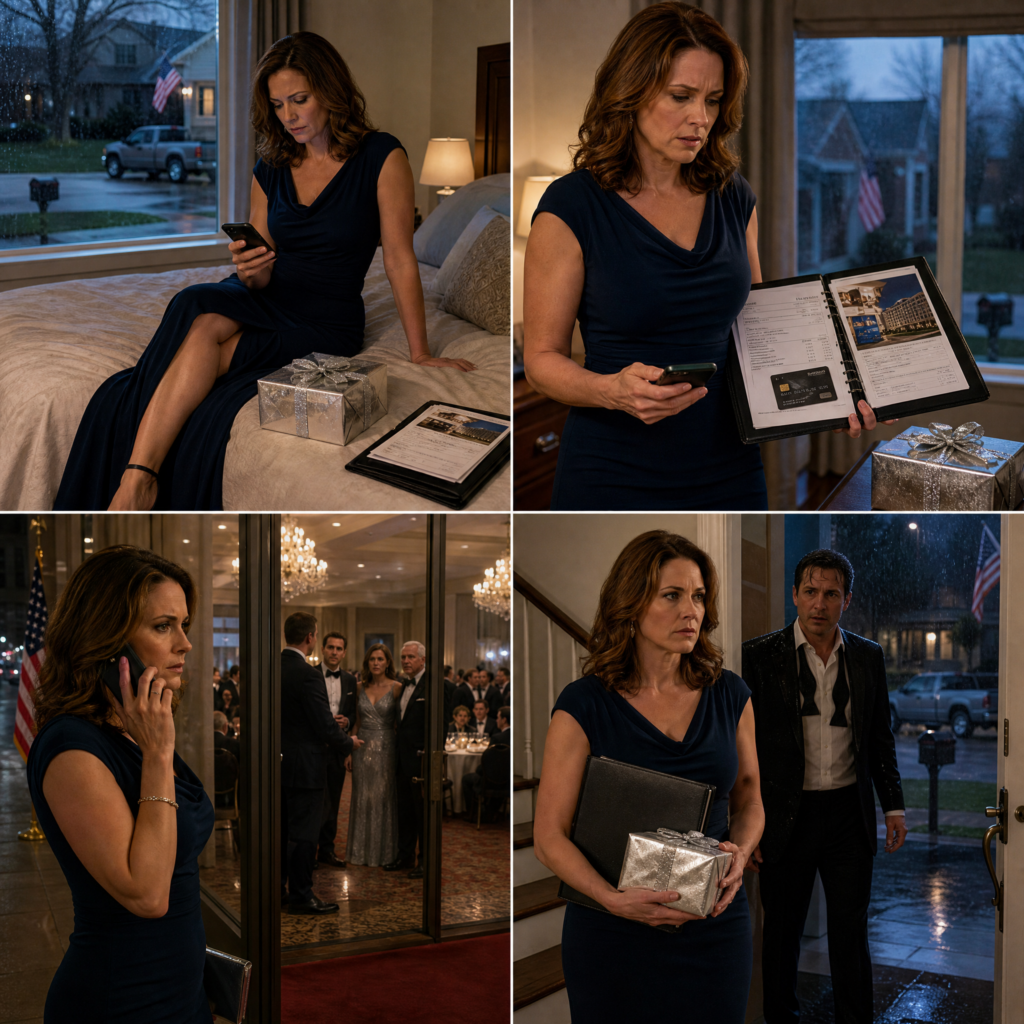
My husband texted me, “Don’t come anymore. My parents don’t want you showing up here,”

My Husband Told Me Not To Come — Ten Minutes Later, His Family’s Perfect Party Began To Unravel
“Don’t come anymore. My parents don’t want you showing up here.”
I stood in front of the bedroom mirror with one heel already on my foot and the other still dangling from my fingertips. For a few seconds, the words on my phone looked so unreal that my mind refused to accept them as an actual message from my husband. The screen glowed in my palm. My reflection stared back at me: soft makeup, carefully curled hair, navy blue dress, a string of tiny pearls at my throat, and a woman who had spent the entire afternoon preparing herself to be welcomed into a room that had never truly opened its doors to her.
Then the second text arrived.
“Please don’t make this harder than it already is.”
That was the sentence that made the air change.
Not because it was loud. Not because it was dramatic. It was almost polite, almost reasonable, almost gentle. And somehow that made it worse. Daniel had not called. He had not come home early. He had not looked me in the eye and explained anything. He had simply sent a message, the way someone might cancel a dinner reservation or postpone a routine meeting. His parents did not want me there, and he had decided that was enough.
I lowered myself onto the edge of our bed. The quiet in the room felt heavy enough to press against my ribs. Outside, rain slid down the window in silver lines, turning the Chicago evening into a blur of streetlights and wet pavement. Downstairs, the dishwasher hummed softly. In the hallway, the thermostat clicked on. Everything around me remained ordinary, which made the moment feel even more unreal.
On the bed beside me sat a silver gift box tied with white ribbon. Inside was the vintage Rolex I had bought for Richard Mercer, Daniel’s father. Nearly four thousand dollars. I had chosen it after weeks of research because Daniel said his father admired old watches and because, foolishly, some part of me still believed a thoughtful gift might soften Richard’s cold politeness toward me. Beside the gift was the hotel folder: confirmations, invoices, receipts, menus, floral agreements, transportation details, event insurance, and final authorization forms. My name appeared again and again across those pages.
Clare Bennett.
Not Evelyn Mercer. Not Richard Mercer. Not Daniel Mercer.
Mine.
Tonight was Richard and Evelyn Mercer’s fortieth wedding anniversary celebration at the Langford Grand Hotel downtown. Daniel’s parents had talked about it for months, describing it as if it were a royal occasion. A ballroom. A jazz trio. Imported white orchids. Custom desserts. A steak-and-seafood menu Evelyn had revised three separate times. Nearly a hundred guests from their church, country club, law firm circles, and old neighborhood friendships. Evelyn had made sure everyone knew it would be elegant.
What she had not made sure everyone knew was that she and Richard could not afford most of it.
Daniel had come to me three months earlier, late at night, carrying a folder full of invoices. His face had been pale then too, but in a softer way, the way a proud man looks when life has backed him into a corner and he needs help from the one person he takes for granted because he assumes she will always say yes.
“My father’s investments are tied up,” he had said, sitting across from me in my home office. “Mom already announced the party. If they cancel, people will talk. She’ll be devastated.”
I remembered looking at the papers, then looking at him. “How much?”
He had hesitated.
That hesitation should have been my answer.
But marriage makes generous people dangerous to themselves. Love can make responsibility feel noble, even when it is one-sided. So I approved the deposit. Then the catering upgrade. Then the floral package. Then the additional guest list. Then the photographer. Then the private car service for several older relatives. Daniel kept saying he would pay me back. I kept nodding, because I had spent years telling myself that partnership meant carrying weight when the other person stumbled.
The problem was that Daniel had not stumbled once.
He had made a habit of falling directly onto the safety net I kept rebuilding under him.
One mortgage payment during a difficult quarter. One payroll gap when his marketing firm lost a client. One tax issue he promised was temporary. One business loan he insisted would be resolved after a contract came through. One credit card balance after his father’s medical bills. One family emergency after another, each presented as a temporary bridge, each quietly becoming part of the structure of our marriage.
For six years, I had protected his pride. I had allowed Daniel to appear more stable than he was. I had allowed his family to assume he was the provider, the fixer, the successful son who had married a woman they considered merely acceptable. I had paid bills they never saw. I had signed authorizations they never thanked me for. I had cleaned up situations Daniel described as small problems until I realized that every small problem came with my name, my accounts, my sleep, my patience, and my silence attached.
And still, his mother could not say my name warmly.
Evelyn Mercer introduced me as “Daniel’s wife” at family dinners, as if I were an accessory he had purchased and might one day replace. She commented on my clothes with a smile that made criticism sound like advice. She corrected my pronunciation of restaurant names, though I ran presentations for corporate clients who trusted me with million-dollar strategy decisions. She once told a woman at Thanksgiving that I had “worked very hard to improve myself,” as if I had arrived in Daniel’s life unfinished.
Richard was no kinder. He preferred jokes. Jokes about my father being a mechanic. Jokes about my neighborhood. Jokes about how Daniel had “married practical,” which was his way of saying I was useful but not impressive. Daniel always laughed too softly at those jokes, then looked at me later with apologetic eyes and said, “You know how Dad is.”
Yes. I knew how he was.
I also knew how Daniel was.
That realization came slowly, then all at once.
My phone buzzed again. Daniel calling.
I watched his name fill the screen. The same name that appeared on our mortgage, our wedding invitation, our joint holiday cards, and every excuse I had ever made for a man who found it easier to disappoint me privately than his parents publicly.
I declined the call.
The phone went quiet. Then it buzzed again. I declined it again.
I stood, walked to the window, and looked out at the rain. My reflection hovered in the glass like a woman standing behind me, watching to see what I would finally do. For years, I had swallowed insults in the name of peace. I had smiled through dinners where I was treated like a guest who had overstayed. I had stayed calm when Evelyn praised Madison Carter, Daniel’s ex-girlfriend, with the kind of warmth she had never offered me. I had paid for things, fixed things, forgiven things, softened things, and made myself smaller so Daniel would not have to feel uncomfortable.
Tonight, I was standing in a dress I had bought to please his mother, holding a message from my husband telling me not to come to an event I had paid for.
Something inside me did not break. It settled.
That was the strangest part. I did not cry. I did not pace. I did not throw the phone. I simply felt the final thread loosen inside my chest, the thread I had mistaken for patience when it was really exhaustion.
I opened my contacts and called the Langford Grand Hotel.
The woman answered on the second ring. “Good evening, Ms. Bennett. This is Vanessa from the Langford Grand. Is everything all right?”
Her voice was warm and professional, the same voice I had heard during three months of planning calls. She knew me well by then. She knew I approved the payments. She knew I answered questions quickly. She knew I was the reason the Mercer anniversary party had grown from a modest dinner into the kind of evening Evelyn could brag about for years.
“Yes,” I said, watching rain gather on the glass. “I need to make a change regarding tonight’s event.”
There was a small pause. “Of course. What kind of change?”
I looked back at the silver gift box on the bed.
“For all remaining charges under my account,” I said, my voice calm enough to surprise even me, “I am revoking authorization effective immediately.”
Silence.
Then Vanessa spoke carefully. “Ms. Bennett, are you certain?”
For a moment, I thought about every time I had been expected to understand. Evelyn did not mean it. Richard was only joking. Daniel was under pressure. Madison was just an old family friend. The business issue was temporary. The check would clear next week. The repayment would happen next month. The apology would come eventually. The respect would appear if I just stayed gracious long enough.
“Yes,” I said. “I’m certain.”
At the Langford Grand, the Mercer anniversary party had already begun.
The ballroom glittered in gold light. Chandeliers reflected against polished marble. White orchids spilled from tall glass vases. Crystal glasses lined the bars. Servers moved between clusters of guests carrying silver trays. A jazz trio played near the stage, filling the room with smooth, tasteful music that made everything feel expensive.
Evelyn Mercer stood at the center of it all, smiling like a woman who had never questioned whether the world belonged to her. She wore emerald silk and diamonds that flashed every time she turned her head. Richard stood beside her in a black tuxedo, shaking hands with old friends, accepting compliments, and pretending the evening represented his success rather than my quiet signature.
Daniel stood near the ballroom entrance, checking his phone every half minute.
At first, Evelyn seemed pleased that I was not there. I was told later that she leaned toward one of her friends near the bar and said, “It’s better this way. Some people never quite adjust to formal settings.”
The women around her gave the kind of polite laughter that rich people use when they do not want to question cruelty.
Daniel heard it.
He said nothing.
That detail would matter to me more than almost anything else.
Because marriage is not proven in the grand speeches people make when everything is easy. Marriage is proven in the small seconds when someone disrespects your partner and you decide whether comfort matters more than loyalty.
Daniel chose comfort so often that eventually he stopped noticing it was a choice.
Nine minutes after my call, a hotel manager approached him near the entrance. Daniel straightened, slipped his phone into his pocket, and tried to smile.
“Mr. Mercer,” the manager said quietly, “may I speak with you for a moment?”
Daniel stepped aside. “What’s going on?”
The manager kept his voice low. “We’ve received notice that the primary financial authorization on this event account has been revoked.”
Daniel blinked. “What?”
“The cardholder has withdrawn approval for any remaining charges.”
“That can’t be right,” Daniel said. His eyes darted across the room toward the bar, the stage, the kitchen doors. “Run the card again.”
“We attempted to verify the account twice.”
“Then use the secondary card.”
“There is no secondary card approved for the remaining balance.”
Daniel’s face changed. First confusion. Then annoyance. Then the kind of fear people feel when a carefully arranged illusion begins to reveal its seams.
Across the ballroom, Evelyn noticed the conversation. She crossed the floor quickly, smiling at guests as she passed, trying to make her urgency look like hostess energy rather than concern.
“Daniel,” she said, still smiling. “What is this?”
“Nothing,” he said too quickly.
The manager’s expression remained professional. “Mrs. Mercer, we need immediate payment authorization to continue full service for the event.”
Evelyn laughed once, as if the sentence were too absurd to consider. “Full service? What exactly does that mean?”
As if answering her, the bartender stopped pouring a drink and set the bottle down. A server near the kitchen doors whispered to another staff member. The music continued, but the musicians looked briefly toward the manager. The room did not stop. Rooms like that never stop all at once. They shift by inches. A glance here. A pause there. A conversation lowering. A smile tightening.
Daniel stepped closer to the manager. “Give me five minutes.”
“I’m sorry, sir. We’ve already extended a courtesy window under Ms. Bennett’s account.”
Evelyn’s smile vanished.
“Ms. Bennett?” she repeated.
The manager looked uncomfortable now. “Clare Bennett is listed as the primary financial guarantor for the event.”
For one second, all of Evelyn’s polish disappeared. Her eyes moved from the manager to Daniel, then to Richard, then back again.
“That can’t possibly be correct.”
But Daniel’s silence told everyone near them that it was.
A couple standing by the champagne table looked over. A woman who had been laughing near the floral arrangements stopped mid-sentence. Richard’s hand tightened around his glass.
“Daniel,” he said in a low voice. “Fix it.”
“I’m trying.”
“Then call her.”
Daniel pulled out his phone. In our bedroom, mine lit up on the nightstand.
I watched it ring.
I let it stop.
Then it rang again.
I let it stop again.
At the hotel, service slowed. The open bar became a cash bar, then closed entirely until the account could be resolved. The dessert presentation was paused. The second musical set was held back. The photographer quietly informed staff he would continue only through the guaranteed minimum. Most guests did not know exactly what was happening, but they knew enough. Wealthy social circles are fluent in discomfort. They can smell financial awkwardness beneath perfume and polished silver.
A man near the stage asked, “Is the event ending early?”
A woman near the dessert table whispered, “I thought Richard said they spared no expense.”
Another guest asked casually, “Where is Clare tonight?”
Evelyn heard that question. I wish I could say it gave her perspective. It did not. It gave her panic.
Daniel texted me again.
“Clare, please answer.”
Then:
“This isn’t funny.”
Then:
“You’re embarrassing my family.”
That message made me sit very still.
For six years, his family had corrected, dismissed, compared, and minimized me. For six years, I had been asked to accept it as personality, tradition, stress, humor, or misunderstanding. And now, when I simply stopped financing the performance, I was the one embarrassing them.
I typed a reply, then erased it.
I did not owe him a performance. I did not owe him a lecture from across the city while his parents stood under chandeliers purchased with my patience. I placed the phone face down on the bed and walked to the kitchen for a glass of water.
I remember how quiet the house felt. Not peaceful, exactly. More like a courtroom after the verdict has been read. The decision had already been made. All that remained was waiting for the consequences to arrive home.
Back at the Langford Grand, Evelyn pulled Daniel into the hallway with Richard close behind them.
“You told me Clare handled some reservations,” Evelyn hissed. “You did not tell me she paid for this.”
Daniel looked cornered. “I was going to pay her back.”
“When?” Richard asked.
Daniel did not answer.
That silence did what no argument could have done. It exposed the truth.
The Mercers had built an evening out of borrowed dignity. They had invited friends, ordered orchids, chosen fine wine, and excluded the woman who made it all possible because acknowledging my role would have required acknowledging their dependence. They wanted my money invisible. They wanted my presence invisible. They wanted the benefit of me without the burden of respecting me.
But invisibility only works while the invisible person keeps cooperating.
By the time Daniel finally came home, the rain had become a full spring storm.
It was nearly midnight. I had changed nothing except my shoes. I still wore the navy dress, though I was barefoot now, sitting on the living room couch with the Rolex box on the coffee table. I did not drink the wine I had poured. I just watched the storm shine against the windows and listened for his car.
When the front door opened, it did not slam, but it closed hard enough to tell me everything. Daniel appeared in the living room with his tuxedo jacket wrinkled and his bow tie hanging loose at his collar. His face was pale, tense, and unfamiliar.
“You embarrassed my parents,” he said.
Not “I’m sorry.”
Not “What happened to us?”
Not “Are you okay?”
Just accusation.
I looked at him for a long moment. “Interesting first sentence.”
His jaw tightened. “Do you have any idea what tonight looked like?”
“Yes,” I said. “I imagine it looked expensive.”
He stared at me as if I had become someone he did not recognize. Maybe I had. Or maybe, for the first time, I had become someone he could not manage.
“You could have talked to me privately,” he said.
“I tried that for six years.”
“That’s not fair.”
The word nearly made me laugh. Fair. Daniel wanted fairness only after the system stopped benefiting him.
“Your parents told you not to bring me to an event I paid for,” I said. “And you sent the message.”
He rubbed his hands over his face. “You know how my mother is.”
There it was. The old sentence. The family shield. The excuse polished by repetition until everyone treated it like truth.
“You know how my mother is.”
As if predictability made disrespect harmless.
I leaned forward. “Do you know what the saddest part is?”
He looked tired. “Clare, please.”
“The saddest part isn’t Evelyn. It’s that you read that message before sending it. You decided those words were acceptable. Then you pressed send.”
His mouth opened, then closed again.
Outside, thunder rolled over the city, low and distant. The house seemed to hold its breath.
Daniel walked toward the kitchen, then turned back. “I was trying to keep the peace.”
“No,” I said quietly. “You were trying to keep everyone comfortable except me.”
He flinched, though I had not raised my voice.
That was another thing I had learned: when a truth is accurate enough, it does not need volume.
“You embarrassed me tonight,” he said.
I nodded slowly. “Now imagine that feeling stretched across six years.”
His face hardened. “That’s not the same.”
“Every holiday dinner where your mother corrected me in front of people? Every family event where she praised Madison while pretending I was temporary? Every time your father joked about where I came from while sitting in a life partly supported by my income? Every time you looked at me afterward and said I should let it go?”
He looked away.
“Daniel, you didn’t just let them make me feel small. You trained me to accept it.”
“I never trained you to do anything.”
“You did. Every time you chose silence.”
That sentence landed between us like a document neither of us could unsigned.
For years, I had mistaken Daniel’s discomfort for kindness. He disliked conflict, so I called him gentle. He avoided confrontation, so I called him patient. He wanted everyone happy, so I called him considerate. But the truth was less flattering. Daniel wanted approval more than he wanted justice inside his own home.
And I had built a marriage around protecting him from that truth.
He leaned against the wall. “I never asked you to throw money in my face.”
I stood then. Slowly.
“Throw money in your face?” I repeated. “Daniel, I paid your company payroll three years ago so your staff wouldn’t spend the holidays wondering whether their checks would clear.”
He said nothing.
“I paid the tax balance you told me was a paperwork issue.”
Silence.
“I covered the mortgage for eight months during the pandemic while you told your parents business was great.”
Still nothing.
“And tonight, your parents celebrated under chandeliers because my name was attached to every invoice in that ballroom.”
His face flushed.
Not because I was being unfair.
Because I had stopped being discreet.
That was the real betrayal in his eyes. Not what I had done. What I had revealed.
He walked to the kitchen island and gripped the edge with both hands. “I was going to pay you back.”
“When?”
He closed his eyes.
Exactly.
For the first time that night, my anger cooled into something sharper and more final.
“Why did your mother really want me gone?” I asked.
Daniel froze.
That tiny hesitation confirmed more than a confession could.
“It wasn’t just about me being inappropriate for the event, was it?”
He looked toward the window.
“Who was there?” I asked.
He swallowed. “Madison came.”
The name landed softly, but it changed the entire room.
Madison Carter.
Daniel’s ex-girlfriend. The woman Evelyn had adored from the beginning. Old Chicago money. Private school. Family connections. Country club holidays. The kind of woman Evelyn believed belonged beside Daniel in photographs. I had met Madison twice during our marriage, both times at family events where Evelyn suddenly became warmer, brighter, more alive. She introduced Madison by name, by accomplishments, by family history. She introduced me as Daniel’s wife.
“When were you planning to tell me?” I asked.
“It wasn’t a big deal.”
I actually laughed then. Not because it was funny, but because disbelief sometimes has nowhere else to go.
“Your ex-girlfriend attended a party I paid for, and your solution was to remove your wife.”
“That’s not what happened.”
“Then explain it clearly.”
He rubbed his forehead. “My mother thought it would create tension.”
“No,” I said. “Your mother thought Madison looked better standing beside you.”
Daniel said nothing.
Again, silence did the work.
For years, I had been trying to earn acceptance from people who had already chosen an imaginary version of Daniel’s life, one where I did not exist. What I understood that night was that Daniel had never fully corrected them. He let them keep that fantasy because it made him feel admired. My money solved real problems. Madison preserved the image. His mother wanted the image. Daniel wanted the approval. And I had been expected to disappear neatly so the picture would look right.
I walked past him toward the stairs.
“What are you doing?” he asked.
“Packing.”
“Clare, don’t be ridiculous.”
I turned around. “I spent six years shrinking inside this marriage so your family could feel larger. I’m done.”
“Where are you going?”
“Rachel’s.”
“My sister, who you’ve always said overreacts?”
He looked exhausted. “Please don’t do this tonight.”
“That’s interesting,” I said. “Because you had no problem doing this tonight when you thought I would simply stay home and swallow it.”
His eyes flickered.
I went upstairs and packed two suitcases. Daniel followed me, talking in circles. He said we should calm down. He said I was making a permanent decision during an emotional moment. He said his parents were difficult but not malicious. He said Madison meant nothing. He said the money could be discussed. He said people were embarrassed, as if embarrassment were the worst thing a person could experience.
He never said, “I should have chosen you.”
So I stopped listening.
When I reached the front door with my bags, he stood in the hallway looking younger than I had ever seen him, like a boy who had broken something valuable and only now understood that it could not be repaired with charm.
“Clare,” he said.
I paused but did not turn.
“You wanted me invisible tonight,” I said. “So I finally disappeared.”
Rachel lived north of the city in a quiet condo building where the wind from Lake Michigan made the streets feel colder than they were. She opened the door after midnight wearing sweatpants and a sleep shirt, her hair pulled into a messy knot. She looked at my dress, my suitcases, my face, and the absence of Daniel behind me.
Then she stepped aside.
“You can take the bedroom,” she said.
That was all.
No lecture. No questions. No demand that I explain myself before receiving kindness.
The next morning, I woke to sunlight on unfamiliar walls and a headache from not sleeping. My phone was full of missed calls. Daniel. Evelyn. Richard. Unknown numbers. Text messages layered over each other like a crowd pressing against glass.
“Please call me.”
“This has gone too far.”
“We need to discuss reimbursement.”
“Your behavior last night was extremely disappointing.”
The reimbursement message came from Evelyn.
I stared at it for a full minute.
Not “Are you safe?”
Not “I’m sorry.”
Not “I should not have excluded you.”
Money. Image. Control. Always in that order.
Rachel slid coffee across the counter. “You going to answer?”
“No.”
“Good.”
I looked at her.
She shrugged. “I’ve wanted to give Daniel a serious lecture for years.”
Despite everything, I smiled.
Rachel had never trusted him completely. She was polite at holidays and civil at dinners, but she once told me Daniel loved being admired more than he loved being accountable. I had defended him then. I said she did not understand his family pressure. I said he was complicated. I said marriage required patience.
Now, sitting in her kitchen with borrowed clothes and shaking hands, I realized she had seen the room more clearly from the doorway than I had from inside it.
By Monday afternoon, the story had begun traveling through the circles Evelyn cared about most.
Not the whole truth. Not at first. Wealthy social groups prefer polished versions of unpleasant events. But rumors know how to find the spaces between lies.
There had been a billing issue at the Langford Grand.
The bar had closed early.
The dessert course had been delayed.
The quartet never played.
Richard looked furious.
Daniel kept calling someone who would not answer.
Clare was not there.
And then, quietly, the most damaging question began to circulate:
Why was Clare the guarantor?
Evelyn tried to control the story. She told friends there had been a misunderstanding with the hotel. She suggested a staff error. She hinted at confusion over business accounts. She made it sound like a technical inconvenience, the kind of thing that happens to important families because institutions cannot keep up with them.
But the truth has a way of becoming clearer when too many people witnessed the beginning of it.
On Wednesday, Daniel came to Rachel’s condo unannounced.
I saw him through the peephole and almost walked away. But there were still questions in me, and answers have their own gravity.
When I opened the door, he looked as if the last few days had aged him. His clothes were neat, but not careful. His eyes were shadowed. His confidence had lost its shine.
“Can I come in?” he asked.
I stepped aside.
Rachel took one look at him, picked up her purse, and said, “I’m going for a walk. A long one.”
When the door closed behind her, Daniel stood awkwardly in the living room. He had been in boardrooms with difficult clients, family dinners with judgmental relatives, and hotel ballrooms full of whispers, but somehow my sister’s small, quiet condo made him look more exposed than all of those places.
“My company account got frozen this morning,” he said.
I crossed my arms. “Okay.”
He frowned. “That’s your response?”
“What exactly would you like from me?”
“You managed payroll processing through your firm. Your withdrawal triggered a review.”
“I know.”
“You knew that could happen.”
“I warned you for two years that your spending was unstable.”
“That’s not the point.”
“It is exactly the point,” I said. “You got used to me fixing problems before consequences reached you.”
He looked away.
Daniel’s marketing company had always looked more successful than it was. The office was beautiful. The dinners were expensive. The cars were leased. The website featured glossy client photos and confident language. From the outside, he looked like a man moving upward. From inside our marriage, I saw the invoices, the delayed payments, the client losses, the panic hidden behind late-night laptop sessions and half-finished explanations.
For years, I had helped because I believed I was helping us.
But “us” had become a word Daniel used whenever he needed support and forgot whenever I needed protection.
“I talked to Madison,” he said suddenly.
My expression did not change. “And?”
He gave a short, tired laugh. “She thought I still owned half the company.”
There it was. Not romance. Not longing. Not some tragic unfinished love. Validation. Madison had represented a version of Daniel that existed only as long as no one checked the books. She saw the polished man his mother advertised. She did not see the late notices, the quiet transfers, the wife balancing his life in the background.
“She left after twenty minutes,” he admitted. “Once she understood things weren’t what she thought.”
I leaned back in my chair. For the first time, I almost felt sorry for him.
Almost.
Then I remembered the text.
“Don’t come anymore.”
I remembered the dress. The gift. The rain. The silence after he sent it. I remembered him choosing a prettier lie over an inconvenient truth, and sympathy turned into clarity.
“I know I handled things badly,” he said.
“That’s a very small sentence for a very large problem.”
He nodded, wounded but listening. “I was trying to keep everyone happy.”
“No. You were trying to avoid disappointing your parents.”
His eyes lifted.
“The difference matters, Daniel. Keeping people happy means caring about everyone in the room. Avoiding disappointment means sacrificing the person least likely to leave.”
He swallowed.
“For six years,” I continued, “that person was me.”
He sat down slowly, as if his body had finally understood what his pride was still resisting.
“Are you really ending our marriage over one night?” he asked.
“One night?” My voice remained calm, but something in it sharpened. “Women do not leave steady marriages because of one night. They leave after years of being shown exactly where they rank.”
He looked down at his hands.
I could see the moment reality reached him, not as a concept but as a fact. I was not punishing him. I was not trying to scare him. I was not waiting for the perfect apology so we could begin again. I was already gone in the place that mattered most.
That frightened him more than anger would have.
“Did you ever really love me?” he asked quietly.
The question hurt because the answer was yes.
I had loved him deeply. Enough to protect him from embarrassment. Enough to carry burdens quietly. Enough to overlook things I should have addressed. Enough to confuse loyalty with endurance. Enough to build my life around his comfort and call it partnership.
“I loved you enough to support the life you wanted,” I said. “But somewhere along the way, you got so used to being supported that you forgot to protect the person supporting you.”
He closed his eyes.
For once, Daniel had no answer.
The days that followed taught me that leaving is not one decision. It is a series of smaller decisions made while the old life keeps calling your name.
The first decision was not answering Daniel before breakfast.
The second was not replying to Evelyn’s email when she asked me to “restore order” for the sake of the family.
The third was opening my laptop, downloading every invoice related to the anniversary party, and saving them into a folder with a name so plain it felt almost cold: Mercer Event Records.
I had never been a careless person. That was one of the reasons Daniel had depended on me so easily. I kept receipts. I tracked payments. I archived contracts. I read fine print. For years, those habits had protected him. Now they protected me.
On Thursday morning, Vanessa from the Langford Grand called. Her tone was cautious, but kind.
“Ms. Bennett, I wanted to confirm how you would like us to handle the final statement,” she said.
“Send all documents directly to my email,” I replied. “Please do not release my personal payment details to anyone else.”
“Of course.”
There was a pause. I could hear a printer in the background, the faint sound of hotel phones, ordinary business moving forward as if my marriage had not shifted beneath me.
Then Vanessa said, “I also want to say, personally, I’m sorry for any difficulty you experienced that night.”
The sentence was simple. Professional. Probably safe. Yet I had to close my eyes for a second because it was the first apology I had received from anyone connected to that evening.
“Thank you,” I said.
After we ended the call, I sat at Rachel’s kitchen table with my coffee going cold and stared at the folder of documents on my screen. The ballroom deposit. The floral upgrade. The private menu tasting. The custom cake. The extra lighting Evelyn had insisted on because, according to Daniel, she wanted the room to “photograph warmly.” Each document carried my authorization. Each one was a quiet record of how far I had gone to help people who would not even allow me to stand in the room.
That afternoon, Richard Mercer called from a number I did not recognize.
I let it go to voicemail.
His message was short.
“Clare, this is Richard. We need to handle this like adults. Call me back.”
I played it twice, not because I wanted to hear his voice, but because I needed to understand the language he used. Handle this like adults. In Mercer language, that meant: return to your role, avoid public discomfort, and do not make us explain ourselves.
I deleted the voicemail.
Rachel came home with groceries and found me still at the table.
“You look like you’re building a case,” she said.
“I’m building a boundary.”
She set the bags down slowly. “That might be even better.”
That evening, I made another decision. I removed Daniel’s access to the shared business support systems that were tied to my firm. Not to punish him. Not to create drama. Simply because the arrangement had been informal, risky, and dependent on trust he had not honored. I sent him one message only, written with the kind of clarity I had once reserved for clients.
“Daniel, as of today, my firm will no longer provide administrative or financial processing support for your company. Please transition your accounts to an independent provider immediately. All future communication regarding shared financial matters should be in writing.”
He replied within three minutes.
“Are you serious?”
I did not answer.
Then:
“You know this puts me in a difficult position.”
I stared at those words for a long time. A difficult position. Not an unfair one. Not an unexpected one. A difficult one. Daniel had lived so long with me cushioning every hard surface that direct contact with reality felt like cruelty to him.
I closed the message thread.
On Friday, Evelyn changed tactics.
She did not call. She sent flowers.
White roses arrived at Rachel’s building just after noon in a crystal vase too large for the small kitchen table. The card was tucked neatly into the arrangement.
“Clare, emotions were high. Let us sit down as a family and resolve this gracefully. — Evelyn”
Rachel read it over my shoulder and made a sound halfway between a laugh and a sigh.
“Resolve this gracefully,” she repeated. “That means she wants you to make her comfortable.”
I touched one of the roses. The petals were perfect. Elegant. Expensive. Evelyn understood appearances so well that even an apology-adjacent gesture arrived curated.
I wrote a short note to the florist asking them to redirect the arrangement to a local community center, then placed the card in my document folder.
Not because I wanted to remember the flowers.
Because I wanted to remember the absence of the word sorry.
By the weekend, the social consequences Evelyn feared had sharpened. Rachel’s friend, who worked with someone from the Mercers’ club, heard that Evelyn had skipped a luncheon. Richard had withdrawn from a committee meeting. Daniel had missed a client dinner. The anniversary party, which had been designed as a celebration of stability, had become a question mark people carried from brunch to boardrooms.
I did not enjoy hearing that.
That surprised me.
I expected satisfaction. A part of me had imagined that if the Mercers finally felt even a fraction of the discomfort they had given me, I would feel light. Instead, I felt tired. The consequences were necessary, but they were not joyful. There is a difference between justice and entertainment, and I wanted no part in turning my pain into a spectacle.
That was why I stayed quiet.
No social posts. No dramatic calls. No explaining myself to people who had watched me be dismissed for years and chosen politeness over concern. Silence became a door I closed softly and firmly.
On Sunday evening, Daniel sent another message.
“My parents want to meet. They’re willing to apologize.”
I read it while Rachel and I sat on the couch eating takeout.
“They’re willing,” Rachel said after I showed her. “How generous of them.”
I typed back:
“If they want to apologize, they can write it clearly. I am not available for a family meeting.”
Daniel replied:
“You’re making this harder.”
This time, I answered.
“No. I’m refusing to make it easier at my expense.”
He did not respond after that.
Monday morning brought a new complication.
My attorney, a calm woman named Marissa Chen, reviewed the preliminary financial documents and asked a question I had avoided asking myself.
“Clare, did Daniel ever sign repayment agreements for these transfers?”
“For some of them,” I said. “Not all.”
“Were the business payments loans or marital support?”
“They were supposed to be loans.”
“Supposed to be is not a category courts love.”
I leaned back in the chair and looked at the framed diplomas on her wall. Everything in Marissa’s office was orderly: clean lines, pale wood, a glass desk, a bowl of wrapped mints no one touched. It was the kind of room where emotion had to put on a jacket before entering.
“I trusted him,” I said.
Marissa’s expression softened without becoming sentimental. “I understand. But from here forward, we document everything.”
I nodded.
She tapped the folder. “The anniversary event is clearer because your name is directly attached to the account. The business transfers may require more sorting. But the most important thing right now is that you stop informal financial support entirely.”
“I already did.”
“Good.”
There was that word again.
Good.
It felt strange to be praised for refusing something I once thought love required.
After the meeting, I walked alone for several blocks through downtown. The rain had passed, leaving the sidewalks bright under a thin gray sky. Office workers hurried past with coffee cups and laptop bags. Taxis moved through puddles. A man in a navy suit argued quietly into his phone near a bus stop. The city was full of people carrying private turning points inside ordinary mornings.
I wondered how many of them were pretending to be fine.
At home that night, I opened an old folder on my laptop labeled Wedding. I do not know why. Maybe grief wants evidence. Maybe some part of me needed to remember that there had once been softness before all this.
The photographs appeared in rows. Me in a white dress under summer light. Daniel smiling at me like I was the only person in the world. Rachel crying during the ceremony. My father adjusting his tie. Evelyn wearing pale lavender and a smile that looked pleasant but never warm.
Then I found one photo I had forgotten.
Daniel and I were standing beside the cake. Richard was making a toast. Everyone around us was laughing. I zoomed in and saw my own face, smiling up at Daniel with complete trust.
I closed the laptop.
Not because I hated the photo.
Because I loved the woman in it enough not to keep asking her to justify what she had survived.
The following week, Daniel asked to meet again, this time through Marissa. That told me he had started listening to advice from someone other than his parents.
The meeting took place in a conference room with glass walls and a long table. Daniel arrived with an attorney I did not know. Richard came with him, though he was not required to be there. Evelyn did not attend, which somehow made her presence feel larger.
Daniel looked nervous, but controlled. Richard looked offended by the chair he had to sit in.
Marissa placed the documents on the table in neat stacks. “We’re here today to identify shared obligations, repayment claims, and immediate separation logistics.”
Richard shifted. “This is unnecessary. Families should not operate this way.”
I looked at him then. Really looked at him. For years, Richard Mercer had used warmth like a reward and withheld it whenever I failed to flatter his image of himself. He had called himself traditional, but what he meant was that he liked structures where other people absorbed discomfort quietly.
“Families should also not exclude the person paying for the celebration,” I said.
The room went still.
Daniel lowered his eyes.
Richard’s mouth tightened. “That night was handled poorly.”
“By whom?”
He blinked. “Excuse me?”
“By whom was it handled poorly?”
Richard looked at Daniel, then at the attorney, then back at me. “By several people.”
“No,” I said. “That is fog. I’m asking for clarity.”
Marissa did not smile, but I sensed her approval.
Richard sat back. “Evelyn made a mistake.”
“And Daniel sent the message.”
Daniel looked up. Pain crossed his face, but he did not deny it.
I continued. “I am not asking for a performance. I am asking that everyone in this room stop speaking as if the evening fell out of the sky. Choices were made.”
For the first time, Richard seemed unsure what to do with me. The old version of me would have softened the moment, offered him a way out, made the truth less direct so he could remain comfortable. That version had retired.
Daniel spoke quietly. “She’s right.”
Richard turned toward him.
Daniel’s voice remained low. “I sent the message. Mom wanted Madison there without tension, and I let Clare be the person removed from the room.”
The sentence changed the air.
Not because it was new information to me. Because Daniel said it in front of his father, without polishing it.
Richard stared at him. “Madison was there?”
Daniel closed his eyes briefly.
That was when I realized Richard had not known the whole story. Evelyn had controlled the information, as always, giving each person only enough truth to keep them useful.
Richard looked older in that moment. Not sympathetic, exactly. Just less certain.
Marissa moved the meeting forward before emotion could swallow the agenda. We discussed accounts, house equity, business entanglements, and reimbursement categories. Daniel’s attorney tried to frame several transfers as mutual marital support. Marissa responded with dates, emails, and memos Daniel had sent asking for “short-term repayment arrangements.” I watched the paper trail do what my voice had never been allowed to do in family rooms: establish reality.
Near the end, Richard cleared his throat.
“Clare,” he said, quieter now. “I didn’t know the extent of what you had contributed.”
I looked at him. “You didn’t ask.”
His face tightened, but he accepted it.
That mattered.
Not enough to repair anything. But enough to prove that truth, once spoken clearly, can alter the posture of a room.
After the meeting, Daniel caught me near the elevator.
“Thank you for not making that worse,” he said.
I turned to him. “Daniel, I told the truth. If that makes things worse, the problem is not the truth.”
He nodded slowly.
The elevator arrived. I stepped inside. The doors closed before he could say anything else.
That evening, I walked through my old house for the first time since leaving it.
Daniel was not there. We had arranged the visit through attorneys. I needed documents from my office, winter clothes, several framed photos, and my grandmother’s tea set. The house smelled the same: cedar, laundry soap, and the faint vanilla candle Daniel liked near the entryway. For a moment, the familiarity made my knees feel weak.
Grief often hides in ordinary objects.
The blue bowl we bought on our honeymoon. The rug we argued about and then both loved. The dent in the hallway wall from the day we moved in and Daniel tried to carry a bookshelf alone. The kitchen counter where I had signed the first emergency transfer for his company while he kissed my forehead and said, “I don’t deserve you.”
Back then, I thought that sentence was tenderness.
Now I wondered if it had been a warning.
In the bedroom, my closet still held pieces of my old life. Dresses Evelyn had once evaluated with her eyes. Shoes purchased for events where I had stood beside Daniel pretending I felt welcome. Coats from winters when I believed next year would be better.
I packed what I wanted and left the rest.
Then, at the back of Daniel’s dresser, I saw a folded sheet of cream paper sticking from beneath a stack of cufflink boxes. I should have ignored it. But my name was handwritten on the corner.
I unfolded it.
It was a seating chart for the anniversary party.
The head table listed Richard and Evelyn in the center. Daniel to Evelyn’s right. Madison Carter beside Daniel. Richard’s sister beside Madison. Several family friends. No Clare.
Not moved to a different table.
Not placed at the family table.
Absent.
The chart was dated three days before the party.
Three days.
My husband had known for three days that there was no seat for me in a room paid for through my account.
I sat on the edge of the bed with the paper in my hand, and the last fragile piece of doubt inside me went quiet.
That night had not been a sudden pressure decision. It had been planned. Discussed. Adjusted. Printed.
Daniel had not merely failed to defend me in the moment. He had helped prepare the moment.
I took a photo of the chart and left the original where it was. I did not need to take the paper. Evidence sometimes matters less than the clarity it gives you.
When I got back to Rachel’s, she found me standing in the kitchen holding my keys.
“What happened?”
I showed her the photo.
Her face hardened, but her voice stayed gentle. “I’m so sorry.”
That was when I finally cried.
Not dramatically. Not endlessly. Just enough for my body to release what my mind had already understood.
Rachel held my hand across the counter, and neither of us said anything for a while. Sometimes comfort is not advice. Sometimes it is another person staying present while the truth finishes settling.
The seating chart changed the divorce negotiations. Not legally in a huge way, but emotionally in an undeniable one. Daniel stopped asking whether I was overreacting. He stopped saying one night. He stopped pretending there had been confusion.
When I sent him the photo with one sentence — “You knew there was no seat for me” — he did not reply for six hours.
Then he wrote:
“I have no defense.”
It was the most honest message he had sent me in years.
Several weeks later, Evelyn requested a private meeting.
I declined.
She requested again, this time through Richard.
I declined again.
Then she sent a handwritten letter to my attorney’s office. Marissa scanned it and asked whether I wanted to read it.
I almost said no.
Then I said yes.
The letter was two pages, written in Evelyn’s perfect slanted handwriting. It began with memories of Daniel as a boy, shifted into how important family tradition was to her, and eventually arrived at the closest thing she could manage to accountability.
“I see now that my desire for a certain image caused pain I did not intend to create.”
I read that sentence three times.
Pain I did not intend to create.
Still careful. Still padded. Still trying to walk near apology without fully stepping into it.
But then, near the end, there was one line that felt different.
“I should have treated you as the person helping hold our family together, not as someone standing outside it.”
I set the letter down.
Rachel, who had been watching me from the couch, asked, “Is it good?”
“It’s something,” I said.
“Is something enough?”
“No.”
And that was the truth.
Something can be better than nothing without being enough to change the ending.
I did not write back. Not because I needed to punish her, but because I had learned that not every message deserves access to your energy. Evelyn’s understanding had arrived after consequences, after gossip, after financial exposure, after her preferred picture cracked. Maybe it was sincere. Maybe it was strategic. Either way, it no longer decided my life.
The divorce moved forward.
There were days I felt strong and days I felt foolish. That combination surprised me too. I could know I was doing the right thing and still feel foolish for not doing it earlier. I replayed moments from the marriage with painful new clarity: Daniel changing the subject when his mother criticized me, Richard asking if my consulting work was “still going well” while Daniel owed me more money than Richard knew, Madison’s name appearing in conversations with too much casualness, Evelyn’s tight smile whenever I succeeded without needing her approval.
But I also replayed good moments. Sunday mornings. Road trips. Daniel making soup when I had the flu. The way he looked at me during our first apartment lease signing. The night he danced with me in the kitchen because our wedding band canceled and he wanted me to practice anyway.
Those memories complicated the anger.
That did not make my decision wrong. It made the grief honest.
People often want endings to be simple. They want a villain and a victim, a clean lesson, a clear before and after. But marriage is rarely that tidy. Daniel was not only the man who failed me. He was also the man I had loved. Evelyn was not only a cold mother-in-law. She was also a woman shaped by a life where appearance had become survival. Richard was not only dismissive. He was also frightened of losing the status that told him who he was.
Understanding those things did not excuse them.
It simply freed me from needing hatred to justify leaving.
By the time the first snow came, I had signed a lease, opened separate accounts, moved the rest of my belongings, and changed my emergency contact from Daniel to Rachel. That last detail made me pause at the online form. Emergency contact. The person called when something matters most. For six years, I had written Daniel’s name automatically. Now I typed Rachel Bennett and felt the quiet ache of rearranging my life around the people who had actually shown up.
A week after that, my father drove in from the suburbs with a small toolbox and helped me hang shelves in the new condo.
He had always been quiet. A mechanic for thirty-five years, practical and observant, with hands that could fix nearly anything and a heart that showed itself through action more than words. Evelyn had once made him feel out of place at a dinner by asking whether he was “still doing repair work” in a tone that made honest labor sound unfortunate. My father had smiled politely. I had spent the ride home apologizing. He had told me not to worry.
Now he stood in my condo measuring the wall above my desk.
“You want this shelf centered or lined up with the window?”
“Centered,” I said.
He marked the wall, then glanced at me. “You doing okay, kiddo?”
The question nearly undid me.
“I’m getting there.”
He nodded, returned to the shelf, and said, “Good. Getting there counts.”
That was my father. No performance. No grand speech. Just a sentence sturdy enough to stand on.
After he finished, we ate sandwiches on the floor because I had not bought a dining table yet. He looked around the condo and smiled.
“Feels like you,” he said.
I swallowed hard. “Really?”
“Yeah. Peaceful.”
That word stayed with me long after he left.
Peaceful.
Not grand. Not impressive. Not approved by Evelyn Mercer. Just peaceful.
For years, I had chased belonging in rooms that made my body tense before I entered them. I had mistaken elegance for value, acceptance for love, endurance for maturity. Now I sat on the floor of a half-furnished condo with sandwich wrappers between my father and me, and I felt more at home than I had in half the ballrooms where Daniel once held my hand without truly standing beside me.
The Heartwell account came two days later, almost as if my life had been waiting for me to clear enough space to receive it.
The final pitch took place in a glass conference room overlooking the river. I wore a gray suit, simple earrings, and the calm expression I had spent years using for clients but rarely for myself. Halfway through the presentation, one of the executives asked a difficult question about risk management and implementation timing.
For a second, I thought of Daniel. Not because I missed him, but because I realized how often I had managed risk in his life while undervaluing that skill in my own.
I answered clearly. I named the risk. I explained the mitigation plan. I did not soften the truth to make the room comfortable.
The executive smiled.
“That’s the first honest answer we’ve heard all week,” he said.
We signed within a month.
When I called Rachel afterward, she screamed so loudly I had to hold the phone away from my ear. Then she said, “I hope you’re celebrating.”
“I bought soup.”
“Clare.”
“And cake.”
“Better.”
That night, I sat by the window in my blue chair with takeout soup, a slice of chocolate cake, and the contract confirmation open on my laptop. Snow had not arrived yet, but the city lights looked winter-ready. I thought about the Langford Grand ballroom, the orchids, the empty seat, the polished people whispering under gold light.
Then I looked around my quiet condo.
Nothing in that room had been chosen to impress anyone who did not love me.
That made it beautiful.
The separation did not become clean overnight. Real life rarely offers that kind of elegance. There were lawyers, accounts, documents, uncomfortable conversations, and the strange grief of dividing a home into two histories. Daniel’s parents contacted me through formal channels once they realized I would not answer personal calls. Evelyn sent one carefully written email that used the phrase “regrettable misunderstanding” three times without once including a sincere apology.
I did not reply emotionally. I forwarded it to my attorney.
That small act felt more powerful than any dramatic confrontation could have. For years, I had tried to make people understand my pain by explaining it perfectly. Now I understood that some people are not confused. They are comfortable. And comfort can be extremely resistant to truth.
I moved into a small condo overlooking the river two months later. It was smaller than the house I had shared with Daniel, but every inch of it felt like mine. I bought a blue chair for the corner by the window. I hung photographs of Rachel, my parents, and friends I had neglected while trying to become acceptable to the Mercers. I cooked simple dinners. I slept badly at first, then better. I woke up some mornings reaching for a life that was no longer there, and other mornings grateful it was gone.
My consulting firm grew faster than expected once my energy stopped draining into Daniel’s emergencies. That was one of the hardest truths to accept. I had told myself for years that I was tired because business was demanding. In reality, my marriage had become a second full-time job, one with no salary, no title, and no respect from the people benefiting most from my labor.
Without that invisible workload, I had room to think. Room to plan. Room to say no. Room to take meetings I had postponed. Room to pursue clients I had been too exhausted to chase.
I landed the Heartwell account in October.
When the contract came through, I sat alone at my kitchen table and cried. Not because of the money, though it was significant. Not because of the professional victory, though I had earned it. I cried because there was no one in the room minimizing it. No one asking if the timing would interfere with a family obligation. No one turning my success into a resource for someone else’s image. It was mine, and for the first time in years, I let that be enough.
There was one more moment before December that I did not expect.
It happened at the bank.
I had gone in to remove my name from one final shared line of credit connected to the house. It was a routine appointment, or at least it should have been. I arrived ten minutes early, signed in, and took a chair near a window overlooking a narrow side street. A young couple sat across from me, whispering over mortgage papers, their fingers intertwined on the table. They looked nervous and hopeful in that specific way people look when they are building a future they have not yet learned can become complicated.
I had to look away.
Not because I envied them, exactly. Because I recognized them.
Daniel and I had once been like that. We had once believed paperwork could prove commitment, that signatures meant safety, that sharing accounts meant sharing values. We had sat in rooms like that, smiling at strangers, planning paint colors, talking about guest bedrooms and summer dinners and children we never quite decided whether to have.
A banker called my name, and I stood.
The appointment was nearly finished when Daniel walked in.
He stopped when he saw me. I stopped too. For a second, the polite machinery of the bank continued around us: printers, keyboards, quiet greetings, a coffee machine hissing near the back wall. Then he approached carefully, holding a folder under one arm.
“I didn’t know you’d be here,” he said.
“Same.”
The banker, sensing the situation without needing details, offered to step out for a moment. I told her it was fine. Daniel and I signed the remaining forms in a silence so controlled it felt rehearsed. Every signature separated another strand of our life. Mortgage adjustment. Credit closure. Beneficiary changes. Account removal. Each page looked boring. Each page mattered.
When it was done, Daniel lingered near the exit.
“I found the seating chart,” he said.
I looked at him.
“In my dresser. After you sent the photo, I looked for it. I don’t know why I kept it.”
I did not answer.
He continued, voice low. “I remember Mom handing it to me. I remember seeing Madison’s name beside mine. I remember noticing yours wasn’t there.”
My chest tightened, but my voice stayed even. “And you still came home that afternoon and let me get ready.”
He nodded once, slowly, as if every inch of the movement cost him. “Yes.”
That single word did not repair anything. It did not make the memory less painful. But it mattered because it did not hide.
“I told myself I would fix it at the hotel,” he said. “Then Mom got upset. Then Madison arrived. Then people started asking questions, and I chose the easiest thing in the moment.”
“No,” I said. “You chose the easiest thing for you.”
He accepted that too.
There are apologies that ask you to comfort the person giving them. There are apologies that arrive dressed as explanations. And then there are rare apologies that simply stand still and let the truth remain uncomfortable.
Daniel was learning the third kind too late for our marriage, but not too late for him as a person. I could see that. I could even respect it. But respect was not the same as return.
“I’m sorry,” he said.
“I believe you.”
His eyes lifted, surprised.
“I believe you’re sorry,” I repeated. “I just don’t believe sorry is a bridge back.”
For a moment, I thought he might argue. Instead, he nodded.
The banker returned, gave us copies of the signed forms, and wished us both a good afternoon with the careful neutrality of someone who had seen hundreds of private endings dressed as administrative tasks.
Outside, Daniel and I paused on the sidewalk. The air was cold enough to turn our breath visible.
“Take care of yourself, Clare,” he said.
“You too.”
That exchange sounded small, almost ordinary. But as I walked away, I realized it was the first conversation we had ended without me carrying his emotional weight out of the room. I did not reassure him. I did not make him feel forgiven enough to sleep easily. I did not offer myself as proof that he was still good.
I simply left with my papers in my hand.
That became one of my private milestones.
Not the day I moved out. Not the day the attorney filed the petition. Not even the day I landed Heartwell.
The day I let Daniel feel his own regret without trying to manage it for him.
After that, my life began changing in quieter ways.
I stopped checking my phone with dread. I stopped planning outfits around Evelyn’s invisible standards. I stopped explaining my family background as if it needed decoration. When clients complimented my directness, I no longer laughed it off. When friends invited me out, I went. When I was tired, I rested instead of using productivity to outrun sadness.
One Saturday, Rachel dragged me to a pottery class because she said my condo needed “something handmade and slightly imperfect.” I made a lopsided bowl that looked more like a question than a bowl. I loved it immediately. I placed it on my kitchen shelf and filled it with oranges. Every time I looked at it, I thought: imperfect things can still hold what they are meant to hold.
That thought stayed with me.
My life did not need to look flawless to be worth keeping.
At the same time, I stopped telling myself I had wasted six years. Waste is too simple a word for a season that teaches you the price of ignoring yourself. I had learned. Expensively, yes. Painfully, yes. But I had learned the difference between being generous and being available for depletion. I had learned that calm people can still be controlling when their comfort depends on your silence. I had learned that love is not proven by how much you endure, but by whether both people are willing to protect the dignity of the relationship.
Most of all, I learned that peace can feel unfamiliar at first.
The first quiet evenings in my condo unsettled me. No crisis to solve. No tense dinner to prepare for. No financial issue to discuss delicately. No mother-in-law’s comment to interpret. No husband pacing while insisting everything would be fine if I just gave him more time. The calm felt empty until I realized it was not emptiness.
It was space.
And slowly, I began filling that space with myself.
By December, Chicago had softened under winter lights. Storefronts glowed with holiday displays. Snow edged the sidewalks. The air smelled like coffee, roasted nuts, and cold stone. Rachel invited me to dinner at a small restaurant in Lincoln Park, the kind with dark wood walls, candlelit tables, and jazz playing low in the background.
I arrived early, wearing a simple black coat and gloves, feeling steady in a way that still surprised me. Not healed completely. Not untouched by what happened. But steady.
Rachel waved from a corner booth.
Before I reached her, I saw Daniel.
He sat alone near the window, a cup of coffee in front of him, looking out at the snow. He seemed older, but not dramatically. Less polished. Less busy. Less protected by the performance that used to surround him. His coat was plain. His phone sat untouched on the table. There was a quietness about him that did not exist when we were married.
He noticed me and stood.
For a moment, we simply looked at each other.
Rachel’s eyes moved between us. “Do you want me to leave?”
“No,” I said. “It’s okay.”
Daniel approached carefully. “Hi.”
“Hi.”
The word carried six years, one ballroom, one storm, two suitcases, and months of silence.
He glanced at Rachel. “Good to see you.”
“You too,” she said, in a tone that made it clear she was being generous on my behalf.
Daniel looked back at me. “Could I sit for a minute?”
I considered it. Then nodded.
He sat across from me while snow drifted past the window behind him. Up close, I noticed the tiredness in his face, but also something else. Humility, maybe. Or the beginning of it.
“How have you been?” he asked.
“Good,” I said.
For the first time, it was completely true.
“I heard about Heartwell,” he said. “Congratulations.”
“Thank you.”
“That’s a major account.”
“It is.”
A quiet settled over the table. Not hostile. Not warm. Just honest.
“My business is gone,” he said after a while.
I looked at him. “I heard.”
He nodded. “Turns out appearances are expensive.”
There was no self-pity in his voice, and that surprised me. For once, he was not asking me to soften the statement for him.
Rachel excused herself a few minutes later to take a phone call outside, though I knew there was no call. She gave me privacy without abandoning me. That was the difference between loyalty and performance.
Daniel folded his hands on the table. “I owe you an apology.”
I did not answer right away.
A year earlier, I would have leaned toward him at that sentence like a starving person offered bread. I would have wanted to forgive quickly, to make the room comfortable, to prove I was kind. But healing had changed the way I listened. I no longer treated apologies as medicine unless they named the wound accurately.
“Not just for the party,” he said. “Not just for Madison.”
I waited.
“For making you feel alone in your own marriage.”
Something inside my chest shifted painfully.
Because that was it.
Not the money. Not the hotel. Not the ex-girlfriend. Not even Evelyn’s coldness.
The loneliness.
The quiet, constant loneliness of sitting beside a husband who would comfort me afterward but would not defend me in the moment. The loneliness of being useful but not cherished. The loneliness of funding a life while being treated like a guest in it. The loneliness of hearing “you know how they are” so often that it became a wall between me and my own dignity.
Daniel looked at the table. “I kept asking you to tolerate things I never should have allowed.”
Outside, snow fell gently under the streetlights.
“My mother still found people to criticize after you left,” he continued. “A waitress. My cousin’s wife. A neighbor. It took me longer than it should have to realize it was never really about you.”
“No,” I said. “It wasn’t.”
“I let people make you feel small because I was afraid to disappoint them.”
There it was.
The truth, finally stripped of excuses.
Simple. Ugly. Human.
For months, I had imagined this moment in different ways. Sometimes I pictured myself triumphant. Sometimes I imagined him pleading. Sometimes I imagined giving a speech so precise and devastating that he would understand everything at once. But the real moment was quieter than any fantasy. He had consequences. So did I. He lost his company, his marriage, his carefully curated image. I lost years trying to earn love that should never have required an audition.
Neither of us looked victorious.
That was the most honest part.
“I did love you,” he said.
“I know,” I replied.
And I did know.
The tragedy was not that Daniel had never loved me. The tragedy was that his love lacked courage. And love without courage becomes unreliable when pressure arrives.
He looked toward the candle between us. “I think about that night all the time. The message. The hotel. Coming home and seeing you sitting there. I don’t think I understood how much of yourself you had given up until you stopped giving.”
I smiled sadly. “Most people don’t notice the bridge holding them up until it closes.”
He absorbed that in silence.
Then he asked the question I believe he already knew the answer to.
“Is there any chance for us?”
I looked at him carefully.
The old Clare might have hesitated. She might have confused history with destiny. She might have mistaken remorse for transformation, or guilt for growth. She might have heard the apology she once needed and convinced herself it meant the future had changed.
But I was not that woman anymore.
“You were the love of a chapter in my life,” I said softly. “But not the rest of it.”
Daniel lowered his eyes. He nodded once.
It hurt. I could see that. It hurt me too, but not in the old way. Not like a wound reopening. More like touching a scar and remembering how hard healing had been.
Rachel returned a few minutes later. Daniel stood to leave.
Before walking away, he paused beside the table.
“You deserved better than the version of me you got,” he said.
Then he left.
I watched him step into the snowy evening. The restaurant door closed softly behind him, and for a moment I saw his reflection vanish into the glass.
Rachel sat across from me. “You okay?”
I looked at the candle, the snow, the untouched menu, the sister who had opened her door without asking me to justify my pain.
“Yes,” I said. “I am.”
And I meant it.
That night they told me not to come was supposed to make me disappear. It was meant to preserve a picture where I was useful in private but absent in public. It was meant to protect Daniel’s comfort, Evelyn’s status, Richard’s pride, and Madison’s polished memory of a man who never fully existed.
Instead, it gave me back to myself.
For years, I had believed being chosen meant earning a seat at someone else’s table. I believed if I dressed correctly, spoke carefully, gave generously, forgave quickly, and stayed patient long enough, they would eventually recognize my worth. But dignity does not come from being invited into rooms where people only value what you provide. It comes from knowing when to stand up, walk out, and stop paying the price of admission.
The strongest answer I ever gave the Mercers was not anger. It was not a public argument. It was not a scene in the ballroom.
It was silence.
It was declining the calls.
It was removing my name from the account.
It was packing my bags.
It was building a life where I no longer needed people who benefited from me to approve of me.
Losing my marriage hurt. Of course it did. You do not spend six years loving someone and walk away without grief. But losing myself would have cost far more. And sometimes the most powerful ending is not about making people regret what they did. It is about becoming someone who no longer waits for them to understand.
Real love should never require you to shrink yourself to keep peace.
Respect should never depend on how useful you are.
And family should never ask you to disappear so their image can remain untouched.
If you have ever stood outside a room you helped build, wondering why there is no place for you inside it, remember this: you are allowed to stop knocking. You are allowed to keep your dignity. You are allowed to choose a life where your presence is not treated like a problem.
Because the night they told me not to come was the night I finally understood something simple.
I was never the one who did not belong.
I was the one who had stayed too long.