My Husband’s Pregnant Mistress Sent A Gift Basket To My Hospital Room After Surgery,

- Part 1 — The Card Beside The Hospital Bed
- Part 2 — The Mother Who Prepared Me
- Part 5 — The New Chapter
Part 1 — The Card Beside The Hospital Bed
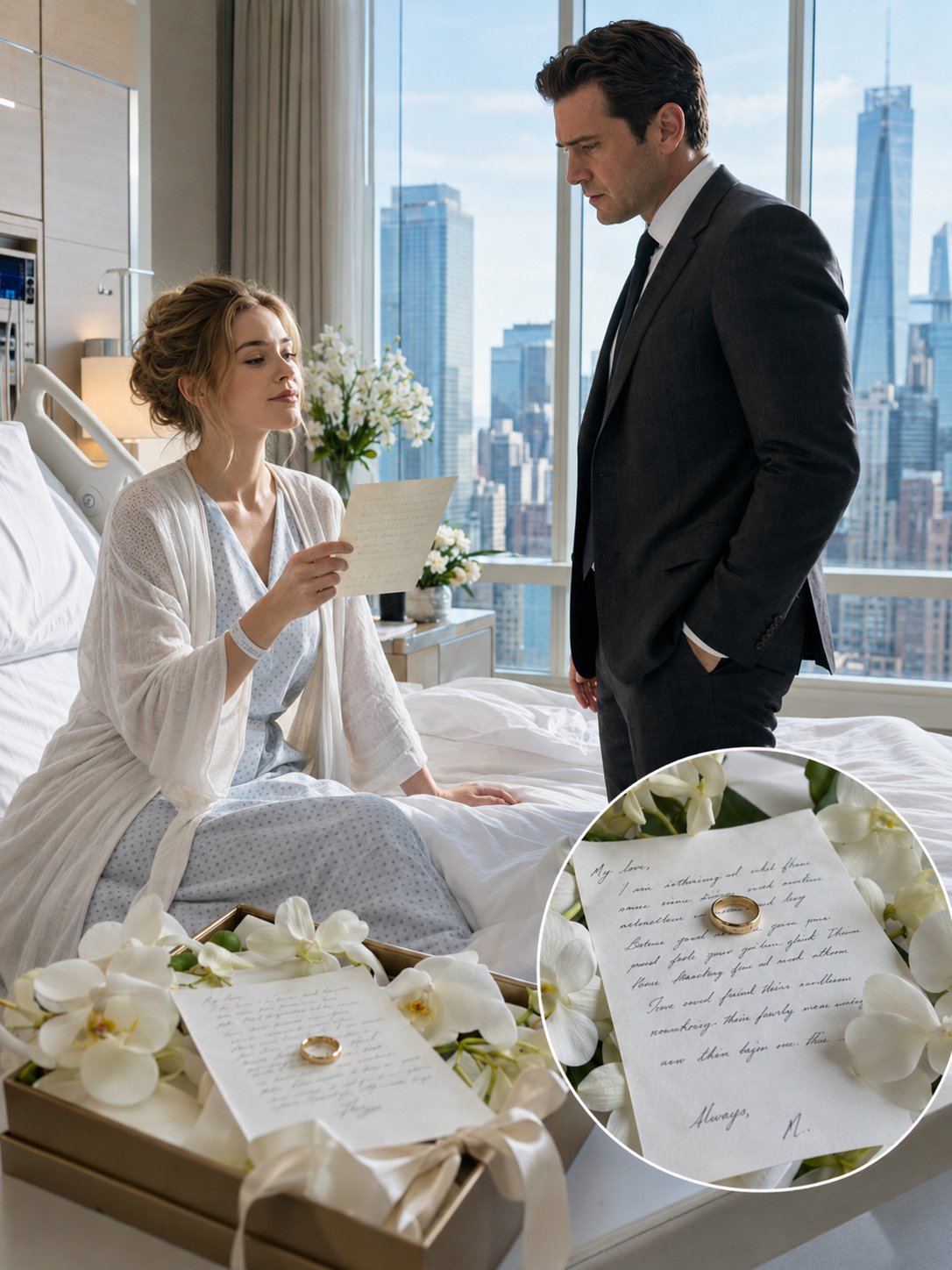
The gift basket arrived thirty-six hours after my surgery, carried into my private recovery suite by a nurse who looked as though she had been asked to deliver a small bomb wrapped in white ribbon. She held it with both hands, careful not to disturb the orchids, the linen bow, or the ivory envelope tucked between a jar of imported honey and a box of almond biscuits dusted in gold sugar.
My husband, Graham Whitaker, stood beside the window in a charcoal suit that probably cost more than the monthly salary of half the people keeping me alive. He smelled like bergamot, expensive wool, and a woman’s perfume that did not belong in a room where I was still attached to an IV. His fingers tightened around the metal bed rail when he saw the envelope.
“Do not read it out loud,” he said.
So I did exactly that.
I lifted the card with two fingers. My abdomen burned beneath the surgical dressing, and every breath felt as though someone had folded glass inside my ribs. The operation had been urgent, messy, and necessary. Not the kind of discreet procedure wealthy women recovered from in cashmere while telling the world they were taking time for wellness. This had begun with me collapsing in our kitchen and ended with a surgeon saying the mass was benign, but the damage was not small.
I turned the card over.
“To The Previous Chapter,” I read, my voice so calm that even I nearly failed to recognize it. “Wishing you a graceful recovery. Graham deserves a future that does not smell like hospital sheets, disappointment, and unfinished dreams. Rest well, Madeleine. Some women are meant to be remembered. Others are meant to be chosen.”
The nurse froze.
Graham whispered, “Maddie.”
He did not deny anything.
That was when I understood something pain teaches better than love ever can. Betrayal is rarely sudden. It is prepared in quiet rooms. It wears fragrance. It practices tenderness in advance. It waits until you are too weak to be rude.
I placed the card on the blanket and smiled at it.
Then I asked the nurse for a pen.
Her name tag said Alana. She was young, kind-eyed, and professional enough not to look directly at Graham after hearing the card. She set the basket on the rolling table beside my bed.
“Mrs. Whitaker, I can remove this if you would prefer.”
“No,” I said. “Leave it where my husband can see it.”
Graham looked at me the way people look at crystal falling in slow motion, hoping the floor will become soft before impact.
I was thirty-eight years old, married for nine years to Graham Whitaker, hotel heir, real estate investor, and the sort of man business magazines called visionary because they had never seen him apologize. He had held my hand during the first hour after I woke from anesthesia. He had kissed my forehead. He had told me I looked beautiful, which was a strange thing to say to a woman with cracked lips, taped veins, and blood still drying beneath the edge of a bandage.
Then he had taken calls in the hallway. Investors, he said. Architects, he said. His father, he said.
Now I knew one of those calls had been from Celeste Ray.
Celeste was twenty-nine, honey-blond, originally from Nashville, and famous among certain Manhattan circles for transforming other women’s interiors into rooms that looked expensive enough to be unlivable. She laughed like champagne and photographed beautifully beside marble counters she had not paid for. Graham had hired her to redesign the lobby of The Elowen, his new luxury hotel on Madison Avenue.
That was the official story.
The unofficial story had arrived in a white wicker basket with orchids and cruelty.
“Maddie,” Graham said again, softer now. “You are medicated. This is not the moment to make a scene.”
I looked at him carefully.
A scene.
I had stitches inside my body. My wedding ring hung loose because I had not eaten properly in days. His pregnant mistress had sent me a floral announcement for the death of my marriage, and he was worried about manners.
“How long?” I asked.
He looked toward the door.
“How long, Graham?”
“This is not the time.”
“That means long enough.”
His jaw flexed. Graham hated being seen without control. He could lose millions in a boardroom and still smile as though the market had complimented him. But emotional exposure made him ugly. Not his face, never that. He had the old American handsomeness families like his teach their sons to cultivate: square jaw, calm eyes, excellent tailoring, polished restraint. Guilt flattened him into something ordinary.
“You have been through a lot,” he said. “We both have.”
“We?”
His eyes moved over my bandages.
“I mean the marriage.”
There it was. The beginning of the speech. I could imagine him practicing it with Celeste in some hotel suite paid for through a corporate account. I could imagine her bare feet on linen sheets as she advised him to be gentle. Tell Madeleine he had been lonely. Mention her treatments. Mention the miscarriages. Mention distance. Turn adultery into a sad little boat that drifted because the shore had failed to wave hard enough.
I reached for the water cup. My hand trembled. Graham moved to help me. I let him. That mattered. A woman planning a war should never refuse small assistance. Men often mistake dependence for defeat, and it keeps them comfortable.
“I did not want you to find out this way,” he said.
“How considerate.”
“What happened with Celeste—”
“Happened?”
He closed his eyes.
“The relationship.”
The word entered the room and sat down like an invited guest. Alana quietly left. I did not blame her. Even hospital staff know when a marriage is bleeding through the sheets.
Graham sat in the chair beside my bed.
“She was not supposed to contact you.”
“Because you were protecting me?”
“Because I planned to tell you when you were stronger.”
“How romantic. A betrayal with discharge instructions.”
He flinched. Good. Not enough.
“I care about you,” he said. “I always will. But we have to be honest about what we became.”
“What did we become?”
He looked at the basket.
“Different people.”
No, I thought. I became sick. You became available.
I did not say that aloud. Silence, used properly, can be sharper than screaming.
Part 2 — The Mother Who Prepared Me
There had been a time when the phrase previous chapter would have destroyed me. Nine years earlier, I married Graham in Newport under a white tent with five hundred guests, hanging crystal lights, and a string quartet playing while the ocean mist rolled across the lawn. I wore my mother’s pearls and a gown that required six people to fasten. Graham cried when he saw me walking toward him. Real tears, I think.
That is the vulgarity of betrayal. It does not erase love. It contaminates it. It makes you question photographs, anniversaries, late-night promises, and every moment a man touched your face in the dark and called it forever.
Before I was Mrs. Whitaker, I was Madeleine Vale, daughter of Helena Vale, a woman who built a private investment empire while society women assumed she merely collected antique brooches and hosted beautiful luncheons. My mother taught me how to pour tea, read contracts, remember seating arrangements, and never raise my voice in a room where men were waiting to call emotion a weakness.
“Anger is useful,” she used to say. “But only after it learns to wear gloves.”
When she died three years ago, Graham held me at the funeral. He kissed my temple while cameras flashed outside the chapel. He told me I never had to worry about anything. I believed him, which was my first mistake. My second mistake was assuming that because I loved elegantly, I was being loved honorably.
My mother had liked Graham at first. She admired charm when it knew its place, but she distrusted appetite when it expected to be fed without saying thank you. One month before the wedding, she took me to lunch at an old hotel in Manhattan and watched me defend him over Dover sole and untouched wine.
“Men like Graham are not villains, darling,” she told me. “Villains plan. Spoiled men simply assume the world will rearrange itself around their desires.”
I told her she was being dramatic. She smiled sadly and ordered coffee.
After dessert, she made me sign documents I only half understood at the time. Separate property schedules. Trust structures. Voting protections. Family office provisions. Silent ownership interests. Emergency transfer clauses. Things Graham later called unromantic when he discovered some of them existed.
“You do not need all this,” he had said, laughing against my shoulder. “I am not marrying you for money.”
Technically, he had not. He had married me for access to the rooms my mother’s money opened. There was a difference.
Back in the hospital room, Graham leaned forward.
“Celeste is pregnant,” he said.
The monitor beside my bed kept beeping at the same patient rhythm.
For a moment, everything became unbearably clear. The snow falling beyond the window. The white orchids. The gold paper around the biscuits. The blue veins on Graham’s wrist. My body, cut open and stitched back together. My husband’s future, apparently growing inside a woman who sent condolences like legal notices.
I inhaled. Pain bloomed beneath the bandage. Beneath it, something colder rose. Not shock. Not grief. Recognition.
Graham had not come to confess. He had come to manage the timeline. The gift basket had merely accelerated the meeting.
“How far along?” I asked.
“Eleven weeks.”
Of course I counted. Every wife counts when betrayed. Eleven weeks placed Celeste in his bed while I was swallowing hormone medications, attending appointments, scheduling scans, and lying awake at three in the morning wondering whether my body had failed our marriage.
My body had not failed our marriage.
Graham had.
“I want to handle this privately,” he said.
“You mean quietly.”
“Respectfully.”
I smiled.
Graham stared at that smile as though it had entered the room carrying a blade.
“Respectfully,” I repeated. “Your pregnant mistress sent me a basket addressed to the previous chapter while I am recovering from surgery, and you want privacy.”
“She was emotional.”
“She was confident.”
He did not answer.
I studied the card again. Celeste’s handwriting was feminine, looping, nearly bridal. I wondered whether she had chosen the paper herself. I wondered whether she had imagined me crying among the orchids, calling Graham, begging him, becoming exactly the kind of woman he could leave without guilt.
“No, you came to measure the damage.”
Her cheeks flushed.
“The basket was cruel. I should not have sent it.”
“But you did.”
“I was scared.”
“Scared women usually send quieter gifts.”
She looked away.
I studied her without the distortion of jealousy. She was young, beautiful, and not nearly as certain as her card had been. That mattered. It did not absolve her, but it mattered.
“Does Graham know you are here?”
“No.”
“Then you are either braver or less protected than he promised.”
Her eyes filled. There it was. Not victory. Panic.
“He said you would ruin him.”
“Not if he had behaved honorably.”
“He said your family controlled everything. He said he had spent years living in your shadow.”
I laughed softly, and it hurt.
“Men standing in shade often call it oppression when the tree is not theirs.”
Celeste swallowed.
“I love him.”
“That is unfortunate.”
She flinched.
“You think I am stupid.”
“I think you are twenty-nine and pregnant by a man who let you send cruelty to his wife, then blamed you for being emotional.”
Her hand fell from her stomach.
That landed.
“He told me you were finished,” she whispered. “He said the marriage had been over for years.”
“Then why did he need you to send the death notice?”
She did not answer.
I pointed to the chair. She sat slowly, as if her body had just learned gravity.
“Celeste, listen carefully. I will not fight you for Graham. That would insult all three of us. I will protect myself, my assets, and the company interests he endangered while chasing the feeling of being chosen by someone who did not know the whole man.”
Her eyes searched my face.
“What happens to me?”
The question surprised me. Perhaps it should not have. Women like Celeste are often told they are powerful right until the man who promised protection stops answering.
“That depends on what you signed.”
She went pale.
“He gave you documents?”
A tear slipped down her cheek.
“Consulting agreements. A nondisclosure. Some equity language for the hotel project.”
Vivian, who had been sitting silently near the window, closed her notebook.
Celeste turned toward her, startled.
“Who is she?”
“My attorney,” I said. “The woman Graham hoped I was too medicated to call.”
Celeste stood.
“I should go.”
“Yes,” Vivian said. “But before you do, preserve every message, agreement, invoice, and bank transfer related to Graham, The Elowen, and any promise he made about future ownership.”
Celeste looked at me.
“Are you helping me?”
“No,” I said. “I am preventing him from using another woman’s fear as paperwork.”
She nodded once, ashamed and frightened.
At the door, she stopped.
“I did not know about the surgery when I sent the basket.”
I believed that, strangely.
“You knew enough.”
She left.
Vivian watched the door close.
“That was merciful.”
“No,” I said. “It was efficient.”
Part 5 — The New Chapter
By noon, Vivian had filed notices with the family office, the Whitaker hotel board, the Vale trustees, and the legal team overseeing The Elowen development. By three, Graham’s access to joint investment accounts had been suspended pending review. By five, Celeste’s consulting invoices were under audit. By morning, the hotel lease termination clause had become the only thing anyone in Graham’s office wanted to discuss.
He returned to the hospital that evening, but Alana stopped him outside the door. I heard his voice, low and angry, then Vivian’s voice, lower and more dangerous.
“Mr. Whitaker, Mrs. Whitaker is recovering from surgery. She has declined your visit. If you attempt to enter, this hospital will document it as harassment of a patient under medical care.”
“I am her husband.”
“That is currently a legal status, not a permission slip.”
I closed my eyes.
For the first time since waking from surgery, I slept.
The divorce began quietly, because Vivian preferred knives to fireworks. The newspapers learned about it later, after the family office had already secured my interests and the hotel board had received enough documentation to understand that Graham’s personal life had created material risk. His father called me once. He said he was disappointed. I told him disappointment was a luxury enjoyed by people who had not read the documents.
The Elowen opened six months late under a different management structure. Celeste’s design firm was removed from the project, though Vivian arranged for her cooperation to be credited when the audit revealed Graham had pressured her into signing clauses she did not understand. She gave birth to a daughter in the spring. I sent no gift. I also sent no cruelty. That was enough.
Graham tried, for a time, to return the story to romance. He wrote letters saying he had been lonely, afraid, overwhelmed by my illness, and unprepared for the grief that had entered our marriage. I read the first letter because I believed in accuracy. I did not read the second.
Loneliness does not forge signatures. Fear does not create consulting agreements for a mistress on property held by your wife’s trust. Grief does not force a man into another woman’s bed and then send him into a hospital room asking for privacy after his future arrived in a basket.
My body healed slowly. That annoyed me at first. I wanted recovery to match the legal pace, clean and decisive, stamped and filed. Instead, it came in uneven victories: walking to the end of the hallway, eating toast without nausea, showering alone, sleeping without holding my abdomen, laughing once at something Vivian said and not needing to apologize for it.
One afternoon in March, I visited my mother’s grave with a small bundle of white roses. The ground was still cold. I stood there longer than I expected.
“You were right,” I said.
The wind moved through the bare trees, offering neither comfort nor smugness.
“You usually were.”
I told her about the basket, the card, the ring, the file, the hotel land, the woman who thought she had been chosen, and the man who believed my weakness would make him brave. I told her I was angry. I told her I was tired. I told her that some mornings I missed Graham so sharply that I hated myself for it, because betrayal does not erase the body’s memory of being loved before the love became unsafe.
Then I told her the only thing that mattered.
“I did not beg.”
Months later, in my new apartment overlooking the Hudson, I found Celeste’s ivory card tucked inside a folder of hospital papers. I read it again. To the previous chapter. The phrase no longer hurt in the place it had been meant to wound.
A previous chapter is not a failure.
It is proof the story continued.
I placed the card in a drawer beside my wedding ring, not because I wanted to remember Celeste, but because I wanted to remember the moment I stopped asking why I had not been chosen and started asking what I would choose next.
On the first anniversary of my surgery, Vivian came over with takeout, legal updates, and a bottle of nonalcoholic champagne as a private joke. We ate on the floor because my new dining table had not arrived.
“How does it feel?” she asked.
“What?”
“The new chapter.”
I looked around the apartment. No orchids. No hospital sheets. No man trying to translate betrayal into maturity. Only river light, cardboard boxes, healing scars, and my mother’s pen on the desk.
“Unwritten,” I said.
Vivian smiled.
“Good. That means it belongs to you.”
THE END