
My Mother Ruined My Dress Until Two Stars Revealed Who My Father Had Humiliated Publicly…-haohao

I walked through the ballroom doors without running, although red wine dripped from my dress and laughter followed me into the marble hallway.
Behind me, my father’s diamond jubilee continued beneath chandeliers, polished medals, floral arrangements, and the comfortable cruelty my family always called humor.
Nobody followed me, because Victor Ross believed humiliation worked best when the person receiving it quietly removed herself from view.
My mother had not spilled wine accidentally, and Kevin had not laughed because the moment caught him by surprise.
They had rehearsed that scene through decades of smaller performances, each designed to remind me I belonged beneath their expectations.
The hotel elevator opened slowly, reflecting my stained dress, straight shoulders, and expression so calm it almost frightened me.
I stepped inside, pressed the button for the private suite level, and removed my phone from the clutch beneath my arm.
There was one message waiting from my aide, Colonel Mara Jennings, who had been parked nearby exactly as protocol required.
Uniform pressed, decorations secured, transportation standing by, ma’am; General Sterling has arrived and is requesting your final authorization.
I looked at the crimson stain across my chest, then typed four words before the elevator doors closed between me and childhood.
Authorization granted; bring everything upstairs.
My father had told everyone I never became anything because I never returned home wearing achievements he could display socially.
He believed I worked an administrative military position somewhere in Washington, useful enough for benefits yet insignificant beside his lieutenant colonel stories.
That misunderstanding had not happened by accident, because Victor never asked questions unless the answers promised to flatter him.
When I graduated from West Point, he skipped commencement because Kevin’s junior golf tournament supposedly required family unity and visible encouragement.
When I deployed to Iraq, Mom mailed one Christmas card addressed to “Elena, somewhere abroad,” without mentioning the war once.
When I earned my first star, I sent both parents an invitation to the ceremony, signed personally, delivered with confirmation.
Three weeks later, the envelope returned unopened, marked by my mother’s handwriting with two words: Moved forward.
So I moved forward too, serving soldiers whose lives depended upon competence rather than begging relatives to notice my existence.
I commanded logistics brigades during evacuations, managed disaster response after hurricanes, and coordinated medical corridors beneath enemy rocket fire overseas.
During the Kabul withdrawal, my task force extracted hundreds of civilians and service members after two planned routes collapsed simultaneously.
I lost friends, gained scars beneath my ribs, and learned responsibility becomes loneliest when every choice carries somebody else’s heartbeat.
Promotion to major general arrived after a classified readiness investigation involving procurement theft, veterans’ funds, and compromised medical supply contracts.
The two silver stars placed upon my shoulders were not ornaments designed to impress ballrooms or silence insulting relatives.
They represented every soldier who trusted my orders, every wounded family awaiting treatment, and every truth I refused allowing power to bury.
What my father did not know was that his own celebration existed uncomfortably close to the investigation now sitting on my desk.
Victor’s diamond jubilee was not merely a birthday party honoring seventy-five years of pride, whiskey, and embellished military memories.
Kevin served as executive director, while my mother hosted fundraising lunches where pearls, champagne, and patriotic language collected enormous donations quickly.
General Robert Sterling had been invited as the evening’s honored guest because Victor wanted a respected signature beneath their public launch.
Sterling was also my immediate superior, the four-star officer who assigned me oversight of suspicious defense-linked philanthropic contracts months earlier.
Three shell nonprofits, missing grants, and falsified veteran beneficiaries had already led our investigators directly toward Kevin’s polished little foundation.
I had accepted my father’s invitation because protocol required one final confirmation before authorities formally intervened during the fundraiser.
Even then, some wounded daughter inside me hoped Victor might see me enter in a simple dress and choose kindness voluntarily.
Instead, Mom drenched me in wine, Kevin mocked my appearance, and Father ordered me hidden inside a parking lot like garbage.
In the private suite, Colonel Jennings waited beside a garment rack carrying my Army Blue Mess Uniform inside a protective cover.
She saw the stained dress, looked immediately toward my face, and restrained her anger only because discipline was part of her brilliance.
“Ma’am,” she said carefully, “was that deliberate, or should I contact medical services and hotel security regarding an incident?”
“It was deliberate,” I answered, stepping out of my heels, “but the evidence downstairs will matter more than the wine.”
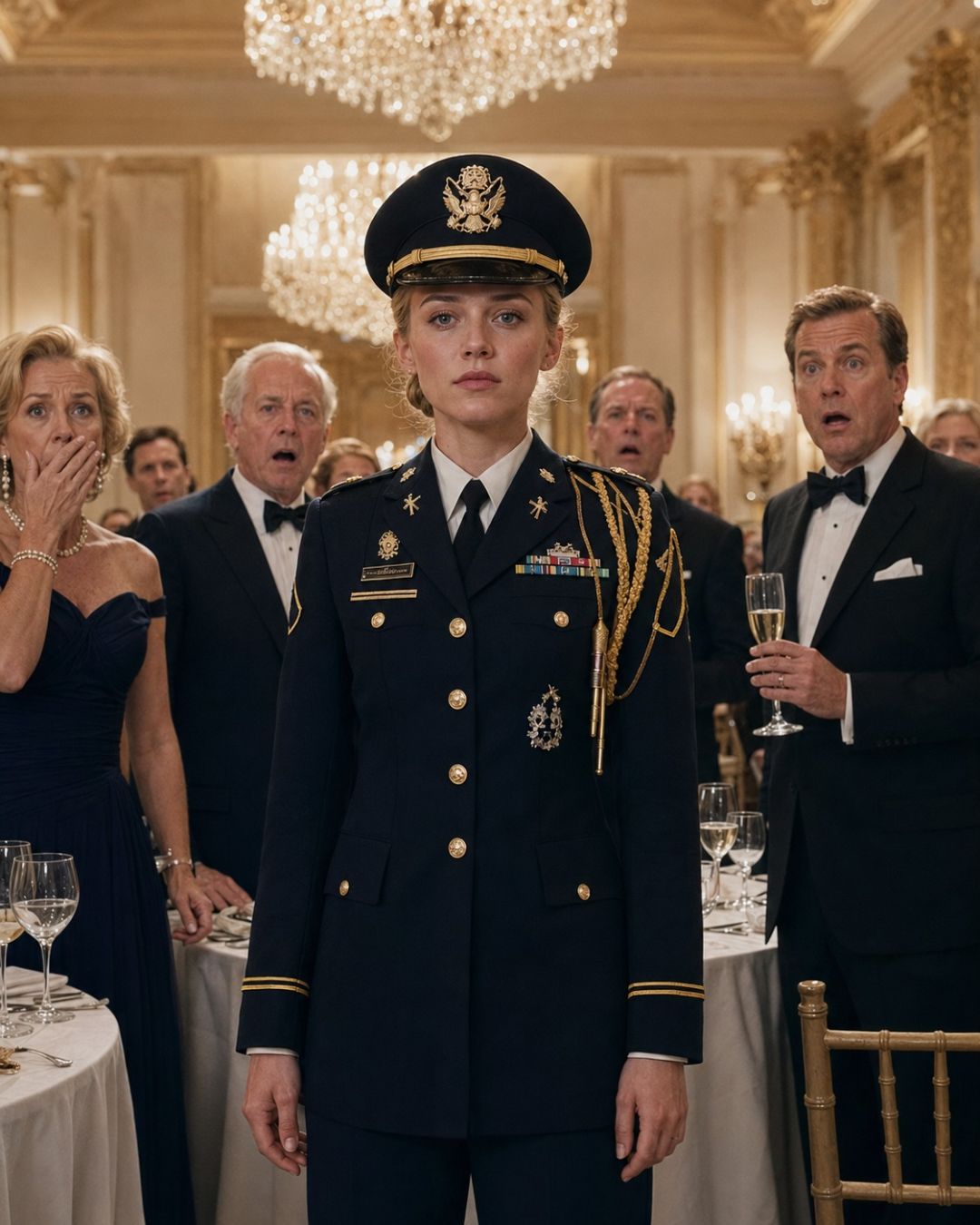
Mara unzipped the garment bag, revealing dark formal fabric, miniature decorations, gold braid, and two stars gleaming beneath lamplight.
For several seconds, I simply stood there, seeing not power, but the years my family treated devotion as embarrassing failure.
Mara helped secure my decorations, adjusted the jacket seam, and silently offered a clean cloth for the wine still touching my skin.
When she finally spoke, her voice was gentler than anything I had heard downstairs throughout the entire glittering evening.
“General Ross, no uniform can make you more worthy than you already were when you entered wearing that black dress.”
That sentence nearly broke me, because compassion from a subordinate exposed how completely my parents had failed basic human decency.
I thanked her, fitted my cover beneath my left arm, and accepted the thick investigation folder she placed into my hand.
On top sat the preliminary evidence summary, followed by donor transfers, falsified beneficiary names, and Kevin’s electronic authorizations.
The final page carried General Sterling’s signed directive permitting notification of civil investigators once public fundraising representations began tonight.
By the time I reached the elevator again, I was no longer the daughter ordered to sit quietly inside a car.
I was Major General Elena Ross, commanding officer, investigator, and witness to a fraud my family considered untouchable.
Downstairs, the ballroom music continued, because Victor never allowed another person’s embarrassment to disrupt an evening celebrating him.
My stained black dress had probably already become an amusing story exchanged beside champagne flutes and expensive dessert plates.
The elevator opened near the grand staircase overlooking the ballroom, where waiters moved beneath chandeliers carrying silver trays of champagne.
I stepped forward onto the balcony landing, my polished shoes striking marble with one clean sound above the music.
A young captain near the staircase saw me first, froze instantly, then straightened with the instinctive recognition of rank.
His motion caught another officer’s attention, then another, until conversations faltered in widening circles across the ballroom below.
The jazz ensemble reached the middle of a song before its bandleader noticed guests turning away from the dance floor.
One by one, instruments lowered, notes disappeared, and the ballroom finally achieved the silence my stained dress never received.
At the center table, my mother looked upward first, champagne glass trembling slightly between perfectly manicured fingers and jeweled bracelets.
Kevin followed her gaze, his smirk collapsing before his mouth managed to construct another easy insult about my appearance.
My father turned last, irritated by any disruption occurring before General Sterling formally toasted his carefully polished public reputation.
Then Victor saw my shoulders, and every rehearsed expression deserted his face in less than one visible breath.
His lips parted slowly, the color beneath his cheeks disappearing while his hand gripped the tablecloth beside his untouched wine.
“Wait,” he whispered, loud enough for nearby guests to hear in the dead ballroom, “are those two stars?”
I descended the staircase without answering, because no explanation could improve the evidence glittering calmly against my uniform shoulders.
An active-duty colonel near the front table snapped to attention first, followed immediately by officers who understood protocol better than gossip.
Retired service members rose next, some slowly, some using canes, their faces shifting from curiosity into unmistakable recognition and respect.
General Sterling emerged from beside the stage, where Victor had apparently positioned him like the evening’s most valuable decoration.
The four-star general did not glance toward my father, shake Kevin’s waiting hand, or accept my mother’s startled social smile.
He walked directly across the dance floor toward me, stopped three paces away, and rendered a deliberate, flawless salute.
“Major General Ross,” he said, his voice filling the ballroom, “thank you for joining us before tonight’s proceedings begin.”
I returned his salute, holding it long enough for my father to understand this was neither costume nor family rebellion.
When our hands lowered, the room remained completely silent, except for one dropped fork clattering against china near the back.
Victor pushed away from his table unsteadily, trying to recover the authority he usually summoned through volume and public confidence.
“General Sterling,” he said, forcing laughter, “surely there is some misunderstanding; Elena never mentioned anything about being a general.”
Sterling turned toward him with an expression so controlled it made my mother immediately lower her glass onto the table.
“Lieutenant Colonel Ross,” he said, emphasizing my father’s retired rank precisely, “your daughter’s promotion was documented through official public channels.”
“He may mean that she never mentioned it personally,” Kevin interrupted quickly, attempting a smile beneath his suddenly damp forehead.
I looked at my brother, remembering the janitor-uniform insult delivered minutes earlier while wine dripped from my mother’s victorious fingers.
“I sent invitations to both promotions,” I said quietly. “Our parents declined to open one and returned the other unopened.”
Guests began turning toward Victor and my mother, because humiliation shifts direction quickly once witnesses understand who manufactured it.
Mom pressed one hand against her chest, insisting invitations became lost after relocations, renovations, travel, and unfortunate household confusion.
“We never knew,” she said. “Elena has always preferred secrets, distance, and making her family feel excluded from her life.”
The words were familiar, beautifully packaged blame, turning abandonment into my privacy and their contempt into wounded parental confusion.
General Sterling appeared prepared to answer, but I lifted one hand slightly, because this truth finally belonged to my voice.
“You knew I joined the Army,” I said. “You knew I deployed, commanded, was injured, and continued serving anyway.”
“You never knew my rank because knowing me required curiosity, while dismissing me allowed Kevin and Father to feel larger.”
My father recoiled as though I had attacked him, then glanced around the room, assessing how many donors still listened.
“This is my celebration,” he snapped. “Whatever resentments you carried here should have stayed outside this ballroom tonight.”
“No, Victor,” Sterling said, before I could respond. “Tonight is not merely your birthday celebration, according to documents provided publicly.”
He gestured toward the enormous banner beside the stage, announcing the Ross Patriot Foundation’s gala launch and adaptive housing mission.
Victor’s anger vanished behind a careful smile, because the charity represented the version of himself he needed guests to believe.
“Yes,” he replied proudly. “We are honoring veterans through action rather than parading around in uniforms demanding personal attention.”
A visible ripple passed through nearby officers, while Mara approached quietly from the staircase carrying a secure leather folio.
I did not react to his insult, because Father had unknowingly stepped directly into the only conversation I came prepared to finish.
“Then let us discuss action,” I said, accepting the folio. “Specifically, where your foundation’s veteran housing donations actually traveled.”
Kevin’s hand tightened around his champagne flute, while Mom whispered his name with the sudden fear of someone seeing smoke.
I opened the investigation folder and placed three certified pages upon the nearest empty table beneath the ballroom chandeliers.
“The Ross Patriot Foundation collected four point six million dollars by promising accessibility renovations for injured veterans,” I stated.
“Our preliminary review identified twelve listed recipients, including five deceased veterans and three addresses belonging to vacant commercial warehouses.”
Nobody moved, because patriotic fraud sounds especially obscene inside a room decorated with flags, medals, and surviving service members.
Kevin laughed weakly, claiming charities often experienced clerical errors, delayed construction, and confused subcontractor addresses during early fundraising expansion.
I turned the next document toward him, displaying electronic transfers traced from foundation accounts into a luxury development company he controlled.
“These are not clerical errors,” I said. “They are signed authorizations transferring donations into properties marketed as private vacation investments.”
My mother reached for a chair before she fell, while Victor stared at Kevin with fury shaped more by exposure than surprise.
“You told me everything was legitimate,” Father hissed, revealing in eight words that ignorance was not the defense he imagined.
Kevin answered too quickly, insisting Victor approved branding agreements and received consulting payments for lending his military reputation publicly.
Several guests withdrew from their tables, as though physical distance could protect them from association with whatever had just opened.
General Sterling nodded once toward two men near the ballroom doors, and federal investigators quietly stepped inside wearing identification credentials.
Victor saw them, then looked toward me with an expression I had waited my entire life to stop fearing.
“You did this,” he said, pointing unsteadily. “You came here intending to ruin my name before my friends.”
I looked at the man who once called my first deployment a childish attempt to make him notice my mediocrity.
“I came here hoping the evidence was wrong,” I answered. “You ruined your name each time you signed without asking.”
He struck the table with his palm, shouting that a daughter owed loyalty before procedure, before agencies, before military ambition.
Every word carried the same entitlement that once made him order me away after my mother drenched me in wine.
“Soldiers owe loyalty to honorable conduct,” I replied. “Children owe honesty, not protection for parents who knowingly profit from wounded veterans.”
General Sterling instructed investigators to proceed, and the lead agent approached Kevin with documents authorizing seizure of electronic records immediately.
Kevin began protesting, pointing toward me and claiming family jealousy had weaponized military authority against his successful charitable enterprise.
The investigator stated calmly that my office initiated review only after independent donor complaints and bank compliance alerts matched precisely.
Father sat down suddenly, as though his legs no longer trusted the stories he forced them to carry through decades.
My mother crossed the floor toward me then, tearful and pale, speaking softly as if kindness could be manufactured instantly.
“Elena, sweetheart, this has gone far enough,” she whispered. “Your father is elderly, and Kevin has children who need stability.”
I glanced toward the darkened stain still drying across the black dress bag Mara carried behind the staircase landing.
“You threw wine over me fifteen minutes ago,” I said. “Did you believe I had no family then?”
Her face collapsed, not from regret, but because witnesses heard the question and recognized her silence as the answer.
A woman from Victor’s church committee stepped backward from my mother, shaking her head with open disgust and disbelief.
Sterling asked the hotel manager to preserve security footage from the evening, including the incident occurring before my uniformed return.
Mom immediately insisted she had tripped, yet several nearby guests began volunteering that they watched her aim the glass deliberately.
I did not need the wine recorded for justice, but watching her social mask dissolve felt like childhood finally receiving witnesses.
Victor rose once more, slower now, no longer commanding a room, but pleading with an audience withdrawing its admiration.
He announced that his service deserved respect regardless of his adult children’s mistakes, and that he personally never stole anything.
General Sterling removed a page from the folio and handed it to him without expression or unnecessary commentary.
Victor read the document, and his remaining confidence disappeared beneath a transfer authorization bearing his unmistakable signature and private account number.
Two hundred thousand dollars had entered an account held jointly by Victor and my mother as foundation advisory compensation payments.
He stared at the page, then at Kevin, while my brother quietly stopped speaking and requested an attorney instead.
That request ended any illusion remaining among the guests, because innocent family misunderstandings rarely require criminal counsel before dessert service.
An investigator asked Victor to remain available for formal questioning, while another secured Kevin’s laptop from beneath the registration table.
The ballroom remained suspended around us, flowers gleaming, candles flickering, champagne warming inside glasses nobody wished to lift anymore.
General Sterling stepped beside me, lowering his voice so only Mara, myself, and the closest officers could clearly hear.
“You conducted yourself with restraint under provocation,” he said. “Your command will document no conflict beyond proper disclosure and recusal.”
I nodded, grateful for the procedural clarity, though inside me a daughter still stood drenched in wine awaiting someone’s defense.
My father watched Sterling address me respectfully, and for the first time appeared to understand rank had not created my worth.
It had merely become the language he respected enough to hear after refusing every softer language I offered throughout life.
He crossed toward me before investigators could stop him, carrying no authority now, only disordered desperation beneath a loosened bow tie.
“Elena,” he said quietly, “why did you never tell me who you became?”
The question nearly made me laugh, because it treated my entire life like a secret rather than evidence he ignored.
“I told you when I commissioned,” I answered. “I told you when I deployed, promoted, returned injured, and requested your presence.”
“You never wanted to know who I became unless it improved the way strangers looked at you in rooms like this.”
His shoulders dropped, and I saw age settle upon him without the flattering protection of medals or loyal family performance.
“I was proud of Kevin,” he muttered weakly, as though admitting preference somehow explained the years it sharpened into cruelty.
“You were cruel to me,” I answered. “Pride in one child never required making the other believe she was shameful.”
He opened his mouth, but no words emerged capable of returning ceremonies, unopened invitations, or wine-stained years to me.
My mother remained near the head table, crying while guests avoided her gaze, and Kevin disappeared between federal agents and lawyers.
I could have remained there to watch every humiliation unfold, but I had spent enough of my life inside their spectacle.
I turned toward Mara and asked her to arrange my departure after providing the necessary statement to investigators downstairs quietly.
Before leaving, General Sterling requested permission to address the guests, because donations and veterans deserved truth rather than rumors.
He stepped onto the stage where Victor expected receiving praise, adjusted the microphone, and faced the frozen ballroom solemnly.
He confirmed the fundraiser was under investigation, promised affected donations would be traced, and requested donors cooperate fully with authorities.
Then he spoke about service, not as decoration, social standing, or an excuse permitting cruelty beneath patriotic table settings.
“Honor is not the rank you once held,” Sterling said. “Honor is what remains when nobody benefits from applauding you.”
He turned toward me near the ballroom doors, and every active-duty officer in the room followed his movement instinctively.
“Major General Elena Ross represents that honor tonight, not because of stars, but because she protected people despite personal cost.”
The officers saluted, followed by retired service members, and then civilians stood slowly, uncertain but moved beyond comfortable silence.
I returned the salute with steady hands, though tears finally reached my eyes beneath the chandeliers my mother wanted me hidden beneath.
Victor did not salute, because his hands hung motionless at his sides while the room offered me the respect he withheld.
Outside, evening air touched my face coolly, carrying rain, car exhaust, and music leaking faintly from another celebration nearby.
Mara walked beside me without speaking until we reached the government sedan waiting beyond the hotel’s circular entrance driveway.
“Would you like the stained dress preserved as evidence?” she asked, holding the garment bag carefully by its clean edge.
I looked at the ruined fabric, once chosen because I hoped appearing modest might make my family finally less threatened.
“Yes,” I answered, “but afterward, donate an identical dress to a woman who needs one for something worth celebrating.”
Mara smiled faintly, opened the rear door, and let me enter without treating my tears like a leadership failure.
The investigation lasted eight months, uncovering falsified grant applications, redirected donations, and repeated payments disguised as family consulting expenses.
Kevin accepted a plea agreement after auditors documented his control of shell companies, while several properties were seized for restitution.
My mother claimed she never read financial records, yet messages proved she coached donor stories and celebrated money reaching their accounts.
Victor avoided prison because of age, cooperation, and limited direct involvement, but probation could not restore his vanished community standing.
His name disappeared from veterans’ boards, charity invitations, speaking engagements, and the social circles he cultivated more carefully than family.
He sent me three letters after sentencing, each beginning with my title before eventually learning to write simply, Dear Elena.
I read the final one months later, not because he earned forgiveness, but because I no longer feared what his words contained.
He admitted my mother intended humiliating me that evening, and he permitted it because my quietness always made cruelty feel consequence-free.
He admitted knowing I served honorably, though never understanding my stature, because asking questions might have challenged his preferred family hierarchy.
At the bottom, he wrote that seeing two stars on my shoulders showed him exactly what his blindness cost.
I folded the letter carefully, placed it inside a locked drawer, and decided understanding was not the same as reconciliation.
My career continued, filled with briefings, deployments, hospital visits, grieving families, and younger officers quietly seeking guidance after being dismissed.
One afternoon, a newly promoted captain stood outside my office holding an invitation to a ceremony her parents declined attending again.
She tried smiling while explaining they believed her brother’s business award deserved the family’s travel budget more than her promotion.
I invited her inside, offered coffee, and told her something Mara once gave me when wine still stained my skin.
“No uniform makes you worthy,” I said. “It only shows people who refused seeing the strength already standing before them.”
At her ceremony, I stood in the first row while her commander pinned new insignia upon shoulders shaking with held-back tears.
Afterward, she hugged me unexpectedly, whispering that nobody in her family had ever risen for her before that afternoon.
Driving home, I finally allowed myself to grieve the version of Elena who once believed excellence could purchase parental tenderness.
It could not, because people determined to diminish you experience your success as disobedience rather than invitation to love.
My two stars remain on my mess uniform, polished carefully before ceremonies and worn without apology beneath whatever lights await.
Beside them, hidden inside the garment case, rests a tiny fragment of the ruined black dress stained forever with dried wine.
I kept it not as evidence of shame, but as proof of the exact evening I stopped dressing for their approval.
My father called me a failure until the ballroom recognized the general standing where his rejected daughter had always been.
And when the music died, it was not my rank that silenced the room, but the truth he could no longer command.