
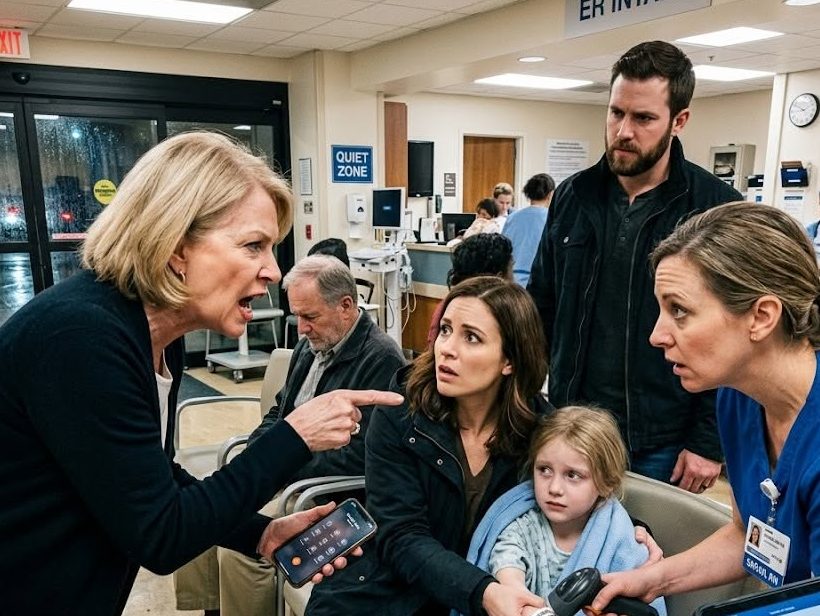
My Niece Whispered From a Locked Closet—Then My Mother Threatened Me

My niece called me whispering from a closet my parents had latched shut from the outside. I carried her to the ER. Then my mother threatened me in front of the nurse: “Return her, or we file a police report saying you kidnapped Lizzy and you lose your own child.” I turned toward the nurse scanning Lizzy’s hospital bracelet and watched her face go pale.
The call came while rain hammered my bedroom window hard enough to wake me before the phone did.
For a few confused seconds, I lay there listening to the weather and trying to understand why my heart was already pounding.
Then I saw the name glowing on my screen.
Lizzy.
My six-year-old niece almost never called me herself.
I answered immediately.
Her voice was so quiet I had to press the phone against my ear.
“Aunt Natalie, please help me,” she whispered. “I’m locked in. I’m hungry.”
There was something in the way she said it that made every other thought disappear.
She was not whispering because someone was sleeping nearby.
She was whispering because she was afraid of being heard.
I pushed myself upright and asked where she was, but the call ended before I could get an answer.
The screen went dark.
I stared at it for half a second, then called her back.
Nothing.
But I already knew where she had to be.
My parents, Gloria and Walt, had taken guardianship of Lizzy after my brother Ian entered treatment.
From the outside, they looked exactly like the kind of grandparents people trusted.
They kept things neat.
They filled out forms carefully.
They knew how to smile at the right time, lower their voices when someone asked a difficult question, and explain away anything uncomfortable before anyone could look too closely.
If Lizzy flinched when Walt moved too quickly, Gloria said she was sensitive.
If I mentioned that Lizzy seemed thinner, Walt said she had become picky about food.
If Lizzy stayed unusually quiet during a visit, my mother would smooth her hair and say she was tired.
Every concern had an answer.
Every warning sign had an explanation.
And because none of those explanations sounded dramatic by themselves, I had let myself wonder whether I was reading too much into things.
That stopped the moment I heard Lizzy whisper that she was locked in and hungry.
I woke my husband, Adam, and told him what had happened.
Our son, Noah, was asleep, and I told Adam to stay with him.
There was no discussion about whether I should go.
I pulled on clothes, grabbed my keys, and drove across town with the windshield wipers fighting to keep up with the rain.
The whole way there, I kept replaying Lizzy’s voice.
Please help me.
I’m locked in.
I’m hungry.
I tried calling again.
No answer.
By the time I reached my parents’ house, fear had settled into something sharper.
Their porch was dark.
The curtains were closed.
I ran up the steps and pounded on the front door.
“Mom! Dad!”
Nothing.
I hit the door again and shouted Lizzy’s name.
Still nothing.
Rain ran down the back of my coat while I stood there listening for movement inside the house.
No footsteps came toward the door.
No light switched on.
No one called out to ask what I was doing there.
That silence made the decision for me.
I went around the house.
Near the kitchen, I grabbed a landscaping rock and struck the window.
The glass broke inward and scattered across the tile.
The sound was enormous inside the dark house.
For one instant I waited, expecting Walt to come charging into the room or Gloria to start yelling.
Nothing happened.
So I climbed inside.
I called Lizzy’s name as I moved through the house.
At first, there was no answer.
Then I heard something faint from upstairs.
I took the stairs fast enough that I nearly slipped.
At the end of the hallway, several plastic Christmas storage bins had been shoved together in front of a closet.
That alone stopped me.
Those bins did not belong there.
I pushed them aside.
Behind them was a metal latch screwed across the outside of the closet door.
I knew the hardware immediately.
It was the same kind Walt used in his garage.
A latch on the outside meant whoever was inside could not open the door.
My hands shook as I lifted it.
I pulled the closet open.
Lizzy was curled behind the winter coats.
She had one skinny arm raised over her face.
For a moment she did not move.
Then she recognized me.
I dropped down beside her and reached for her.
She did not burst into tears.
She did not start talking.
She simply let me pick her up.
Somehow, that frightened me more than crying would have.
A six-year-old who had just been found locked in a closet should have had a hundred things to say.
Lizzy just folded against me as if she had learned that being quiet was safer.
I wrapped my jacket around her and carried her downstairs.
Before I left, I forced myself to slow down long enough to document what I had seen.
I photographed the broken kitchen window so there would be no question about how I entered.
I photographed the Christmas bins blocking the hallway.
I photographed the closet door.
I photographed the metal latch screwed to the outside.
I photographed the dark space behind the coats where Lizzy had been curled.
Then I captured the call log on my phone with Lizzy’s name, the time, and the length of the call still visible.
I was terrified, but I understood one thing clearly.
My parents always had an explanation.
This time, I wanted facts that could not be smoothed over with a calm voice.
I carried Lizzy out into the rain and drove her to the ER.
Under the bright hospital lights, she somehow looked even smaller.
A nurse wrapped a warm blanket around her shoulders and fastened a white hospital bracelet around her wrist.
Lizzy kept one hand around mine while she ate crackers in tiny bites.
She chewed carefully and quietly.
Even the way she ate bothered me.
She seemed to be trying not to make noise.
I sat beside her and watched every small movement, remembering all the times I had accepted the explanation that she was simply shy, sensitive, tired, or picky.
Now those words sounded different.
Adam arrived before intake was finished.
He came straight to us and stood beside my chair.
He did not ask why I had broken the window.
He did not ask whether I was sure I had done the right thing.
He looked at Lizzy.
Then he looked at the crackers in her hand and the careful way she was eating them.
His jaw tightened.
That was enough.
For the first time since the phone rang, I felt that I was not carrying the entire situation by myself.
Then I saw my parents walk into the waiting area.
Gloria came in first, with Walt beside her.
My mother’s eyes went immediately to Lizzy.
But there was something strange about the way she looked at her.
She did not rush forward.
She did not ask whether Lizzy was hurt.
She did not ask why her granddaughter was wrapped in a hospital blanket.
Instead, her gaze moved over the details around her.
The blanket.
The white bracelet.
The nurse’s chart.
My phone in my hand.
It looked less like concern and more like calculation.
As though she were trying to determine how much had already been seen, recorded, and written down.
Walt stayed slightly behind her.
My mother came closer.
Lizzy’s fingers tightened around mine.
That tiny movement told me more than any speech could have.
Gloria stopped close enough that the nurse could hear her clearly.
Then she said, “Return her, or we file a police report saying you kidnapped Lizzy and you lose your own child.”
For a second, I could barely process the threat.
She was not only demanding that I hand Lizzy back.
She was threatening Noah.
She knew exactly which fear to use against me.
Adam stiffened beside me.
The nurse stopped writing.
Every angry thought in my head collided at once.
I wanted to ask my mother how she could stand in a hospital and threaten me after I had found a six-year-old locked behind an outside latch.
I wanted to demand an explanation for the closet.
I wanted to tell Walt exactly what I thought of the hardware he had installed.
I wanted to raise my voice loudly enough that every person in the waiting area understood what had happened.
But Lizzy’s hand was still inside mine.
Her fingers were cold.
And I realized that giving my mother the argument she wanted would not protect Lizzy.
Proof might.
So I did not argue.
I took out my phone.
Gloria watched me, probably expecting me to call someone or back down.
Instead, I opened the call log.
I showed the nurse Lizzy’s name.
I showed her the time.
I showed her the length of the call.
Then I opened the photographs.
The broken kitchen window came first.
I did not hide it.
I had broken it, and I was prepared to say so.
Then came the upstairs hallway.
The plastic storage bins.
The closet door.
The metal latch mounted on the outside.
The dark space behind the winter coats.
The nurse’s expression changed gradually as she moved from one image to the next.
She did not make a dramatic announcement.
She did not lecture my parents.
She simply looked more carefully.
That was worse for Gloria than anger would have been.
My mother had always been good at managing emotions.
She knew what to do with someone who was upset.
She could dismiss anger as overreaction.
She could describe concern as misunderstanding.
She could turn accusations into family conflict and family conflict into two sides of the same story.
But the nurse was not arguing with her.
She was observing.
The photographs did not shout.
They just existed.
Lizzy had called me.
There had been a latch.
The latch had been outside the closet.
The bins had been pushed into the hallway.
Lizzy had been inside.
My mother could tell a story around those facts, but she could not make them disappear.
The nurse looked from my phone to Lizzy.
Her gaze settled on the white hospital bracelet around Lizzy’s wrist.
Then she looked back at Gloria.
For the first time since my parents walked into the waiting area, my mother’s confidence seemed less certain.
She pointed toward me as though she could still force the conversation back onto what I had done.
The broken window.
Taking Lizzy.
Bringing her to the hospital.
The threat about a kidnapping report had been designed to make those actions the center of the story.
But the nurse now had the call log in front of her.
She had seen the pictures of the latch.
She had Lizzy sitting only a few feet away, wrapped in a warm blanket and eating crackers in careful little bites.
Adam remained beside me.
He still had not said anything unnecessary.
He did not need to.
His presence mattered because my mother’s threat had included our own child.
She wanted me to imagine losing Noah if I refused to return Lizzy.
Adam standing there reminded me that the threat did not automatically become truth just because Gloria said it with confidence.
Lizzy squeezed my hand again.
I looked down at her.
She did not seem interested in the argument happening around her.
She watched the nurse.
Maybe the blanket felt warm.
Maybe the crackers were the first thing that mattered to her in that moment.
Maybe she was simply exhausted.
I could not know everything she was thinking.
But I knew she had called me from that closet.
Whatever happened next, I could not pretend I had not heard her.
The nurse reached gently for Lizzy’s wrist.
She rolled the hospital bracelet until the barcode faced upward.
The movement was small and ordinary.
Yet everyone around us seemed to follow it.
The nurse positioned the scanner.
A soft beep cut through the waiting area.
Gloria’s pointing hand froze.
Walt finally moved.
He lowered himself into a chair and looked away from all of us.
It was the first time since they arrived that he seemed to understand the situation was no longer contained inside the family.
Lizzy tightened her grip on me.
I kept my hand steady around hers.
The nurse turned back to the chart.
She opened it to a blank section.
There was no dramatic confrontation, no shouting match, no speech about who was right.
There was simply an empty space waiting to be filled with what had happened.
I looked at my mother.
For years, she had been able to give people explanations before they had time to ask the harder question.
Why was Lizzy flinching?
She was sensitive.
Why did she look thinner?
She was picky.
Why was she so quiet?
She was tired.
Each answer had closed the subject before anyone examined it for very long.
Now the nurse had seen the call record and the photographs before Gloria could reshape them into something harmless.
The white bracelet was still around Lizzy’s wrist.
The scanner rested in the nurse’s hand.
The chart was open.
My mother’s threat was still hanging in the waiting area exactly as she had delivered it.
Return her, or we file a police report saying you kidnapped Lizzy and you lose your own child.
But instead of making me move toward the door, the threat had made the nurse stop writing and pay closer attention.
That was the part Gloria had not calculated correctly.
She had expected fear to make me surrender Lizzy.
Instead, it made me show everything I had documented.
The broken window.
The bins.
The latch.
The closet.
The call.
Nothing about those pictures answered every question.
They did not explain how long Lizzy had been inside.
They did not tell me what my parents planned to say about the latch.
They did not tell me why no one had answered when I pounded on the front door.
And they did not tell me what Gloria believed she could say that would make the situation disappear.
But they changed what could be denied.
That mattered.
The nurse looked once more at Lizzy’s bracelet and then at my mother.
Her face had gone pale.
She placed the scanner down beside the chart.
Adam shifted closer to my chair.
Walt kept his eyes lowered.
Gloria stood in front of us, no longer speaking.
Lizzy’s fingers remained wrapped tightly around mine.
The nurse put her pen to the blank section of the chart.
Then she looked directly at my mother and asked one question.