My sister beat me every day, and my parents always protected her.

- My brother secretly sold my $6.3M house for $3M and gave every dollar to his girlfriend’s business. When I rushed home and saw the…
- My husband violently shattered a ceramic dinner plate over my head in front of twenty silent relatives because I refused to hand my apartment…
- When my husband locked me inside our house while I was in labor, chose his mother’s birthday celebration over my desperate pleas, and dismissed…
“Emily, I need you to tell me what happens in your house when no one else is watching,” Angela Moore whispered, her voice a lifeline thrown into a dark, suffocating ocean. And as I finally opened my mouth to speak, the fifteen years of silence my parents had meticulously built to protect my sister instantly shattered, raining down upon them like broken glass.
The Whitaker house, located in a quiet, affluent cul-de-sac, was a masterclass in curated, picturesque misery. To the outside world—to the neighbors, the teachers, and the congregation at our local church—we were a flawless, enviable suburban family. My father, Richard, was a successful corporate litigator who wore expensive suits and commanded respect. My mother, Diane, was a smiling, perfectly coiffed fixture at local charity bake sales. My older sister, Brittany, was nineteen, a brilliant, high-achieving college sophomore, and the undisputed, golden star of the Whitaker universe.
On the inside, however, we were a hostage situation managed entirely by my father’s iron, authoritarian will, my mother’s silent, anxious complicity, and my sister’s violent pathology.
Brittany was deeply, terrifyingly unstable. For as long as I could remember, she had used my physical body to regulate her chaotic emotions. It didn’t begin with a trip to the emergency room; it began with normalized, terrifying micro-aggressions that escalated over a decade. A bad grade on her history exam meant she would twist my wrist in the hallway until I cried. A fight with her high school boyfriend meant she would deliberately slam a heavy wooden door on my fingers. If she was stressed, I bled.
Every single time, my father would deliver the same chilling, inescapable mantra, his voice dropping into a dangerous, low register: “We are family. We handle this at home. We do not air our dirty laundry to strangers.”
My mother would nervously twist her diamond rings, offering me ice packs in the dead of night, whispering that I needed to be more “forgiving,” that Brittany was just “under a lot of pressure to succeed,” and that I was “so strong” for bearing it. I was deeply, fundamentally conditioned to believe that my bruises were simply the required currency to purchase my family’s peace. I believed my pain was a burden that I was obligated to carry silently.
But that Tuesday afternoon, the fragile, toxic equilibrium of the Whitaker house finally broke.
Brittany had returned home from her university for the weekend, already vibrating with a manic, aggressive energy over a failed midterm. Furious over a missing cashmere sweater she claimed I had stolen—I hadn’t touched it—she cornered me at the top of the basement stairs. She didn’t pinch me. She didn’t slap me. She placed both hands flat against my chest and violently shoved me backward into the dark.
The sickening crack of my ribs hitting the sharp wooden edge of the stairs stole the breath entirely from my lungs. I tumbled down the steep flight, my shoulder slamming against the concrete floor at the bottom.
As I lay there, gasping for air, the metallic taste of blood pooling in my mouth, the agonizing pain radiating through my chest, my father did not rush down the stairs in horror. He did not immediately call 911. He spent ten agonizing minutes upstairs, rehearsing the narrative with Brittany in the kitchen, ensuring their story was airtight before he finally came down to load me into the back of his SUV.
“She tripped carrying a heavy laundry basket,” my father instructed me, his eyes meeting mine in the rearview mirror as we drove toward the hospital. His gaze was cold, flat, and devoid of any paternal warmth. “You were rushing, and you lost your balance. Don’t make this a bigger deal than it is, Emily. Do you understand?”
I nodded weakly, clutching my burning side, entirely prepared to deliver the lie to the triage nurse. I was a sixteen-year-old girl trapped in a cage of fear. I didn’t know that my father’s meticulously crafted script was about to violently collide with a medical professional who knew exactly how to read the silence.
I sat shivering in a thin, cotton gown on the crinkling paper of the hospital bed in Trauma Bay 4, watching my father charm the intake nurse with his practiced, concerned-parent routine. But an hour later, as the attending physician, Dr. Marisol Grant, clipped my X-rays to the glowing light board, the atmosphere in the room fundamentally shifted.
Dr. Grant’s eyes scanned the dark shadows of my skeletal structure. She paused, her brow furrowing. She slowly traced a pen over a faint, white hairline fracture near my left collarbone—a distinct, unhealed injury from two years ago that my father had treated with ice packs, ibuprofen, and absolute silence after Brittany had hit me with a lacrosse stick.
Dr. Grant didn’t turn around and smile reassuringly at my father. She didn’t offer a polite medical summary. She simply turned around, her clipboard in hand, and the temperature in the trauma bay plummeted to absolute zero as she prepared to light a match to my family’s entire, fraudulent existence.
Chapter 2: The Fracture of Control
“Mr. Whitaker,” Dr. Grant began carefully, her voice deliberately measured, projecting the calm, lethal authority of a veteran emergency physician. She did not look at her clipboard; her eyes were locked dead onto my father’s face. “Your daughter has three fractured ribs that will require binding and pain management.”
My father let out a heavy, theatrical sigh of relief, reaching out to pat my knee. “Thank God it’s just ribs. I told her she needs to be more careful on those basement stairs. She’s always been so terribly clumsy, Doctor.”
Dr. Grant didn’t blink. She didn’t accept the narrative. She stepped directly into his line of sight, blocking his view of my bed.
“I also noticed anomalies on the scans that suggest this may not be an isolated incident of ‘clumsiness,’” Dr. Grant continued, her tone dropping into a register of undeniable, scientific confrontation.
My mother, standing near the door, let out a small, strangled gasp, her hands flying instantly to cover her mouth. My father’s jaw tightened visibly, the muscles ticking rapidly beneath his skin as the illusion of his control was challenged.
“Kids get hurt, Doctor,” my father replied, his voice dropping into the dangerous, low, rumbling register that usually sent me scrambling for cover in my bedroom. He puffed out his chest, attempting to use his physical size and expensive suit to intimidate her. “She plays rough. She falls. As I said, she’s clumsy. We appreciate your care, but we will follow up with our primary pediatrician.”
Dr. Grant didn’t flinch. She was a woman who rebuilt shattered bodies for a living; a corporate lawyer’s bluster meant absolutely nothing to her. She turned slightly, tapping her pen aggressively against the illuminated X-ray on the board.
“Clumsiness does not explain three distinct, improperly healed, calcified fractures on her left ulna, scapula, and clavicle, Mr. Whitaker,” Dr. Grant stated, her voice echoing clearly off the tile walls, dismantling his lie with surgical precision. “These are defensive injuries that appear to have occurred at vastly different times over the past several years. Furthermore, the bruising pattern on her torso is inconsistent with a forward fall down a staircase. It is entirely consistent with a high-velocity, forceful push.”
My father took a step forward, his face flushing dark red with a sudden, violent rage. The mask of the concerned father evaporated, revealing the authoritarian warden underneath.
“You are out of line, Doctor,” he barked, pointing a finger at her. “You are making baseless, defamatory accusations. You are not calling anyone. Unhook her monitors. We are leaving this hospital immediately.”
Dr. Grant stood her ground. “As a licensed physician in this state, I am a mandatory reporter. I am required by federal and state law to contact Child Protective Services when I observe undeniable radiological evidence of chronic, systemic abuse.”
“I said we are leaving!” my father roared, lunging toward my bed to grab my arm.
“Sir, step back from the patient.”
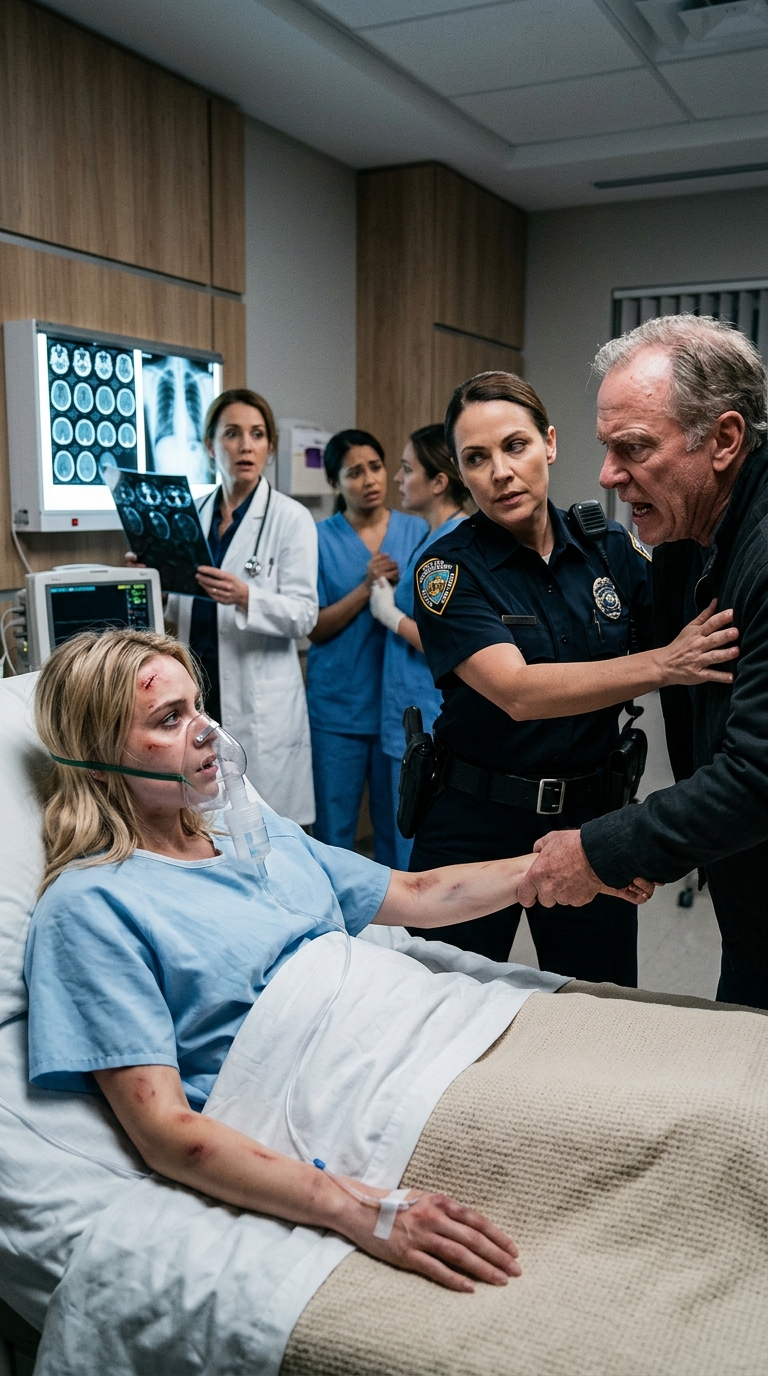
A deep, gravelly voice commanded from the doorway. My father spun around. A massive, broad-shouldered hospital security officer in a tactical uniform had materialized at the edge of the privacy curtain, his hand resting near his radio. He had been summoned by Dr. Grant before she even spoke to my parents.
“Step back against the wall, sir, or you will be physically restrained,” the guard ordered.
Twenty minutes later, the absolute nightmare my father had spent fifteen years trying to prevent walked right into Trauma Bay 4.
Detective Claire Nolan, a sharp-eyed investigator with the Special Victims Unit, didn’t knock, and she didn’t ask for permission to enter. She strode into the room, her badge gleaming on her belt, followed closely by a woman carrying a clipboard. Detective Nolan placed her hand casually on her utility belt, looked my father dead in the eye, and pointed toward the hallway.
“Mr. and Mrs. Whitaker, you are to step out of this room immediately,” Detective Nolan commanded, her voice broker no argument. “You will accompany my officers to the waiting area for separate interviews.”
“This is an outrage! I am an attorney! You cannot question a minor without her parents present!” my father shouted, spittle flying from his lips.
“She is the victim of a suspected felony assault, Counselor,” Detective Nolan replied coldly. “You are currently suspects in a criminal investigation. Get out of the room.”
For the first time in my entire sixteen years of life on earth, my father, the absolute, terrifying dictator of my universe, the man who controlled every breath I took, was rendered completely, utterly powerless. As the police physically escorted him and my weeping mother out of the bay, Brittany, who had been waiting in the hallway, realized the terrifying severity of the situation.
Brittany burst into hysterical, frantic tears. She pointed a trembling finger toward my curtain and screamed, “I didn’t mean for anyone to get hurt! I just pushed her! She provoked me!”
But Angela Moore, the CPS investigator who had entered with the detective, simply ignored Brittany’s theatrical hysteria. Angela walked over to my bed and pulled the heavy, blue privacy curtain shut with a sharp clack, sealing my family on the outside, cutting off their noise and their power.
Angela sat gently on the stool beside my bed. She pulled out a fresh notepad, clicked her pen, looked into my terrified eyes, and whispered the question that would officially, permanently end my life as Emily Whitaker, the punching bag, and begin the long, agonizing, beautiful process of my salvation.
Chapter 3: The Breach of the Dam
“Emily,” Angela said softly. Her voice was steady, warm, and anchored with a profound, trauma-informed empathy that I had never experienced from an adult. “I need you to tell me what happens in your house when no one else is watching.”
I looked at the heavy blue fabric of the privacy curtain. Even though the police were out there, I could see the shadowy outlines of my parents’ feet pacing frantically on the other side of the glass doors. My throat felt like it was coated in dry sand. My heart hammered against my fractured ribs, every beat a spike of pain and terror.
“If I tell you,” I whispered, panic rising like bile in my chest, my hands trembling violently as I clutched the thin hospital blanket. “If I tell you the truth, my dad will kill me when we get home. He promised me. He said they’ll split our family up and put me in an orphanage if I ever talk to strangers. He said it would be my fault.”
Angela didn’t look at her notebook. She leaned closer, her eyes fiercely, fiercely protective, locking onto mine to pull me out of the panic spiral.
“Emily, listen to me very carefully,” Angela said, her tone carrying absolute, undeniable authority. “He doesn’t have the power to hurt you anymore. He is not in control of this room. I am. I do this for a living, and I am very, very good at it. You are safe here. You are not going home with them tonight.”
You are not going home with them tonight.
The words hit me with the physical force of a tidal wave. The sheer, overwhelming relief of that promise fractured the fifteen-year-old mental dam inside my head.
I took a deep, shuddering breath, tasting my own tears, and the dam completely, violently broke.
I told her everything. I told her about the stairs today. I told her it wasn’t an accident. But I didn’t stop there; I couldn’t stop. I spilled a decade of venom, fear, and pain onto Angela’s notepad. I told her about the time Brittany broke my arm with a heavy, hardcover biology textbook because I had changed the channel on the television, and how my dad made me wear a baggy, oversized sweater for a month instead of taking me to the doctor so no one would see the swelling. I told her how my mom would buy me expensive ice cream the next day to apologize for not stopping the violence, silently bribing me to keep the peace. I explained the intricate, terrifying dynamics of how Brittany’s academic success was prized above my physical safety.
While I wept, shaking uncontrollably on the hospital bed, I could hear the muffled, sharp, commanding voice of Detective Nolan outside the curtain. She had separated my family.
Through the fabric, I heard Brittany’s voice. Without my father there to coach her or enforce silence, Brittany was completely unable to handle the pressure of police interrogation. She was hysterically sobbing, attempting to justify her actions, entirely unaware that she was legally incinerating her own life.
“She’s just a brat!” Brittany screamed in the hallway, her voice shrill with narcissistic panic. “I only pushed her down the stairs because she wouldn’t listen to me! She stole my sweater! It’s not my fault she’s so weak! You can’t arrest me, I have midterms next week!”
Inside the curtain, Angela stopped writing. She looked at me, a profound sadness and fierce determination in her eyes. She closed her notebook, placing the cap back on her pen, and placed a warm, steady hand over my trembling fingers.
“That’s all I need, Emily,” Angela said firmly. “You did incredibly well. You are incredibly brave.”
Angela stood up. She took a deep breath, squaring her shoulders, and pulled the privacy curtain back, revealing a scene of absolute, spectacular devastation in the hospital hallway.
Detective Nolan was standing over my father, holding a pair of heavy, polished steel handcuffs in her hand. Two massive, uniformed patrol officers were stepping aggressively toward a screaming, thrashing Brittany.
As the heavy metal ratcheted shut around my sister’s wrists with a sharp, unforgiving click, my father locked eyes with me through the open curtain. His face was a mask of pure, unadulterated, apoplectic fury, realizing in that exact, devastating moment that the daughter he thought was weak, the daughter he thought he had successfully beaten into submission, had just burned his entire, fraudulent kingdom to the absolute ground.
Chapter 4: The Annihilation of the Facade
“You are making a massive, catastrophic mistake, Detective!” my father roared, his face flushing a violent, mottled purple as the officers locked the cuffs onto Brittany’s wrists, forcing her arms behind her back. “She’s a college student! She’s on the Dean’s List! You’re ruining a brilliant girl’s life over a minor sibling spat! I will sue this hospital, and I will have your badge!”
“She’s a nineteen-year-old adult who just confessed, on police body camera, to intentionally pushing a minor down a flight of wooden stairs,” Detective Nolan replied, her voice cutting through the chaotic ER hallway like a bullwhip, entirely unbothered by his legal threats. “That is felony aggravated assault.”
My father lunged forward, pointing a finger at the detective’s chest. “Take those cuffs off her right now!”
Detective Nolan didn’t flinch. She stepped directly into his personal space, her hand resting heavily on her duty belt.
“Mr. Whitaker, if you take one more step toward my officers, or if you raise your voice again in this trauma ward, I will arrest you right now for felony child endangerment, obstruction of justice, and medical neglect,” Detective Nolan stated, her words dropping like anvils onto the linoleum floor. “We have your daughter’s radiological history. We have Emily’s statement. We know you actively denied her emergency care for severe, broken bones to cover up a crime. You are completely done ‘handling things at home.’”
My father froze, the terrifying reality of federal and state law finally piercing his authoritarian delusion. The power he wielded in his living room meant absolutely nothing to a detective holding his daughter’s X-rays.
My mother, realizing that her fifteen years of anxious silence had just cost her both of her daughters simultaneously, fell to her knees on the hospital floor. She began weeping hysterically, a pathetic, high-pitched wail that echoed down the corridor.
She crawled forward, reaching a trembling hand out toward my bed.
“Emily, please!” my mother begged, her mascara running down her face in dark streaks. “Tell them it was an accident! Tell them you tripped! Don’t let them take your sister away! Please, Emily, we’re a family! Fix this!”
She was completely, grotesquely ignoring the fact that I was strapped to a cardiac monitor, breathing shallowly through the agonizing pain of the ribs her “golden child” had deliberately cracked. She was still asking me to sacrifice myself to save Brittany.
Angela Moore, the CPS investigator, moved with the speed of a protective mother bear. She stepped squarely between my kneeling mother and the open curtain of my trauma bay, forming an impenetrable, physical human shield.
“Do not speak to my client,” Angela ordered, her voice vibrating with absolute, uncompromising legal authority. “Do not look at her. As of ten minutes ago, the State holds emergency protective custody of Emily Whitaker. You are no longer her guardians. You have absolutely no legal right to access her room, view her medical records, or speak to her person.”
Angela turned her head slightly to address the officers. “Officers, escort Mr. and Mrs. Whitaker off the premises. If they resist, arrest them for interfering with an active child abuse investigation.”
As the officers forcefully grabbed my screaming, thrashing father by the arms, and hauled my hysterical, handcuffed sister toward the sliding glass doors of the ER, my mother was practically dragged out behind them, sobbing my name.
The heavy glass doors slid shut, cutting off their screams.
The deafening, profound, miraculous silence of true safety finally settled over Trauma Bay 4.
Dr. Grant walked back into the room, checked the readouts on my monitors, adjusted my IV, and offered me a gentle, immensely reassuring smile.
But as I closed my eyes, sinking back into the hospital pillows, the chaotic adrenaline of the confrontation began to fade. It was replaced by a new, terrifying, overwhelming realization. I was finally, miraculously free of my monsters. The cage was broken. But I was now a sixteen-year-old girl entering the massive, intimidating labyrinth of the state foster care system, entirely, profoundly alone in the world.
Chapter 5: The Karmic Annihilation and the Sanctuary
The fallout over the next two years was not merely a legal proceeding; it was a masterpiece of karmic destruction, a localized apocalypse that systematically dismantled the Whitaker family’s entire fraudulent existence.
Without my forced silence to protect them, the family imploded with spectacular, public violence.
Brittany, facing overwhelming physical evidence and her own panicked confession on body camera, was advised by her public defender to take a plea deal for felony aggravated assault. The golden child was formally expelled from her prestigious university. With a violent felony on her permanent criminal record, her brilliant future evaporated. She served eighteen months in a state correctional facility, stripped of her designer clothes and her unearned arrogance.
But the true devastation occurred between my parents.
Desperate to save his own legal career and avoid a lengthy prison sentence, my father threw my mother completely under the bus during the criminal neglect trial. He testified that as the “primary homemaker,” she was entirely in charge of my daily medical care and had hidden the extent of the abuse from him.
My mother, enraged by his cowardly betrayal, retaliated by testifying extensively about his authoritarian, terrifying control over the household, detailing exactly how he had forced her to lie to doctors for a decade.
They cannibalized each other on the witness stand. The jury saw through both of them. They were both convicted of severe criminal negligence and child endangerment. My father was disbarred, his lucrative legal career permanently destroyed. Their pristine, massive suburban home was seized and sold by the state to pay for their exorbitant, mounting legal fees and civil restitution.
They were left bankrupt, publicly disgraced, and bitterly divorced, utterly destroyed by the very secrets they had sacrificed my body to keep.
Meanwhile, under the fierce, unwavering protection of Angela Moore, I was not lost in the labyrinth of the system.
Angela personally ensured I was placed with a highly specialized, trauma-informed foster family—the Millers.
The transition was agonizing at first. I spent the first three months in their home in a state of hyper-vigilance. I flinched every time a door closed too loudly. If I dropped a fork in the kitchen, I would cower, waiting for a twisted wrist or a screaming lecture, waiting for the punishment that never came.
But slowly, the bruises faded. The fractured bones healed.
I learned, through extensive, grueling therapy, that dropping a plate didn’t result in a fractured wrist; it just resulted in someone gently handing me a broom and helping me sweep up the glass. I learned that I didn’t have to apologize for simply existing in a room. I learned the profound, beautiful peace of living in a house without screaming.
On the day I turned eighteen, officially and legally aging out of the foster system as a free, independent adult, Dr. Grant and Angela took me and the Millers out to a celebratory dinner at a nice Italian restaurant.
As we toasted with sparkling cider, I looked at the two women sitting across from me. They didn’t just save my life that day in the blinding light of the ER trauma bay; they handed me the tools, the courage, and the safety to actually build one.
My life had become a beautiful, fiercely protected sanctuary. I had started college, pursuing a degree in social work with the explicit goal of becoming an advocate just like Angela.
But on a rainy Tuesday morning during the fall semester of my sophomore year, the past attempted to reach out from the grave. I received an automated email notification from the State Department of Corrections. Brittany was scheduled for an early parole hearing, and she had formally requested that I, as the primary victim, be present. Her lawyer claimed she had a “vital, life-altering confession” that would change everything I thought I knew about our childhood, begging me to listen.
Chapter 6: The Altitude of Indifference
I sat at my small desk in my college dorm room, the rain pattering against the windowpane, staring at the flashing notification on my laptop screen.
A few years ago, the promise of a “confession” from Brittany would have consumed my every waking thought. The traumatized, abused sixteen-year-old girl inside me would have agonized over the email, desperately searching for a hidden reason, a secret justification for why she hated me so much. I would have wondered if my parents had abused her too, or if there was some profound, hidden tragedy that explained her violence. I would have felt the toxic, conditioned urge to go to that hearing and offer her forgiveness just to hear the truth.
But today, the confident, healed twenty-year-old woman reading the screen felt absolutely, profoundly nothing.
There was no sudden spike of anger. There was no morbid curiosity. There was just a vast, unshakeable, beautiful indifference.
I had learned in my psychology courses, and through my own brutal lived experience, that narcissists and abusers don’t possess earth-shattering, redeeming confessions. They only possess new, desperate angles of manipulation. Brittany didn’t want to give me closure; she wanted an audience. She wanted to use my presence to perform remorse for the parole board.
I didn’t attend the hearing. I didn’t even reply to her lawyer’s email.
Instead, I downloaded the standard victim impact statement form from the state website. I typed a single, concise paragraph reiterating my demand for the permanent, lifetime restraining order to be strictly enforced upon her release. I attached the medical records from Trauma Bay 4. I hit submit, closed my laptop, and deleted the email thread entirely, severing the final, pathetic thread connecting me to the Whitaker bloodline.
Three years later, on a bright, blindingly sunny afternoon in May, I stood on the massive graduation stage at the state university, wearing a black cap and gown. I was receiving my Master’s degree in Social Work, graduating at the top of my cohort.
I stood at the podium as my name was called. I looked out into the massive sea of thousands of cheering people, bypassing the faces of strangers, scanning the crowd until my eyes locked onto the front row.
My foster parents, the Millers, were cheering wildly, holding up a bouquet of yellow roses. Sitting right next to them, taking photos on her phone, was Angela Moore, wiping a proud tear from her eye. And beside her was Dr. Marisol Grant, clapping loudly.
I smiled. It was a fierce, unbreakable, radiant smile. I was about to enter the field, armed with a degree and a lifetime of survival, to do for other terrified, silent children exactly what these incredible women had done for me.
I thought back to that cold, sterile ER room, to my father’s arrogant, booming demand that we “handle this at home.”
He was right about one fundamental thing. A home is exactly where things should be handled. He just didn’t realize that by breaking my body, by pushing me to the absolute edge of death, he had forced me to find a true home—one built on undeniable truth, fierce protection, and unconditional love.
And that truth had burned his house of cards entirely, permanently to the ground.
If you want more stories like this, or if you’d like to share your thoughts about what you would have done in my situation, I’d love to hear from you. Your perspective helps these stories reach more people, so don’t be shy about commenting or sharing.