My Sister Mocked My Job Until Her SEAL Fiancé Recognized Me-heyily
Ethan Cole stared at me and breathed, “Dear God… the Blizzard Hero.”
Brianna looked from him to me as if one of us had suddenly started speaking another language.
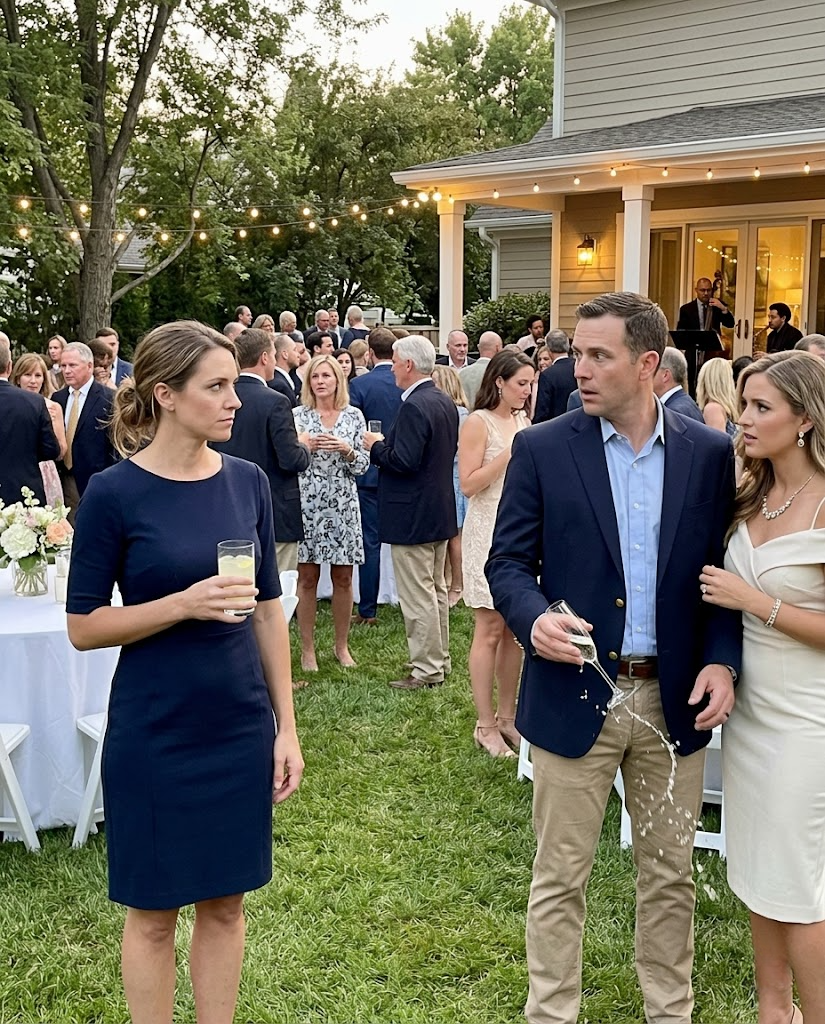
The broken glass glittered at Ethan’s shoes, but he didn’t seem to notice it.
Neither did I.
Three years disappeared in the space between us.
For one second, the backyard, the string lights, the jazz trio, and almost fifty dressed-up guests were gone.
I could smell frozen fabric again.
I could feel wind pressing against my goggles hard enough to make every exposed inch of skin ache.
I could hear a voice coming through a radio connection so broken that half the words vanished into static.
Ethan’s voice.
Brianna gave a nervous laugh. “What are you talking about?”
Ethan still hadn’t looked at her.
One of the men who had arrived with him glanced sharply at Ethan, then at me.
“You know her?” he asked.
Ethan swallowed.
“I know exactly who she is.”
That finally pulled every nearby conversation to a stop.
Mom had been standing near the patio doors with one of her friends.
She stepped closer.
Dad followed her.
Brianna’s fingers tightened around the stem of her champagne glass. “Ethan, this is Lauren. My sister. She does government logistics.”
He turned his head toward her slowly.
“No,” he said. “She doesn’t just do government logistics.”
I set my lemonade on the nearest table.
“Ethan.”
His eyes came back to mine.
He understood the warning immediately.
Whatever else he had become since that night, he was still trained well enough to know when somebody was telling him there were details that did not belong in a backyard full of civilians.
His shoulders eased a fraction.
“I won’t say anything I shouldn’t,” he said.
Then he looked at Brianna again.
“But I’m not going to pretend I don’t recognize the woman who got us out.”
Brianna blinked.
“Got you out of what?”
I wished she hadn’t asked.
Not because I was ashamed of the answer.
Because I had spent three years making sure my family never needed one.
The operation had happened during a storm severe enough to erase ordinary distinctions between road, slope, sky, and distance.
Plans had already failed before my unit was sent in.
Conditions kept changing faster than anyone could comfortably predict, and the people we were trying to reach were stuck where conventional access had become unreliable.
That was what my team did.
We worked after the easy options were gone.
Nobody called it heroic while we were doing it.
You checked equipment.
You checked the person beside you.
You moved when you could move.
You stopped when the terrain told you to stop.
Then you moved again.
That night, Ethan had been one of the people waiting on the other side of the weather.
I hadn’t known his last name mattered to my family because, at the time, it didn’t matter to me at all.
He was another person we had been sent to reach.
His team was tired, exposed, and running out of good choices.
Ours still had one.
So we went.
The wind made normal conversation almost useless when we finally reached them.
Commands had to be short.
Movements had to be deliberate.
Nobody had energy for speeches.
I remember Ethan looking at me through blowing snow while I checked that everyone was accounted for.
He stared at the patch on my gear long enough to read my call sign.
Whiteout One.
He repeated it once, probably so he wouldn’t forget who was directing the movement.
I told him to save his breath.
He laughed at that later.
Not then.
Nobody laughed then.
We got them moving.
That was the job.
The story grew afterward, the way stories sometimes do when people survive something they had started believing they might not survive.
Somewhere along the line, somebody began calling me the Blizzard Hero.
I hated the nickname.
It made one person sound larger than the team that had actually done the work.
So when people used it, I usually ignored them.
Apparently Ethan hadn’t forgotten it.
Back in my parents’ backyard, he rubbed one hand across his mouth.
“Three years ago,” he said carefully, “my team got caught in conditions that turned bad fast. Her unit reached us when getting anybody in or out had become… difficult.”
That last word was doing a lot of work.
I appreciated it.
Dad stared at me.
“Your unit?”
“Yes.”
Mom’s face had gone completely still.
“You told me you handled contracts.”
“I do sometimes.”
“You said paperwork.”
“There is an unbelievable amount of paperwork.”
One of Ethan’s teammates made a sound that was almost a laugh before stopping himself.
Even Dad’s mouth twitched.
Brianna didn’t smile.
She looked angry now, but beneath the anger was something more complicated.
Embarrassment.
Not embarrassment about me anymore.
Embarrassment because the social ranking system she had spent two months building had just turned on her.
“Why wouldn’t you tell us?” she asked.
The question landed strangely after what she had said in the hallway.
I studied her face.
“Tell you what?”
“Any of this.”
“My work isn’t something I bring home and turn into dinner conversation.”
“But you let us think you were just sitting behind a desk.”
There it was.
Just.
Ethan heard it too.
His jaw tightened.
I didn’t need him to defend me.
I had spent enough years defending people in situations far more dangerous than my sister’s opinion.
“Brianna,” I said, “if I really had spent every day behind a desk, would what you said to me earlier have been okay?”
She went quiet.
Mom looked between us. “What did she say?”
Brianna’s eyes flashed toward me.
For a moment, I could see exactly what she wanted.
Privacy.
The same privacy she hadn’t given me when two cousins were standing close enough to hear her call my work low-class.
I could have repeated every word.
I could have watched the humiliation move across her face and called it justice.
Instead, I shook my head.
“That’s between us.”
One of the cousins who had overheard her earlier suddenly became fascinated by the ice in his drink.
Brianna noticed.
So did Ethan.
He didn’t ask me again.
He asked her.
“What did you say?”
“Nothing.”
I watched him carefully.
He had walked into the party as the person Brianna expected everyone else to admire.
Now he was looking at her the way people look when they have realized the real problem is not the fact they just learned, but what that fact exposes about everything around it.
“Brianna.”
She lowered her voice. “I told her to keep her job vague tonight. That’s all.”
“Why?”
“Because your commanding officers are here. Your teammates are here. I wanted tonight to go well.”
“What does Lauren’s job have to do with that?”
Brianna’s face reddened.
“I didn’t know what she actually did.”
“That’s not what I asked.”
Short.
Calm.
Worse than shouting.
Brianna stared at him.
Then she glanced toward me and seemed to understand that there was no answer that would make her look better.
“I thought you respected accomplished people,” she said finally.
Ethan’s expression changed.
Not dramatically.
Just enough.
“I respect people,” he said. “Their résumé comes later.”
I looked away before Brianna could read my reaction.
A few minutes earlier, she had told me Ethan couldn’t stand unimpressive people.
Now I wondered how much of that had ever come from him.
Maybe none of it.
Maybe she had borrowed his career because she thought it gave her a taller platform to stand on.
Dad stepped closer to me.
“Whiteout One?”
I sighed.
“Please don’t start.”
“I’m your father. I’m absolutely starting.”
Mom touched my elbow.
Her voice was quieter.
“Were you in danger?”
That was the question I had actually been avoiding for three years.
Not what I did.
What it cost the people who loved me to know what I did.
“Sometimes,” I said.
Mom’s eyes filled, but she didn’t turn it into a performance.
She simply squeezed my arm once and released it.
That hurt more than a dramatic reaction would have.
Dad stared toward the lawn, then back at me.
“And every time I complained that you never had an interesting story from work…”
“I probably had one.”
“You let me talk about replacing the garage shelves for forty minutes.”
“That was safer.”
He laughed once under his breath.
Ethan finally stepped around the broken glass.
He stopped several feet from me rather than crowding me.
“I never got to thank you properly.”
“You don’t owe me anything.”
“I know.”
He hesitated.
“I’m still grateful.”
That, I could accept.
I nodded.
“You’re welcome.”
No applause followed.
I was grateful for that too.
One of Ethan’s teammates came over next, looked at me for a second, then offered his hand.
He didn’t ask for details.
He just said, “Good to meet you.”
“You too.”
Another man gave me a small nod from farther away.
That was enough.
The party tried to restart around us, but it couldn’t return to what it had been ten minutes earlier.
People who had barely asked me a question in years suddenly wanted to know everything.
Where had I trained?
How many missions had I done?
Was Whiteout One an official title?
Had I received medals?
I answered almost none of it.
“I work in logistics,” I told one aunt.
She thought I was joking.
I wasn’t.
Eventually, I collected my purse.
Brianna found me near the hallway where she had cornered me before the party.
For the first time all evening, nobody else was close enough to hear us.
“You’re leaving?” she asked.
“Yes.”
“Lauren, wait.”
I did.
She folded her arms, unfolded them, then pressed her palms against the sides of her dress.
“I didn’t know.”
“I know.”
“If I had known—”
“Don’t.”
She stopped.
I lowered my voice.
“That’s the part you need to think about.”
Her forehead creased.
“What part?”
“If I had really spent my days scheduling warehouse deliveries, you still would have said what you said.”
She opened her mouth.
Closed it.
“You thought I deserved less respect because you thought my job sounded boring. Finding out you were wrong about my job doesn’t fix that.”
For once, Brianna had no quick answer.
She looked toward the backyard where Ethan was speaking quietly with one of the men who had arrived with him.
“Is he going to leave me?”
There was fear in her voice now.
Real fear.
I could have punished her with it.
I didn’t.
“That’s a conversation you need to have with Ethan.”
“You could tell him I didn’t mean it.”
“Did you mean it?”
She looked at me.
That answer took longer.
“At the time,” she said, “yes.”
It was the first honest thing she had given me all night.
“Then start there.”
I picked up my purse.
She didn’t try to stop me again.
The next morning, Mom called before eight.
She had apparently spent half the night alternating between being furious that I had hidden so much and terrified by all the things she now imagined I had hidden.
I reminded her that imagination was precisely why I hadn’t told her more.
Dad got on the phone and asked whether he was allowed to tell the neighbor that his daughter had a call sign.
“No.”
“What about my brother?”
“No.”
“Can I tell anybody?”
“You can tell people I work in logistics.”
He groaned.
For the first time in years, that answer made me laugh.
Brianna didn’t call that morning.
Or that afternoon.
She came to my place two days later carrying two paper coffee cups.
No makeup perfect enough for an engagement party.
No carefully prepared speech.
She wore jeans, old sneakers, and the expression of somebody who had finally run out of ways to manage how she looked.
I let her in.
She handed me one of the coffees.
“I owe you an apology.”
I waited.
“Not because of what you really do,” she added quickly. “I figured out that’s what you’re going to ask.”
“Good start.”
She winced.
“I was cruel to you because I thought being connected to Ethan made me important.”
That surprised me more than the apology.
She stared down at her cup.
“People ask him questions. People listen when he talks. They hear what he does and they immediately decide he’s worth paying attention to. I liked standing next to that.”
I said nothing.
“Then I started acting like I had earned it too.”
Still, I waited.
Brianna looked up.
“And I used you to prove I was above somebody.”
There it was.
Ugly.
Accurate.
Useful.
“Yes,” I said.
She nodded.
“Ethan said almost the same thing.”
“How are you two?”
Her shoulders dropped.
“Still engaged. Wedding planning is on hold for a little while.”
I didn’t celebrate that.
I didn’t pretend it meant nothing either.
“He said he needs to know that the person he marries doesn’t decide someone’s value based on whether their job impresses a room.”
“That’s fair.”
“I know.”
She took a breath.
“I hate that it’s fair.”
I almost smiled.
That sounded more like my sister.
Repair didn’t happen in one conversation.
It happened in small, irritating ones.
Brianna caught herself when she started using Ethan’s career as social currency.
Sometimes I watched the correction happen in real time.
She would begin a sentence with, “Ethan’s team—” then stop and ask herself whether the story was actually hers to tell.
Mom quit introducing me as “our mysterious daughter” after I told her twice that it wasn’t funny.
Dad mostly respected my rule about Whiteout One, although I later discovered he had written the call sign on a scrap of paper and tucked it into his wallet.
I pretended not to know.
Ethan never asked me for details about that storm.
That mattered.
He knew enough to understand why I kept parts of my life compartmentalized.
Months later, we were all in my parents’ backyard again.
No jazz trio this time.
No white-covered tables.
No officers, teammates, or champagne.
Just family food on the patio, folding chairs on the grass, and Dad arguing with the grill as if it had personally insulted him.
Brianna was helping Mom carry drinks outside.
She set a glass of lemonade in front of me.
“Busy week?” she asked.
“Pretty normal.”
“Logistics?”
“Logistics. Contracts. Mostly paperwork.”
She looked at me for half a second.
Then she handed me the glass without asking another question.
I took it.
She let the answer be enough.