
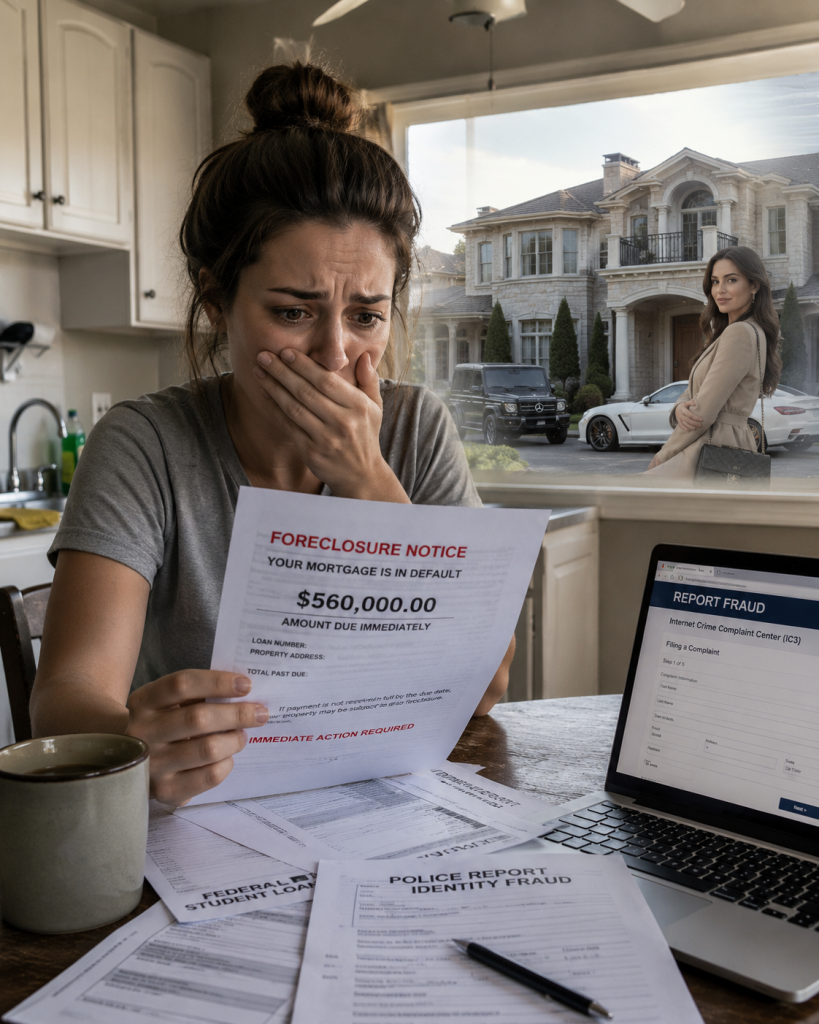
My SISTER Took a $560,000 Loan in My Name to Buy a House and My Parents Begged Me to Stay Quiet..

The Bank Said I Owed $560,000 On A Mortgage I Never Signed. Turns Out, My Sister Used My Name To Buy Her Dream House. My Parents Told Me To Stay Quiet. At Dinner, I Slid The Police Report Across The Table.
Part 1
The letter came on a Tuesday, the kind of Tuesday that should have disappeared without leaving a mark.
It was thicker than junk mail, heavier than coupons, and too official to ignore. A bank seal pressed into the flap. My name printed in crisp black letters. My address correct down to the apartment number I still sometimes forgot when ordering takeout.
I stood in my kitchen holding it like it might bite.
The apartment smelled like coffee and lemon dish soap. The dishwasher hummed. My old ceiling fan clicked on its third speed, the way it always did when the humidity rose. Normal sounds. Normal life. A life I had earned with careful choices, student-loan payments, and a decade of doing the boring thing instead of the fun thing.
Then I tore the envelope open.
Mortgage delinquent.
Balance notice.
Foreclosure threatened.
Then the number hit me.
$560,000.
My throat tightened like I had swallowed glass.
I read the page again, slowly, as if the words might rearrange themselves if I stared hard enough. Account number. Property address. Past-due amount. Late fees. A neat breakdown of what I supposedly owed and when they planned to take “my” home if I didn’t pay.
Except there was one problem.
I didn’t own a home.
Not that one. Not any one.
I rented a second-floor apartment with thin walls and drove a twelve-year-old Honda that wheezed whenever I turned the key on cold mornings. My biggest luxury purchase that year had been a decent mattress because my back had started sounding like bubble wrap.
My hands shook so badly I had to sit at the kitchen table.
My name was there.
Part of my Social Security number was there.
My signature was there too—or something trying to be. My letters. My loops. My slant.
Except I had never signed it.
Not for this.
My first thought was absurd.
Maybe they sent it to the wrong person.
My second thought was worse.
Maybe I bought a house and forgot.
That one made me laugh, a short, bitter sound that bounced off the cabinets. I was the woman who checked her credit score like some people checked the weather. I kept an emergency folder in a fireproof box. I knew exactly what I owned because I had spent years terrified of owing the wrong thing.
I called the number at the bottom of the letter.
The line rang twice before a calm voice answered.
“Thank you for calling Horizon Lending. This is Megan. How can I help you today?”
“Hi,” I said, and my voice came out thin. “I received a mortgage delinquency notice, but there’s a mistake.”
Megan asked for the account number. I read it to her with sweaty fingers slipping over the page.
Keyboard clicks.
A pause.
“Okay,” she said. “I see the account. For verification, may I have your full name, date of birth, and the last four digits of your Social?”
I gave them.
My heart hammered so hard it felt like it was trying to bruise its way through my ribs.
“Ma’am,” Megan said carefully, “we confirmed your identity on the purchase back in July. The deed lists you as the primary owner.”
The kitchen tilted.
“I didn’t purchase anything in July,” I said slowly. “I didn’t buy a house.”
Her voice softened, the way customer service voices do when they realize they have stepped into something dangerous.
“Let me pull up the closing documents.”
I stared at the sink, at a fork drying in the rack, at the normalness of all of it.
When Megan returned, she said, “We have a notarized signature and ID verification on file. If you believe this is fraudulent, you’ll need to file a report. But I can provide the property address.”
“Yes,” I said. “Give me the address.”
She read it out.
Three hours away.
A luxury property in a gated community with a name that sounded like a real estate commercial. The kind of neighborhood where the HOA fined you for leaving trash bins out too long. The kind of place I used to scroll past online and joke about, like, look at this marble kitchen that costs more than my entire life.
I wrote it down anyway.
Then Megan said, “I can email you copies of the closing documents. I just need to confirm the email address on file.”
“Tell me,” I said.
My stomach tightened before she even answered.
It wasn’t mine.
It was my sister’s email.
I went completely still.
Cassandra.
Cass.
My older sister by two years. My parents’ golden girl. The woman who could sell a bottle of water to a drowning man and make him thank her for the opportunity. The one who treated rules like suggestions and consequences like things that happened to people less charming than her.
She had borrowed my clothes without asking. My car without permission. My credit card without warning. Once, years ago, she booked a vacation with my card, dumped her boyfriend halfway through the trip, and came home with a tan and no shame.
But this was different.
This was not “forgot to ask.”
This was not “I’ll pay you back later.”
This was federal.
This was my identity nailed to a mortgage like a butterfly pinned to a board.
I hung up after Megan promised to send the documents.
For a long moment, I sat with my phone in my hand, listening to my own breathing.
Shallow.
Uneven.
Then something inside me clicked into place.
Cold.
Precise.
I did not call Cass.
I did not text her.
I did not warn her.
I opened my laptop, pulled up the police department’s website, and filled out the report with hands that were still shaking.
Because if someone had built a mansion on my name, I was done being the quiet foundation.
Part 2
The police station smelled like old coffee and disinfectant, the kind of smell that clings to your clothes and makes you feel guilty even when you haven’t done anything wrong.
I sat across from an officer with tired eyes and a calm face. He looked like a man who had seen too many versions of human stupidity to be surprised anymore.
“So you’re saying you didn’t sign for this mortgage at all,” he said.
“I’m saying I didn’t buy a house,” I replied. “Someone used my Social Security number and forged my signature. My sister’s email is on the account.”
He nodded slowly. “And you suspect your sister.”
Saying it out loud made it heavier.
“Yes.”
He asked for documents. I gave him the delinquency notice, the account number, and the property address. He studied the papers like he was looking for the first crack in the story.
“You know,” he said, “a lot of people come in here with family stuff and change their minds later.”
My jaw tightened. “I’m not changing my mind.”
He watched me for a moment.
I knew what he saw. Not someone storming in screaming. Not someone making threats she might regret. I wore plain jeans and a cardigan. My hair was in a low bun because I had pulled it back when my hands wouldn’t stop shaking. I looked like a woman who paid her bills on time.
Then he asked, “Do you want to press charges?”
The question landed like weight on my chest.
When you are raised in a certain kind of family, charges does not sound like justice. It sounds like betrayal. Like you are the one breaking an unwritten rule.
Don’t embarrass us.
Don’t make this public.
Don’t ruin her life.
I could already hear my mother saying it, soft and pleading. My father’s silence behind it. Cass’s outrage, as if she were the injured party.
Then I saw the number again.
$560,000.
The years of my life it could swallow if I let it.
I thought about my student debt, the old Honda, the dinners I skipped so I could grow my emergency fund. I thought about every morning I checked my balance before my messages because I was terrified of being surprised by something I couldn’t control.
Cass had taken my control and lit it on fire.
“Yes,” I said quietly. “I want to press charges.”
The officer nodded. “We’ll open a case. A detective will contact you. Freeze your credit and notify the lender in writing that this is fraud.”
“I already started,” I said. “And I’m meeting with a lawyer.”
For the first time, his tone held something like respect. “Smart.”
On the way back to my car, my phone buzzed.
A text from my mother.
Family dinner Sunday? Your dad’s grilling. Cass is bringing dessert.
I stared at the screen until the words blurred.
Cass was bringing dessert.
Like she hadn’t built a house out of my identity.
Like we were just a normal family making normal plans.
In our family, Sunday dinner was not optional. It was a ritual. A performance. A way to keep the illusion polished.
My parents lived in a tidy house in a quiet neighborhood, the kind with trimmed grass and matching curtains. My mother collected throw pillows. My father collected silence. Cass collected attention.
And I collected receipts.
Bank statements.
Truth.
I typed back: Sure. I’ll be there.
Then I sat in my car and let myself remember how we got here.
Cass had been loud since birth. My mother loved telling people she came into the world with her fists already swinging. Teachers called her “a natural leader.” My parents called her “special.”
I was the quiet one. The one who read in corners. The one who got straight A’s and didn’t make trouble. The one who learned early that being easy was the fastest way to get love.
Cass needed things.
Cass wanted things.
Cass demanded things.
And my parents smoothed. Excused. Covered.
When Cass totaled my father’s car at seventeen, it was an accident.
When she cheated on a college test, the professor was unfair.
When she bounced checks, my parents paid quietly and told me not to be judgmental.
“She’ll grow up,” my mother said.
“She’s finding herself,” my father said.
“Don’t be so serious,” Cass said, smiling like I was the problem.
I had spent years shrinking my anger because it was easier than fighting the family machine.
But a $560,000 mortgage was not a machine problem.
It was a wrecking ball.
Sunday dinner was not going to be a conversation.
It was going to be a collision.
And for the first time in my life, I was not stepping aside.
Part 3
Sunday arrived bright and clean, the kind of weather that made everything look healthier than it was.
I drove to my parents’ house with a folder on the passenger seat. Inside were copies of the delinquency notice, the police report, and the closing documents Megan had sent.
I had read them twice the night before.
Once more that morning.
There it was in legal language: I had “purchased” a home in July. I had “verified” my identity. I had “signed” the mortgage and deed.
The signature looked enough like mine to fool a careless notary.
The ID attached was not mine at all. It was a blurry scan of something shaped like my driver’s license, except the photo was Cass with darker hair and toned-down makeup.
She did not just take my name.
She wore it.
I pulled into my parents’ driveway and watched through the windshield.
My father stood at the grill in faded jeans and a polo shirt, tongs in hand like a weapon. My mother moved between the kitchen and patio with a tray, smiling at neighbors. The whole scene looked like a commercial for stability.
Cass’s SUV sat at the curb, shiny and impossible to afford on her “influencer” income. She had been telling everyone she had “a real estate thing” now. Her posts were full of sold signs and captions about manifestation.
I picked up the folder and walked inside.
The house smelled like barbecue and vanilla.
“Elena!” my mother sang, pulling me into a hug.
Her warmth almost made me hesitate.
Almost.
Cass appeared in the doorway like she was stepping into a spotlight.
Designer dress. Gold jewelry. Perfect hair. A smile bright enough to be weaponized.
“There she is,” Cass said, leaning in for a cheek kiss. “My little sis.”
I didn’t smile.
For one second, her eyes flickered.
Then the sparkle returned.
“Come sit,” she said. “Wait until you hear what I’m doing next. Big things.”
We sat at the table. My mother served food. My father asked Cass about her “real estate luck” like it was charming instead of suspicious. Cass launched into her story, all confidence and no detail.
“I just knew it was my time,” she said. “The universe was finally aligning.”
My mother clapped softly. “I’m so proud of you.”
Cass winked at me. “It’s all about mindset, El.”
I waited until everyone had eaten, until conversation settled into that comfortable rhythm that usually lulled me into compliance.
Then I reached into my bag.
The folder landed on the table with a soft thud.
Cass’s smile faltered.
My mother’s eyebrows lifted. “What’s that?”
I slid the delinquency notice across the table toward Cass.
“Funny,” I said, my voice calm. Too calm. “You bought your dream house with my nightmare.”
The air changed.
Cass opened the folder. Her eyes skimmed the page. Her face drained so fast it was almost impressive.
Her fork clattered onto her plate.
“You wouldn’t,” she whispered.
I leaned back. My hands were steady now.
“You already did,” I said. “I’m just returning the favor.”
Her head snapped up. “What does that mean?”
“It means I filed a police report. It means I pressed charges.”
My mother made a small sound. “Elena—”
Cass shot to her feet so fast her chair screeched.
“You’re going to ruin my life,” she hissed.
“No,” I said. “You did that when you signed my name and put a mansion on my credit score.”
My mother reached for the papers like she could smooth this into something smaller.
“Let’s talk about this privately,” she whispered.
“Privately,” I repeated, and a sharp, tired laugh escaped me. “Because family?”
My father finally spoke, his voice flat. “You don’t need to involve the police.”
I turned to him slowly.
“You knew.”
It was not a question.
His eyes flicked away.
That silence hit harder than anything else.
They knew.
Maybe not every detail, but enough. Enough to see Cass’s sudden wealth and not ask. Enough to suspect and choose blindness. Enough to protect her from consequences and leave me holding the debt.
Betrayal rooted itself deep in my chest.
“You all thought I was too quiet,” I said. “Too focused. Too boring to notice. You forgot I’m the one who checks the numbers.”
Cass reached toward me like her hand could rewind time. “I’ll pay it back. I promise.”
“With what?” I asked. “Your fake real estate job? The influencer career funded by my identity?”
“It’s not fake.”
“It’s funded,” I corrected. “By me.”
My mother began to cry. “Sweetheart, please. She made a mistake.”
“A mistake is forgetting to call,” I said. “A mistake is buying the wrong size dress. A mistake is not forging your sister’s identity for a half-million-dollar mortgage.”
Cass’s voice cracked. “I needed it.”
“You wanted it,” I said. “And you thought you could take it.”
My father muttered, “We’re family.”
I gathered the papers back into the folder.
“I wanted to believe this family would protect me,” I said quietly. “Turns out I was just the signature you needed when no one else trusted her.”
Cass began sobbing, the dramatic kind she always used when she needed rescue.
My mother reached for me. “Elena, don’t go.”
But I was already standing.
As I walked out, I heard Cass sob, “You’re so jealous,” like jealousy was the only explanation for accountability.
I stepped into sunlight, and for the first time that day, the air felt clean.
That night, the detective called.
“We served her,” he said. “She’s facing felony fraud. The DA is fast-tracking the case.”
I didn’t smile.
Some victories don’t feel good.
They feel necessary.
Heavy.
Final.
Part 4
The mugshot leaked by Thursday.
I found it in my inbox, buried between work emails and store promotions, sent by a coworker who didn’t know whether to be horrified or entertained.
Subject line: Is this your sister?
Cass looked hollow in the photo. No filters. No lashes. No polished grin. Just a face stripped of entitlement, staring at a reality she had never believed would catch her.
The internet did what it always does when it smells blood.
Local Facebook groups shared it.
Real estate forums posted warnings.
Someone stitched Cass’s old Instagram reels—her “morning routine,” her “new house tour,” her hand sliding over marble countertops like she had earned them—beside her mugshot like a before-and-after of consequences.
Her agency dropped her within hours.
Sponsorships vanished like someone had unplugged her life.
My phone buzzed constantly. Cousins I hadn’t heard from in years. Old classmates who had always “felt something was off.” Strangers asking if it was true my sister stole half a million dollars.
I ignored the strangers.
I answered the bank.
Because while the internet was feasting, the mortgage was still tied to me.
Horizon Lending did not care about family drama. They cared about documents. The paper trail said Elena Carter bought a luxury house in July and missed payments by April.
I spent lunch breaks with their fraud department. I sent the police report, case number, detective’s contact information. I requested a fraud hold, a review, anything to stop the foreclosure machine from rolling over my life.
“We’ll investigate,” the representative said. “But until the matter is resolved, the account remains in your name.”
I hung up and stared at my desk.
My coworkers talked about weekend plans. Someone heated pasta in the microwave.
Life moved as if everything were not fragile.
I wanted to stand and scream.
Instead, I made a plan.
That evening, I met with a lawyer named Raymond Park.
Sharp suit. Sharper mind. He did not waste time with sympathy. He dealt in solutions.
He flipped through my folder. “Identity theft. Mortgage fraud. Forgery. Civil damages.”
“I need my name off that loan,” I said.
“We’ll push the lender to recognize the fraud,” he replied. “That can take time. Meanwhile, we file civil claims, subpoena records, track the money.”
Good.
Because Cass was not subtle.
She had posted everything.
The marble counters. The pool. The four-car garage. The $12,000 fridge with the blue light. The down payment she bragged about making with “smart investments.”
All paid for with my identity.
Raymond scrolled through the screenshots I had printed.
“She made this easy,” he said dryly.
That weekend, Cass called from a blocked number.
“Elena, please,” she sobbed. “They’re going to take the house. Mom won’t help. Dad won’t help. Please just tell them I had your consent.”
I let the words hang.
Then I asked, “When you signed my name, were you thinking about me?”
Her crying stuttered.
Silence.
No apology.
No recognition.
Just the sound of someone realizing she did not have a script for accountability.
I hung up.
The eviction notice went up the following week.
A neighbor filmed it, of course. The video showed a notice taped to the mansion door, wind lifting the corners like it wanted to expose the whole thing.
Cass screamed at the officers that it was a misunderstanding, that she was famous, that someone was out to get her.
They gave her seventy-two hours to vacate.
According to my mother, Cass spent seventy-one hours throwing tantrums and the last one disappearing.
My mother called the night before the deadline.
“She’s scared, sweetheart,” she said. “Can’t you find it in your heart to forgive her?”
I closed my laptop slowly.
“You’re asking the wrong daughter for grace.”
She sighed. “You don’t know what it’s like to lose everything.”
There it was again.
The expectation that I would sacrifice myself to keep their illusion alive.
“No, Mom,” I said. “I know exactly what it’s like. I’ve spent ten years losing pieces of myself just to keep you comfortable.”
Silence.
Then, sharp as a slap: “We didn’t raise you to be so cold.”
I smiled, bitter and small.
“No,” I said. “You raised me to be convenient.”
The next morning, I drove past the house.
Not for pity.
Not revenge.
Closure.
Boxes littered the porch: designer bags, framed fake affirmations, a shattered mirror. In the middle of it all stood Cass.
No makeup.
No perfect angle.
Just a woman who built a castle on someone else’s name and watched it sink.
She saw my car and ran toward it, pounding on my passenger window.
“Please,” she cried. “Just tell them I didn’t mean it.”
I rolled the window down barely enough to hear her.
“You meant it every time you signed my name,” I said. “Every time you smiled for the camera knowing it was built on my identity.”
She sobbed harder. “I didn’t think it would get this bad.”
“That’s the problem,” I said. “You never do.”
Then I said the truest thing I had said in years.
“I don’t need you to go to jail. I just need you to finally live without me.”
I rolled the window up and drove away.
For the first time in months, my hands did not shake on the wheel.
Part 5
After that, the calls came from everyone else.
Aunt Marie, who once told me I was “too serious.”
Uncle Dennis, who had borrowed from my parents and never paid them back.
Even Grandma Evelyn, who once called me “the quiet failure” for choosing accounting over something glamorous.
They all said the same thing.
She’s your sister.
Blood is thicker.
She learned her lesson.
Do you really want her to go to jail?
Not one asked what she had done.
Not one asked how I was sleeping.
Not one asked how it felt to learn my parents had known and stayed silent.
They asked why I wasn’t covering it up better.
As if I were the stain.
Not the forged documents.