
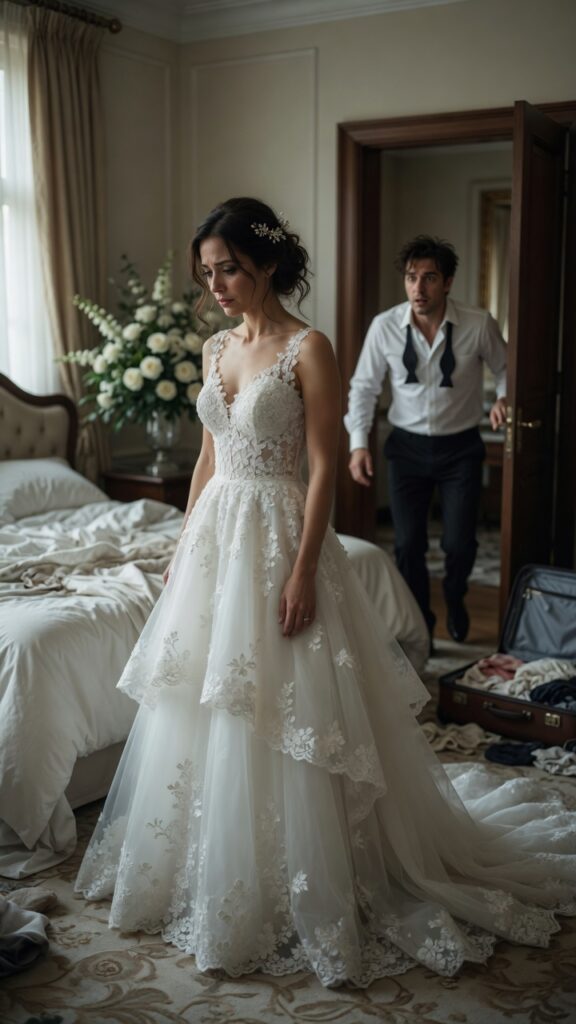
On Our Wedding Night, My Husband Left Me For His Mistress. The Next Day, He Returned Back Panicked!

My husband left me alone in our bridal suite to pick up another woman from JFK.
He told me not to make a scene on our wedding night.
By morning, I had taken back my billion-dollar trust, my name, and the future he thought he had already spent.
The rain hit the floor-to-ceiling windows of our Manhattan bridal penthouse like a thousand little stones thrown by the sky.
Outside, the city had blurred into streaks of yellow headlights, black glass, and wet pavement. Far below us, traffic along the FDR crawled through sheets of water, horns muffled by the storm. Inside the suite, the air still smelled of champagne, white roses, expensive perfume, and the faint waxy smoke from the candles the hotel staff had lit before we arrived. My wedding dress lay around my feet in heavy folds, the hem stained where someone at the reception had spilled champagne and apologized too many times.
I had just taken off my heels.
That was what I remember.
Not the vows.
Not the orchestra.
Not the way Andrew Walker had looked at me in front of two hundred guests and said, “Catherine, my life begins with you.”
I remember my aching feet on the pale carpet and the sound of his phone ringing.
It rang once.
Then again.
A sharp, urgent sound from the table near the terrace doors.
Andrew froze.
Not startled.
Caught.
There is a difference, and wives learn it too late.
He crossed the room so fast that his tuxedo jacket pulled across his shoulders. His face, still handsome from the photographs, still arranged in that charming groom’s glow everyone had applauded all night, tightened the moment he saw the caller’s name. He grabbed the phone and stepped toward the terrace.
“Andrew?” I said.
He lifted one finger without looking at me.
One finger.
On our wedding night.
The glass door slid open. A slice of freezing air entered the warm suite, bringing rain mist with it. He stepped outside, his back to me, shoulders hunched against the wind, voice low.
But the suite was not as soundproof as he believed.
“How did you manage to do this right now?” he said. “You know what today is.”
A pause.
His posture changed.
The irritation softened.
That hurt before the words did.
“Okay. Okay, don’t cry. Stay at arrivals. Wait for me at JFK. I’m coming.”
The room tilted slightly.
I stood where I was, one hand still holding the loosened bodice of my dress, and watched the man I had married three hours earlier become someone else for another woman.
He ended the call and turned.
For half a second, panic showed in his eyes.
Then came annoyance.
“Nobody,” he said before I asked.
I looked at him.
He moved past me toward the bedroom, already reaching for his black trench coat.
“A friend got stranded at the airport because of the storm,” he said. “I’ll pick her up and come right back.”
“A friend.”
My voice sounded calm. That surprised me.
He pulled the coat from the rack. “Yes.”
“Tonight is our wedding night.”
“I’m aware.”
“It’s pouring so hard the highway is probably half-flooded.”
“Catherine.”
He said my name with the warning tone men use when they want obedience to sound like reason.
“What kind of friend,” I asked, “is worth leaving your bride alone in an empty penthouse three hours after your vows?”
His jaw tightened.
“She’s alone in the city.”
“So am I.”
His eyes sharpened.
“Don’t be dramatic.”
The word entered the room like a slap.
Dramatic.
Because I expected my husband to stay beside me on our wedding night.
Because I expected the vows to last longer than the flowers.
Because I expected not to compete with a phone call before I had even changed out of my dress.
“Who is she?” I asked.
He looked toward the foyer.
The pause told me before he did.
Then I said her name.
“Allison Bennett.”
His face changed completely.
The last scraps of performance fell away.
He stopped pretending.
“Yes,” he said. “Allison. She changed her flight to congratulate us, and now she’s stuck at JFK. She doesn’t know anyone here.”
“Changed her flight,” I repeated.
“She came for me.”
“For us?”
He did not answer quickly enough.
I laughed once, quietly. It was not humor. It was the body rejecting poison.
“Allison skipped the ceremony, skipped the reception, and chose this exact storm, this exact hour, to call you from the airport.”
“She’s sensitive. She gets overwhelmed.”
“And I don’t?”
His eyes flashed.
“Catherine, I am not doing this tonight.”
“You are doing this tonight. You are putting on a coat.”
He stepped closer.
“I’m going to be gone an hour.”
The rain beat harder against the glass.
Behind him, the champagne tower from our private afterparty still glittered under the chandelier. The wedding portraits the hotel photographer had rushed to print leaned against the wall in silver frames. In one, Andrew held my face between his hands, looking at me with a devotion so convincing that I wondered whether acting was a form of financial strategy in his family.
“Do you love her?” I asked.
His expression hardened.
“Don’t make a scene.”
That was the answer.
Not yes.
Not no.
A command.
I stepped into his path as he reached for the umbrella.
“If you walk out that door right now,” I said, “you cannot come back to me.”
He stared at me.
For one second, he looked almost amused.
Not because he did not hear me.
Because he did not believe me.
Andrew Walker had been raised inside rooms where women cried and men waited. He believed remorse could be scheduled. He believed money could soften humiliation. He believed my family’s wealth was a river already redirected toward him. He believed, most dangerously of all, that I loved elegantly enough to suffer quietly.
“Be a good girl,” he said. “Get some sleep.”
Then he opened the door and left.
The heavy front door slammed so hard the nearest wedding portrait rattled against the wall.
For a moment, I stood perfectly still.
Rain hammered the windows.
The scent of roses turned suddenly rotten.
Downstairs, the roar of his sports car rose from the private garage, sharp and violent, then faded into the storm.
I looked down at the wedding dress pooled around my feet.
I did not cry.
That was the first mercy.
My phone vibrated in the pocket of the silk robe draped over the bed.
Thomas.
Would you like me to bring you warm milk, Miss Sterling?
Thomas Bell had worked for my grandfather for thirty-two years before becoming my personal estate manager. He was not dramatic. He did not gossip. He could pack a house, fire a driver, calm a banker, and arrange international security in the same tone other people used to order tea.
Before the wedding, my grandfather had insisted I take Thomas with me.
“Not because I distrust Andrew,” he said.
I remember looking at him.
“Then why?”
Arthur Sterling, founder of Sterling Group, did not soften truth for comfort.
“Because I distrust men who need my money too much.”
At the time, I had been offended.
Now, standing barefoot in my bridal suite while my husband drove through a storm toward Allison Bennett, I understood.
I typed three words.
Activate the protocol.
The reply came instantly.
Understood, Miss Sterling.
Then I called him.
Thomas answered on the first ring.
“Miss Sterling.”
“My husband has left the residence.”
“I know.”
Of course he knew.
“Begin personal extraction. Jewelry, legal documents, clothing, private stationery, the vintage watch collection, my mother’s pearls, everything registered under my name.”
“Already in motion.”
“Contact Naomi Lee at the family office. Withdraw all discretionary trust support attached to the Walker marital structure. Freeze all pending credit enhancements. No bridge guarantees. No pledged securities. Nothing leaves my estate.”
A pause.
Not hesitation.
Confirmation.
“Yes, Miss Sterling.”
“And Thomas?”
“Yes?”
“Make it clean.”
His voice remained steady.
“It was designed to be clean.”
The protocol had not been revenge when we created it.
It had been risk management.
My grandfather’s attorneys had built my prenuptial structure like a fortress: assets in my name, family trust under my exclusive control, business resources extended to Walker Investments only through conditional credit support, revocable at will upon breach of marital conduct, reputational harm, or attempt to misuse Sterling capital. Andrew had signed the agreement with a careless flourish at the bottom, laughing that lawyers made love look like war.
He had not read carefully.
Men who assume they have already won rarely do.
I walked into the bedroom, unfastened the wedding dress, and stepped out of it.
It fell to the floor with a soft, defeated whisper.
In the mirror, my makeup was still intact except for a faint smudge beneath my left eye. My hair was pinned with pearls. My collarbones were flushed from champagne and anger. I looked less like a bride than a woman photographed one second before a verdict.
I changed into black trousers, a cashmere sweater, and flat shoes.
In the back of the closet, behind a panel Andrew had never noticed, waited a small overnight bag packed months earlier. Passport. Secondary phone. Copies of the prenup. Trust documents. My mother’s ring. A flash drive containing my private asset inventory. Cash. Keys.
I removed my wedding band and placed it on Andrew’s pillow.
Then I wrote one sentence on the hotel stationery.
You made your choice while the flowers were still fresh.
I did not sign it.
He would know.
By the time I reached the private elevator, Thomas had already sent a black Cadillac Escalade to the service entrance. The driver stepped out with an umbrella, shielding me from the rain as if the world had not just rearranged itself.
The SUV smelled of leather, sandalwood, and heat.
I slid into the back seat and watched Manhattan smear across the tinted windows.
Thomas called again.
“Miss Sterling, Naomi Lee confirms the liquid portion of the trust has been moved into protected accounts. The equity positions and real estate holdings remain in their existing structures, but all Walker access, leverage rights, and cross-collateral authorization have been formally revoked.”
“Good.”
“Your personal belongings are being removed from the penthouse through the service lift. Walker staff were told there is a family emergency.”
“There is.”
A slight pause.
“Yes, Miss Sterling.”
“My Porsche?”
“Already on its way to the Hamptons.”
“And the Walker corporate accounts?”
“Naomi has placed monitoring alerts on every credit facility linked to Sterling guarantees. The first bank notices will go out at six a.m.”
I leaned back against the headrest.
Only then did I feel cold.
Not emotional cold.
Physical.
My hands trembled from the shock my mind had refused to process.
I stared at the rain and let one memory come.
Andrew at the engagement dinner, standing beside my grandfather, laughing easily as if old money did not intimidate him. Andrew squeezing my hand under the table. Andrew whispering, “I’m not marrying your family, Kate. I’m marrying you.”
Kate.
Only people who loved me called me that.
He had used the name like a key.
I closed my eyes.
When I opened them, we had crossed into the quiet roads leading toward the Hamptons.
The estate gates opened in the dark.
My house rose beyond them, not enormous in the vulgar sense, but strong—shingled gray walls, white columns, warm interior lights, the Atlantic somewhere beyond the dunes, hidden by rain. I bought it before the wedding with my own money because every woman, no matter how loved, should own a place no one can exile her from.
Thomas stood at the front entrance under the portico.
Beside him were three steamer trunks.
My life, or the parts of it worth carrying.
“Miss Sterling,” he said.
No pity.
Thank God.
“Your bath is ready. Chef made tomato basil soup and grilled sourdough.”
That almost broke me.
Not Andrew’s betrayal.
Soup.
Warmth offered without condition.
“Thank you, Thomas.”
Inside, the house smelled of cedar, lemon oil, and rain-damp stone. The fireplace was lit. Someone had placed towels near the entry and a wool blanket over the back of the sofa.
Before going upstairs, I took one secure video call with Naomi Lee.
Naomi was the Sterling family CFO, forty-eight, precise, sharp-eyed, and allergic to emotional spending.
“The liquid portion is secured,” she said. “Three hundred million in cash equivalents moved into protected vehicles. The remaining seven hundred million in equities, commercial real estate, and Sterling Group voting structures remain untouched but severed from all Walker-related leverage. Andrew Walker cannot access, pledge, audit, borrow against, or represent any of it.”
“Any breach?”
“Not from our side.”
“What about Walker Investments?”
Her mouth tightened.
“Fragile. Worse than they disclosed. They were relying heavily on the credibility of the pending marital trust support. Without it, their bridge lenders will panic.”
“They should.”
Naomi looked at me for a moment.
“Catherine, may I say something outside my professional role?”
“Yes.”
“I’m sorry he made you activate this.”
That did it.
Not fully. Just enough.
A single tear slid down my cheek.
I wiped it away immediately.
“So am I.”
After the call, I stood in the shower until the hot water turned the mirror white with steam. Champagne, rain, perfume, and the last hours of being Mrs. Walker washed down the drain. I did not sob. I did not collapse. I simply stood there with my palms against the marble wall, breathing until my body understood what my mind had already decided.
By dawn, Andrew returned to an empty penthouse.
Thomas told me later because Thomas believed I deserved not gossip, but record.
Andrew came in soaked, furious, his tuxedo shirt open at the throat, mud on his shoes, hair plastered to his forehead. He shouted my name from the foyer with the entitlement of a man expecting a punishment scene rather than absence.
“Catherine, I’m back. Enough of this.”
The living room was dark.
The flowers drooped.
The champagne tower had gone flat.
He ran upstairs to the master suite.
My closet was empty on one side.
The vanity cleared.
My jewelry gone.
My silk pillow gone.
My toothbrush gone.
There are absences that become louder than screams.
Andrew found Thomas in the hallway holding a silver tray.
“Where is she?”
“To her family,” Thomas said.
“Tell me where.”
“I cannot.”
“Thomas.”
“Mr. Walker,” Thomas replied, “Miss Sterling left last night after you abandoned her on your wedding night. She has also withdrawn her full private trust from any association with your household or company.”
Andrew went pale.
“What?”
“The billion-dollar trust you planned to use as corporate collateral,” Thomas said, with the professionalism of a blade sliding from its sheath, “is no longer available to you. Nor is Sterling Group’s institutional support.”
For a moment, Andrew could not speak.
I imagine, perhaps unfairly, that he remembered the exact line of my warning then.
If you walk out that door right now, you cannot come back to me.
At the time, he had heard drama.
In the morning, he heard contract.
He called me from his dead phone as soon as he found a charger.
Blocked.
Corporate line.
Blocked.
Social media.
Blocked.
Email.
Auto-response: Counsel will contact you regarding annulment proceedings.
Then he drove to my grandfather’s Greenwich estate and shouted into the intercom until security threatened to call police.
He called Arthur Sterling.
That call lasted two minutes.
“Andrew Walker,” my grandfather said. “You have unusual confidence for a man who abandoned my granddaughter in a wedding dress.”
Andrew pleaded.
He apologized.
He called me Kate.
He said Walker Investments needed time.
“Mr. Sterling, the company is going to drown without the trust support.”
“And what business is that of ours?” my grandfather asked. “Catherine’s inheritance is not a bucket for your leaking boat.”
Then he hung up.
By noon, Walker Investments was shaking.
By four, it was bleeding.
By the next morning, it was in the papers.
Sterling Group issued a statement so short it made bankers sweat.
Miss Catherine Sterling has initiated annulment proceedings against Mr. Andrew Walker. Sterling Group’s corporate decisions are based solely on fiduciary obligations and risk management.
Two sentences.
No emotion.
No gossip.
Wall Street understood immediately.
Sterling had cut the cord.
Banks called in loans. Vendors invoked exit clauses. Partners paused negotiations. Investors read the word risk and behaved like investors always do when reputation and liquidity begin sinking in the same boat: they left early enough to call it prudence.
Andrew called everyone.
Fraternity brothers.
Golf partners.
Old classmates.
Men who once drank his scotch and called him a genius.
Nobody wanted to be seen throwing a life raft into waters Arthur Sterling had chosen to let freeze.
Within forty-eight hours, Andrew came to Sterling Group headquarters.
Not through the private entrance.
Through the front plaza.
It was a cold, bright afternoon after rain. The glass tower rose over Midtown like a verdict. Employees moved through the lobby in tailored coats. Reporters were already waiting because bankruptcy rumors attract cameras the way blood attracts sharks.
Security stopped him at the door.
“The director has barred you from the premises, Mr. Walker.”
“The director?” he snapped.
“Miss Sterling.”
That was the part I liked.
Not that he was refused.
That they named me correctly.
Andrew stepped back into the plaza. His face was gray with exhaustion. His suit was wrinkled. He had not shaved. For a man who once believed appearance could outrun failure, it must have been unbearable.
Then, because desperation often humiliates itself, he dropped to his knees.
Not privately.
In the middle of Midtown.
Phones lifted.
Reporters moved closer.
“Kate!” he shouted toward the glass doors. “I know I was wrong. Please. Just talk to me.”
I watched from the forty-sixth floor.
Thomas stood beside me.
“You do not have to go down,” he said.
“I know.”
“Then why?”
“Because he is still using the performance of remorse to ask for money. That should be answered clearly.”
I took the elevator down.
When I stepped through the glass doors, flanked by Thomas and two senior executives, the plaza fell into a strange hush. I wore a black suit, not because I wanted to look severe, but because grief often makes useful choices. My hair was pulled back. My heels clicked against the stone. Cameras flashed.
Andrew looked up.
For one second, hope entered his eyes.
That was his last mistake.
“Catherine,” he said, crawling forward slightly before security stopped him. “I was wrong. I never should have left. I lost my mind. I’ll give you anything. Voting shares. Control. Half the company. Just save Walker Investments. Save me.”
I looked at him for a long moment.
There was the man from the altar.
The man from the engagement dinner.
The man from the terrace.
The man from the rain.
All of them kneeling now, not because he loved me, but because the numbers no longer loved him.
“Andrew,” I said, “what exactly are you apologizing for?”
His mouth opened.
Nothing came.
So I answered for him.
“For leaving your bride alone on your wedding night to pick up Allison Bennett from JFK? For telling me not to make a scene while you walked out in a storm? For planning to use my private trust as emergency liquidity for a company you knew was already unstable? Or for coming here because apologies are cheaper than repayment?”
The plaza went still.
A reporter shouted a question, but I did not look away from him.
Andrew’s face collapsed.
“Kate, please.”
“Do not call me that.”
He flinched.
Good.
“Catherine—”
“No.” I raised my voice, clear enough for every microphone to catch. “I want everyone here to understand something simple. Walker Investments received access to favorable financing because of its relationship with the Sterling family. That relationship ended when Mr. Walker abandoned his wife hours after their wedding ceremony. As director of Sterling Group and sole beneficiary of my private trust, I withdrew support according to contract. Nothing was stolen from him. Nothing was taken from his company. The money was mine. The decision was legal. The consequences are his.”
The crowd shifted.
Andrew’s eyes filled with panic.
“This will destroy me.”
“No,” I said. “It will reveal what could not survive without me.”
Then I turned to Thomas.
“Please have security clear the entrance. We cannot conduct business around a personal demonstration.”
“Yes, Madam Director.”
Madam Director.
From bride to director in less than twenty-four hours.
People think power changes a woman.
Sometimes it simply introduces her properly.
Walker Investments filed for Chapter 7 liquidation three days later.
Andrew sold the penthouse, the Ferrari, the art, and a beach house he had bought with confidence he had not earned. It was not enough. It was never going to be enough. His firm had been beautiful from the outside and hollow inside, the way many ambitious men become when they confuse leverage with strength.
Allison Bennett did not disappear quietly.
She tried.
First, she demanded money from Andrew for a condo he had apparently promised her.
Then she threatened to go to Page Six.
Then, when he could not pay, she turned her rage toward me.
Her mistake was assuming I only protected money.
I protect records.
A week after the plaza incident, anonymous documents were sent to the SEC alleging that Sterling Group had fabricated vendor contracts, moved money through offshore channels, and manipulated the valuation of a renewable energy acquisition I had just pushed through the board. The packet was dramatic. Color-coded. Full of language meant to frighten regulators and impress journalists.
It might have worked against a less prepared company.
It did not work against mine.
Thomas walked into the boardroom holding an iPad.
“Madam Director,” he said, “the investigation is complete.”
Around the table sat my grandfather, Naomi, general counsel, the chief technology officer, and four executives who had been skeptical of me the day before and now watched me as if I were carrying weather.
Thomas connected the tablet to the screen.
“The documents are fabricated. The signatures contain micro-pattern discrepancies. The SWIFT codes are invalid. The vendor numbers do not match internal records. The metadata traces back to a laptop registered to Allison Bennett’s hotel account.”
He changed the slide.
Dark web chat logs.
Crypto transfers.
CCTV from a FedEx drop box in Queens.
“Allison commissioned the forgery,” Thomas said. “She paid in Bitcoin. We have footage of her mailing the physical packet.”
Naomi’s mouth flattened.
“She wanted an SEC inquiry.”
“She wanted headlines,” I said.
My grandfather leaned back.
“Give her both.”
So we did.
One hour later, I stood at a podium in Sterling Group’s main atrium before a sea of cameras.
This time, I did not hide the personal inside the legal.
A woman can spend her life being told to keep pain private so men can keep consequences polite.
I was done with that bargain.
“These allegations,” I said, “are false. They were manufactured by Miss Allison Bennett as retaliation after Mr. Andrew Walker’s financial collapse. Miss Bennett is the woman my former husband abandoned me for on our wedding night.”
Gasps.
Flashbulbs.
Questions.
I continued.
“Sterling Group has submitted all forensic findings to the SEC, the FBI, and the Department of Justice. We have also filed civil claims for defamation, attempted corporate sabotage, and fraud.”
Behind me, the screen displayed the evidence.
Not all of it.
Enough.
The forged signature discrepancies.
The invalid bank codes.
The dark web communications.
The video of Allison mailing the package.
Then Thomas played one legally obtained audio clip from Andrew’s hotel dispute with Allison, in which she demanded money for a luxury condo and threatened public exposure if he failed to pay.
It was not pretty.
It was not glamorous.
It was the sound of two people discovering their relationship had been financed by a fantasy neither could afford.
By evening, the public narrative had turned completely.
The SEC closed its preliminary inquiry. The FBI arrested Allison at a cheap motel in Queens after her hotel card failed and her family refused to wire her money. Later, journalists found her debts in Europe, a falsified degree, and a pattern of attaching herself to men whose money looked easier than work.
I did not celebrate her arrest.
I sat in my office long after the cameras left, jacket off, sleeves rolled, staring at the skyline until the lights blurred.
Thomas placed tea on my desk.
“You handled it perfectly.”
“No,” I said. “I handled it efficiently.”
He paused.
“That is sometimes the only version of perfect available.”
For months, my life became depositions, board meetings, contract reviews, and newspaper headlines.
The annulment was granted.
The court found Andrew had entered the marriage while maintaining a materially concealed intimate relationship and had attempted to leverage marital association for corporate benefit. There was no dramatic trial scene. No shouting. Just documents, lawyers, sworn statements, and a judge who seemed relieved the prenup had been written by people who expected human foolishness.
Andrew’s company was liquidated. Some employees found new jobs through placement assistance Sterling quietly funded—not for Andrew, but because secretaries and analysts should not lose rent money because their CEO confused his mistress with strategy. The bank recovered part of its loans. Contractors settled for less than they were owed. Andrew moved from a glass tower to a rented apartment in Stamford and took consulting work under another man’s supervision.
The first time he wrote to me, the letter came through counsel.
Catherine,
I do not know whether apology has any meaning now. I was selfish, arrogant, and cruel. I treated you as a resource instead of a person. I thought I could manage your pain later. I see now there is no later for some choices. I am sorry for leaving you that night. I am sorry for making you feel replaceable. I am sorry I only understood your value after losing access to it.
Andrew
I read it once.
Then I placed it in a file marked Closed.
Not because I forgave him.
Because I no longer needed to keep rereading the wound.
Six months after the wedding night, I returned to the bridal suite.
Not with Andrew.
With Thomas.
The hotel had offered to refund the night after everything became public, but I refused. I did not want money back from a room. I wanted to walk through it once as someone no longer abandoned there.
It was afternoon this time.
No storm.
Sunlight poured through the windows. The terrace doors were closed. The furniture had been rearranged. No roses. No champagne tower. No dress on the floor. Just a luxury suite waiting for the next person’s fantasy.
I stood near the terrace.
“This is smaller than I remember,” I said.
Thomas stood respectfully near the door.
“Pain distorts square footage.”
That made me laugh.
Actually laugh.
Then, unexpectedly, I cried.
Not for Andrew.
For the woman who had stood there in a stained wedding dress trying to understand why vows had failed before midnight.
I let myself cry because nobody was asking me to be impressive. Not the board. Not the cameras. Not my grandfather. Not Wall Street. Not the version of me who had believed control meant never showing damage.
When it passed, I wiped my face.
“Ready?” Thomas asked.
“Yes.”
I left the suite and did not look back.
A year later, Sterling Group’s renewable energy acquisition became the most profitable infrastructure deal of the decade.
The Southeast Asia facility came online in eighty-seven days. The German training firm stayed on as a long-term partner. The overseas client doubled its order. Analysts who had once called my leadership “aggressive” began calling it visionary because markets have a charming habit of renaming women’s decisions once they make money.
My grandfather retired the following spring.
At the board meeting, he stood slowly, both hands on his cane, and looked around at men who had once assumed I was decorative.
“My granddaughter saved this company from complacency,” he said. “Then she saved it from sentiment. I am stepping down as chairman. Catherine Sterling will succeed me.”
The vote was unanimous.
Afterward, in his office, he removed a small silver key from his desk drawer.
“What is this?” I asked.
“The first Sterling office,” he said. “A two-room space above a stationery shop. Your grandmother kept the books at a card table. I wanted you to have it.”
I took the key.
It was small, worn, ordinary.
More meaningful than any stock certificate.
“Grandpa.”
He smiled faintly.
“You were never protected because you were fragile, Kate. You were protected because you were valuable. There is a difference. Now protect what you build without forgetting to live inside it.”
That became harder than revenge.
Living.
Not winning.
Not correcting the record.
Not issuing statements.
Living.
I bought new sheets for the Hamptons house.
Not silk.
Cotton.
Soft, white, washable.
I planted lavender along the back path. I learned to cook soup without asking the chef. I donated the wedding dress to a theater program because someone should wear it for a role where betrayal could end at curtain call. I created the Sterling Women’s Financial Autonomy Fund, offering legal reviews, emergency housing, and private wealth education for women marrying into families where love and money came braided too tightly to separate without help.
At the first workshop, a young woman in a beige cardigan asked, “Is it cynical to prepare for betrayal before marriage?”
I thought of the hidden overnight bag.
The signed prenup.
The phone call in the rain.
“No,” I said. “It is loving yourself enough to make sure trust is a choice, not a trap.”
She cried.
I did not touch her immediately.
Instead, I passed her tissues and waited until she asked for a hug.
Consent matters in healing too.
Two years after the annulment, I saw Andrew once in person.
Not at a gala.
Not in court.
At a quiet coffee shop in Greenwich, where I had stopped after visiting my grandfather. He was seated near the window in a gray sweater, reading printed spreadsheets with a red pen. He looked older. Thinner. Less polished. More human, which was perhaps the most dangerous thing about him in the beginning and the saddest thing about him at the end.
He stood when he saw me.
“Catherine.”
“Andrew.”
For a moment, there was only the hiss of the espresso machine and rain tapping lightly on the awning outside.
“I won’t keep you,” he said.
“Good.”
He gave a small, wounded smile. “Fair.”
He looked down at his papers.
“I work for a restructuring firm now. Under supervision. Mostly cleaning up failed companies.”
“That seems appropriate.”
“It is.”
There was no performance in his voice.
I believed that much.
“Allison was sentenced last month,” he said.
“I know.”
“Three years.”
“Yes.”
He nodded.
“I keep thinking about that night.”
“So do I,” I said.
His eyes lifted.
“Do you?”
“Not every day. But yes.”
“I wish I could change it.”
“You would change the outcome,” I said. “I’m not sure you would change the character that created it.”
The words hurt him.
They were supposed to.
Not cruelly.
Accurately.
He lowered his gaze.
“You’re right.”
That was new.
Once, Andrew would have argued until the room surrendered.
Now he sat with truth like a man learning a punishment that might eventually become instruction.
“I hope you become better,” I said.
He swallowed.
“Thank you.”
“I’m not saying that for you.”
“No?”
“No. I’m saying it because I prefer a world with one less man who mistakes women for capital.”
He almost smiled.
“I deserved that.”
“You deserved more. You received enough.”
I left him there with his red pen and his rain-streaked window.
Outside, the air smelled of wet leaves and roasted coffee. I stood under the awning for a moment and felt something loosen.
Not forgiveness.
Release.
People often confuse the two because both can make your hands open.
That evening, I returned to the Hamptons house.
The ocean was dark blue under a cloudy sky. Wind moved through the dune grass. Inside, the kitchen lights glowed warm against the glass. Thomas had retired the year before but still visited every Sunday and criticized the way I watered lavender.
Naomi had become CEO of a new Sterling climate subsidiary.
My grandfather came for dinner twice a month and pretended not to enjoy soup.
Life did not become small.
It became rooted.
I worked hard. I traveled. I negotiated. I made difficult calls. I learned which rooms admired power and which respected wisdom. I made mistakes. Corrected them. Apologized when necessary. Fired people when necessary. Stayed silent when noise wanted to be mistaken for strength.
And sometimes, in the quietest part of the morning, I walked barefoot through the house with coffee and remembered the woman in the bridal suite.
I no longer felt ashamed of her.
She had been hurt.
But she had also been clear.
She gave one warning.
Then she believed herself.
That is rarer than people think.
On the third anniversary of the annulment, I opened the cedar box where I kept evidence of old lives.
The unsigned wedding thank-you cards.
The printed prenup.
The note I left on Andrew’s pillow.
The press statement.
The small silver key from my grandfather.
I added one more thing: the board resolution naming me chairwoman of Sterling Group.
Then I closed the box and placed it on the highest shelf of my study.
Not hidden.
Not displayed.
Stored.
The past no longer needed a spotlight.
People like to tell my story as revenge.
The abandoned bride.
The billion-dollar trust.
The ruined husband kneeling outside the tower.
The mistress arrested.
The empire reclaimed.
It is dramatic that way, and I understand why people like it. It gives betrayal a clean shape. It makes consequence feel fast, elegant, and deserved.
But the real story is quieter.
The real story is a woman learning that wealth cannot prevent humiliation, but preparation can prevent captivity.
The real story is an old grandfather who saw risk before love did.
A loyal estate manager who understood dignity as logistics.
A CFO who moved money not to punish, but to protect.
A company that learned the difference between inherited power and earned command.
And a bride who stood barefoot in a stained dress, heard the door slam, and chose not to spend the rest of her life begging a man to return from the wrong airport.
Andrew thought I was waiting.
Allison thought I was replaceable.
Wall Street thought I was a sheltered heiress wearing a family name like jewelry.
They were all wrong.
I was not waiting.
I was deciding.
I was not replaceable.
I was withdrawing consent.
And my name was not jewelry.
It was a signature.
A key.
A line of inheritance, discipline, and women before me who understood that love without respect is just a pretty room with no lock on the door.
That night, Andrew drove into the storm for another woman.
I drove out of it for myself.
And by the time the rain stopped, I was no longer a bride abandoned in a penthouse.
I was Catherine Sterling.
And I had finally come home.