“PRETEND TO HUG ME,” A POOR GIRL BEGS A STRANGER

“PRETEND TO HUG ME,” A POOR GIRL BEGS A STRANGER — UNAWARE HE’S A MILLIONAIRE
The Dirty Little Girl Begged A Millionaire To Pretend He Was Her Father — Then He Discovered Why Powerful Men Wanted Her To Disappear
She did not ask him for money.
She did not ask him for food.
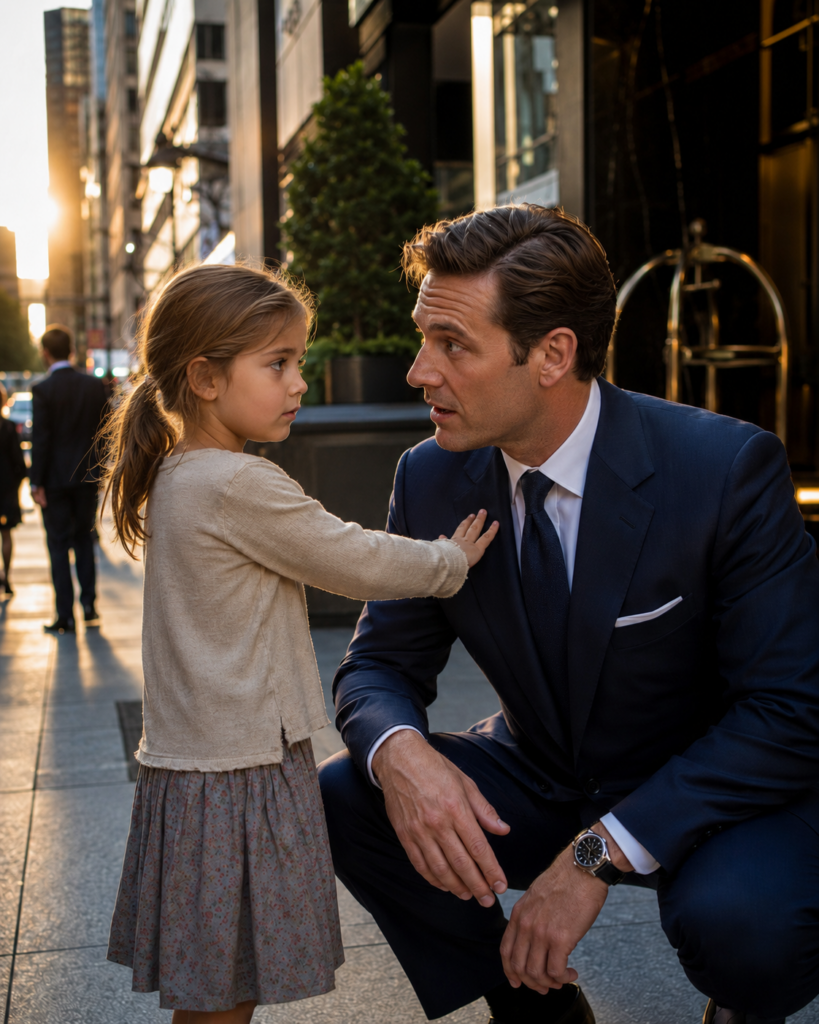
She only wrapped her tiny arms around a stranger’s legs on a Manhattan sidewalk and whispered, “Please… pretend you’re hugging me. Pretend you’re my dad.”
Robert Mitchell had just walked out of the most important meeting of his life.
Two hundred and fifty million dollars.
That was the number written across the final acquisition papers now locked inside the leather folder under his arm. Two hundred and fifty million dollars in assets, stock options, real estate holdings, and private investment rights. The kind of deal that made men slap each other on the back, smile too wide, and pretend they had not been terrified until the ink dried.
The conference room at Mitchell Investments still smelled faintly of black coffee, polished wood, and expensive cologne when Robert closed the folder and stood at the head of the table.
For three seconds, no one spoke.
Then the room erupted into congratulations.
“Rob,” said James, his COO, clapping him hard on the shoulder, “that was history. You understand that, right? We need to celebrate tonight.”
Robert gave the smile people expected from him.
Controlled.
Polite.
Empty.
“Thanks,” he said. “But I have some work to catch up on.”
James laughed because he thought it was modesty.
It wasn’t.
It was the excuse Robert had been using for months.
Maybe years.
At thirty-nine, Robert Mitchell had everything the world told men to chase. A penthouse on Fifth Avenue with windows that framed Central Park like a private painting. A summer home in the Hamptons. A private driver. A firm that had tripled its portfolio in five years. Journalists called him disciplined. Investors called him brilliant. Competitors called him ruthless.
But no one knew what happened when the elevator doors opened into his penthouse at night.
Silence.
Perfect, expensive silence.
No wife calling from another room. No child leaving shoes in the hallway. No small voice asking why he was late. No laughter spilling out from the kitchen. Just marble floors, modern art, museum lighting, and the kind of order that slowly begins to feel like loneliness if no one ever disturbs it.
Robert had grown used to it.
That was what he told himself.
He stepped out of the office building into a crisp November morning, the wind cutting through his cashmere coat. Manhattan moved around him with its usual indifference. People crossed the sidewalk with coffee cups in one hand and phones in the other. Yellow taxis slid through traffic. Steam rose from a street grate. A cyclist cursed at a delivery truck.
Robert’s town car waited near the curb.
He was halfway toward it when the noise started.
“Stop! Hey, stop!”
Two uniformed officers were moving quickly through the crowd, not running exactly, but close. Pedestrians turned their heads. Someone stepped aside with a startled gasp.
Then a little girl burst through the space between two men in suits.
She was blonde, thin, and dirty.
Her coat was far too large for her shoulders, the sleeves hanging past her wrists. Her hair was tangled, her cheeks smudged, her knees scraped beneath a faded dress and mismatched tights. She moved like a child who knew how to run before she knew where she was going.
Robert barely had time to react before she crashed into him.
Not hard.
Desperate.
Her small hands clutched his coat. Her face pressed against his leg. She was trembling so violently he could feel it through the fabric.
“Please,” she whispered.
Robert looked down.
Her blue eyes were huge and terrified.
“Please pretend you’re hugging me,” she said, her voice breaking. “Pretend you’re my dad.”
The words went straight through him.
For a moment, Robert was not a millionaire standing outside a Manhattan office tower after closing a historic deal.
He was fourteen again.
A boy in the back seat of a social worker’s car after his parents’ accident. A boy holding a garbage bag with his clothes inside. A boy pretending he did not care which temporary home came next because caring made the leaving hurt worse.
He knelt before he thought about it.
“Hey,” he said gently. “You’re okay. What’s your name?”
The girl’s fingers tightened around his coat.
Behind her, the officers reached them, slightly breathless.
“Sir, sorry about this,” one said. “She’s from East Side Children’s Home. Third time this month.”
The girl flinched at the name.
Robert saw it.
A tiny movement, but unmistakable.
He kept one hand lightly on her shoulder, not holding her in place, only letting her know he was there.
“What’s your name?” he asked again.
The girl’s lips barely moved.
“Lily.”
“Lily,” he repeated. “I’m Robert.”
She stared at him as if deciding whether names meant anything.
The taller officer cleared his throat. “We need to take her back now.”
Robert stood slowly, keeping his tone controlled. “What happens after that?”
“The home handles it,” the officer said.
Lily’s face went pale.
Robert looked at her raw knuckles, her worn backpack, the way her entire body seemed ready to disappear inside itself.
“Is there any legal way I can come with you?” he asked.
The officers exchanged a look.
“Are you family?”
“No.”
“Then why?”
Robert could have said many things.
Because she asked me to pretend.
Because no child should look that afraid.
Because I know what it feels like to belong nowhere.
Instead, he said, “Because I’m concerned.”
Twenty minutes later, Robert Mitchell sat in the front passenger seat of a patrol car while Lily sat in the back, silent, clutching her backpack to her chest. He had canceled the rest of his day with one text to his assistant.
Something urgent came up. Clear my calendar.
He did not explain.
He could not have explained.
East Side Children’s Home occupied a weathered brick building on a block that seemed to exist in a different city from the one Robert had just left. The walls inside were institutional green. The lights were fluorescent. The air smelled like old paper, floor cleaner, and cafeteria food.
The director, Patricia Wilson, introduced herself with careful professionalism.
“Mr. Mitchell, this is unusual,” she said as she led him into her office. “But the officers told me you were asking about Lily’s situation.”
“I want to understand it,” Robert said.
Patricia sat behind a metal desk covered with files. Children’s drawings were pinned to a corkboard behind her. Some were bright. Some were not.
“Lily has been with us for three years,” she said. “She came in when she was five.”
Robert looked through the glass partition where Lily sat in another room with a social worker. Her backpack was still on her lap.
“How did she arrive here?”
Patricia’s expression changed.
“She was found at a service station off I-95. A trucker called it in. She had a small suitcase with expensive clothes but no identification. All she would say was that her mother told her to wait for her father.”
Robert leaned forward.
“No one came for her?”
“No one.”
“No missing child report?”
“Nothing that matched. No family. No confirmed identity. We ran everything we could.”
His gaze returned to Lily.
She was drawing now, her pencil moving quickly over paper.
Patricia studied him. “May I ask why you’re interested in Lily specifically? We have many children who need foster families.”
Robert did not answer immediately.
Because he did not entirely know.
Then he said, “I was in foster care.”
The director’s expression softened.
“I aged out at eighteen,” he continued. “I know what it means when people stop expecting anyone to show up for you.”
A knock interrupted them. The social worker entered, carrying a folder.
“Sarah Jenkins,” she said. “I handle Lily’s case.”
Robert stood and shook her hand.
Sarah sat across from him, compassionate but cautious. “If you’re considering temporary guardianship, I need to be honest with you. Lily is intelligent and creative, but she has significant attachment difficulties. She has been placed with six foster families. None lasted.”
“What happened?”
Sarah opened the folder. “Whenever she begins to bond, she sabotages the placement. She stops speaking. She takes small objects. She tells elaborate stories. Sometimes she runs. It’s as if she wants to control the abandonment before the adults can do it first.”
Robert absorbed that quietly.
Sarah slid a drawing across the desk.
A house.
A smiling family inside.
And in the corner of the page, outside the window, a small girl watching.
“She draws this over and over,” Sarah said. “Families. Homes. But she always places herself outside.”
The picture hit Robert harder than he expected.
“What does she like?” he asked.
Sarah blinked, surprised by the question.
Then she smiled faintly. “Art. She has extraordinary talent. She reads above her grade level. And she sings a French lullaby with perfect pronunciation, though she does not speak conversational French.”
“French?”
“Yes. She also remembers details from what appears to be an affluent early childhood. Specific perfumes. Food. Fabric. A blue ring her mother wore. But trauma and time have fragmented the memories.”
Robert looked again through the glass.
Lily was still drawing.
A house.
A window.
A small figure outside.
“May I speak with her?”
In the adjoining room, Lily sat stiffly in an oversized chair, her backpack pressed to her chest like armor.
Robert took the chair across from her, careful to give her space.
“I hear you’re an artist,” he said.
She shrugged.
“I used to draw when I was your age,” Robert continued. “It helped when things were difficult.”
Lily’s eyes narrowed slightly. “Are you taking me to another family?”
“Would you want that?”
“They always send me back.”
The sentence came without drama.
That made it worse.
“Why do you think they send you back?” Robert asked.
“Because I’m not what they want.”
He felt something in his chest tighten.
“Lily,” he said carefully, “what if I told you I was interested in being your temporary guardian? Not to replace anyone. Just to give you a safe place while we figure things out.”
She studied him with a seriousness too old for her face.
“Why would you want me?”
Robert had no business answer for that.
No strategic answer.
No clean explanation he could place inside a legal document.
“Because sometimes,” he said, “people find each other when they both need someone.”
Lily looked at him for a long moment.
“Do you have a big house?”
“Yes,” he said. “Too big, probably.”
“Does it get quiet?”
The question caught him off guard.
“Yes,” he admitted. “Very.”
She nodded like she understood exactly.
“I know about quiet.”
Three weeks later, Robert Mitchell’s penthouse looked like a different home.
The guest room had become Lily’s room. Sky-blue walls. Shelves of children’s books. A window seat overlooking Central Park. A small desk. An easel. Canvases. Professional-grade pencils and paints Robert had ordered after reading three articles about art supplies for gifted children.
His housekeeper, Eleanor Hayes, arranged stuffed animals on the window seat while giving him the kind of look only a grandmother of four could give a man who had just spent absurd money trying to make a child feel welcome.
“Mr. Mitchell,” she said, “children do not need perfect rooms.”
Robert adjusted a lamp shaped like a hot air balloon. “What do they need?”
“Consistency,” Eleanor said. “Boundaries. Food when they’re hungry. Patience when they’re frightened. And someone who stays after the first hard day.”
Robert nodded as if receiving instructions for the most important merger of his life.
The temporary guardianship was approved faster than expected, helped by his clean background, resources, home evaluation, parenting classes, and Lily’s urgent placement history. Still, Sarah Jenkins warned him at every step.
“This is not a rescue fantasy, Mr. Mitchell,” she said. “Lily will test you.”
“I expect that.”
“No. You don’t. Not yet.”
She was right.
The first day Lily came home, she wore a navy dress and white tights, her blonde hair braided neatly by someone at the children’s home. She stood in the lobby with her suitcase and backpack, guarded and silent.
“Ready?” Robert asked.
She nodded, but her eyes said she had survived too many beginnings to trust this one.
At the penthouse, the doorman smiled warmly.
“Welcome home, Miss Lily.”
Lily shrank slightly behind Robert.
In the private elevator, she stood perfectly still, hands gripping her backpack straps.
“It’s okay to be nervous,” Robert said softly. “I am too.”
She looked at him.
Not comforted exactly.
But listening.
When she saw her room, she stopped in the doorway.
Robert watched her take in every detail: the bed, the books, the art corner, the window, the small bathroom attached to her room with fluffy towels monogrammed with an L.
“This is all for me?” she asked.
“All for you.”
She touched the comforter like she was checking if it would vanish.
“Can I lock the bathroom door?”
“For privacy, yes,” he said carefully. “But we’ll make safety rules together.”
That seemed to matter to her.
Together.
Not orders.
Not control.
Together.
The first nights were quiet but not peaceful. Lily ate politely, thanked Eleanor for meals, asked permission before touching anything, and retreated often to her room. At bedtime, Robert offered to read.
“No, thank you,” she said formally.
“All right. My room is down the hall if you need anything.”
He started to leave.
“Mr. Mitchell?”
He turned.
“Can I keep the bathroom light on?”
“Of course.”
“And can I keep my backpack next to me?”
“Yes.”
Later that night, Robert woke to singing.
Soft.
Melodic.
French.
He followed the sound down the hall and found Lily sitting by the window, the bathroom light casting a faint glow across her face. She sang with perfect pronunciation, though Robert did not understand the words. It sounded like a lullaby carried from another life.
When she finished, she whispered something into the dark city.
Robert stepped away before she saw him.
The child in his home was not only wounded.
She was a mystery.
And somewhere behind that mystery, he began to suspect, there was a truth no one wanted found.
The first clue came at dinner.
Eleanor had made pot roast. Lily pushed a carrot around her plate, then said quietly, “My mother used to make something like this.”
Robert set down his fork.
“With different spices,” Lily added.
“Do you remember your mother?”
Lily’s face softened. “She had hair like mine. She smelled like jasmine. She wore a ring with a blue stone.”
“A sapphire?” Robert asked gently.
“Maybe. It sparkled when she moved her hand.”
“What about your father?”
Lily’s expression changed.
“He traveled a lot,” she said. “He called me his little princess.”
The words should have sounded sweet.
They didn’t.
“But he didn’t come back for me,” she finished.
That night, Robert called Michael Donovan, a former FBI agent who now ran a private investigation firm. Robert had hired him for corporate background checks before.
This time was different.
“I need you to look into a child,” Robert said. “Found three years ago at a service station off I-95. About five years old at the time. No ID. Expensive clothing. Possible French connection. Mother wore a blue ring. Name unknown.”
“That’s not much to go on,” Michael said.
“I know.”
“Why does this matter?”
Robert looked toward Lily’s room.
“Because her story doesn’t add up.”
Weeks passed.
Trust arrived in pieces.
A smile when Eleanor made strawberry pancakes.
A question about Robert’s day at work.
A drawing left on the kitchen counter.
A tiny hand slipping into his on a snowy walk through Central Park.
But with trust came memories.
A house with a garden.
A bedroom ceiling painted with glow-in-the-dark stars.
A mother packing quickly while looking out windows.
A long drive.
A big gas station.
Pistachio ice cream.
A promise.
“Wait here,” Lily whispered one night, eyes fixed on her blanket. “Mommy said she had to make a phone call. She said she would be right back.”
Robert stayed very still.
“And she didn’t come back?”
Lily shook her head.
“I waited until morning.”
Robert put his arm carefully around her shoulders.
For the first time, she leaned into him.
“I think she wanted to come back,” he said. “I really do.”
The next day, Michael called him to a quiet café in Brooklyn.
He arrived with a thick folder and a grim face.
“I think I know who Lily is,” Michael said.
He slid a magazine clipping across the table.
The photograph showed a beautiful blonde woman in an evening gown. A sapphire ring flashed on her hand. Beside her stood a silver-haired man with a possessive arm around her waist.
“Caroline and William Harrison,” Michael said. “Harrison Global Industries. Shipping, real estate, technology investments. Headquarters in Boston overlooking the harbor. Old money. New power.”
Robert stared at the woman’s face.
The hair.
The blue eyes.
The ring.
“Three years ago,” Michael continued, “Caroline Harrison and her five-year-old daughter, Elizabeth, were reported lost at sea during a private yacht excursion off the coast of Maine. William Harrison was in London at the time.”
“Bodies?”
“Never recovered.”
Robert’s pulse slowed in a dangerous way.
Michael slid another photograph forward.
A formal portrait of a little blonde girl in an expensive dress, serious blue eyes looking into the camera.
Robert stopped breathing.
It was Lily.
Younger.
Polished.
Called Elizabeth.
But unmistakably Lily.
“There’s more,” Michael said. “In the months before the supposed accident, Caroline liquidated personal assets. Nearly two million dollars. She contacted a divorce attorney. She transferred money to an account under the name Claire Fontaine.”
Robert looked up.
“The French lullaby.”
“Exactly. I think Caroline was planning to run.”
“From William.”
“That is my working theory.”
“Why?”
Michael’s face darkened. “Harrison Global has been under quiet investigation for financial irregularities. Money laundering allegations. Tax evasion concerns. Questionable overseas entities. Nothing proven, but enough smoke to suggest Caroline may have discovered something.”
Robert leaned back.
“And Lily?”
“If Elizabeth Harrison is alive, she triggers a succession clause in the Harrison family trust. Thirty percent of Harrison assets go to any living direct heir who reappears after being presumed deceased.”
“How much?”
“With the current sale of Harrison Global pending? Roughly nine hundred million dollars.”
The café noise faded around Robert.
Nine hundred million reasons for William Harrison to keep his daughter dead.
Michael lowered his voice.
“Robert, if this is true, Lily is not just a lost child. She is a threat to a very powerful man.”
The pressure started slowly.
First, a sealed envelope delivered to Robert’s building.
No return address.
Inside, one typed sentence.
Those who involve themselves with the past often become lost in it.
Robert photographed the note, placed it in a plastic sleeve, and sent it to Michael.
Then came the man in the parking garage.
Expensive suit. Calm smile. Dead eyes.
“Mr. Mitchell,” he said. “I represent interests concerned about your recent inquiries.”
Robert kept one hand near the panic button on his key fob. “What interests?”
“Discreet ones.”
The man handed him an envelope.
Inside was the name of a private school in Switzerland.
“Exceptional education. Complete anonymity. All expenses paid for the child currently in your care. You would, of course, be compensated for your cooperation.”
Robert’s voice went cold. “You’re suggesting I give up Lily.”
“I’m suggesting a mutually beneficial solution.”
“How much?”
“Ten million dollars.”
Robert almost laughed.
Not because it was funny.
Because the insult was so cleanly dressed.
“Tell your interests,” he said, stepping closer, “that Lily is not for sale.”
The man’s pleasant mask hardened.
“You don’t appreciate the forces involved here.”
“I understand perfectly,” Robert said. “A powerful man is trying to erase a child. Tell William Harrison if he wants a fight, he found one.”
After that, the attacks became more sophisticated.
Anonymous calls to Lily’s school alleging neglect.
A fabricated tax investigation aimed at Robert.
Questions from child services based on vague claims that Lily was being held against her will.
Photographers outside the building.
A black car parked across the street for three hours with professional-looking men inside.
Harrison was not simply threatening.
He was building a cage around Robert, one invisible wire at a time.
That night, Robert helped Lily pack for a sudden trip to his property in Key West.
“Are we running away?” she asked.
He paused, holding a stack of her sweaters.
“Not running away,” he said. “Taking a break somewhere safer while I handle some business problems.”
“Is it because of me?”
Robert sat beside her.
“No, Lily. The problems are not your fault.”
“But they started after I came.”
“They started because some people do not understand that you matter.”
She looked at him carefully.
“Like my other foster families?”
“No,” he said. “Different. Some people with money and power think they can control everyone.”
“Can they?”
Robert took her hand.
“Not if we stand together.”
Key West should have felt like peace.
The villa sat at the end of a private peninsula, surrounded by water on three sides. Palm trees shifted in the warm wind. Bougainvillea spilled purple over white walls. Lily collected shells on the private beach and laughed more in three days than Robert had heard in three months.
For a little while, she looked like a child again.
Then Michael called.
“William Harrison landed in Miami yesterday,” he said.
Robert looked through the glass doors at Lily crouched by a tidal pool, sunlight bright in her hair.
“He’s coming himself.”
“Yes.”
The next morning, Robert’s head of security appeared in the doorway.
“Sir, there are three men at the main gate. One claims to be William Harrison. He says he needs to speak with you about his daughter.”
Robert felt a cold stillness settle inside him.
“His exact words?”
“Yes, sir.”
“Let him in. Alone.”
William Harrison arrived on the terrace in an immaculate linen suit, silver hair untouched by the humidity, face composed with the smooth confidence of a man who had used money like gravity all his life.
“Mr. Mitchell,” he said. “I appreciate you seeing me.”
“Cut the performance,” Robert replied. “We both know why you’re here.”
Harrison smiled thinly. “Indeed. I have come for my daughter.”
“The daughter you let the world believe drowned.”
“My wife was unstable. She fled with Elizabeth during a psychological episode. The accident was a tragedy.”
“Save it,” Robert said. “I know about Caroline’s money transfers. The divorce attorney. Claire Fontaine. The woman found in Maryland with sedatives in her system. The succession clause. The three-billion-dollar sale.”
For the first time, Harrison’s mask cracked.
Only for a second.
Then it returned.
“You’ve constructed a conspiracy from fragments.”
“You tried to buy me.”
“I offered a practical solution.”
“You offered ten million dollars to make a child disappear quietly.”
Harrison’s voice lowered. “You are out of your depth. Elizabeth is my blood. My heir. My legacy.”
“She is a child,” Robert said. “Not a stock certificate.”
Harrison leaned forward.
“You think affection gives you standing against biology?”
Robert met his eyes.
“No. Love does. Sacrifice does. Showing up does. Sitting beside her while she wakes from nightmares does. Teaching her that mistakes don’t mean abandonment does. You may be her biological father. But you are not the man who became her home.”
The terrace went silent except for the ocean.
Then a small voice came from the doorway.
“My name is Lily.”
Both men turned.
Lily stood there with Eleanor behind her, small but straight-backed, pale but steady.
Harrison softened his face instantly.
“Elizabeth,” he said. “My little princess.”
She took one step closer to Robert.
“My name is Lily now.”
“Of course,” Harrison said gently. “If that is what you prefer.”
Lily watched him.
Robert could see her memories working behind her eyes like shadows behind curtains.
“You didn’t look for me,” she said.
Harrison’s hand twitched.
“I thought you were gone.”
“If you were looking,” Lily said, “you would have found me.”
The words hit harder than any accusation Robert could have made.
Harrison tried again. He spoke of her room with the stars on the ceiling. The garden. The swing. Her mother’s ring. He used memories like keys, trying to unlock her trust.
But children know when tenderness is real.
And when it is being performed.
“My mother was scared of you,” Lily said.
Harrison’s expression chilled.
“Your mother was confused.”
“She told me to hide.”
“She was sick.”
“She sang to me,” Lily whispered. “She said if they found me, they would take me away forever.”
Robert stepped beside her.
“That’s enough.”
Harrison straightened.
“You have twenty-four hours to cooperate before I return with attorneys and a court order.”
Robert looked at him calmly.
“I’ll see you in court.”
The hearing became national news before it even began.
Business reporters smelled a scandal. Society pages remembered Caroline Harrison. Financial analysts questioned the pending sale of Harrison Global. Family court observers whispered about wealth, custody, sealed records, and a child who had lived three years under the name Lily Jane Doe.
Robert hated every camera outside the courthouse.
Lily held his hand so tightly her fingers felt cold.
“You don’t have to speak to anyone,” he told her.
“I know.”
“You don’t have to look at him.”
“I know.”
“You are not alone.”
This time, she looked up.
“I know.”
Judge Rebecca Winters presided with the expression of a woman who had no patience for rich men confusing children with property.
“This court’s priority,” she said, looking over her glasses, “is the best interest of the child. Not inheritance. Not public reputation. Not corporate convenience.”
Harrison’s attorney spoke first.
He presented DNA evidence. Birth certificates. Family photographs. The tragic story of a grieving father who believed his wife and daughter had died at sea. He argued that Elizabeth Harrison should return to her rightful family and legacy.
Then Robert’s attorney, David Levenson, stood.
“This case is not about rightful anything,” he said. “It is about a child who spent three years abandoned in the system while a man with limitless resources made no meaningful effort to find her.”
He displayed Lily’s drawings.
A child outside the window.
A child watching families from a corner.
Then he showed the recent ones.
The penthouse.
A table.
Robert and Lily inside.
Together.
“This is not sentimentality,” David said. “This is psychological evidence. Lily is healing. She has attached. She has begun to place herself inside the family circle for the first time in years.”
Michael’s investigation entered the record carefully.
Caroline’s financial preparations.
The divorce consultation.
The Claire Fontaine account.
Dental confirmation that the unidentified woman found in Maryland was Caroline Harrison, not a drowning victim lost at sea.
The suspicious timing of William Harrison’s sudden interest in his daughter just as a multibillion-dollar sale approached.
Harrison’s attorney objected repeatedly.
Judge Winters allowed enough.
Then she asked to speak with Lily privately in chambers, with only a court-appointed child psychologist present.
Robert knelt before Lily outside the chamber door.
“You tell the truth,” he said. “Nothing else.”
“What if the truth makes him angry?”
“Then that is his burden. Not yours.”
She nodded and went inside.
Those twenty minutes felt longer than every business negotiation Robert had ever survived.
When Lily returned, her face was pale, but she walked straight to Robert and slipped her hand into his.
Judge Winters took the bench again.
The courtroom went still.
“This case presents extraordinary circumstances,” she began. “We have biological paternity. We also have three years of unexplained absence, substantial concerns regarding the circumstances of the child’s separation from her mother, suspicious financial timing, and most importantly, the clear emotional needs and stated preference of the child.”
Harrison sat rigidly.
Robert could not breathe.
Judge Winters looked directly at Lily.
“Having reviewed the evidence and spoken with this remarkable young person, I find that Lily’s best interests are clearly served by remaining in the custody of Robert Mitchell.”
A murmur ran through the room.
Robert froze.
Judge Winters continued.
“I am granting Mr. Mitchell’s petition for permanent adoption, effective immediately. Mr. Harrison’s biological connection is legally recognized, but any future visitation petition will require full psychological evaluation, parenting assessment, and further review pending the ongoing investigation into Caroline Harrison’s death.”
The gavel fell.
“This matter is decided.”
For one second, Robert did not move.
Then Lily threw her arms around his neck.
“We won,” she whispered. “We really won.”
Robert held her so tightly he had to remind himself to loosen his arms.
“Yes, sweetheart,” he said, voice breaking. “We did.”
Across the courtroom, William Harrison stood with his attorneys, his face dark with controlled fury. As Robert and Lily prepared to leave, he approached.
“This isn’t over, Mitchell,” Harrison said quietly. “I have resources you cannot imagine.”
Robert looked at him.
“It is over as far as Lily is concerned.”
Harrison’s gaze shifted to the child.
“Elizabeth,” he said. “One day you’ll understand what it means to be a Harrison.”
Lily stepped out from behind Robert.
“My name is Lily Mitchell now,” she said. “And I already understand what matters.”
Harrison said nothing.
Because for once, there was nothing he could buy, threaten, or erase.
Months later, the penthouse no longer felt like a museum.
There were colored pencils on the dining table. A school bag by the door. A half-finished solar system project hanging from Lily’s ceiling. Strawberry ice cream in the freezer. A crooked drawing taped to Robert’s office wall that showed two people holding hands under a sky full of stars.
Robert still worked.
He still closed deals.
He still made difficult calls and negotiated with impossible people.
But he came home earlier now.
Because someone was waiting.
One evening, Lily sat beside him at the kitchen counter while Eleanor made dinner. She was drawing quietly, her tongue pressed to the corner of her mouth in concentration.
“What are you making?” Robert asked.
She turned the paper toward him.
It was a family portrait.
Not perfect.
Not polished.
But clear.
A tall man. A little girl. Eleanor in the kitchen. Central Park outside the window. And in the sky, faint but present, a blonde woman with a sapphire ring, smiling down.
“My mother,” Lily said softly. “I think she would like you.”
Robert swallowed.
“I hope so.”
“She came back for me,” Lily said after a moment.
Robert looked at her.
“I know she didn’t get there. But she wanted to. I remember now.”
He reached for her hand.
“Yes,” he said. “She wanted to.”
Lily leaned against him.
“And you stayed.”
Those two words nearly undid him.
You stayed.
The thing every child in the system secretly asks without saying it.
Will you stay when I’m scared?
Will you stay when I make mistakes?
Will you stay when my past becomes complicated?
Will you stay when powerful people make it easier to walk away?
Robert Mitchell had once believed success was measured in numbers: assets acquired, companies saved, portfolios multiplied, deals closed.
But sitting in that kitchen with Lily’s head against his arm, he understood that the greatest thing he had ever done began on a sidewalk when a frightened child asked him to pretend.
Pretend you’re hugging me.
Pretend you’re my dad.
He had pretended for one minute.
Then he became the real thing.
And somewhere in the city, under the same Manhattan sky, men were still chasing money, power, and names on buildings.
Robert had chased all of that too.
But Lily had taught him the truth.
A house is not a home because it is expensive.
A man is not a father because blood says so.
And a child is not lost forever just because powerful people want the world to stop looking.
Sometimes, the whole story changes because one stranger kneels on a sidewalk, looks into a little girl’s terrified eyes, and decides not to let go.
Sometimes, family begins as a rescue.
Sometimes, love begins as a promise.
And sometimes, the most important deal of a man’s life is not worth two hundred and fifty million dollars.
It is worth one small hand holding his and finally believing, maybe this time, no one will send me back.
Disclaimer : This content may be created by AI for entertainment purposes. Any resemblance to real persons, events, or places is coincidental.