She Came Home For Grandma’s Will. Then The Paychecks Came Out.-heyily

I almost let the call die in my hand when my father’s name lit up the screen.
Dad.
The phone buzzed against my palm while the window in my cheap Columbus apartment shook in the May wind.
Rain clicked against the fire escape in thin little taps, and somewhere down the block a siren dragged through traffic before disappearing into the wet evening.
Once, that name had meant safe.
By then, it sounded like a warning.
I answered for one reason.
Curiosity.
“Where the hell are you?” my father snapped before I could say hello.
His breathing was rough, like he had been pacing.
“You need to get home. Now.”
Home.
That was the word he used, like I had stepped outside to check the mail and forgotten to come back.
Three years earlier, I had walked out of that house with two duffel bags, a blue folder, and a heart so tired it had stopped asking to be held.
Nobody noticed.
Not my mother, who treated me like background noise that occasionally bought groceries.
Not Jake, my older brother, who could do damage and still get called a good kid.
Not Hailey, my younger sister, whose recital photos filled the hallway like proof she was the only daughter worth framing.
And definitely not my father.
He remembered me only when something needed paying, fixing, driving, carrying, covering, or saving.
Now he sounded like I had been gone for five minutes.
So I said nothing.
I wanted to hear how long it took panic to crawl into his voice.
“Taylor,” he said, sharper now. “Answer me.”
My apartment smelled like rain, old carpet, and the instant coffee I kept reheating because I hated wasting anything.
My couch had come from a neighbor who was moving out.
My kitchen table had one wobbly leg.
The lamp beside my window flickered if the cord bent the wrong way.
It still felt more like home than the house I grew up in.
From the curb, our family used to look normal enough.
Two-story house in Columbus, Ohio.
Maple trees.
A small American flag by the porch steps.
A mailbox my mother repainted every spring, even though the inside of that house got colder every year.
Inside, everyone had a rank.
Jake was the golden child.
Loud, charming, impossible to blame.
If Jake dented the car, Dad said boys made mistakes.
If Jake forgot homework, Mom said teachers were too hard on him.
If Jake came home smelling like somebody else’s beer after a football game, everyone lowered their voices and acted like shame belonged to the person who noticed.
Hailey was the princess.
Glitter, costumes, rides to practice, new shoes when hers looked tired.
There was always money for recital fees.
There was always gas for her school pickup line.
There was always time to clap for her.
I was the dependable one.
That sounds like praise until you realize it means convenient.
My mother used to smile and tell people, “We never have to worry about Taylor.”
What she meant was that Taylor did not get to need anything.
By sixteen, I had a part-time job and a joint account my father opened for convenience.
Every paycheck went in.
Somehow, none of it stayed there.
At first, it was temporary.
Then it was family.
“Jake needs football camp.”
“Hailey’s dance fees are due.”
“We’re short on the electric bill.”
“Don’t be selfish, Taylor.”
I bought my own shampoo, school supplies, gas, and winter boots when the soles split open.
When I asked where my money went, Dad laughed like I had asked something childish.
“This is what families do,” he said. “We help each other.”
A family can teach you the word help until it turns into theft with better manners.
The moment that finally changed me came the summer I won an out-of-state scholarship.
The acceptance email hit my inbox at 2:17 PM on a Tuesday.
I still remember the time because I stared at it until the numbers blurred.
I printed the letter at the school office because I wanted something real in my hands.
The paper was warm from the printer.
My fingers left tiny crescent dents in the top edge because I was gripping it too hard.
I carried it home like it might break if I held it wrong.
At dinner, I read it out loud.
My hands shook.
I thought maybe this time, somebody would look up and see me.
Dad nodded once and said, “That’s nice. Just make sure you’re back before Hailey starts school. She’ll need rides.”
Mom asked if meals were included.
Jake asked if I could bring him back a hoodie.
Nobody asked how hard I had worked.
Nobody asked when I was leaving.
Nobody asked if I was scared.
Nobody came to the airport.
When I landed, I sent a picture of myself in front of the campus sign.
The timestamp under it read 4:12 PM, July 18.
No one replied.
Weeks later, I came home sunburned, exhausted, and happier than I had been in years, with a trophy tucked under my arm.
Dad was watching TV.
Mom was at the sink.
I stood in the doorway waiting for one person to ask.
Dad glanced over and said, “Did you bring milk?”
That was all.
No how was it.
No we missed you.
No we’re proud of you.
Just milk.
Something cold turned in me that day.
Not rage.
Not grief.
A lock.
After that, I started documenting my own life like somebody preparing to prove she had existed.
I opened a new bank account at a branch across town.
I rented a P.O. box.
I collected my birth certificate, Social Security card, scholarship letters, pay stubs, and old account statements.
Then I sealed them inside a blue folder and hid it under the spare tire in my car.
One bag left the house at a time.
A sweatshirt folded under my work apron.
A pair of shoes in the trunk.
Three books tucked inside a grocery bag.
A box of winter clothes I told Mom I was donating.
Nobody noticed my closet getting emptier.
Nobody noticed I stopped coming home for dinner.
Nobody noticed I was no longer available to pick up Hailey, cover Jake, or rescue my parents from emergencies they had created themselves.
They only noticed what I stopped doing.
My phone still lit up for a while.
Can you send money?
Can you pick up Hailey?
We need milk.
The first time my father realized my paychecks had stopped going into that joint account, he called six times.
I answered on the seventh.
“Did you change something?” he asked.
“Yes.”
Silence.
Then, offended instead of scared, he said, “Without asking me?”
Not where are you.
Not are you safe.
Just money.
By the time my part-time classes turned into a full-time job and my tiny apartment filled with secondhand furniture, I had already grieved them.
That is the thing about emotional abandonment.
The loss happens before the leaving.
Months passed.
Then a year.
Then three.
Birthdays came and went.
Holidays passed in silence unless somebody needed something.
Eventually, even the requests faded.
I kept the same number for one reason.
Proof.
Proof of what it would take for them to remember I existed.
Apparently, it took my grandmother dying.
Dad’s voice cracked through the phone.
“Taylor, listen. This isn’t funny. You need to come here now.”
At Grandma Ruth’s name, my grip tightened.
She was the only one who ever really saw me.
Not loudly.
Not like some dramatic rescue.
Quietly.
She pressed twenties into my palm and said, “For gas,” even when both of us knew it was not about gas.
She asked if I had eaten and waited for the real answer.
She noticed when my shoes were worn thin.
She noticed when I stopped talking at family dinners.
She noticed when I smiled without meaning it.
A year before I left, she sat across from me at her kitchen table and said, “Make sure nobody turns your heart into a wallet.”
It was the closest anyone had ever come to saying they understood.
“When did she die?” I asked.
“This morning,” Dad said too fast.
Then his voice sharpened.
“The lawyer’s here. Stop making this difficult and come home.”
There it was.
Not grief.
Not concern.
Paperwork.
“So that’s what this is,” I said.
“Don’t start,” he snapped. “She wasn’t thinking clearly. She put your name on some things. We just need you to sign a few papers.”
We need you.
Even after three years, he still sounded like he was assigning chores.
Ten minutes later, an attorney named Mr. Mercer called from a quiet office line.
Calm.
Professional.
Precise.
He confirmed Grandma Ruth had passed and that she had left specific instructions for certain documents to be placed directly in my hands.
Specifically, not my father’s.
“Do not sign anything before I arrive,” he said.
“Was she alone?” I asked.
His pause was small, but I heard it.
“She was cared for,” he said gently. “And she was very clear-minded.”
That mattered.
I knew exactly why Dad was saying otherwise.
If he could make her sound confused, he could make himself sound reasonable.
By the time I pulled onto their street at 7:38 PM, the evening had flattened everything gray.
The house looked exactly the same.
Porch light glowing.
Artificial flowers tipped in the planter.
That small American flag hanging beside the steps.
For a moment, I sat in my car and stared at the place that had made losing me look so easy.
Then I went inside.
The air smelled like lemon cleaner and tension.
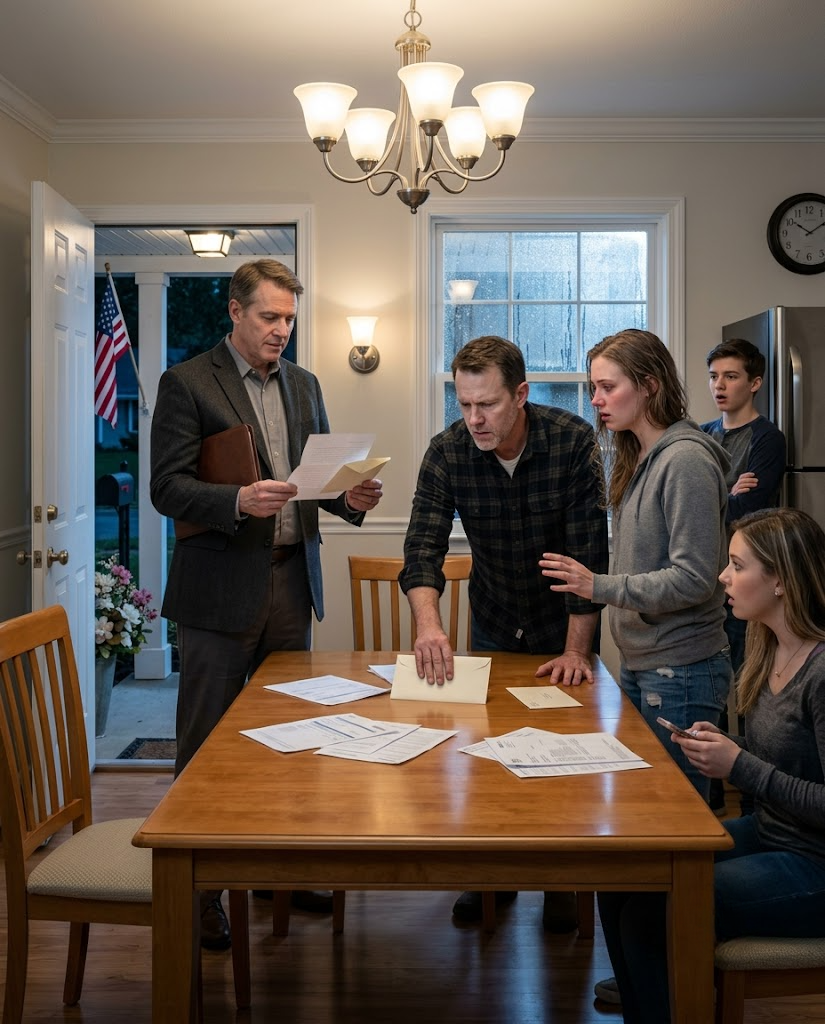
Everyone was there.
Dad by the dining table.
Mom with her lips pressed thin.
Jake pretending not to care.
Hailey staring at her phone, one glittered nail frozen above the screen.
The room stopped the way it used to when I was about to be blamed for something.
My mother’s hand tightened around a dish towel.
Jake looked at the leather folder instead of at me.
Hailey’s phone dimmed in her lap.
The refrigerator hummed.
The clock ticked.
Nobody asked where I had been for three years.
Nobody moved.
On the dining table sat a leather folder, a stack of papers, and one cream envelope with my name written in Grandma Ruth’s careful handwriting.
My father put his hand over it before I could reach.
“She wasn’t thinking clearly,” he said. “We need to keep this fair.”
Fair.
In my family, fair always meant give us what is yours.
“Move your hand,” I said.
He looked surprised that I had spoken at all.
“Don’t use that tone with me.”
For one ugly second, I saw myself at sixteen again, standing beside that kitchen table with cracked winter boots and an empty account, apologizing for needing what I had earned.
Then the front door opened behind me.
Mr. Mercer stepped inside, shook rain from his coat, and took in the room.
My father’s hand on the envelope.
My silence.
The papers waiting on the table like a trap.
He looked directly at me.
“Ms. Bennett,” he said calmly, “before anyone asks you to sign anything, your grandmother instructed me to read her letter aloud.”
My father’s fingers tightened on the envelope.
Mr. Mercer paused.
Then he added, “Especially the part about what he did with your paychecks.”
The room changed so fast I almost heard it.
My mother’s face went blank first.
Jake stopped pretending not to care.
Hailey finally looked up from her phone.
For once, nobody told me I was being dramatic.
Dad pulled the envelope closer to his chest like paper could become property if he touched it hard enough.
“That’s private family business,” he said.
Mr. Mercer didn’t raise his voice.
He didn’t need to.
He set his leather folder on the dining table and slid one document out with two fingers, careful and exact.
It was the way people handle things that have already been copied, dated, and witnessed.
“Mrs. Ruth Bennett was very clear,” he said. “Taylor is to receive the letter before any signatures are discussed. She also asked me to bring the bank statements from the joint account.”
Bank statements.
My father’s jaw shifted.
Then Mr. Mercer placed a second, thinner envelope beside the first one.
This one had my name on it too.
Under it, Grandma Ruth had written four words in blue ink.
For what they took.
My mother sat down without meaning to.
The chair legs scraped the floor so sharply that Hailey flinched.
Jake whispered, “Dad… what is that?”
Dad didn’t answer him.
He was looking at me now, really looking, like I had become a problem he could no longer send to the store for milk.
Mr. Mercer opened the cream envelope, unfolded Grandma Ruth’s letter, and read the first line aloud.
“Taylor, if your father is standing in front of you pretending this is about fairness, ask him why your name appears beside every withdrawal from March 2016 through August 2020.”
The kitchen went silent.
Even the refrigerator seemed too loud.
Mr. Mercer continued.
“Ask him why he told you that family helps family while he used your wages to pay for things he never intended to repay.”
Dad’s face flushed dark.
“That is enough.”
“No,” I said.
One word.
Small.
Steady.
It startled me more than it startled him.
Mr. Mercer looked at me for permission.
I nodded.
He read on.
Grandma Ruth had listed dates.
Amounts.
Deposits.
Withdrawals.
The first grocery store paycheck I had been proud of.
The summer hours I worked until my feet ached.
The scholarship stipend that was supposed to help with travel.
The birthday money she had given me that Dad said must have been spent already.
It was all there.
Not every dollar, maybe.
But enough.
Enough to make the story real outside my memory.
That was the strange part.
I had lived it.
I had carried it in my body for years.
Still, seeing it in neat columns made me feel like I had finally stepped out of a fog.
My mother whispered, “We needed help.”
I looked at her.
She had said we.
Not he.
Not your father.
We.
“You could have asked,” I said.
She looked down at the dish towel twisted in her hands.
“You always said yes anyway.”
That hurt more than denial would have.
Because it was true.
I had said yes so many times they stopped hearing it as permission.
They heard it as ownership.
Mr. Mercer opened the second envelope.
Inside was a short note from Grandma Ruth and a cashier’s check from her estate account.
He did not wave it around.
He did not make a show of it.
He simply placed it in front of me.
“Your grandmother could not undo everything,” he said. “But she wanted you to have a beginning that no one in this room could touch.”
My father laughed once.
It was an ugly sound.
“So that’s what this is? She poisoned you against us?”
I looked at him and remembered every ride I had given Hailey.
Every shift I had worked.
Every time I had swallowed hunger because there was not enough gas and food money for both.
Every time he called it family.
“No,” I said. “She believed me.”
His eyes cut to the papers.
Then to Mr. Mercer.
Then to me.
For the first time in my life, my father looked smaller than the room he was trying to control.
“You’re not taking this house from us,” he said.
The sentence landed wrong.
Too fast.
Too revealing.
Mr. Mercer closed the folder halfway.
“No one said she was.”
My father froze.
Jake slowly turned his head toward him.
Hailey whispered, “What does that mean?”
Mom covered her mouth.
There are moments when a lie does not collapse because someone exposes it.
It collapses because the liar reaches for the next excuse too early.
Mr. Mercer explained that Grandma Ruth had not left me the house they lived in.
She had left me money from her own accounts, a small storage unit of personal items, and a signed letter requesting that I receive copies of every relevant bank record before anyone in the family contacted me about inheritance papers.
She had known what they would do.
That was what made my knees feel weak.
Not the money.
Not the paperwork.
The fact that someone had known me well enough to protect me after she was gone.
Dad started talking then.
Fast.
Angry.
Messy.
He said I was ungrateful.
He said I had no idea how hard it was to raise three kids.
He said I had always been dramatic.
He said Grandma Ruth was old and bitter.
He said everything except I’m sorry.
I listened until his words became weather.
Then I picked up the cream envelope and held it against my chest.
The paper was soft at the fold.
Grandma Ruth’s handwriting curved over my name like she had taken her time.
“Taylor,” my mother said quietly. “Don’t do this.”
I almost laughed.
“Do what?”
She had no answer.
Because I was not screaming.
I was not threatening.
I was not asking them to love me.
I was simply taking back what had my name on it.
That felt unforgivable to them.
Mr. Mercer asked if I wanted a few minutes alone with the letter.
I said no.
I had been alone with the truth for years.
I did not need to protect them from hearing it.
He read the rest.
Grandma Ruth wrote about the twenties for gas.
About the way I used to sit at her kitchen table with both hands wrapped around a mug like warmth was something I had to borrow.
About the afternoon she saw my father take my debit card from the counter and put it in his pocket without asking.
About how she confronted him and he told her I did not understand money.
About how she started keeping notes after that.
My father stared at the wall.
My mother cried silently.
Jake looked sick.
Hailey kept her phone facedown in her lap.
When Mr. Mercer finished, the room felt emptied out.
Not peaceful.
Exposed.
He handed me the letter.
“She wanted you to know,” he said, “that leaving was not betrayal.”
I looked down.
At the bottom, Grandma Ruth had written one final line.
You were never hard to love, Taylor. They were just too greedy to do it right.
I pressed my lips together because I refused to cry in that room.
Not because they did not deserve to see it.
Because she did not deserve to have her last words turned into another scene about them.
Dad finally spoke.
“So what now?”
There it was again.
Not remorse.
Strategy.
I slid the bank statements back into the folder.
“Now I leave.”
“You can’t just walk out.”
That was the first true thing he had said all night.
Because walking out was not simple.
It had taken years.
Two duffel bags.
A blue folder.
A locked heart.
A grandmother who saw more than anyone wanted her to.
But I did it anyway.
I turned toward the door.
Behind me, Mom said my name.
Not Taylor, come back.
Not Taylor, I’m sorry.
Just my name, like she was testing whether it still worked as a leash.
It didn’t.
Outside, the rain had slowed to a mist.
The small American flag by the porch steps moved softly in the wet air.
My car smelled like old upholstery and the paper envelope in my hands.
I sat behind the wheel for a long moment before starting the engine.
For three years, I had kept the same phone number as proof of what it would take for them to remember I existed.
Now I had better proof.
A letter.
A stack of statements.
A beginning no one in that house could touch.
My phone buzzed before I reached the end of the street.
Dad.
Then Mom.
Then Jake.
Then Hailey.
For once, everyone noticed I was gone.
I let the calls ring until they stopped.
Then I drove back to my cheap Columbus apartment, where the window rattled in the wind and the lamp flickered if the cord bent wrong.
The couch was secondhand.
The kitchen table wobbled.
The coffee was terrible.
But when I unlocked the door, nobody asked what I had brought them.
Nobody reached for my pockets.
Nobody called theft family.
I set Grandma Ruth’s letter on the table and finally cried where no one could use it against me.
The next morning, at 8:06 AM, I opened a folder and began making copies.
Not because I wanted revenge.
Because I had learned what happens when nobody documents the truth.
People like my father call it fairness.
People like my mother call it needing help.
And girls like me spend years wondering why love always comes with a receipt.
But Grandma Ruth had been right.
Nobody gets to turn your heart into a wallet and call it home.
Not anymore.