
She Mocked His “Computer Job” Until The Penthouse Truth Came Out

My sister, Paige, had spent most of our lives being treated like a blessing that arrived wrapped in silk.
I had spent most of mine being treated like the cardboard box she came in.
That sounds bitter, and maybe it is, but bitterness is often just memory without decoration.
In my family, Paige was the miracle child.
That was the phrase my mother used, especially when company was over.
“Our miracle.” She said it with her hand on Paige’s hair, her voice softened, her expression glowing.
My father was less poetic about it, but no less devoted.
He anticipated Paige’s needs before she voiced them.
He made things easier for her the way some people smooth a blanket over a sleeping child.
I was Jaden, three years older, practical by necessity and mostly invisible by design.
When I was younger, I used to think it would even out with time.
I believed adulthood would solve what childhood distorted.
Once we were older, I thought, my parents would naturally see us more clearly.
They would notice effort.
Character.
Reality.
That never happened.
Paige grew into the kind of person the world often rewards before it asks any hard questions.
She was beautiful in the polished, easy way that made strangers warm to her quickly.
She knew how to laugh at the right volume.
She knew how to occupy a room.
She knew how to receive attention as if it were her birthright.
And because she had always been treated as exceptional, she moved through life expecting exceptions.
My parents fed that expectation constantly.
They paid for private school, acting lessons, dance classes, expensive summer programs, and shopping weekends.
Every accomplishment of hers was framed like a triumph of destiny.
If she got cast in a student production, my mother called three relatives.
If she got a callback for an ad, my father took us out to dinner.
I did well in school too, but my achievements were handled differently.
Good grades were expected.
Scholarships were practical.
Working after class was “good for me.” When I needed help, I got speeches.
When Paige wanted something, she got solutions.
The clearest symbol of it came when we turned sixteen.
For Paige, there was a white Audi in the driveway under a red bow so large it looked absurd.
She cried, my mother cried, my father recorded the whole thing, and the video was sent around the family like evidence of love.
For me, there was a text message sent after nine at night because I was working a grocery shift.
“Happy birthday, champ.” My mother added a cake emoji.
I ate a stale muffin and told myself it was fine.
That became my skill: telling myself things were fine.
After high school, Paige went to an expensive performing arts college in Los Angeles.
My parents behaved like they were launching royalty into the world.
I moved to New York with two duffel bags, a laptop with a cracked corner, and just enough money to start failing slowly.
New York was not kind at first.
I rented one bedroom in apartments that felt like accidental architecture.
I worked tech support, debugged code for companies too cheap to hire full teams, took overnight freelance gigs, and attended classes during the day with caffeine in my
veins and panic just beneath it.
I learned how to stretch every dollar, how to live without sleep, and how to build things because nobody was interested in building me.
Then one of the tools I made for small businesses started spreading online.
It solved one irritating, expensive problem well enough that people kept recommending it.
A project I thought might cover one month’s rent turned into a contract.
That contract turned into a client base.
The client base turned into a small team.
The team became a startup.
There were years in there I can barely describe without sounding like I’m reciting a weather report from a natural disaster.
I worked constantly.
I made mistakes, fixed them, made smarter ones, hired too early, fired too late, trusted the wrong people, then found the right ones.
I learned how to pitch, negotiate, build, present, recover, and keep moving while exhausted.
And then, one afternoon, a larger company made an acquisition offer.
When the deal closed, I sat in my apartment staring at the number in my account with the feeling that someone had misplaced a decimal point.
I should have felt triumphant.
Instead, I felt protective.
I knew my family too well.
If I told them I had money, they would not suddenly become proud in the clean, simple way healthy families are proud.
My father would ask why I hadn’t told him sooner, not out of hurt but control.
My mother would become emotionally theatrical.
Paige would turn defensive and competitive.
And at some point, someone would decide that my success should be redistributed, minimized, or explained away.
So I told no one.
A year later, I bought a penthouse on the Upper East Side.
The apartment still felt unreal the first time I saw it empty.
Floor-to-ceiling windows facing the park.
White oak floors.
A kitchen large enough to host the sort of dinner nobody in my family had ever given me.
A terrace with skyline views that shifted color with the hour.
It was elegant without feeling cold, expensive without feeling showy.
I bought it because I loved it, because I had earned it, and because for once in my life I wanted something that wasn’t shaped by anyone else’s expectations.
I moved in quietly.
The only person I considered telling was my grandmother.
Grandma Ruth had always loved me with a steadiness that asked for nothing back.
She remembered details.
She noticed moods.
She sent cards when nobody else called.
When I was a teenager, she was the one who slipped me grocery money without making me feel pitied.
When I got into college, she was the one who hugged me as if I had done something noble, not merely practical.
So when she invited the whole family to her eighty-fifth birthday dinner, I went.
The dinner was at an old restaurant my grandparents used to visit when they were younger.
It was one of those places with thick carpeting, low gold light, framed oil paintings, and servers who made even a water refill look intentional.
The air smelled like wine, butter, and polished wood.
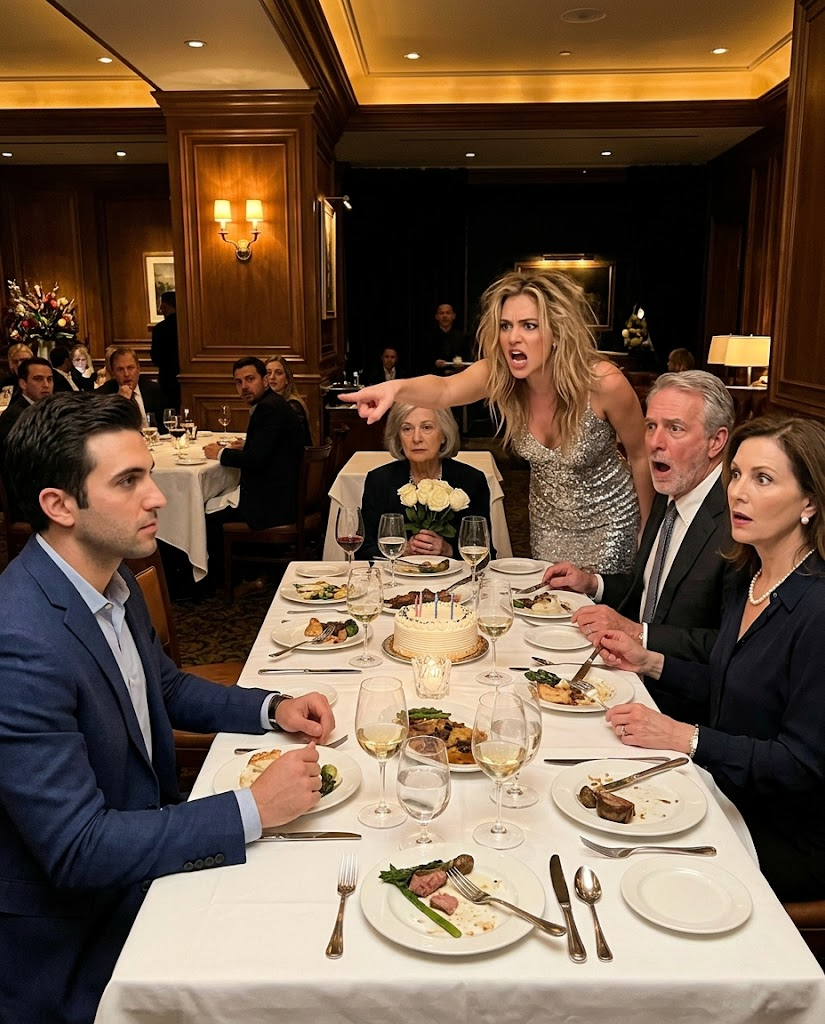
Paige was already holding court when I arrived.
She wore a silver dress that caught the light every time she moved, which she clearly knew.
My parents sat to either side
of her, radiating the same familiar pride they always had when she was performing herself.
I gave Grandma white roses, kissed her cheek, and sat down.
“Oh, Jaden,” she whispered.
“You always think of the little things.”
Paige barely let the moment land before redirecting the room.
“We were just talking about my callback,” she said.
“This one’s serious.
Streaming platform.
Big producers.”
Everyone leaned in.
Everyone always leaned in.
I sat back and listened while she described auditions, meetings, industry friends, and a career built largely from future tense.
She was good at talking about momentum even when she had not actually moved.
At some point, she turned to me with the smile that had irritated me since childhood.
“So, Jaden,” she asked, “are you still doing that computer thing?”
A few people laughed.
That was the part that used to get me: people in my family laughed before checking whether something was cruel.
I smiled back.
“Yeah,” I said.
“Still doing that.”
She lifted her glass.
“Must be nice working in pajamas while some of us have real careers.
Real pressure.
Real people waiting on us.”
My mother smiled.
My father cut his steak.
Aunt Cheryl watched the table with the expression of someone sensing weather.
Then Grandma stopped moving.
Her hand tightened around her fork, and though she said nothing, I saw it.
She had heard the insult land.
She always heard what others preferred to call teasing.
The conversation drifted on, but Paige kept circling back to me like she needed an audience for the contrast.
When Aunt Cheryl finally asked if I was at least comfortable in New York, Paige laughed and answered for me.
“He probably lives in some depressing little box with six roommates and one burner on the stove.”
My father chuckled.
I set down my glass.
“Actually,” I said, “I moved last year.”
Paige tilted her head.
“Oh? Where?”
“Upper East Side.”
That got a pause.
“Renting?” she asked.
“No,” I said.
“I bought.”
My mother blinked.
My father frowned.
Paige laughed too quickly.
“You bought an apartment in Manhattan?”
“A penthouse.”
The table stilled.
My father was the first one to speak.
“What do you mean, a penthouse?”
“I mean exactly that.”
“With what money?” he asked.
“With mine.”
My mother set down her glass with controlled care.
“Since when do you have that kind of money?”
I looked at all of them and suddenly felt something I had never felt at a family dinner before.
Not small.
Not angry.
Clear.
“I built a company,” I said.
“And I sold it.”
My father dropped his fork.
The clang against the plate was so sharp that people at nearby tables turned.
Paige stared at me as if the room had tilted.
“You had a company?”
“Yes.”
“You sold it?”
“Yes.”
“For how much?”
“Enough to buy the penthouse in cash.”
Paige’s chair scraped backward.
“No,” she said immediately.
“No.
That’s not even believable.”
My father looked insulted in a way I recognized well: not because I had hurt him, but because I had disrupted his understanding of the hierarchy.
“Why,” he asked slowly, “wouldn’t you tell your family something like this?”
It was such a revealing question.
Not Are you happy?
Not Did you do this alone?
Not I’m proud of
you.
Why didn’t you tell us?
Because to him, information was owed upward.
I looked at him and said, “Because you were never interested in who I was.
Only whether I made life easier, stayed quiet, and didn’t compete with Paige for attention.”
My mother inhaled sharply like I had committed the first offense of the evening.
Paige recovered by getting louder.
“Oh, please.
So now you’re the victim? You hide money, show up at Grandma’s birthday, and ambush everybody because you want some dramatic reveal?”
“Ambush?” I repeated.
“Yes!” she snapped.
“You think buying a fancy apartment makes you better than everyone?”
“No,” I said.
“I think it proves you never bothered to know me.”
That landed harder than the penthouse.
Paige’s face changed.
Not hurt—threatened.
She had always understood herself through the way the family mirrored her back.
If I became undeniable, then maybe she was not the only success story in the room.
Maybe she was not even the most impressive one.
My father tried to regain authority.
“You should have consulted us,” he said.
“Big financial decisions—”
I actually laughed then, once, quietly.
“Consulted you?” I asked.
“About a company you didn’t know I built? An apartment you didn’t know I bought? A life you didn’t ask about?”
My mother’s eyes were wet now, but not with the emotion I once used to chase from her.
She looked exposed.
“That’s unfair, Jaden.”
“No,” I said.
“What was unfair was watching you buy Paige every possible advantage while telling me struggle would build character.
What was unfair was acting like my needs were negotiable and hers were sacred.
What was unfair was expecting gratitude from the child you neglected because he happened to survive it.”
Grandma set down her napkin.
Nobody moved.
Then Aunt Cheryl, who rarely said anything useful at family events, spoke in a level voice.
“Maybe the real problem,” she said, “is that the wrong child was underestimated.”
The entire table froze.
Paige turned slowly toward her.
My father stared.
My mother looked scandalized that anyone had said the quiet part out loud.
Then Grandma spoke.
“I asked Jaden about his work two years ago,” she said.
“Not details.
Enough to know he had built something significant.
Do you know why he kept the rest from you?”
No one answered.
“Because this family has a habit,” she continued, “of treating his achievements like inconveniences and Paige’s potential like a coronation.”
“Mom,” my father warned.
Grandma ignored him.
“You gave one child confidence and gave the other endurance, then congratulated yourselves as if both were love.”
My mother’s face folded inward.
“We loved both our children.”
Grandma looked directly at her.
“No.
You adored one.
You expected the other not to need it.”
Even Paige went silent.
Then Grandma did something I never expected.
She reached into her handbag and pulled out a folded packet.
My father stiffened immediately.
I felt a strange chill crawl up my arms.
“Since honesty seems to have arrived late tonight,” Grandma said, “perhaps we should finish dinner with all of it.”
She slid the packet across the table toward my father.
He didn’t touch it.
My mother’s voice dropped.
“Ruth…”
Grandma’s eyes never left my father.
“Tell them why Jaden had to work at sixteen while Paige was getting
a car.”
My father went completely still.
Paige looked between them.
“Dad?”
He swallowed once and looked older than I had ever seen him.
I felt my heartbeat in my throat.
“What is she talking about?” I asked.
Grandma turned to me, and in her face I saw anger, sorrow, and something close to apology.
“The money your grandfather left for both of you,” she said softly.
“The education trust.
The one meant to be split equally.”
My chair might as well have disappeared beneath me.
Paige frowned.
“What trust?”
Grandma looked back at my father.
“Tell them.”
He finally reached for the packet with a trembling hand.
“I was going to fix it,” he said.
Nobody breathed.
He stared down at the papers and said, very quietly, “The account was in both your names.
Half for college, half to help each of you start your adult lives.
Paige got her portion.
And Jaden’s… paid for other things.”
My whole body went cold.
“What other things?” I asked.
He didn’t answer fast enough.
So Grandma did.
“Paige’s tuition,” she said.
“The Audi.
Some of the Los Angeles expenses.
Debt your parents were hiding.
And a failed investment your father never admitted.”
Paige’s face drained white.
“My car?”
My mother started crying then, real crying, but it came too late to mean anything.
I stared at my father and suddenly understood the shape of my own life with brutal clarity.
The jobs at sixteen.
The scholarships.
The scrambling.
The way every request for help had been met with a lecture.
It wasn’t just favoritism.
It had been theft wearing the mask of parenting.
“You stole from me,” I said.
My father looked up fast.
“I was trying to keep the family afloat.”
“The family?” I asked.
“Or the image of it?”
Paige turned on our parents in disbelief.
“Wait.
You used his money on me and never told me?”
My mother reached for her.
“Sweetheart—”
Paige jerked away.
“Don’t call me that right now.”
For the first time in maybe her entire life, she looked not glamorous or offended, but genuinely shattered.
Because now every gift she had built her identity around had a stain on it.
I should have felt triumphant.
Instead, I felt sick.
Grandma touched my wrist.
“I found out last month when I was reviewing old estate papers,” she said softly.
“I asked your father to correct it before this dinner.
He said he would.
I no longer believed him.”
I swallowed hard.
“So this was all going to stay buried?”
My father had no answer.
The waiter approached with dessert menus, took one look at the table, and quietly retreated.
Aunt Cheryl leaned back and muttered, “Well.
There it is.”
Nobody glared at her.
We were all too busy watching the wreckage.
Paige sat down slowly, like her bones had changed weight.
“How much?” she asked.
Grandma answered plainly.
“Enough that Jaden’s first years in New York never should have looked the way they did.”
That sentence cracked something in me more than the revelation itself.
Because it named the part nobody had cared to imagine: the exhaustion, the fear, the years built on scarcity that had not been necessary.
My mother whispered, “We were going to make it right.”
I looked at her.
“When?”
She
cried harder.
That was answer enough.
Dinner ended without ceremony.
My father tried twice to ask if we could talk privately.
I said no twice.
My mother asked me not to leave angry.
I told her I wasn’t angry enough for what she meant.
Paige walked out alone, ignoring everyone.
Aunt Cheryl hugged Grandma and left with the stunned expression of someone who had finally seen the script from the inside.
Outside, the city air felt cold and clean.
Grandma asked my driver to give us ten minutes before heading back to the hotel.
We stood on the sidewalk under the restaurant’s old brass awning while traffic moved past in ribbons of light.
“I’m sorry,” she said quietly.
“You didn’t do it.”
“No,” she replied.
“But I saw more than I should have tolerated over the years.
And loving you privately was not the same as defending you publicly.”
That honesty nearly undid me.
I looked at her, really looked, and saw an old woman who had spent years trying to keep peace in a family that used peace as cover.
“I bought the apartment because I wanted something that was mine,” I said.
“Completely mine.
No strings.
No comparison.
No permission.”
She nodded.
“Then keep it that way.”
I almost smiled.
“You want to see it?”
Her face softened.
“Very much.”
So two days later, I flew her back to New York with me.
The doorman greeted us by name.
Grandma looked around the lobby with wide, curious eyes like she was stepping into another century.
In the elevator, she squeezed my arm and said, “You did this.”
Not Can you afford this?
Not Why didn’t you say something?
Just: You did this.
When the doors opened into the penthouse, sunlight spilled across the floors and the skyline flashed silver beyond the glass.
Grandma stood in the living room, took one slow turn, and laughed softly under her breath.
“Oh, Jaden,” she said, tears filling her eyes.
“You built yourself a life so beautiful they can’t reduce it.”
That was the first moment the apartment truly felt like home.
My father called for weeks.
My mother sent long messages full of regret, none of which contained the one thing I wanted most: an admission that they had chosen this pattern over and over.
Paige texted only once.
I’m furious with them.
I don’t know what to say to you yet.
Oddly, that was the most honest message anyone in my family had sent in years.
Lawyers got involved after that.
The trust records were clear enough.
My father did not go to jail, but he paid back what he had taken, with interest, after selling assets and emptying accounts he had once used to stage generosity.
My mother stood beside him because standing beside the story had always been easier for her than interrupting it.
Paige moved out to Los Angeles again, this time without family money.
I have no idea whether that will save her or simply finally introduce her to herself.
As for me, I stopped mistaking silence for strength when it came to family.
I stopped showing up where I was only valued in proportion to my usefulness.
I stopped waiting for people to see what they had trained themselves not to notice.
Grandma visits often.
She loves the terrace at sunset.
She says the city looks like it’s remembering itself.
Sometimes I think about that dinner and the years before it, and I wonder what hurts more: being overlooked, or discovering how deliberate it was.
I still don’t fully know.
But I know this much: the penthouse was never the real shock.
The real shock was that once the truth finally entered the room, nobody could pretend not to see me anymore.
And maybe that’s the aftertaste that lingers longest in stories like mine.
Not whether money was repaid.
Not whether apologies were offered.
But whether love that arrives after exposure is love at all—or just fear of losing access to the person you should have cherished from the beginning.