
“Smile Like It’s a Joke—Red Dot on Your Head” She Said to Mafia Boss—He Smiled: “Stay. Please.”

THE NIGHT A CURATOR WAS FORCED TO HELP SET UP A MOB BOSS’S PUBLIC EXECUTION AT A CHARITY AUCTION — BUT SHE WARNED HIM WITH ONE WHISPER AND TURNED THE WHOLE ROOM AGAINST THE MEN WHO THOUGHT THEY OWNED IT
The red dot appeared on Cassian Morelli’s forehead the exact moment the orchestra struck its first note.
Three hundred people were smiling beneath crystal chandeliers.
And not one of them realized a murder had just been dressed up as charity.
From the second-floor balcony of the Savannah Grand Ballroom, Cassian looked down at the kind of room men like him were supposed to admire from a distance. Marble floors polished to a mirror shine. Champagne flutes rising and falling in manicured hands. Diamonds blinking under chandelier light. Oil paintings glowing behind velvet ropes as if beauty could cleanse the money moving through the room.
The annual Aurelia Art Charity Auction had always been a performance.
Cassian knew that.
He had attended for seven years, each time watching millionaires pay absurd prices for paintings they barely understood, then leave feeling morally improved because some small percentage would fund arts education in neighborhoods they never visited.
Tonight, though, something felt different.
Not obvious.
Not loud.
Danger rarely announces itself properly. It changes the air first. It sits under the music. It makes a waiter’s smile hold half a second too long. It makes men in expensive suits stop laughing before the joke ends.
Cassian Morelli had survived forty-one years because he respected details other men dismissed.
His hand remained steady on the brass railing. His black Italian suit caught the warm light without reflecting it. He looked calm, almost bored, like a man admiring an evening built for wealthy people to congratulate themselves.
But his eyes were working.
One man near the northeast corner had adjusted his cuff three times without looking at it.
A catering assistant by the service doors moved with the economy of a trained soldier, not a hotel employee.
The orchestra’s second violinist kept glancing toward the mezzanine.
And Preston Thorne, the real estate developer hosting the auction, looked too relaxed.
That was always the detail that mattered most.
Men who control a room rarely look proud.
They look relieved.
Below, a woman in an emerald dress moved between display podiums with a leather portfolio pressed against her ribs. Her dark hair was swept back in a polished style that made younger socialites appear overdecorated by comparison. She adjusted the placement of small white information cards, checked the distance between a bronze sculpture and its spotlight, and made notes with a fountain pen as if every inch of the room belonged to a larger equation.
Cassian watched her for longer than he intended.
She was beautiful, yes.
But Savannah was full of beautiful women who knew how to become scenery.
This woman was not scenery.
She was conducting an operation.
Her movements were graceful but purposeful. She never stood with her back fully to an entrance. She smiled politely while speaking to collectors, but her eyes kept measuring sight lines, exits, balconies, and reflective surfaces. She was not here to impress anyone.
She was here to control what could still be controlled.
Then she looked up.
For two seconds, their eyes met across the ballroom.
In those two seconds, Cassian understood three things.
She knew who he was.
She knew something was wrong.
And she had already decided he was part of it.
He descended the curved staircase slowly, nodding to donors, businessmen, politicians, and widows with inherited fortunes. A state senator touched his elbow and began complaining about zoning delays near the riverfront. Cassian smiled, gave him three sentences polished enough to sound engaged, and slipped away near a display of impressionist watercolors.
The woman in emerald was now speaking with an elderly collector beside a row of pre-Columbian artifacts.
“The provenance is impeccable,” she said, voice calm, cultured, and low enough that only the collector and those near him could hear. “I verified the acquisition documents through three independent sources, including the original estate records.”
The collector nodded, reassured.
Cassian moved closer, pretending to examine a painting of Savannah Harbor at sunrise. Soft blues. Pale gold. All implied hope.
The painting was wrong.
He did not know art the way professionals knew art, but he knew deception. The colors had been aged too carefully. The wear looked theatrical. An honest old thing never tries that hard to appear old.
The woman finished with the collector and turned.
She nearly collided with Cassian.
Nearly.
Her eyes told him she had known exactly where he stood.
“My apologies,” she said.
“No harm done.”
Her gaze flicked to the painting behind him.
“The Monet is a reproduction,” she said quietly.
Cassian looked at the painting again.
“Is it?”
“An excellent one. But the lower-left brushwork is too clean. Modern restraint attempting to imitate a master’s looseness.”
“You say that as if you intend to embarrass someone.”
“I intend to tell the truth before people spend money.”
He studied her face.
“People rarely enjoy truth when invoices are involved.”
A faint smile touched her mouth but did not reach her eyes.
“Then tonight may disappoint them.”
“Your name?”
“Alba Rosalind.”
She extended a hand.
Her handshake was firm, but what interested Cassian were the calluses on her fingers. Not the calluses of a socialite handling champagne and silk. These were made by tools, archive boxes, locks, perhaps old wooden frames. A woman who touched the work herself.
“Cassian Morelli,” he said.
“I know.”
That amused him.
“Most people pretend not to.”
“I don’t waste energy pretending ignorance.”
“Curator?”
“Chief authentication consultant for tonight’s auction. Which means if something is fraudulent, improperly documented, or morally rotten beneath a beautiful surface, it becomes my problem.”
“Busy evening, then.”
This time she almost smiled.
Almost.
Around them, Savannah’s elite performed comfort. Women complimented one another’s gowns with blade-thin sincerity. Men discussed market volatility and college donations. Waiters moved through the crowd with silver trays, their white gloves glowing under the lights.
Alba’s eyes moved past Cassian’s shoulder.
Once.
Only once.
Enough.
Cassian adjusted his stance by a few degrees, turning the champagne flute in his hand so it reflected the balcony behind him.
A red dot trembled briefly across the glass.
Then vanished.
His pulse did not change.
That came from training, not courage.
Courage is noisy.
Training is quiet.
Alba’s face remained composed.
“The Renaissance sculptures arrived yesterday from a private collection in Barcelona,” she said, voice unchanged. “Their documentation is flawless. Too flawless. The stated excavation history suggests nineteenth-century storage, but the marble treatment indicates modern climate preservation.”
Cassian followed her meaning.
“Money laundering.”
Her eyes returned to his.
“Through inflated purchases, shell buyers, and clean documentation.”
“Who is behind it?”
She glanced toward the champagne fountain, where Preston Thorne was laughing with the mayor’s wife.
“Who do you think?”
Preston Thorne looked like respectability designed by a committee. Silver hair. Perfect tuxedo. Straight posture. Clean nails. The polished face of a man who donated publicly, threatened privately, and considered both activities part of the same civic strategy.
Cassian had been watching him for six months.
Thorne’s new galleries. His shell buyers. His sudden interest in port-adjacent warehouses. His cheerful investment in art storage facilities that happened to sit near shipping routes Cassian controlled.
“Thorne is using the auction to clean money,” Cassian said.
“Yes.”
“And he thinks I know.”
“He knows you know enough.”
“Which explains the red dot.”
Alba’s expression did not change, but a tiny muscle in her jaw tightened.
“There are three shooters,” she said.
The words slid between them beneath the music.
“Northeast balcony corner. Mezzanine behind the orchestra. Service corridor near catering staging. They came in forty minutes ago with equipment cases logged as floral lighting equipment.”
Cassian looked at her, truly looked now.
“You have been tracking them.”
“I track anything in a room that can end a life.”
“That is not a typical curator’s skill.”
“My father collected rare manuscripts and made enemies of men who believed some documents should stay buried. I learned early that culture and violence often share patrons.”
The orchestra shifted into Mozart. The crowd adjusted its volume with the music, laughter rising as if cued by invisible staff.
Cassian took a champagne flute from a passing tray and handed it to her.
“To honesty,” he said.
Alba accepted.
“To surviving it.”
She raised the glass, smiling for anyone who might be watching.
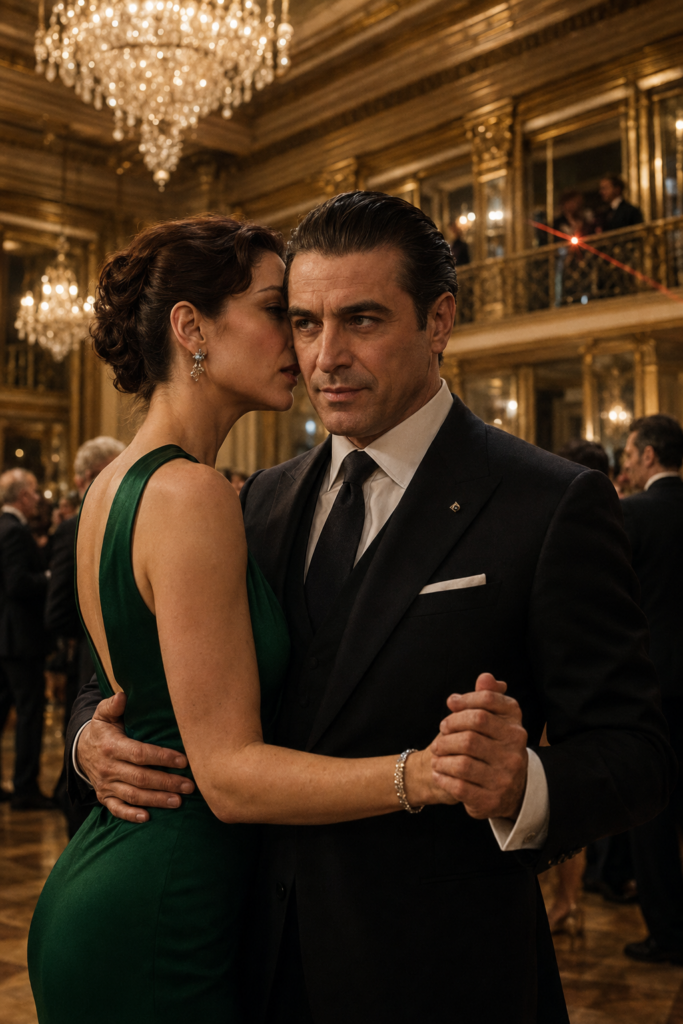
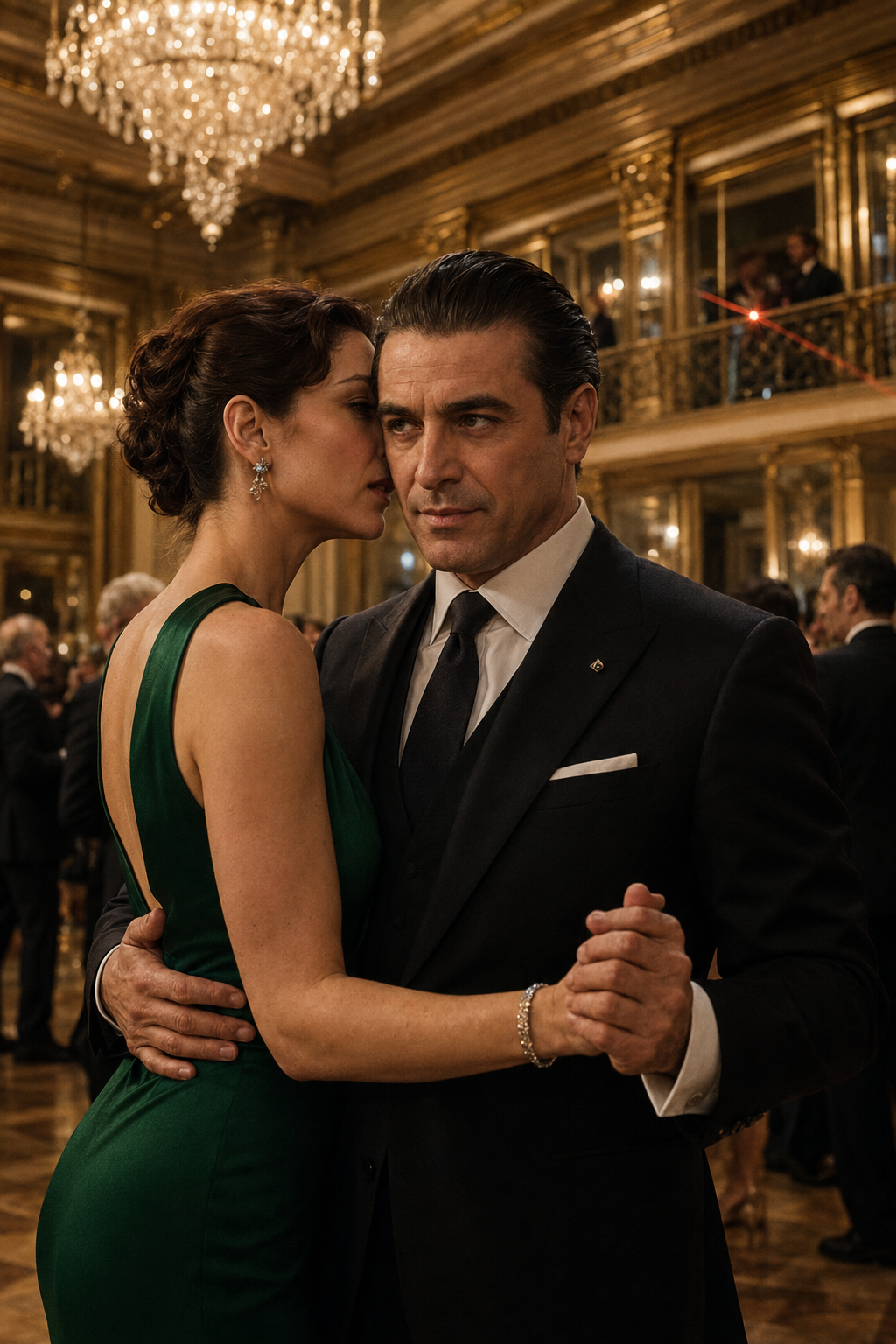
Then, barely moving her lips, she whispered, “Red dot on your forehead.”
He smiled too.
The red dot settled between his brows.
A perfect little promise of death.
“Why warn me?” Cassian asked.
“Because if you die, I die next.”
“Efficient honesty.”
“I’m beyond polite lies.”
His eyes moved over the crowd.
“Thorne has leverage on you.”
“Yes.”
“Someone you love.”
She took a slow breath.
“My brother owed money to a lender in Charleston. Thorne’s people discovered it. They told me if I authenticated their pieces and kept quiet, they would keep him alive.”
“Would?”
Her silence answered before her words did.
“He died eight months ago. Car accident, according to police. Brake lines cut, according to the mechanic who was paid to disappear his report.”
Cassian felt something hard settle in his chest.
Not pity.
Recognition.
Grief weaponized correctly becomes dangerous.
“You stayed in their system after he died.”
“To document everything.”
Her voice remained controlled, but pain lived beneath the words like a blade under silk.
“Every false authentication. Every wire transfer. Every shell buyer. Every forged provenance file. Twenty-six months of evidence. Three copies with attorneys. One original in a safety deposit box.”
“You planned to expose him tonight.”
“I planned to stop the Barcelona sale publicly, trigger independent verification, and force enough attention that Thorne could not bury the questions.”
“And he planned to kill me first.”
“Then me, during the chaos.”
Cassian looked at the ballroom.
Three hundred witnesses.
Three shooters.
A criminal operation wearing a charity’s face.
“You understand,” Alba said softly, “that if I make my announcement, they will fire.”
“Yes.”
“And if you try to run, they will fire.”
“Yes.”
“And if we do nothing, Thorne wins, your influence over the port collapses, my evidence becomes useless, and the people who killed my brother keep turning stolen art into clean money.”
Cassian looked back at her.
“You make a compelling case for ruining the evening.”
For the first time, Alba smiled for real.
It lasted less than a second.
But it changed her whole face.
“Dance with me,” he said.
Her eyebrow lifted.
“That is your plan?”
“Movement complicates aim.”
“So romantic.”
“I save romance for second meetings.”
She placed her hand in his.
They stepped onto the dance floor as if the decision had been social rather than tactical. Around them, couples swayed beneath chandeliers, gowns brushing tuxedos, diamonds glinting like cold stars. Cassian guided Alba through the first turn, placing other dancers between himself and the northeast shooter.
She followed instantly.
Not like a woman being led.
Like a partner reading the same map.
“Thorne is watching,” she murmured near his ear.
“I would be offended if he weren’t.”
“He is trying to decide whether I warned you.”
“Let him wonder.”
Cassian turned her again, catching sight of the mezzanine in the ballroom mirror. The second shooter stood too still among musicians. People who blend in badly often think stillness looks calm. It does not. Stillness in a moving room is confession.
“How many buyers are involved?” Cassian asked.
“At least eleven through shell companies. Three tonight. The Barcelona sculptures were supposed to sell to a Cayman entity for $2.3 million.”
“Charity auctions have become ambitious.”
“Criminals love philanthropy. It provides receipts and applause.”
He almost laughed.
“Do you always talk like this under threat of assassination?”
“Only when I’m nervous.”
“You don’t look nervous.”
“I’m very good at disappointing expectations.”
That, Cassian thought, made two of them.
The orchestra moved toward a crescendo. Preston Thorne began making his way toward the stage. The formal auction would start in minutes.
Alba’s hand tightened on Cassian’s shoulder.
“When I speak, the order goes out.”
“Then we change the board.”
Her eyes sharpened.
“What does that mean?”
“It means Thorne planned for one curator making one disclosure and one mob boss dying in a convenient public panic. He did not plan for us to turn exposure into theater.”
Cassian released her hand and walked toward the stage.
A murmur followed him.
People recognized him. Some by name, some by reputation, some by instinct. In Savannah, Cassian Morelli was not the kind of man invited everywhere. He was the kind of man people invited because excluding him made a louder statement than inclusion.
Thorne reached the microphone first.
“Ladies and gentlemen—”
“Preston,” Cassian called warmly, loud enough for the first three rows to hear. “Before bidding begins, I believe Miss Rosalind has something worth sharing about the centerpiece collection.”
Thorne’s smile froze.
Only for an instant.
But Alba saw it.
Cassian saw it.
And the shooters, wherever they waited, were now trapped inside a room full of witnesses staring at the stage.
“How thoughtful,” Thorne said smoothly. “Miss Rosalind and I were going to address routine matters later.”
“Authenticity is never routine at an auction,” Cassian replied.
The crowd chuckled politely because they did not yet know they were laughing inside a crime scene.
Cassian stepped onto the stage and gestured for Alba.
She climbed the steps with the calm of a woman walking toward a cliff because the bridge behind her had already burned.
Her emerald dress caught the chandelier light.
For the first time that night, every eye in the ballroom was on her.
Preston Thorne’s eyes were knives.
Alba took the microphone.
“Good evening,” she said. “Before formal bidding begins, I must address the Barcelona Renaissance collection in the western alcove.”
A rustle moved through the room.
Collectors leaned forward.
Journalists lifted phones.
Thorne’s smile became a mask stretched too tightly over bone.
“The sculptures are beautiful,” Alba continued. “The craftsmanship is consistent with fifteenth-century Florentine workshop techniques. However, beauty is not provenance. And provenance is not decoration. It is the ethical spine of an object’s history.”
Cassian watched the northeast balcony through a mirrored panel.
The shooter shifted.
Not firing.
Waiting.
“Recent molecular analysis identified traces of polymer sealants on the marble surface,” Alba said. “Those sealants were developed in the late twentieth century. They are incompatible with the documented nineteenth-century excavation and storage history provided to tonight’s buyers.”
The room changed.
Not panic yet.
Awareness.
The kind that begins in whispers and sharpens into suspicion.
“Are you saying they’re fake?” someone called.
“No,” Alba said. “I am saying the documentation contains material inconsistencies. Until independent verification is completed, selling the pieces under the current provenance would be professionally irresponsible.”
It was elegant.
Not an accusation.
A blade wrapped in velvet.
Thorne stepped toward her.
“Miss Rosalind is being cautious, as experts often are. Naturally, the auction house values transparency.”
His voice was still controlled.
His eyes were not.
“We will postpone those three items pending additional review,” he announced, turning to the crowd. “The rest of tonight’s program will proceed.”
Applause began uncertainly.
Then grew.
Rich people love applauding integrity that costs them nothing.
But Preston Thorne had just lost $2.3 million in public.
And he knew exactly who had made it happen.
Cassian leaned toward Alba as the audience settled.
“He won’t let us leave easily.”
“No,” she said. “He’ll wait until we move out of sight.”
“Then we stay visible.”
The auction continued.
Thorne’s voice carried across the ballroom with practiced ease, but his hands betrayed him. He gripped the podium too hard. His gaze returned to Alba again and again. The shooters remained positioned, unable to act while every guest was alert from the disruption.
A Dutch landscape sold for $80,000.
A bronze sculpture attributed to Rodin came next.
Alba leaned closer.
“That one is legitimate.”
“Good.”
“But the bidder is not. Shell corporation registered in Delaware.”
Cassian raised his hand.
“Three hundred thousand,” he said.
The auctioneer froze for half a beat, then recovered.
“Three hundred thousand from Mr. Morelli.”
The previous bidder dropped out immediately.
Thorne looked as if someone had stepped on his throat.
Cassian smiled faintly.
He had no interest in the bronze.
He had every interest in turning Thorne’s carefully arranged money route into a public financial irregularity.
The gavel fell.
Sold.
Then came the final piece.
A collection of illuminated medieval manuscripts displayed in climate-controlled glass beneath a focused white light. Gold leaf shimmered across the pages, tiny saints and vines glowing from another century.
Alba went still.
Cassian felt it before he saw it.
“What?” he asked.
“Those were stolen.”
“From where?”
“Lyon. Private collection. Eighteen months ago. French authorities have been tracking them.”
“You can prove it?”
She opened her phone beneath the edge of her portfolio, pulling up database images.
The same cracked corner on one vellum page.
The same blue pigment loss near a painted angel.
The same restoration mark shaped like a crescent along the binding.
Proof.
Small.
Precise.
Fatal.
The auctioneer started the bidding at $200,000.
It climbed fast.
Too fast.
People who cared about manuscripts did not bid that way. People hiding money did.
Cassian waited until the final call.
“Four hundred thousand,” he said.
The room turned again.
By now, even the most oblivious guests understood they were watching something unusual.
Thorne stared at him.
The muscles in his jaw worked once.
The auctioneer called for higher bids.
Silence.
“Five hundred thousand,” Thorne said.
A mistake.
A public one.
He had abandoned the appearance of neutrality.
Cassian did not hesitate.
“Six hundred thousand.”
Alba’s eyes flicked to him.
He did not look away from Thorne.
The developer had two choices. Continue bidding and expose his desperation over stolen manuscripts, or let Cassian take possession of evidence that could connect his operation to international art theft.
Thorne chose silence.
The gavel fell.
“Sold to Mr. Morelli for six hundred thousand.”
Polite applause followed.
Cassian had just spent almost a million dollars ruining an enemy’s evening.
He considered it a bargain.
After the final sale, guests began moving toward the exits in glittering clusters. Some whispered about the Barcelona collection. Others speculated about Cassian’s strange bidding. A few journalists had already begun making calls.
Thorne approached with the smile of a host and the eyes of a man imagining graves.
“Quite a performance, Mr. Morelli.”
“Quite an auction.”
“I hope you are prepared to complete your purchases.”
“I brought certified funds.”
“Of course you did.”
Thorne turned to Alba.
“And you, Miss Rosalind. We will need all your documentation regarding these sudden concerns.”
“You’ll have it,” she said.
“Good.”
His smile sharpened.
“Thoroughness matters.”
“So does preservation,” she replied.
They stared at one another.
The words were polite.
The threat was not.
When Thorne walked away, Alba released a breath so small no one else would have noticed.
“He’ll move tonight.”
“Yes,” Cassian said.
“I have to get to the bank. The originals are in a safety deposit box.”
“Not tonight.”
“I need them.”
“You need to be alive to use them.”
She looked at him then, anger flaring through exhaustion.
“I have survived two years of being managed, threatened, followed, and used. Do not start speaking to me like another man who thinks he gets to decide my safety.”
Cassian respected that.
Immediately.
“You’re right,” he said. “I apologize.”
That startled her more than an argument would have.
“I’m not deciding for you,” he continued. “I’m offering resources. Cars. Security. A safe location. A forensic accountant. A federal contact who owes me more than he likes admitting. You choose.”
Alba studied his face.
“You have a federal contact?”
“I contain multitudes.”
Despite everything, she nearly smiled.
“Why help me?”
Cassian looked across the ballroom at Preston Thorne, who was now speaking calmly to a police commissioner’s wife as if he had not spent the last hour trying to decide where to put bodies.
“Because men like Thorne believe every room belongs to them.”
“And?”
“And I dislike boredom.”
“Cassian.”
He looked back at her.
“Because he used your brother to make you useful. Because he planned to kill you when you stopped being convenient. Because he aimed at me in a room full of people and trusted fear to make everyone decorative. And because you warned me when walking away would have been easier.”
Her eyes softened slightly, but only slightly.
“Walking away was never an option.”
“It often is.”
“Not for people who have already lost the person they were protecting.”
That stayed with him.
They left through the main doors together.
Cassian’s security team appeared from the crowd in pairs, not obvious enough to panic guests, but visible enough to warn professionals. Six men in dark suits formed a loose perimeter.
Outside, the Savannah night was damp and warm. Thunder rolled somewhere beyond the river. Three black cars waited with engines running.
Alba paused beneath the awning.
She looked back at the ballroom.
For a moment, the emerald dress, the perfect hair, the curated calm all seemed to fall away. What remained was a woman who had spent twenty-six months alone inside someone else’s threat.
“I don’t know what happens after tonight,” she said.
“No one ever does.”
“I don’t trust easily.”
“Good.”
“I don’t want protection that becomes ownership.”
“You won’t have it.”
“You say that now.”
Cassian stepped closer, stopping far enough away for her to choose the final distance.
“I have never mistaken possession for loyalty.”
She looked into his eyes for a long moment.
Then nodded.
“Then take me somewhere we can work.”
He opened the car door himself.
Not because she needed help.
Because respect sometimes begins with the smallest visible correction.
The safe house was not what Alba expected.
She had imagined dark leather, weapons laid on tables, men smoking in corners. Instead, it was a restored warehouse overlooking the river, all exposed brick, steel beams, secure glass, and computer monitors. It looked like a design firm built by paranoid people with excellent taste.
Cassian’s men locked down the building.
Phones were placed in signal-blocking cases. Security feeds came alive across one wall. Coffee appeared without anyone asking. A woman named Marisol, thin, sharp-eyed, and dressed in an immaculate gray suit, opened a laptop and began building folders before Cassian finished explaining.
“Forensic accountant,” he told Alba.
Marisol glanced up.
“Former IRS Criminal Investigation. Current problem solver.”
“I like her,” Alba said.
“Most people don’t,” Marisol replied.
They worked until sunrise.
Alba unpacked everything.
False provenance documents.
Shell corporation structures.
Wire transfer trails.
Auction records.
Forgery reports.
Emails from Thorne’s men.
Copies of threats disguised as professional instructions.
The brake line report from her brother’s car.
That one she placed on the table last.
Carefully.
As if paper could bruise.
Cassian did not touch it.
“His name?” he asked.
“Elliot.”
“Tell me about him.”
She looked at him.
No one had asked that.
Not in a way that wanted an answer.
“He was reckless,” she said after a moment. “Funny. Irresponsible. Charming in a way that made people forgive him too quickly. He loved jazz and old maps. He never learned how to lose quietly.”
“Gambling?”
“Yes.”
“Did he know you were covering him?”
“At first. Then I lied. I said I had handled it. I thought I was protecting him.”
“Love makes poor accountants of us all.”
Alba exhaled something that might have been a laugh if grief had not stood in its way.
“Thorne killed him to prove I would never be free.”
Cassian looked at the report.
“Then we prove he chose badly.”
By noon, Marisol had mapped the money.
By evening, Cassian’s federal contact — a tired prosecutor named Daniel Reeves — arrived through the private elevator with two agents and the weary expression of a man about to accept evidence from criminals because the evidence was too good to ignore.
“I hate when you’re useful,” Reeves told Cassian.
“I hear that often.”
Alba stepped forward.
“These are original copies. I have chain-of-custody notes, timestamps, metadata, financial reconciliation summaries, and cross-referenced transaction maps. The Lyon manuscripts are currently in Mr. Morelli’s legal possession through last night’s auction. They match stolen-art registry photographs.”
Reeves looked at her.
Then at the files.
Then back at her.
“You built all this?”
“Yes.”
“While under coercion?”
“Yes.”
“Why not come forward earlier?”
Alba’s face did not change.
“Because the last person I tried to protect ended up dead.”
Reeves said nothing after that.
Good men know when a question has been answered too fully.
The raid happened thirty-six hours later.
Not with gunfire.
Not with screams.
With warrants.
Search teams hit Thorne’s gallery, his auction office, two storage units, three shell business addresses, and a private warehouse near the port. Federal agents seized servers, art pieces, ledgers, burner phones, shipping records, and one locked cabinet containing passports that did not belong to Preston Thorne.
By the end of the week, the headlines were everywhere.
SAVANNAH DEVELOPER LINKED TO INTERNATIONAL ART LAUNDERING NETWORK.
STOLEN LYON MANUSCRIPTS RECOVERED AFTER CHARITY AUCTION.
FEDERAL PROBE EXPANDS INTO SHELL BUYERS, PORT CONTRACTS, AND AUCTION FRAUD.
Thorne tried to smile for cameras when leaving his attorney’s office.
It did not work.
His face had lost its architecture.
Arrogance requires the assumption of control. Without it, men like him look suddenly unfinished.
Then came the second wave.
Marisol found the connection between Thorne’s laundering network and the Charleston lender tied to Elliot’s debts. Reeves reopened Elliot’s case. The mechanic who had been paid to disappear came forward after Cassian’s people located him and Reeves offered protection. Phone records placed one of Thorne’s men near Elliot’s apartment two nights before the crash.
Not enough for a clean murder conviction yet.
Enough for fear.
Enough for leverage.
Enough to make men start talking.
And talk they did.
Because criminal loyalty is often just silence waiting for a better deal.
Thorne’s empire collapsed in layers.
First the art world.
Then the real estate financing.
Then the port contracts.
Then the charitable foundation.
The same donors who had praised his generosity pretended they had always had doubts. Politicians returned checks. Gallery owners issued statements about integrity. Auction board members resigned with language so carefully written it practically came with legal insurance.
Alba watched it unfold from Cassian’s safe house, wearing one of his spare shirts because she had not gone home yet and refusing to admit she liked the coffee there.
“You don’t look satisfied,” Cassian said one night.
They stood beside the tall warehouse windows, looking out over the river.
“I thought I would.”
“Revenge rarely pays what grief is owed.”
She looked at him.
“That sounds like something you learned badly.”
“Most useful lessons arrive bleeding.”
She turned back to the water.
“I wanted him arrested. Ruined. Exposed. I wanted his name destroyed in every room he ever controlled.”
“And now?”
“Now my brother is still dead.”
Cassian stood beside her in silence.
Not fixing it.
Not softening it.
Just staying.
That was the first thing Alba truly trusted about him.
He did not rush into her grief like a man trying to prove usefulness. He let it exist without making it perform.
Two weeks later, Alba returned to her apartment for the first time.
Cassian went with her, but only after she asked.
The apartment was elegant, old, filled with books, framed maps, and objects collected by someone who loved history not as status, but as survival. A photograph of Elliot sat on the mantel. He was younger than she had described, laughing beside a saxophone player on a rainy street.
Alba stood in front of the photo.
“He would have hated that I worked with you.”
“Smart man.”
“He would have liked you eventually.”
“Questionable taste.”
She laughed.
A real one.
Small, surprised, almost guilty.
Cassian looked at her as if the sound had changed something in the room.
“What?” she asked.
“Nothing.”
“Don’t lie.”
“I was thinking I would like to hear that again.”
She turned away too quickly.
But not quickly enough.
Months passed.
The trial began in autumn.
Preston Thorne entered court in dark suits and controlled expressions, flanked by attorneys who specialized in making guilt look like complexity. Alba testified for six hours. She wore navy, no jewelry except her father’s old signet ring on a chain beneath her blouse.
The defense tried to make her look compromised.
They called her coerced.
They called her emotionally unstable.
They implied her professional judgment had been corrupted by grief.
They suggested Cassian Morelli had manipulated her.
Alba sat still through all of it.
When the attorney finally asked, “Miss Rosalind, isn’t it true that your conclusions are motivated by personal vengeance?”
She leaned toward the microphone.
“My conclusions are motivated by documentation.”
A ripple moved through the courtroom.
The attorney tried again.
“You hated Mr. Thorne.”
“Yes.”
The honesty startled him.
“But hatred does not forge wire transfers,” Alba continued. “Hatred does not create shell corporations. Hatred does not falsify provenance records, alter shipping documents, or place stolen French manuscripts in a Savannah auction house. Mr. Thorne did those things. I only kept the receipts.”
Cassian sat at the back of the courtroom.
He did not smile.
But his eyes did.
Thorne was convicted on fraud, money laundering, conspiracy, and trafficking in stolen cultural property. Additional charges connected to Elliot’s death remained under investigation, but two of Thorne’s associates accepted plea deals and testified against him in related cases. His foundation dissolved. His properties were seized. His name became poison in every room where it had once been currency.
At sentencing, Alba did not cry.
She read a statement.
“My brother Elliot was not perfect. He made mistakes. He owed money. He trusted people he should not have trusted. But Preston Thorne turned weakness into ownership and grief into a business tool. He believed people could be managed forever if he found what they loved and threatened it properly.”
She paused.
The courtroom was silent.
“He was wrong.”
Thorne stared at the table.
Not at her.
Never at her.
Cowardice, Alba realized, wears excellent tailoring when it can afford it.
After the sentencing, she stepped outside the courthouse into cold sunlight.
Reporters shouted questions.
Cassian waited by the black car, hands in the pockets of his coat, expression unreadable.
She walked to him.
“It’s over,” he said.
“No.”
He nodded once.
“No. But one part is.”
She looked at the street, the cameras, the court steps, the city that had watched her be silent for years without knowing it.
“I don’t want to go back to curating rooms for people who treat beauty like currency.”
“What do you want?”
She turned to him.
“To build something that returns stolen things.”
He studied her.
“Art recovery?”
“Provenance investigation. Financial tracing. Cultural property repatriation. Real authentication. Not the performance of it.”
“You’ll need money.”
“Yes.”
“Security.”
“Yes.”
“Legal structure.”
“Yes.”
“Office space.”
She narrowed her eyes.
“Are you offering or negotiating?”
“Both.”
“Dangerous habit.”
“I’m a dangerous man.”
“I noticed.”
He stepped closer.
Still leaving space.
Always leaving space now because he understood Alba’s life had been full of men who confused pressure with power.
“I have warehouses,” he said. “Lawyers. Funds. Contacts in places respectable people pretend not to call. You have the expertise, legitimacy, rage, and terrifying file organization.”
“That was almost romantic.”
“I’m improving.”
She looked at him for a long moment.
“Partners?”
“In business?” he asked.
“For now.”
His mouth curved.
“For now.”
The Rosalind Recovery Institute opened six months later in a restored brick building near the river. No marble. No chandeliers. No velvet ropes. Just glass walls, secure archives, forensic labs, legal offices, and a small public gallery displaying recovered objects with their histories properly told.
Not owned.
Returned.
The first exhibit featured the Lyon manuscripts before their repatriation to France. Schoolchildren came through in quiet lines. Elderly collectors stood with tears in their eyes. Journalists wrote articles about justice, beauty, and provenance.
Alba read every label herself before opening night.
Cassian watched from the doorway.
“You built it,” he said.
She looked around the gallery.
“We built it.”
“No,” he said. “I funded walls. You gave them a conscience.”
She looked at him then, the way she had looked across the ballroom the first night.
Assessing.
Seeing.
But no longer afraid of what she found.
“Cassian.”
“Yes?”
“Stay.”
The word returned to him from that night outside the auction, when he had asked her the same thing with more vulnerability than he had known he possessed.
He walked to her slowly.
“I am here.”
She placed her hand against his chest.
This time, not uncertain.
Not hovering.
Certain.
When he kissed her, it was not desperate. Not dramatic. Not the kind of kiss meant to erase danger or pretend wounds vanish because someone powerful chooses you.
It was slower than that.
A beginning built by two people who knew trust was not found.
It was documented.
Verified.
Proven over time.
Two years later, the Savannah Grand Ballroom hosted another auction.
Not for Preston Thorne’s world.
For Alba’s.
Recovered art. Verified history. Transparent buyers. Public records. Proceeds funding repatriation work and legal aid for families trying to reclaim stolen cultural property.
The chandeliers were the same.
The marble was the same.
The orchestra played again beneath fractured light.
But the room was different because power had changed hands.
Alba stood on the second-floor balcony in a black silk gown, her father’s signet ring still resting against her heart. Below, guests moved between displays with genuine reverence. Cassian stood beside her, no longer pretending to admire a room he distrusted, but watching her watch it.
“Any red dots tonight?” she asked.
He glanced around.
“Only from photographers.”
“Progress.”
“An underrated miracle.”
She smiled.
Across the ballroom, a young intern adjusted an information card beside a bronze sculpture. The card was slightly crooked. Alba noticed immediately.
Cassian sighed.
“You’re going to fix it.”
“It’s crooked.”
“No one else sees it.”
“That has never stopped me.”
She descended the staircase, elegant and precise, moving through the room with the same purposeful grace that had first caught his attention. But this time, no one owned her silence. No one held her grief like a chain. No one used her hands to clean their money.
She stopped at the podium, straightened the card, and looked up toward the balcony.
Cassian raised his glass.
Alba raised one eyebrow, unimpressed by sentimentality.
Then she smiled.
A real smile.
The kind that belonged to a woman who had survived the room, exposed the men who thought they controlled it, and returned not as a victim, not as a witness, but as the authority.
That was the lesson of that first night.
The red dot had appeared on Cassian’s forehead.
But the real target had always been Alba’s silence.
Preston Thorne believed she was a tool. A frightened curator. A woman with grief he could manage and expertise he could exploit. He believed Cassian was just another criminal obstacle to remove from a business plan.
He underestimated both of them.
More dangerously, he underestimated what happens when two people who have lived too long inside separate cages decide to open the doors for each other.
Justice did not come like thunder.
It came through records.
Through provenance.
Through wire transfers.
Through a woman brave enough to whisper a warning when silence would have been safer.
Through a man ruthless enough to understand that survival without truth is only a slower kind of death.
Some rooms are built to make people feel small.
Some chandeliers are hung over dirty money.
Some smiles are just knives wearing lipstick.
But every lie, no matter how elegantly framed, has a weak corner.
And sometimes all it takes to bring the whole gallery down is one person with the courage to point at the masterpiece and say:
Look closer.