The Custody Trial Secret That Turned My Sister’s Smug Smile Cold-thuyhien

The hallway outside Courtroom Three smelled like rain on wool coats, burnt coffee, and the sharp lemon cleaner the county courthouse used on every floor.
I remember that smell better than I remember walking through the metal detector.
I remember the cold strap of my purse cutting into my shoulder.
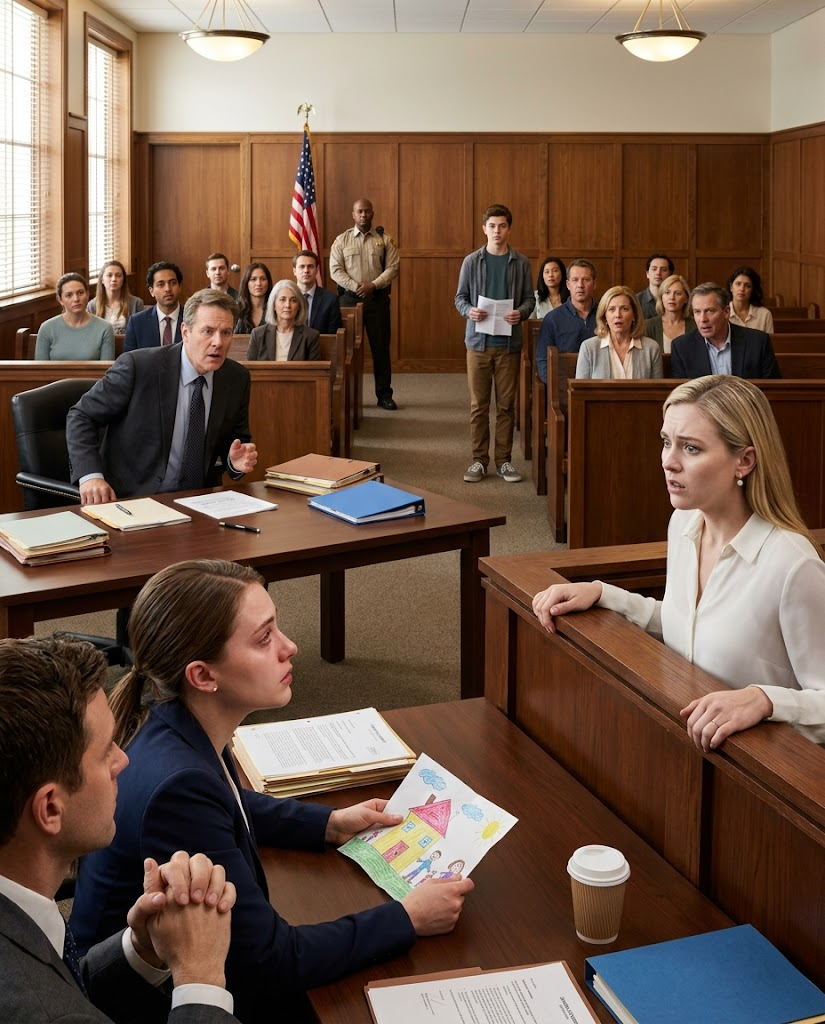
I remember the crinkled preschool drawing folded inside my attorney’s blue folder, the one Lily had made before sunrise while I packed her lunch at our small kitchen table.
She had drawn us standing on our apartment porch beside the little American flag my neighbor put in the flowerpot every summer.
The sun was too big.
My hair was orange because she could not find the brown crayon.
Underneath, in uneven letters, she had written, Mommy home.
I kept touching that paper with my thumb because it reminded me why I had to stay quiet.
Across the hallway, my sister Amber stood between our parents like a bride waiting to enter a room where everyone already admired her.
She wore a navy dress, pearl earrings, and the soft, worried expression she practiced whenever strangers were close enough to see her.
My mother had one hand on Amber’s shoulder.
My father leaned against the wall with his arms crossed, calm in a way that made me feel twelve years old again.
They had always looked at me like a problem that kept refusing to solve itself.
Amber glanced down the hallway, then stepped close enough for me to smell her perfume.
“I want to see the look on your face when we take away your daughter,” she whispered.
I looked at the beige courtroom door instead of at her.
My nails pressed into my palm.
My father heard her.
So did my mother.
Neither of them told her to stop.
My mother gave a tiny laugh, the kind she used at restaurants when she wanted the waiter to feel ashamed.
“Get ready to be publicly humiliated, Rachel,” she said. “You brought this on yourself.”
There are moments when answering back feels like dignity.
That morning, they wanted me angry.
They wanted me shaking.
They wanted the judge to see a tired single mother lose control in a public hallway.
So I held Lily’s drawing and said nothing.
My attorney, Diana, sat beside me on the bench with her binder across her knees.
She did not look at Amber.
She did not look at my parents.
She only clicked her blue pen once and said, “Let them talk first.”
I stared at her.
She was calm enough to make me nervous.
“People who lie,” she said, “usually think volume is the same as proof.”
When the bailiff opened the courtroom door, my legs felt wooden.
Family court is not dramatic the way people imagine.
There are no grand speeches in the hallway.
There are old chairs, tired parents, scuffed floors, and children’s lives being decided under fluorescent lights.
Inside, the courtroom smelled like old wood and paper.
Judge Margaret Sullivan entered in a black robe, and everyone stood.
She had silver hair pulled back neatly and the kind of face that did not invite performance.
“We are here regarding the petition for custody filed by Amber Louise Morrison against Rachel Anne Morrison concerning the minor child, Lily Grace Morrison, age five,” she said.
Hearing Lily’s full name spoken in that room made my stomach twist.
Lily Grace Morrison.
Five years old.
My baby, who still slept with one sock off because she kicked in her dreams.
My baby, who believed pancakes tasted better when shaped like clouds.
My baby, who had kissed my cheek that morning and told me to be brave because her preschool teacher said brave meant doing the hard thing with shaky hands.
Amber’s attorney rose first.
Gerald Hutchkins had polished cufflinks, silver hair, and a voice that made accusation sound like concern.
“Your Honor,” he began, “this case is painful but necessary.”
I had heard people use that tone before.
It was the tone my mother used when she slid an adoption brochure across the kitchen table while I was pregnant.
It was the tone my father used when he told me I had made life harder than it needed to be.
It was the tone Amber used when she said she only wanted what was best.
Hutchkins told the judge that Amber was seeking custody because I had created an unstable and emotionally unhealthy environment.
He said I was overwhelmed.
He said I was financially insecure.
He said I could not provide structure.
He said those things while my daughter’s lunchbox sat at preschool with a note folded under the napkin, because I wrote Lily a note every day even when my eyes burned from working late.
Diana wrote something in her binder but did not object.
She let him talk.
That almost scared me more.
Then Hutchkins said Amber and her husband Nathan could give Lily a stable home, a better routine, and a wider family network.
Amber lowered her eyes at exactly the right moment.
My mother dabbed beneath one eye with a tissue.
There were no tears.
When Diana stood, she did not raise her voice.
“Your Honor,” she said, “this petition is not concern. It is punishment.”
Amber’s mouth tightened.
Diana continued, “The evidence will show that Lily is safe, enrolled, medically cared for, loved, and deeply bonded to her mother. It will also show that this petition was built on resentment, selective photographs, and testimony from relatives who have not been part of Lily’s daily life for months.”
I wanted to breathe.
I still could not.
The judge nodded once.
“Call your first witness.”
Amber rose like she had been waiting for applause.
She walked to the stand carefully, smoothing her dress, placing one hand on the Bible, then sitting with her knees together and her hands folded.
Anyone who did not know her would have seen a worried aunt.
I saw the girl who once smiled when I was grounded for something she had done.
I saw the woman who stood at Caleb’s memorial and whispered that tragedy had finally made me interesting.
Caleb had been Lily’s father.
He died in a construction accident three months before Lily was born.
Amber knew he had not abandoned us.
She knew I had not chosen to raise Lily alone because I was reckless or stubborn.
She knew exactly what grief had done to me.
But when Hutchkins asked about my pregnancy, Amber lowered her eyes and said, “Rachel got pregnant at twenty-two. She was unmarried. The father was not involved. She insisted on raising Lily alone even though she had no plan and no real support.”
The room blurred for a second.
I saw Caleb’s work boots by our old apartment door.
I saw the voicemail I kept for two years because it was the last time he said my name.
I saw myself eight months pregnant, standing at a funeral while my mother told me not to cry so much because people were watching.
Diana’s pen moved once across the page.
I stayed still.
Amber kept going.
She said Lily looked exhausted at family events.
She said Lily’s clothes were sometimes wrinkled.
She said I worked late and left Lily with strangers.
She said I got defensive whenever anyone asked questions.
Every sentence was built around one little piece of truth and wrapped in enough poison to change its shape.
Yes, Lily had wrinkled clothes sometimes.
She was five.
She sat on the floor, spilled applesauce, hugged dogs, and climbed into the car seat sideways.
Yes, I worked late sometimes.
I also arranged care with Mrs. Helen Duarte, a licensed retired kindergarten teacher who had watched Lily since she was a baby.
Yes, I got defensive.
People get defensive when their family treats love like evidence against them.
Then Hutchkins asked what Amber could offer.
Amber straightened.
“My husband Nathan and I have a stable marriage, a beautiful home in Riverside Heights, and the resources to give Lily the life she deserves,” she said.
Family values came next.
That phrase landed in the room like a polished stone.
My mother nodded.
My father smiled.
Diana waited.
When her cross-examination began, she walked slowly to the lectern.
“Ms. Morrison,” she said, “when was the last time you spent an entire day with Lily?”
Amber blinked.
“I’m not sure.”
“Six months ago?”
“Maybe.”
“Seven?”
“Around that.”
Diana let the answer sit in the air.
“When was the last time you visited Rachel’s home?”
Amber shifted.
“I have not been invited recently.”
“So you have not seen Lily’s bedroom, her schoolwork, her medical records, her daily routine, or her current living environment in more than half a year?”
Amber’s lips pressed together.
“No.”
I saw my father’s ankle uncross.
Diana turned a page.
“You testified that Rachel leaves Lily with strangers. Do you know the name of Lily’s regular caregiver?”
Amber looked toward Hutchkins.
He could not answer for her.
“No.”
“Her name is Mrs. Helen Duarte,” Diana said. “She is a licensed retired kindergarten teacher who has cared for Lily since infancy. Were you aware of that?”
Amber’s face flickered.
“No.”
“No further questions.”
It was not a victory yet.
It was only a crack.
But after months of being treated like a bad mother because I was tired, that crack felt like air.
My mother testified next.
She wore a cream suit and carried herself like the courtroom had personally inconvenienced her.
She told the judge I had always been rebellious.
Prideful.
Dramatic.
Irresponsible.
She said those words so easily that I wondered how long she had been saving them.
“When Rachel became pregnant,” she said, “we encouraged her to consider adoption.”
My stomach turned.
“She refused because she wanted to prove she could do everything alone. That child has suffered because of Rachel’s stubbornness.”
I remembered the kitchen table.
I remembered the brochure.
I remembered my mother saying, “Amber and Nathan have been trying. At least one of my daughters could do this properly.”
I remembered folding my hands over my stomach so Lily would not feel how hard I was shaking.
Diana stood.
“Mrs. Morrison, how often do you see Lily?”
My mother lifted her chin.
“Rachel keeps her from us.”
“How many visits have you requested in writing in the last year?”
“Families do not always communicate in writing.”
“So none?”
My mother’s mouth tightened.
“Not formally.”
“Have you offered regular childcare?”
“I am her grandmother.”
“That was not my question.”
The judge looked at my mother.
My mother looked away first.
My father took the stand after her.
He said I was unstable because I cried at Caleb’s funeral while pregnant.
He said I was too emotional.
He said I had always made things harder than necessary.
Hutchkins then presented photographs of my apartment.
One showed toys on the living room floor.
One showed a laundry basket in the hallway.
One showed breakfast dishes in the sink.
One showed Lily’s birthday decorations still taped near the kitchen window.
Amber watched the judge while the photos were displayed.
She looked proud.
Diana waited until Hutchkins finished.
Then she asked, “Mr. Morrison, who took these photographs?”
My father looked at Amber.
The courtroom became quiet enough to hear the vent overhead.
Hutchkins rose halfway.
The judge raised one hand.
“Answer the question.”
My father swallowed.
“Amber took them.”
“When?” Diana asked.
“During a visit.”
“A visit six months ago?”
“Yes.”
“The day after Lily’s birthday party, when Rachel had pneumonia and Lily had opened presents all over the living room?”
My father did not answer right away.
That answer was enough.
There is a kind of shame that belongs to the person being judged.
There is another kind that belongs to the people who enjoy doing the judging.
For the first time that morning, I watched the second kind enter the room.
Amber stopped smiling.
Then Hutchkins called his final witness.
A private investigator walked to the stand with a folder under his arm.
He said he had observed me entering a downtown building late at night several times over the previous months.
He described the dates.
He described the parking lot.
He described me carrying a bag and leaving after dark.
Hutchkins asked whether he knew what I was doing there.
The investigator said no.
That no was the point.
Amber stared straight at me, her eyes bright again.
My mother’s mouth curved.
My father leaned back like the day had corrected itself.
Hutchkins implied I had been working secret shifts.
He implied I had hidden income.
He implied I had left Lily somewhere unsafe.
He never said anything directly enough to prove, only enough to stain.
Diana did not object.
She looked once at me.
Then she looked at the judge.
Judge Sullivan leaned forward.
“Ms. Morrison,” she said.
My heart hit hard against my ribs.
“Yes, Your Honor.”
She lifted one of the surveillance photographs.
“Is the downtown building in these photographs the Marshall Family Justice Center?”
The room changed.
Not loudly.
Not dramatically.
It changed the way a kitchen changes when the smoke alarm starts chirping and everyone suddenly knows something has been burning.
Amber’s smile disappeared.
Hutchkins looked down at his own papers.
My mother froze with the tissue still in her hand.
I raised my eyes.
“Yes, Your Honor,” I said.
The judge studied me over her glasses.
“And are you the same Rachel Anne Morrison who has been completing court-approved certification as a child welfare advocate under sealed victim-protection assignments for the past eighteen months?”
Gerald Hutchkins dropped his pen.
It hit the table, rolled, and stopped near the edge.
I heard it like a gavel.
“Yes, Your Honor,” I said.
Amber went pale.
My father sat forward.
My mother’s face emptied.
For eighteen months, after Lily went to sleep, after lunches were packed and bills were sorted and laundry was switched from the washer to the dryer, I had been completing supervised training hours.
I had done it because I knew what it felt like to be cornered by a family story that was not true.
I had done it because I wanted work that meant something.
I had done it quietly because some assignments were sealed for victim protection, and because I had learned the hard way that not every part of your life belongs to the people who want to weaponize it.
Diana opened the sealed envelope in front of her.
The sound of paper sliding out seemed to reach every corner of the courtroom.
“Your Honor,” she said, “with the court’s permission, we are prepared to submit records proving that Ms. Morrison’s so-called late-night disappearances were supervised legal training hours, that Lily was never left unattended, and that the petitioner’s counsel received notice this morning that several of their claims were materially false.”
She placed the first set of documents on the table.
Training logs.
Childcare records.
Stamped notices.
Emails.
A signed statement from Mrs. Duarte confirming dates, pickup times, bedtime routines, and emergency contacts.
A letter from the program coordinator stating that my attendance had been supervised and approved.
It was not glamorous.
It was not a miracle.
It was paperwork.
But sometimes paperwork is what keeps a lie from becoming someone’s future.
Hutchkins stood so quickly his chair scraped backward.
“Your Honor, I was not fully informed.”
Judge Sullivan looked at him slowly.
“That is becoming very clear, Mr. Hutchkins.”
Amber turned toward him like he had betrayed her by not saving her quickly enough.
But Diana had not emptied the envelope.
Behind the certification papers was another document.
The paper looked ordinary.
White.
Stapled.
Signed at the bottom.
Diana slid it forward.
“Your Honor,” she said, “there is also a sworn statement from Nathan Morrison, the petitioner’s husband.”
Amber’s hand closed around the edge of the witness stand.
For one strange second, I could not understand why Nathan’s name was there.
Nathan had always been quiet.
He was the man who carried dishes after family dinners, who stood behind Amber in photos, who said little when my mother praised Amber and criticized me in the same breath.
He had never been cruel to Lily.
He had never been especially brave either.
At least, that was what I thought.
The judge unfolded the statement.
Amber stared at the paper as if it were a living thing.
My mother whispered, “Amber?”
Amber did not look back.
My father’s face had gone stiff.
The judge read silently.
One page.
Then another.
Nobody moved.
Nobody coughed.
Even the bailiff seemed to stop shifting his weight.
I watched Amber’s fingers tighten until her knuckles turned white against the witness stand.
The woman who had whispered in the hallway that she wanted to see my face now looked like she was afraid of her own.
Judge Sullivan looked toward the back row.
“Mr. Morrison,” she said, “please step forward.”
Nathan stood.
He wore a gray jacket, no tie, and an expression I had never seen on him before.
Not anger.
Not pride.
Exhaustion.
He walked down the aisle holding his own folded copy of the statement.
Amber shook her head once.
Small.
Fast.
A warning.
Nathan did not stop.
He raised his right hand and was sworn in.
Hutchkins looked like he wanted to object but could not find a safe reason.
Diana returned to my side.
I felt her presence more than I saw her.
Nathan looked at the judge.
Then he looked at Amber.
Then, finally, at me.
“I am sorry,” he said.
Two words can be useless.
Two words can also crack open a locked room.
Judge Sullivan asked him to explain the statement.
Nathan took a breath.
“My wife did not file this petition because Lily was unsafe.”
Amber covered her mouth.
My mother whispered her name again, sharper this time.
Nathan’s voice shook, but he kept going.
“She filed because she said Rachel did not deserve to be a mother when we could not have a child of our own.”
The words hit me so hard I forgot to breathe.
For years, I had been told I was selfish.
Told I had embarrassed the family.
Told Lily would be better off with people who had more money, more space, more respectability.
But hearing it stated plainly, in a courtroom, under oath, made the cruelty look smaller and uglier than it had ever looked at the kitchen table.
Nathan unfolded the second page.
“She also told me that if the court gave us custody, she would make sure Rachel only saw Lily when Amber allowed it.”
My mother made a sound like air leaving a tire.
My father stared at Amber.
Amber did not deny it.
Not then.
Not quickly enough.
Diana touched the edge of her binder but did not speak.
Judge Sullivan’s face hardened.
“Mr. Morrison,” she said, “is there additional evidence supporting this statement?”
Nathan swallowed.
“Yes, Your Honor.”
Amber whispered, “Don’t.”
It was the first honest word I had heard from her all day.
Nathan reached into his jacket pocket and took out his phone.
The screen lit his fingers.
The entire courtroom seemed to lean toward that small rectangle of light.
Hutchkins put one hand on the table.
My mother’s tissue slipped from her lap.
My father stared at the phone like it might explode.
I thought of Lily’s drawing again.
Mommy home.
I thought of the school pickup line, the grocery bags digging into my wrists, the pink backpack by our door, the tiny socks I found under the couch, the nights I studied with one ear turned toward Lily’s room.
I thought of all the ordinary, unphotographed proof that a mother is a mother.
Nathan looked at the judge.
“There is a recording,” he said.
Amber’s hand trembled against the witness stand.
Judge Sullivan nodded once.
“Proceed carefully.”
And that was when the room finally understood that my sister had not walked into court to rescue a child.
She had walked in expecting to take one.
The phone unlocked with a small click.
No one spoke.
Diana’s pen rested still on the table.
The bailiff watched Amber.
The judge watched Nathan.
I watched the phone, knowing that whatever came out of it next could not give me back the years my family had spent making me feel small.
But it could stop them from taking Lily.
Nathan pressed play.
Amber’s recorded voice filled the courtroom, thinner through the speaker but unmistakably hers.
“She doesn’t deserve her,” the voice said.
My mother closed her eyes.
Amber grabbed the rail harder.
The recording continued.
“She got everything by accident. I did everything right, and she gets to be called Mom.”
Nobody moved.
That was the part I had never known how to answer in my own heart.
Not because it was true.
Because envy can sound so much like grief when people dress it carefully.
Then Amber’s recorded voice said, “Once the judge sees what we show them, Rachel will be begging us for visits.”
Hutchkins sat down.
He did not lower himself gracefully.
He dropped into the chair as if his legs had stopped cooperating.
Judge Sullivan stopped the recording after several more seconds and asked for the phone to be marked for review.
Nathan handed it over.
Amber looked at him like he had destroyed her.
He looked back like he had finally stopped helping her destroy someone else.
The judge called a recess.
The sound of the gavel was not loud, but it made my whole body jolt.
I stood because Diana stood.
I did not feel victorious.
I felt hollowed out.
My mother turned toward me in the aisle, and for one second I saw panic in her face instead of judgment.
“Rachel,” she said.
I stepped around her.
Not because I had nothing to say.
Because everything I had to say belonged somewhere she could no longer interrupt.
In the hallway, the same courthouse coffee smell waited for us.
The same lemon cleaner.
The same damp coats.
But the hallway felt different now.
Amber had entered that courtroom expecting to watch my face collapse.
Instead, everyone had watched hers.
Diana handed me Lily’s drawing.
I had not realized I dropped it.
The corner was bent.
The little American flag beside our stick-figure porch was smudged where my thumb had pressed too hard.
“Breathe,” Diana said quietly.
So I did.
One breath.
Then another.
Through the glass doors at the end of the hallway, rain ran down the courthouse steps, and beyond it, parents were probably hurrying through pickup lines, people were checking grocery lists, someone was drinking cold coffee in a parked SUV, and a little girl in preschool was waiting for her mother to come home.
That was the only ending I cared about.
Not humiliation.
Not revenge.
Not seeing Amber punished in front of everyone.
I wanted Lily’s backpack by our door.
I wanted her shoes in the hallway.
I wanted the ordinary mess they had tried to use against me.
When court resumed, Judge Sullivan did not let the room drift back into performance.
She addressed the false claims.
She addressed the surveillance.
She addressed the photographs.
She addressed the fact that the petitioner had not been involved in Lily’s daily life and had presented old, selective images as current concern.
Then she looked at me.
“Ms. Morrison,” she said, “this court is not persuaded that poverty, grief, exhaustion, or a sink with breakfast dishes equals unfitness.”
My throat closed.
She continued, “The child’s best interest is not served by rewarding a family dispute disguised as rescue.”
Amber stared at the floor.
My mother held her purse with both hands.
My father looked older than he had that morning.
The judge denied the emergency custody request.
She ordered the submitted evidence preserved.
She warned Amber and her counsel about misrepresentation.
She set strict boundaries around any future contact and made clear that Lily’s stability would not be gambled on resentment.
I heard the words.
I understood them.
But my body only fully believed them when Diana leaned toward me and whispered, “She is going home with you.”
She is going home with you.
I pressed Lily’s drawing to my chest.
Across the aisle, Amber began crying.
It was not the pretty kind of crying she had practiced.
It was angry, frightened, exposed.
My mother reached for her.
Nathan did not.
He stood alone near the aisle, looking at the floor, as if the cost of telling the truth had arrived all at once.
I did not thank him then.
I could not.
Maybe one day I would.
Maybe not.
Some truths come too late to feel like kindness, even when they still matter.
When I left the courthouse, the rain had slowed to a mist.
Diana walked beside me down the steps.
My phone buzzed with a message from Mrs. Duarte.
Lily had eaten all her lunch except the carrots.
She wanted to know if brave meant Mommy could have pancakes for dinner.
I laughed so suddenly that it came out almost like a sob.
Diana smiled.
“Pancakes sound reasonable,” she said.
At home that evening, Lily ran to me in the doorway wearing one sock, her pink backpack sliding off one shoulder.
I knelt and caught her before she could crash into my knees.
She smelled like crayons, playground air, and the strawberry shampoo she insisted was for big girls.
“Did you do the hard thing?” she asked.
I held her tighter.
“Yes,” I said. “With shaky hands.”
She patted my cheek like she was the one comforting me.
Then she ran to the kitchen to ask for pancakes shaped like clouds.
I stood in the doorway for one second and looked at the living room.
Toys on the rug.
Laundry basket in the hallway.
Breakfast dishes still beside the sink.
All the evidence.
All the proof.
A home.